Abstract
The myocardial extracellular matrix (ECM) is essential for cardiac architecture, ventricular compliance, and cell-matrix signaling. Because dietary lipid quality can influence oxidative stress, inflammation, and cardiometabolic regulation, it may also affect myocardial ECM homeostasis. This exploratory study assessed whether different lipid-enriched diets modified myocardial ECM-related transcript expression in healthy rats. Forty rats were allocated to five groups (n = 8 per group) and received for 12 weeks either a control diet or diets enriched with crude palm oil, refined palm oil, olive oil, or lard. Myocardial tissue was collected at sacrifice, RNA was extracted and reverse-transcribed into complementary DNA, and relative expression of elastin, vimentin, myonectin, matrix metalloproteinase-2 (MMP-2), and the apelin receptor (APJ) was assessed by polymerase chain reaction using ribosomal protein lateral stalk subunit P0 (Rplp0) as the reference gene. Results were expressed as mean ± standard deviation and analyzed by analysis of variance followed by Tukey-Kramer multiple comparisons, with p < 0.05 considered statistically significant. No statistically significant between-group differences were observed for elastin, vimentin, MMP-2, myonectin, or APJ expression (all p > 0.05), although slight non-significant qualitative fluctuations were observed for myonectin and APJ in some lipid-fed groups. Overall, the findings indicate that under the specific conditions of this 12-week experiment in healthy rats, the tested dietary lipids did not measurably disrupt myocardial ECM-related gene expression. Because the study was limited to transcript-level assessment and did not include protein, histological, or functional validation, the biological interpretation should remain restricted to early molecular observations under non-pathological conditions.
|
Published in
|
Advances in Biochemistry (Volume 14, Issue 2)
|
|
DOI
|
10.11648/j.ab.20261402.12
|
|
Page(s)
|
28-33 |
|
Creative Commons
|

This is an Open Access article, distributed under the terms of the Creative Commons Attribution 4.0 International License (http://creativecommons.org/licenses/by/4.0/), which permits unrestricted use, distribution and reproduction in any medium or format, provided the original work is properly cited.
|
|
Copyright
|
Copyright © The Author(s), 2026. Published by Science Publishing Group
|
Keywords
Extracellular Matrix, Myocardium, Dietary Lipids, Crude Palm Oil, Refined Palm Oil, Olive Oil, Lard, APJ
1. Introduction
The myocardial extracellular matrix (ECM) is a dynamic network of structural proteins, glycoproteins, proteoglycans, and matrix-regulating enzymes that preserves the mechanical stability and functional integrity of the heart. Beyond structural support, the ECM participates in force transmission, cell signaling, ventricular compliance, repair, and remodeling. Changes in ECM composition or turnover are strongly associated with fibrosis, hypertrophy, ventricular stiffening, and heart failure
| [1] | Weber KT, Janicki JS, Shroff SG, Pick R, Chen RM, Bashey RI. Collagen remodeling of the pressure-overloaded, hypertrophied nonhuman primate myocardium. Circ Res. 1988; 62(4): 757-765. https://doi.org/10.1161/01.RES.62.4.757 |
| [2] | Frangogiannis NG. The extracellular matrix in myocardial injury, repair, and remodeling. J Clin Invest. 2017; 127(5): 1600-1612. https://doi.org/10.1172/JCI87491 |
[1, 2]
. More recent literature continues to emphasize that cardiac ECM biology is highly dynamic and context dependent, especially during injury, metabolic stress, and repair processes
.
Among myocardial ECM-related markers, elastin contributes to tissue elasticity and ventricular compliance, whereas vimentin, an intermediate filament protein, is involved in cytoskeletal organization, mechanotransduction, and cellular adaptation to stress
| [3] | Eriksson JE, Dechat T, Grin B, Helfand B, Mendez M, Pallari HM, Goldman RD. Introducing intermediate filaments: from discovery to disease. J Clin Invest. 2009; 119(7): 1763-1771.
https://doi.org/10.1172/JCI38339 |
| [9] | Wagenseil JE, Mecham RP. Elastin in large artery stiffness and hypertension. J Cardiovasc Transl Res. 2012; 5(3): 264-273.
https://doi.org/10.1007/s12265-012-9349-8 |
[3, 9]
. Matrix metalloproteinases (MMPs), particularly MMP-2, regulate extracellular protein turnover and are implicated in cardiac remodeling after injury or inflammation
| [4] | Spinale FG. Myocardial matrix remodeling and the matrix metalloproteinases: influence on cardiac form and function. Physiol Rev. 2007; 87(4): 1285-1342.
https://doi.org/10.1152/physrev.00012.2007 |
| [10] | Lindsey ML, Iyer RP, Jung M, DeLeon-Pennell KY, Ma Y. Matrix metalloproteinases as input and output signals for post-myocardial infarction remodeling. J Mol Cell Cardiol. 2016; 91: 134-140. https://doi.org/10.1016/j.yjmcc.2015.12.018 |
[4, 10]
. Metabolic signaling pathways are also relevant: myonectin is a myokine linked to lipid handling and systemic metabolic communication
| [5] | Seldin MM, Peterson JM, Byerly MS, Wei Z, Wong GW. Myonectin (CTRP15), a novel myokine that links skeletal muscle to systemic lipid homeostasis. J Biol Chem. 2012; 287(15): 11968-11980. https://doi.org/10.1074/jbc.M111.336834 |
| [15] | Petro JL, Gallo-Villegas J, Calderon JC. Myonectin and metabolic health: a systematic review. Front Endocrinol (Lausanne). 2025; 16: 1557142.
https://doi.org/10.3389/fendo.2025.1557142 |
| [17] | Jin L, Diaz-Canestro C, Wang Y, Tse MA, Xu A. Exerkines and cardiometabolic benefits of exercise: from bench to clinic. EMBO Mol Med. 2024; 16(3): 432-444.
https://doi.org/10.1038/s44321-024-00027-z |
[5, 15, 17]
, whereas the apelin/APJ axis contributes to cardiovascular regulation, vascular tone, myocardial performance, and metabolic adaptation
| [6] | Chandrasekaran B, Dar O, McDonagh T. The role of apelin in cardiovascular function and heart failure. Eur J Heart Fail. 2008; 10(8): 725-732. https://doi.org/10.1016/j.ejheart.2008.06.002 |
| [11] | de Oliveira AA, Vergara A, Wang X, Vederas JC, Oudit GY. Apelin pathway in cardiovascular, kidney, and metabolic diseases: therapeutic role of apelin analogs and apelin receptor agonists. Peptides. 2022; 147: 170697.
https://doi.org/10.1016/j.peptides.2021.170697 |
| [12] | Chapman FA, Maguire JJ, Newby DE, Davenport AP, Dhaun N. Targeting the apelin system for the treatment of cardiovascular diseases. Cardiovasc Res. 2023; 119(17): 2683-2696.
https://doi.org/10.1093/cvr/cvad171 |
[6, 11, 12]
.
Dietary fat quality is an important modulator of cardiometabolic risk. Crude palm oil contains fatty acids together with antioxidant micronutrients such as carotenoids and tocotrienols, whereas refined palm oil may lose part of this micronutrient content during processing. Olive oil is rich in monounsaturated fatty acids and is commonly associated with favorable cardiovascular profiles, whereas lard provides a more saturated fatty acid pattern
| [7] | Mensink RP. Effects of saturated fatty acids on serum lipids and lipoproteins: a systematic review and regression analysis. Geneva: World Health Organization; 2016. |
| [8] | Wang DD, Hu FB. Dietary fat and risk of cardiovascular disease: recent controversies and advances. Annu Rev Nutr. 2017; 37: 423-446.
https://doi.org/10.1146/annurev-nutr-071816-064614 |
| [13] | Christensen JJ, Arnesen EK, Rundblad A, Telle-Hansen VH, Narverud I, Blomhoff R, Bogsrud MP, Retterstol K, Ulven SM, Holven KB. Dietary fat quality, plasma atherogenic lipoproteins, and atherosclerotic cardiovascular disease: an overview of the rationale for dietary recommendations for fat intake. Atherosclerosis. 2024; 389: 117433.
https://doi.org/10.1016/j.atherosclerosis.2023.117433 |
| [16] | Maki KC, Dicklin MR, Kirkpatrick CF. Saturated fats and cardiovascular health: current evidence and controversies. J Clin Lipidol. 2021; 15(6): 765-772.
https://doi.org/10.1016/j.jacl.2021.09.049 |
[7, 8, 13, 16]
. Current evidence indicates that the biological impact of dietary fat depends not only on total fat intake but also on fat quality, lipid transport effects, and the broader metabolic context
| [13] | Christensen JJ, Arnesen EK, Rundblad A, Telle-Hansen VH, Narverud I, Blomhoff R, Bogsrud MP, Retterstol K, Ulven SM, Holven KB. Dietary fat quality, plasma atherogenic lipoproteins, and atherosclerotic cardiovascular disease: an overview of the rationale for dietary recommendations for fat intake. Atherosclerosis. 2024; 389: 117433.
https://doi.org/10.1016/j.atherosclerosis.2023.117433 |
| [16] | Maki KC, Dicklin MR, Kirkpatrick CF. Saturated fats and cardiovascular health: current evidence and controversies. J Clin Lipidol. 2021; 15(6): 765-772.
https://doi.org/10.1016/j.jacl.2021.09.049 |
[13, 16]
.
In this context, the present study aimed to evaluate whether different lipid-enriched diets altered myocardial ECM-related gene expression in healthy rats. Given the absence of overt pathology in this model, we hypothesized that any observed changes would likely be subtle and would need to be interpreted cautiously at the transcript level.
2. Materials and Methods
2.1. Animals and Experimental Protocol
This exploratory animal study included 40 rats distributed into five experimental groups (n = 8 per group). The control group received a standard laboratory diet based on soybean oil. The four experimental groups received diets enriched with crude palm oil (CPO), refined palm oil (RPO), olive oil (OO), or lard, respectively. After one week of acclimatization, rats were fed for 12 weeks with either a control diet containing 5% soybean oil, a crude red palm oil diet containing 30% crude palm oil and 2.5% soybean oil, a palm olein diet containing 30% palm olein and 2.5% soybean oil, an olive oil diet containing 30% olive oil and 2.5% soybean oil, or a lard diet containing 30% lard and 2.5% soybean oil. Animals were housed two per cage with free access to food and water. Feed allotment was 1000 g/kg body weight for all diets. Food consumption was monitored every two days and body weight was recorded weekly to document dietary exposure conditions during the intervention.
2.2. Myocardial Tissue Collection
At the end of the 12-week feeding period, rats were sacrificed under intraperitoneal anesthesia with sodium pentobarbital (Ceva Sante Animale, Libourne, France). All animals were fasted the day before sacrifice. Hearts were rapidly excised, rinsed with physiological saline, divided into two fragments with a sterile knife, and processed for downstream analysis. The myocardial fragment intended for molecular biology was snap-frozen in liquid nitrogen, transferred to cryotubes, and stored at -80°C until analysis.
2.3. PCR-Based Evaluation of ECM-Related Markers
Myocardial transcript expression of elastin, vimentin, myonectin, MMP-2, and APJ was assessed from tissue samples. Total RNA was extracted from myocardial tissue and reverse-transcribed into complementary DNA (cDNA). Relative gene expression was then determined by polymerase chain reaction (PCR) using gene-specific primers. Rplp0 was used as the reference gene for normalization. The present manuscript reports transcript-level results only; no complementary protein assays, histological analyses, or cardiac functional measurements were included in this dataset.
Table 1. Primer sequences used for gene expression analysis.
Gene | Forward primer (5'->3') | Reverse primer (5'->3') |
Rplp0 | CACTGGCTGAAAAGGTCAAGG | GACTTGGTGTGAGGGGCTTA |
Vimentin | TGCGGCTGCGAGAAAAATTG | GGTCAAGACGTGCCAGAGAA |
Myonectin | TGTTGTTGAAAGGTGCGGTA | TCTCAAGCTCCTGGGTGACT |
Elastin | GGAAAGTTCCTGGTGTCGGT | AACCTTGGCCTTGACTCCTG |
APJ | TTCCTTCTAGGCACCACAGG | CCAAAAGGCCAGTCAAACTC |
MMP2 | TTTGGTCGATGGGAGCATGG | AGTACTCGCCATCAGCGTTC |
2.4. Statistical Analysis and Ethics
Values were expressed as mean ± standard deviation (SD). Statistical analysis was based on two-way analysis of variance (ANOVA), followed by Tukey-Kramer multiple-comparison testing. Statistical analyses were performed using StatView software (SAS Institute, Cary, NC, USA), and differences were considered statistically significant at p < 0.05. All animal procedures were approved by the local ethics committee in Montpellier, France (Reference CEEA-LR-12002).
3. Results
Analysis of myocardial ECM-related markers revealed no statistically significant differences between the control group and the groups fed crude palm oil, refined palm oil, olive oil, or lard (all p > 0.05). Within the reporting framework available for this revision, the findings therefore support overall stability of the selected transcript-level endpoints across dietary groups.
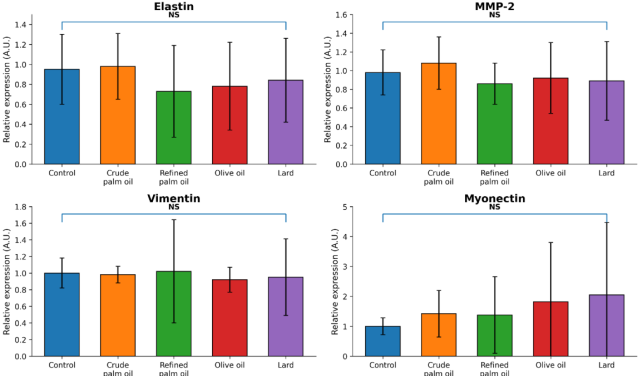
Elastin expression remained globally comparable among groups, suggesting preservation of myocardial elastic properties under the tested dietary conditions. MMP-2 expression was also stable, indicating no clear activation of enzymatic matrix remodeling at the transcript level. Likewise, vimentin expression did not vary significantly, supporting the absence of major structural or cytoskeletal adaptation in the healthy myocardium during the study period.
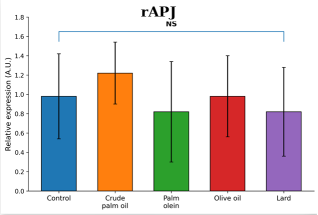
Myonectin and APJ expression showed slight qualitative fluctuations in some lipid-fed groups, but these variations did not reach statistical significance. Taken together, the transcript profiles suggest that the tested lipid sources did not induce measurable disruption of myocardial ECM-related gene expression under the specific experimental conditions of this study. The expression profiles of elastin, MMP-2, vimentin, and myonectin are shown in
Figure 1, APJ expression is presented in
Figure 2, and a synthetic interpretation is summarized in
Table 2.
Figure 1. Effects of lipid diets on myocardial expression of elastin, MMP-2, vimentin, and myonectin. Results are expressed as mean ± SD (n = 8 per group). NS indicates no significant between-group difference.
Figure 2. Effects of lipid diets on myocardial APJ expression. Results are expressed as mean ± SD (n = 8 per group). NS indicates no significant between-group difference.
Table 2. Summary of myocardial ECM-related findings according to dietary group.
Marker | Overall result vs. control | Interpretation |
Elastin | No significant variation | Preservation of myocardial elastic properties at the transcript level |
MMP-2 | No significant variation | No clear activation of matrix remodeling pathways at the transcript level |
Vimentin | No significant variation | No major structural or cytoskeletal adaptation detected |
Myonectin | Non-significant qualitative fluctuations | Possible metabolic modulation without statistical significance |
APJ | No significant variation | Stable apelin/APJ transcript profile under study conditions |
4. Discussion
The principal finding of this study is that 12 weeks of exposure to diets enriched with crude palm oil, refined palm oil, olive oil, or lard did not significantly modify myocardial expression of elastin, vimentin, MMP-2, myonectin, or APJ in healthy rats. This observation suggests that, in a non-pathological setting, moderate variation in dietary lipid quality was not sufficient to produce detectable changes in the selected myocardial ECM-related transcripts.
This result should be interpreted in light of the biological behavior of the cardiac ECM. In pathological states, ECM remodeling is commonly associated with altered structural protein composition, fibroblast activation, protease induction, and progressive tissue stiffening
| [2] | Frangogiannis NG. The extracellular matrix in myocardial injury, repair, and remodeling. J Clin Invest. 2017; 127(5): 1600-1612. https://doi.org/10.1172/JCI87491 |
| [4] | Spinale FG. Myocardial matrix remodeling and the matrix metalloproteinases: influence on cardiac form and function. Physiol Rev. 2007; 87(4): 1285-1342.
https://doi.org/10.1152/physrev.00012.2007 |
| [10] | Lindsey ML, Iyer RP, Jung M, DeLeon-Pennell KY, Ma Y. Matrix metalloproteinases as input and output signals for post-myocardial infarction remodeling. J Mol Cell Cardiol. 2016; 91: 134-140. https://doi.org/10.1016/j.yjmcc.2015.12.018 |
| [14] | Wang X, Yu S, Xie L, Xiang M, Ma H. The role of the extracellular matrix in cardiac regeneration. Heliyon. 2025; 11: e41157. https://doi.org/10.1016/j.heliyon.2024.e41157 |
[2, 4, 10, 14]
. In contrast, the present model involved healthy animals without overt metabolic or hemodynamic stress, which may explain the overall stability of the markers studied. The preserved elastin and vimentin profiles are consistent with the absence of major structural adaptation, while the unchanged MMP-2 signal suggests that a proteolytic remodeling program was not activated under these conditions.
The non-significant behavior of myonectin and APJ is also informative. Myonectin is increasingly discussed as a mediator linking skeletal muscle, lipid metabolism, and cardiometabolic regulation
| [5] | Seldin MM, Peterson JM, Byerly MS, Wei Z, Wong GW. Myonectin (CTRP15), a novel myokine that links skeletal muscle to systemic lipid homeostasis. J Biol Chem. 2012; 287(15): 11968-11980. https://doi.org/10.1074/jbc.M111.336834 |
| [15] | Petro JL, Gallo-Villegas J, Calderon JC. Myonectin and metabolic health: a systematic review. Front Endocrinol (Lausanne). 2025; 16: 1557142.
https://doi.org/10.3389/fendo.2025.1557142 |
| [17] | Jin L, Diaz-Canestro C, Wang Y, Tse MA, Xu A. Exerkines and cardiometabolic benefits of exercise: from bench to clinic. EMBO Mol Med. 2024; 16(3): 432-444.
https://doi.org/10.1038/s44321-024-00027-z |
[5, 15, 17]
, whereas the apelin/APJ pathway is recognized as a multifunctional cardiovascular axis with vasodilatory, inotropic, anti-fibrotic, and metabolic actions
| [11] | de Oliveira AA, Vergara A, Wang X, Vederas JC, Oudit GY. Apelin pathway in cardiovascular, kidney, and metabolic diseases: therapeutic role of apelin analogs and apelin receptor agonists. Peptides. 2022; 147: 170697.
https://doi.org/10.1016/j.peptides.2021.170697 |
| [12] | Chapman FA, Maguire JJ, Newby DE, Davenport AP, Dhaun N. Targeting the apelin system for the treatment of cardiovascular diseases. Cardiovasc Res. 2023; 119(17): 2683-2696.
https://doi.org/10.1093/cvr/cvad171 |
[11, 12]
. The absence of marked transcript changes in these pathways may indicate that the animals did not develop sufficient systemic or myocardial stress to recruit these adaptive signaling systems at the tissue level.
The biochemical nature of the tested fats nevertheless remains relevant. Olive oil is generally associated with favorable cardiometabolic effects, crude palm oil retains antioxidant micronutrients, refined palm oil has a different micronutrient profile after processing, and lard provides a more saturated fatty acid pattern
| [7] | Mensink RP. Effects of saturated fatty acids on serum lipids and lipoproteins: a systematic review and regression analysis. Geneva: World Health Organization; 2016. |
| [8] | Wang DD, Hu FB. Dietary fat and risk of cardiovascular disease: recent controversies and advances. Annu Rev Nutr. 2017; 37: 423-446.
https://doi.org/10.1146/annurev-nutr-071816-064614 |
| [13] | Christensen JJ, Arnesen EK, Rundblad A, Telle-Hansen VH, Narverud I, Blomhoff R, Bogsrud MP, Retterstol K, Ulven SM, Holven KB. Dietary fat quality, plasma atherogenic lipoproteins, and atherosclerotic cardiovascular disease: an overview of the rationale for dietary recommendations for fat intake. Atherosclerosis. 2024; 389: 117433.
https://doi.org/10.1016/j.atherosclerosis.2023.117433 |
| [16] | Maki KC, Dicklin MR, Kirkpatrick CF. Saturated fats and cardiovascular health: current evidence and controversies. J Clin Lipidol. 2021; 15(6): 765-772.
https://doi.org/10.1016/j.jacl.2021.09.049 |
[7, 8, 13, 16]
. Despite these compositional differences, the myocardium remained transcriptionally stable for the markers examined here. This does not mean that all diets are biologically equivalent; rather, it suggests that under basal physiological conditions the myocardium may buffer moderate dietary lipid variation before overt ECM remodeling becomes detectable.
Several limitations must be acknowledged explicitly, in line with the reviewer's observations. First, the study relies on PCR-based transcript analysis only and therefore does not establish whether protein abundance, enzyme activity, or downstream biological function changed in parallel. Second, no histological assessment, heart weight index, echocardiographic evaluation, or other cardiac functional measurement was available to contextualize the molecular findings. Third, although food intake and body weight were monitored during the experimental protocol, those variables were not integrated into the present molecular report, and serum lipid profiling was not available. Finally, the present manuscript reports non-significance at the threshold level (all p > 0.05), and the absence of exact p-values or effect-size estimates limits the granularity of interpretation.
Accordingly, the findings should be framed cautiously. Rather than concluding that the myocardium is intrinsically resistant to dietary lipid variation, it is more appropriate to state that myocardial ECM-related gene expression appeared preserved under the specific conditions studied: healthy rats, selected transcript-level markers, and a 12-week exposure period. Future work should combine transcript, protein, histological, metabolic, and functional endpoints, ideally in longer interventions and in models with cardiometabolic stress, to better define whether different dietary lipid sources differentially affect cardiac remodeling.
5. Conclusions
Different lipid-enriched diets based on crude palm oil, refined palm oil, olive oil, and lard did not significantly alter the myocardial expression of selected ECM-related genes in healthy rats. Under the specific experimental conditions of this exploratory transcript-level study, myocardial ECM homeostasis appeared preserved. These findings should be interpreted cautiously because no protein, histological, metabolic, or functional validation was available. Additional integrative studies are required before broader conclusions can be drawn about the cardiac effects of dietary lipid quality.
Abbreviations
ANOVA | Analysis of Variance |
APJ | Apelin Receptor |
cDNA | Complementary DNA |
CPO | Crude Palm Oil |
ECM | Extracellular Matrix |
MMP-2 | Matrix Metalloproteinase-2 |
OO | Olive Oil |
PCR | Polymerase Chain Reaction |
Rplp0 | Ribosomal Protein Lateral Stalk Subunit P0 |
RPO | Refined Palm Oil |
SD | Standard Deviation |
Acknowledgments
The authors thank the participating research teams and the institutional structures that contributed to the completion of this study, particularly the Institut Universitaire de Recherche Clinique (IURC), Montpellier, and the Fonds Interprofessionnel pour la Recherche et le Conseil Agricoles (FIRCA).
Author Contributions
Koffi Konan Gervais: Conceptualization, Data curation, Formal Analysis, Investigation, Methodology, Writing – original draft
Germaine Niamke: Data curation, Investigation, Writing – original draft
Chantal Gauze–Gnagne: Investigation
Luc Dere: Investigation
Benedicte Yapo: Investigation
Eric Badia: Validation, Writing – review & editing
Fabrice Reynaud: Conceptualization, Formal Analysis, Methodology, Supervision, Writing – review & editing
Bernard Jover: Conceptualization, Formal Analysis, Methodology, Supervision, Writing – review & editing
Ferdin& Djohan: Validation, Writing – review & editing
Jean Paul Cristol: Supervision, Validation, Writing – review & editing
Ake Absalome Monde: Supervision, Validation, Writing – review & editing
Conflicts of Interest
The authors declare that there is no conflict of interest regarding the publication of this article.
References
| [1] |
Weber KT, Janicki JS, Shroff SG, Pick R, Chen RM, Bashey RI. Collagen remodeling of the pressure-overloaded, hypertrophied nonhuman primate myocardium. Circ Res. 1988; 62(4): 757-765.
https://doi.org/10.1161/01.RES.62.4.757
|
| [2] |
Frangogiannis NG. The extracellular matrix in myocardial injury, repair, and remodeling. J Clin Invest. 2017; 127(5): 1600-1612.
https://doi.org/10.1172/JCI87491
|
| [3] |
Eriksson JE, Dechat T, Grin B, Helfand B, Mendez M, Pallari HM, Goldman RD. Introducing intermediate filaments: from discovery to disease. J Clin Invest. 2009; 119(7): 1763-1771.
https://doi.org/10.1172/JCI38339
|
| [4] |
Spinale FG. Myocardial matrix remodeling and the matrix metalloproteinases: influence on cardiac form and function. Physiol Rev. 2007; 87(4): 1285-1342.
https://doi.org/10.1152/physrev.00012.2007
|
| [5] |
Seldin MM, Peterson JM, Byerly MS, Wei Z, Wong GW. Myonectin (CTRP15), a novel myokine that links skeletal muscle to systemic lipid homeostasis. J Biol Chem. 2012; 287(15): 11968-11980.
https://doi.org/10.1074/jbc.M111.336834
|
| [6] |
Chandrasekaran B, Dar O, McDonagh T. The role of apelin in cardiovascular function and heart failure. Eur J Heart Fail. 2008; 10(8): 725-732.
https://doi.org/10.1016/j.ejheart.2008.06.002
|
| [7] |
Mensink RP. Effects of saturated fatty acids on serum lipids and lipoproteins: a systematic review and regression analysis. Geneva: World Health Organization; 2016.
|
| [8] |
Wang DD, Hu FB. Dietary fat and risk of cardiovascular disease: recent controversies and advances. Annu Rev Nutr. 2017; 37: 423-446.
https://doi.org/10.1146/annurev-nutr-071816-064614
|
| [9] |
Wagenseil JE, Mecham RP. Elastin in large artery stiffness and hypertension. J Cardiovasc Transl Res. 2012; 5(3): 264-273.
https://doi.org/10.1007/s12265-012-9349-8
|
| [10] |
Lindsey ML, Iyer RP, Jung M, DeLeon-Pennell KY, Ma Y. Matrix metalloproteinases as input and output signals for post-myocardial infarction remodeling. J Mol Cell Cardiol. 2016; 91: 134-140.
https://doi.org/10.1016/j.yjmcc.2015.12.018
|
| [11] |
de Oliveira AA, Vergara A, Wang X, Vederas JC, Oudit GY. Apelin pathway in cardiovascular, kidney, and metabolic diseases: therapeutic role of apelin analogs and apelin receptor agonists. Peptides. 2022; 147: 170697.
https://doi.org/10.1016/j.peptides.2021.170697
|
| [12] |
Chapman FA, Maguire JJ, Newby DE, Davenport AP, Dhaun N. Targeting the apelin system for the treatment of cardiovascular diseases. Cardiovasc Res. 2023; 119(17): 2683-2696.
https://doi.org/10.1093/cvr/cvad171
|
| [13] |
Christensen JJ, Arnesen EK, Rundblad A, Telle-Hansen VH, Narverud I, Blomhoff R, Bogsrud MP, Retterstol K, Ulven SM, Holven KB. Dietary fat quality, plasma atherogenic lipoproteins, and atherosclerotic cardiovascular disease: an overview of the rationale for dietary recommendations for fat intake. Atherosclerosis. 2024; 389: 117433.
https://doi.org/10.1016/j.atherosclerosis.2023.117433
|
| [14] |
Wang X, Yu S, Xie L, Xiang M, Ma H. The role of the extracellular matrix in cardiac regeneration. Heliyon. 2025; 11: e41157.
https://doi.org/10.1016/j.heliyon.2024.e41157
|
| [15] |
Petro JL, Gallo-Villegas J, Calderon JC. Myonectin and metabolic health: a systematic review. Front Endocrinol (Lausanne). 2025; 16: 1557142.
https://doi.org/10.3389/fendo.2025.1557142
|
| [16] |
Maki KC, Dicklin MR, Kirkpatrick CF. Saturated fats and cardiovascular health: current evidence and controversies. J Clin Lipidol. 2021; 15(6): 765-772.
https://doi.org/10.1016/j.jacl.2021.09.049
|
| [17] |
Jin L, Diaz-Canestro C, Wang Y, Tse MA, Xu A. Exerkines and cardiometabolic benefits of exercise: from bench to clinic. EMBO Mol Med. 2024; 16(3): 432-444.
https://doi.org/10.1038/s44321-024-00027-z
|
Cite This Article
-
APA Style
Gervais, K. K., Niamke, G., Gauze-Gnagne, C., Dere, L., Yapo, B., et al. (2026). Effects of Different Lipid Diets on Myocardial Extracellular Matrix-Related Gene Expression in Healthy Rats. Advances in Biochemistry, 14(2), 28-33. https://doi.org/10.11648/j.ab.20261402.12
 Copy
|
Copy
|
 Download
ACS Style
Gervais, K. K.; Niamke, G.; Gauze-Gnagne, C.; Dere, L.; Yapo, B., et al. Effects of Different Lipid Diets on Myocardial Extracellular Matrix-Related Gene Expression in Healthy Rats. Adv. Biochem. 2026, 14(2), 28-33. doi: 10.11648/j.ab.20261402.12
Copy
|
Download
AMA Style
Gervais KK, Niamke G, Gauze-Gnagne C, Dere L, Yapo B, et al. Effects of Different Lipid Diets on Myocardial Extracellular Matrix-Related Gene Expression in Healthy Rats. Adv Biochem. 2026;14(2):28-33. doi: 10.11648/j.ab.20261402.12
Copy
|
Download
-
@article{10.11648/j.ab.20261402.12,
  author = {Koffi Konan Gervais and Germaine Niamke and Chantal Gauze-Gnagne and Luc Dere and Benedicte Yapo and Eric Badia and Fabrice Reynaud and Bernard Jover and Ferdinand Djohan and Jean Paul Cristol and Ake Absalome Monde},
  title = {Effects of Different Lipid Diets on Myocardial Extracellular Matrix-Related Gene Expression in Healthy Rats},
  journal = {Advances in Biochemistry},
  volume = {14},
  number = {2},
  pages = {28-33},
  doi = {10.11648/j.ab.20261402.12},
  url = {https://doi.org/10.11648/j.ab.20261402.12},
  eprint = {https://article.sciencepublishinggroup.com/pdf/10.11648.j.ab.20261402.12},
  abstract = {The myocardial extracellular matrix (ECM) is essential for cardiac architecture, ventricular compliance, and cell-matrix signaling. Because dietary lipid quality can influence oxidative stress, inflammation, and cardiometabolic regulation, it may also affect myocardial ECM homeostasis. This exploratory study assessed whether different lipid-enriched diets modified myocardial ECM-related transcript expression in healthy rats. Forty rats were allocated to five groups (n = 8 per group) and received for 12 weeks either a control diet or diets enriched with crude palm oil, refined palm oil, olive oil, or lard. Myocardial tissue was collected at sacrifice, RNA was extracted and reverse-transcribed into complementary DNA, and relative expression of elastin, vimentin, myonectin, matrix metalloproteinase-2 (MMP-2), and the apelin receptor (APJ) was assessed by polymerase chain reaction using ribosomal protein lateral stalk subunit P0 (Rplp0) as the reference gene. Results were expressed as mean ± standard deviation and analyzed by analysis of variance followed by Tukey-Kramer multiple comparisons, with p  0.05), although slight non-significant qualitative fluctuations were observed for myonectin and APJ in some lipid-fed groups. Overall, the findings indicate that under the specific conditions of this 12-week experiment in healthy rats, the tested dietary lipids did not measurably disrupt myocardial ECM-related gene expression. Because the study was limited to transcript-level assessment and did not include protein, histological, or functional validation, the biological interpretation should remain restricted to early molecular observations under non-pathological conditions.},
 year = {2026}
}
Copy
|
Download
-
TY  - JOUR
T1  - Effects of Different Lipid Diets on Myocardial Extracellular Matrix-Related Gene Expression in Healthy Rats
AU  - Koffi Konan Gervais
AU  - Germaine Niamke
AU  - Chantal Gauze-Gnagne
AU  - Luc Dere
AU  - Benedicte Yapo
AU  - Eric Badia
AU  - Fabrice Reynaud
AU  - Bernard Jover
AU  - Ferdinand Djohan
AU  - Jean Paul Cristol
AU  - Ake Absalome Monde
Y1  - 2026/04/30
PY  - 2026
N1  - https://doi.org/10.11648/j.ab.20261402.12
DO  - 10.11648/j.ab.20261402.12
T2  - Advances in Biochemistry
JF  - Advances in Biochemistry
JO  - Advances in Biochemistry
SP  - 28
EP  - 33
PB  - Science Publishing Group
SN  - 2329-0862
UR  - https://doi.org/10.11648/j.ab.20261402.12
AB  - The myocardial extracellular matrix (ECM) is essential for cardiac architecture, ventricular compliance, and cell-matrix signaling. Because dietary lipid quality can influence oxidative stress, inflammation, and cardiometabolic regulation, it may also affect myocardial ECM homeostasis. This exploratory study assessed whether different lipid-enriched diets modified myocardial ECM-related transcript expression in healthy rats. Forty rats were allocated to five groups (n = 8 per group) and received for 12 weeks either a control diet or diets enriched with crude palm oil, refined palm oil, olive oil, or lard. Myocardial tissue was collected at sacrifice, RNA was extracted and reverse-transcribed into complementary DNA, and relative expression of elastin, vimentin, myonectin, matrix metalloproteinase-2 (MMP-2), and the apelin receptor (APJ) was assessed by polymerase chain reaction using ribosomal protein lateral stalk subunit P0 (Rplp0) as the reference gene. Results were expressed as mean ± standard deviation and analyzed by analysis of variance followed by Tukey-Kramer multiple comparisons, with p  0.05), although slight non-significant qualitative fluctuations were observed for myonectin and APJ in some lipid-fed groups. Overall, the findings indicate that under the specific conditions of this 12-week experiment in healthy rats, the tested dietary lipids did not measurably disrupt myocardial ECM-related gene expression. Because the study was limited to transcript-level assessment and did not include protein, histological, or functional validation, the biological interpretation should remain restricted to early molecular observations under non-pathological conditions.
VL  - 14
IS  - 2
ER  -
Copy
|
Download





 Share This Article
 Twitter
 Linked In
 Facebook