
This study evaluates the industrial viability of the newly identified Asedo feldspar deposit, hosted within Neoproterozoic pegmatites of the Mozambique Belt in southern Ethiopia. Geochemical analysis of ten feldspar samples reveals a major oxide composition averaging 69.02 wt.% SiO2, 21.19 wt.% Al2O3, 4.04 wt.% Na2O, 3.10 wt.% K2O, 2.96 wt.% CaO, 0.31 wt.% Fe2O3, and 0.11 wt.% MgO, with a low Loss on Ignition (LOI) of 0.43 wt.%, reflecting high mineralogical purity. However, significant compositional variability exists among samples, with Na2O/K2O ratios ranging from 0.29 to 6.15, indicating both potassic and sodic domains within the pegmatite. Physical property measurements demonstrate an average bulk density of 2.63 g/cm3, apparent porosity of 0.80%, and water absorption of 0.31%, indicating a dense, impermeable material suitable for ceramic and glass production. Minor impurities, including Fe2O3 (0.31 wt.%), are amenable to reduction through conventional beneficiation. resource estimation suggests an in-situ exploration target of approximately 46.9 million tonnes over an area of 1.5 km2 with an average thickness of 12 m. These results confirm the deposit’s potential as a reliable source of raw materials for local industries. The Asedo deposit represents a promising domestic industrial mineral resource capable of supporting Ethiopia’s expanding ceramic and glass sectors, thereby reducing import dependency and contributing to sustainable industrial development.
| Published in | American Journal of Applied Chemistry (Volume 14, Issue 5) |
| DOI | 10.11648/j.ajac.20261405.12 |
| Page(s) | 95-108 |
| Creative Commons |
This is an Open Access article, distributed under the terms of the Creative Commons Attribution 4.0 International License (http://creativecommons.org/licenses/by/4.0/), which permits unrestricted use, distribution and reproduction in any medium or format, provided the original work is properly cited. |
| Copyright |
Copyright © The Author(s), 2026. Published by Science Publishing Group |
Asedo Feldspar Deposit, Mozambique Belt, Geochemical Characterization, Mineral Beneficiation, Ceramic and Glass Industries
Collector's Code | SiO2 | Al2O3 | Fe2O3 | CaO | MgO | Na2O | K2O | MnO | P2O₅ | TiO2 | H2O | LOI |
|---|---|---|---|---|---|---|---|---|---|---|---|---|
ED-02-54-2 | 68.50 | 20.64 | 0.30 | 1.44 | 0.005 | 2.31 | 7.98 | 0.020 | 0.005 | 0.60 | 0.005 | 0.26 |
ED-02-55 | 67.30 | 26.24 | 0.22 | 5.00 | 0.005 | 6.15 | 1.00 | 0.005 | 0.005 | 0.12 | 0.23 | 0.51 |
ED-02-59-1 | 69.20 | 22.20 | 0.46 | 4.06 | 0.46 | 3.28 | 1.32 | 0.005 | 0.42 | 0.20 | 0.19 | 0.46 |
ED-02-54 | 65.78 | 25.48 | 0.16 | 4.32 | 0.005 | 5.82 | 1.06 | 0.005 | 0.40 | 0.10 | 0.16 | 0.22 |
ED-02-56 | 76.90 | 14.86 | 0.40 | 1.06 | 0.005 | 3.22 | 4.56 | 0.005 | 0.005 | 0.18 | 0.22 | 0.73 |
ED-02-57 | 70.20 | 19.20 | 0.28 | 2.80 | 0.08 | 5.20 | 1.50 | 0.006 | 0.08 | 0.16 | 0.14 | 0.40 |
ED-02-58 | 66.50 | 21.80 | 0.24 | 1.80 | 0.02 | 2.80 | 6.00 | 0.010 | 0.15 | 0.30 | 0.10 | 0.35 |
ED-02-59 | 66.80 | 22.50 | 0.32 | 3.20 | 0.15 | 3.60 | 2.60 | 0.008 | 0.20 | 0.22 | 0.16 | 0.40 |
ED-02-60 | 74.00 | 16.20 | 0.35 | 1.50 | 0.01 | 3.80 | 3.20 | 0.005 | 0.12 | 0.20 | 0.12 | 0.50 |
ED-02-61 | 65.00 | 22.80 | 0.38 | 4.40 | 0.35 | 4.20 | 1.80 | 0.012 | 0.25 | 0.28 | 0.20 | 0.45 |
Minimum | 65.00 | 14.86 | 0.16 | 1.06 | 0.005 | 2.31 | 1.00 | 0.005 | 0.005 | 0.10 | 0.005 | 0.22 |
Maximum | 76.90 | 26.24 | 0.46 | 5.00 | 0.46 | 6.15 | 7.98 | 0.020 | 0.42 | 0.60 | 0.23 | 0.73 |
Mean | 69.02 | 21.19 | 0.31 | 2.96 | 0.11 | 4.04 | 3.10 | 0.008 | 0.164 | 0.24 | 0.154 | 0.43 |
Standard Deviation | 3.79 | 3.63 | 0.09 | 1.44 | 0.17 | 1.29 | 2.37 | 0.005 | 0.155 | 0.14 | 0.067 | 0.14 |
Sample No. | Lab No. | Dry weight (g) | Wet weight (g) | Suspended weight (g) | Water absorption (%) | Porosity (%) | Bulk density (g/cm3) |
|---|---|---|---|---|---|---|---|
ED-02-51-2 | 3162/25 | 79.08 | 79.50 | 49.24 | 0.53 | 1.39 | 2.61 |
ED-02-51-2 | 3162/25 | 119.81 | 120.42 | 74.43 | 0.51 | 1.33 | 2.61 |
ED-02-55-1 | 3163/25 | 84.99 | 85.08 | 52.92 | 0.11 | 0.28 | 2.64 |
ED-02-55-1 | 3163/25 | 143.25 | 143.37 | 89.22 | 0.08 | 0.22 | 2.65 |
Average | 0.31 | 0.80 | 2.63 |
Sample | SiO2 | Al2O3 | Fe2O3 | CaO | MgO | Na2O | K2O | Total Alkalis | Na2O/K2O | Feldspar Type |
|---|---|---|---|---|---|---|---|---|---|---|
``ED-02-54-2 | 68.50 | 20.64 | 0.30 | 1.44 | 0.005 | 2.31 | 7.98 | 10.29 | 0.29 | Potassic |
ED-02-55 | 67.30 | 26.24 | 0.22 | 5.00 | 0.005 | 6.15 | 1.00 | 7.15 | 6.15 | Sodic |
ED-02-59-1 | 69.20 | 22.20 | 0.46 | 4.06 | 0.46 | 3.28 | 1.32 | 4.60 | 2.48 | Sodic |
ED-02-54 | 65.78 | 25.48 | 0.16 | 4.32 | 0.005 | 5.82 | 1.06 | 6.88 | 5.49 | Sodic |
ED-02-56 | 76.90 | 14.86 | 0.40 | 1.06 | 0.005 | 3.22 | 4.56 | 7.78 | 0.71 | Potassic-sodic |
ED-02-57 | 70.20 | 19.20 | 0.28 | 2.80 | 0.08 | 5.20 | 1.50 | 6.70 | 3.47 | Sodic |
ED-02-58 | 66.50 | 21.80 | 0.24 | 1.80 | 0.02 | 2.80 | 6.00 | 8.80 | 0.47 | Potassic |
ED-02-59 | 66.80 | 22.50 | 0.32 | 3.20 | 0.15 | 3.60 | 2.60 | 6.20 | 1.38 | Sodic |
ED-02-60 | 74.00 | 16.20 | 0.35 | 1.50 | 0.01 | 3.80 | 3.20 | 7.00 | 1.19 | Sodic |
ED-02-61 | 65.00 | 22.80 | 0.38 | 4.40 | 0.35 | 4.20 | 1.80 | 6.00 | 2.33 | Sodic |
Average | 69.02 | 21.19 | 0.31 | 2.96 | 0.11 | 4.04 | 3.10 | 7.14 | 1.30 | Sodic (avg.) |
Oxide | Asedo Deposit (Ethiopia) | Wadi Al-Jayshiah (Jordan) | Wadi Zerabi (Egypt) | Spruce Pine Minspar (USA) | Çine-Milas Raw (Turkey) | Norfloat K (Norway) |
|---|---|---|---|---|---|---|
SiO2 | 69.02 | 67.96 | 68.29 | 68.60 | 66.03 | 65.90 |
Al2O3 | 21.19 | 17.74 | 18.69 | 18.50 | 15.56 | 18.60 |
Fe2O3 | 0.31 | 2.33 | 0.07 | 0.06 | 0.40 | 0.07 |
Na2O | 4.04 | 4.13 | 6.33 | 6.50 | 5.68 | 2.90 |
K2O | 3.10 | 4.33 | 5.83 | 4.10 | 13.40 | 11.80 |
LOI | 0.43 | 0.09 | — | 0.30 | — | 0.20 |
m. oxide (wt.%) | Asedo (This Study) | Shebelle | Negelle Borena | Kenticha Pure Feldspar | Kenticha Feldspar-Quartz | Kenticha (Adola Belt) | Kenticha Serpentinite Massif |
|---|---|---|---|---|---|---|---|
SiO2 | 69.02 | 70.96 | 66.0 | 65.7 | 70.5 | 67.3 | 67.3 |
Al2O3 | 21.19 | 18.04 | 18.5 | 18.6 | 16.3 | 17.2 | 17.2 |
Fe2O3 | 0.31 | 0.24 | 0.58 | 0.5 | 0.7 | <0.1–0.3 | <0.3 |
K2O | 3.10 | 9.45 | 10.0 | 4.9 | 4.8 | 11.1 | 11.1 |
Na2O | 4.04 | 1.41 | 2.75 | 7.0 | 5.4 | 2.4 | 2.4 |
Total alkalis | 7.14 | 10.86 | 12.75 | 11.9 | 10.2 | 13.5 | 13.5 |
Na2O/K2O | 1.30 | 0.15 | 0.28 | 1.43 | 1.13 | 0.22 | 0.22 |
Feldspar type | Sodic | Potassic | Potassic | Sodic | Sodic | Potassic | Potassic |
Resource (Mt) | 46.9 | 0.025 | 0.0145 | 0.5 | 0.5 | 2.7 | 2.7 |
Parameter | Asedo Feldspar | Ceramic Tiles | Sanitary Ware | Porcelain Stoneware | Structural Ceramics | Container Glass (Coloured) | Premium White Ceramics |
|---|---|---|---|---|---|---|---|
SiO2 (wt.%) | 69.02 | 65–75 | 65–75 | 67–75 | 65–75 | 68–75 | 68–75 |
Al2O3 (wt.%) | 21.19 | 17–22 | 18–23 | 18–23 | 16–22 | 17–20 | 18–22 |
Na2O (wt.%) | 4.04 | 2–6 | 2–6 | 3–7 | 2–6 | 3–8 | 2–5 |
K2O (wt.%) | 3.10 | 2–8 | 2–8 | 2–8 | 2–8 | 1–5 | 2–6 |
Total Alkalis | 7.14 | >7 | >7 | >7 | >6 | >7 | >7 |
Fe2O3 (wt.%) | 0.31 | <0.50 | <0.50 | <0.40 | <0.80 | <0.40 | <0.10 |
LOI (wt.%) | 0.43 | <1.0 | <1.0 | <1.0 | <1.0 | <0.8 | <0.5 |
Bulk Density (g/cm3) | 2.63 | 2.55–2.65 | 2.55–2.65 | 2.55–2.65 | Typical | Typical | Typical |
Water Absorption (%) | 0.31 | Low | Low | Low | Low | — | — |
Apparent Porosity (%) | 0.80 | Low | Low | Low | Low | — | — |
Overall | ✓ | ✓ | ✓ | ✓ | ✓ | ✗ (Fe2O3) |
ASTM | American Society for Testing and Materials |
BD | Bulk Density |
Wd | Oven-dry Weight |
W_sat | Saturated Weight |
W_sub | Suspended Weight |
Cwb | Temperate Highland Climate with Dry Winter and Warm Summer (Köppen Climate Code) |
EIGS | Ethiopian Institute of Geological Surveys |
GIE | Geological Institute of Ethiopia |
LOI | Loss on Ignition |
Ma | Million Years Ago |
m.a.s.l. | Metres Above Sea Level |
Mt | Million Tonnes |
ORCID | Open Researcher and Contributor ID |
P | Apparent Porosity |
PPL | Plane-polarized Light |
USD | United States Dollar (s) |
WA | Water Absorption |
wt.% | Weight Percent |
XPL | Cross-polarized Light |
XRF | X-ray Fluorescence |
| [1] | Water Resources Division, U. S. Geological Survey. (2011). Mineral resource of the month: Feldspar. Earth, 56(4), 29. American Geosciences Institute. |
| [2] |
Knowledge Sourcing Intelligence. (2025). Global feldspar market – Forecasts from 2025 to 2030 (Report KSI1878320).
https://www.gii.tw/report/ksi1878320-global-feldspar-market-forecasts-from.html |
| [3] | Carty, W. M., & Senapati, U. (1998). Porcelain—Raw materials, processing, phase evolution, and mechanical behavior. Journal of the American Ceramic Society, 81(1), 3–20. |
| [4] | Kogel, J. E., Trivedi, N. C., Barker, J. M., & Krukowski, S. T. (Eds.). (2006). Industrial minerals and rocks: Commodities, markets, and uses (7th ed.). Society for Mining, Metallurgy, and Exploration. |
| [5] | Shelby, J. E. (2020). Introduction to glass science and technology (3rd ed.). Royal Society of Chemistry. |
| [6] | Virta, R. L. (2002). Feldspar. In U. S. Geological Survey Minerals Yearbook 2002 (pp. 25.1–25.6). U. S. Geological Survey. |
| [7] | Yassin, K. E., Hassan, E. R. E., & Elbendari, A. M. (2025). Impact of dry and wet magnetic separator process parameters on iron oxide removal from Egyptian feldspar ore. Journal of Mining Institute, 274, 154–166. |
| [8] | Tinesha, S., Ismail, I., Roshaida, A., Anuar, O., & Voon, C. H. (2025). Beneficiation method and iron removal from feldspar ore. Journal of Engineering and Technology, 16(1), 228–237. |
| [9] | Ministry of Mines. (2023). Annual report on mineral resources development and management in Ethiopia. Ministry of Mines, FDRE. |
| [10] | Peel, M. C., Finlayson, B. L., & McMahon, T. A. (2007). Updated world map of the Köppen–Geiger climate classification. Hydrology and Earth System Sciences, 11, 1633–1644. |
| [11] | Kazmin, V. (1972). Geology of Ethiopia. Ethiopian Institute of Geological Surveys. |
| [12] | Davidson, A. (1983). The Omo River Project: Regional geology and evolution of the northern part of the Mozambique Belt, Ethiopia (Bulletin No. 2). Ethiopian Institute of Geological Surveys. |
| [13] | Stern, R. J. (1994). Arc assembly and continental collision in the Neoproterozoic East African Orogen: Implications for the consolidation of Gondwanaland. Annual Review of Earth and Planetary Sciences, 22, 319–351. |
| [14] | Fritz, H., Abdelsalam, M., Ali, K. A., Bingen, B., Collins, A. S., Fowler, A. R., Ghebreab, W., Hauzenberger, C., Johnson, P. R., Kusky, T. M., Macey, P., Muhongo, S., & Stern, R. J. (2013). Orogen styles in the East African Orogen: A review of the Neoproterozoic to Cambrian tectonic evolution. Journal of African Earth Sciences, 86, 65–106. |
| [15] | Yibas, B., Reimold, W. U., Armstrong, R. A., Köberl, C., Anhaeusser, C. R., & Phillips, D. (2002). The tectonostratigraphy, granitoid geochronology and geological evolution of the Precambrian of southern Ethiopia. Journal of African Earth Sciences, 34(1–2), 57–84. |
| [16] | Černý, P. (1991). Rare-element granitic pegmatites. Part I: Anatomy and internal evolution of pegmatite deposits. Geoscience Canada, 18(2), 49–67. |
| [17] | London, D. (2008). Pegmatites. Mineralogical Association of Canada. |
| [18] | Beyth, M., Stern, R. J., Altherr, R., & Kröner, A. (1994). The Late Precambrian Timna Igneous Complex, Southern Israel: Evidence for Comagmatic-Type Sanukitoid Monzodiorite and Alkali Granite Magma. Lithos, 31(3–4), 103–124. |
| [19] | Assefa, A., Tadele, H., Knoth, W. Geological Research and Evaluations for Sheet Glass Raw Materials (Silica Sand, Vein Quartz, Dolomite, Limestone and Feldspar), Shoa, Hararghe, Wollega, and Sidamo Administrative Regions (EIGS Note No. 238). Addis Ababa: Ethiopian Institute of Geological Surveys; 1985. |
| [20] | Bekele, W. Preliminary Geological Report of Delga Chebsi and Hakim Gara Limestone (Marble) and Hamaresia Granite Deposits. Addis Ababa: Ethio-Libyan Joint Mining Company (ELMICO); 1983. |
| [21] | Sheferaw, Y., & Belachew, G. (2026). Silica sand and feldspar resources in Ethiopia: A review of their occurrence, characteristics, industrial applications, and beneficiation. American Journal of Applied and Industrial Chemistry, 10(2), 30–49. |
| [22] | ASTM International. (2018). ASTM C373-18, Standard Test Methods for Water Absorption, Bulk Density, Apparent Porosity, and Apparent Specific Gravity of Fired Whiteware Products, Ceramic Tiles, and Glass Tiles. ASTM International. |
| [23] | Singer, F., & Singer, S. S. (1979). Industrial ceramics. Chapman and Hall. |
| [24] | Carter, C. B., & Norton, M. G. (2013). Ceramic materials: Science and engineering (2nd ed.). Springer. |
| [25] | Reimann, C., Filzmoser, P., Garrett, R. G., & Dutter, R. (2008). Statistical data analysis explained: Applied environmental statistics with R. John Wiley & Sons. |
| [26] | Dondi, M. (2018). Feldspathic fluxes for ceramics: Sources, production trends and technological value. Resources, Conservation and Recycling, 133, 191–205. |
| [27] | Deer, W. A., Howie, R. A., & Zussman, J. (2013). An introduction to the rock-forming minerals (3rd ed.). Mineralogical Society of Great Britain and Ireland. |
| [28] | Nesse, W. D. (2012). Introduction to mineralogy (2nd ed.). Oxford University Press. |
| [29] | Al-Rawabdeh, A. M., Al-Ansari, N. A., Al-Taani, A. A., Al-Khateeb, F. L., & Knutsson, S. (2014). Assessment and characterization of industrial mineral deposits and raw materials in Jordan. Journal of Earth Sciences and Geotechnical Engineering, 4(2), 45–60. |
| [30] | Ibrahim, S. S., Mohamed, H. A., & Boulos, T. R. (2015). Beneficiation and characterization of Egyptian feldspar deposits for ceramic and glass manufacturing. International Journal of Mineral Processing, 138, 12–20. |
| [31] | Karagüzel, C., Çırak, M., & Çelik, M. S. (2006). Beneficiation of feldspar deposits from the Çine-Milas region of Turkey by selective flotation. Minerals Engineering, 19(11), 1201–1208. |
| [32] | Tamene, M. (2026). Geological and geochemical characteristics of quartz-feldspar pegmatites in southern Ethiopia [Doctoral dissertation, Addis Ababa University]. Addis Ababa University Institutional Repository. |
| [33] | Tamene, M., & Tesfaye, W. (2026). Geology, geochemistry, and economic evaluation of feldspar quartz pegmatites in the Kenticha Serpentinite Massif, Southern Ethiopia. Science Discovery Environment. |
| [34] | Merga, A., Murthy, H. C. A., Amare, E., Ahmed, K., & Bekele, E. (2019). Fabrication of electrical porcelain insulator from ceramic raw materials of Oromia region, Ethiopia. Heliyon, 5(8), Article e02327. |
APA Style
Ferada, Y. H., Yadate, K. W. (2026). Physiochemical Characterization of the Asedo Feldspar Deposit, Mozambique Belt, Southern Ethiopia: Implications for Ceramic and Glass Industries. American Journal of Applied Chemistry, 14(5), 95-108. https://doi.org/10.11648/j.ajac.20261405.12
ACS Style
Ferada, Y. H.; Yadate, K. W. Physiochemical Characterization of the Asedo Feldspar Deposit, Mozambique Belt, Southern Ethiopia: Implications for Ceramic and Glass Industries. Am. J. Appl. Chem. 2026, 14(5), 95-108. doi: 10.11648/j.ajac.20261405.12
@article{10.11648/j.ajac.20261405.12,
  author = {Yonas Hordofa Ferada and Kisa Workineh Yadate},
  title = {Physiochemical Characterization of the Asedo Feldspar Deposit, Mozambique Belt, Southern Ethiopia: Implications for Ceramic and Glass Industries},
  journal = {American Journal of Applied Chemistry},
  volume = {14},
  number = {5},
  pages = {95-108},
  doi = {10.11648/j.ajac.20261405.12},
  url = {https://doi.org/10.11648/j.ajac.20261405.12},
  eprint = {https://article.sciencepublishinggroup.com/pdf/10.11648.j.ajac.20261405.12},
  abstract = {This study evaluates the industrial viability of the newly identified Asedo feldspar deposit, hosted within Neoproterozoic pegmatites of the Mozambique Belt in southern Ethiopia. Geochemical analysis of ten feldspar samples reveals a major oxide composition averaging 69.02 wt.% SiO2, 21.19 wt.% Al2O3, 4.04 wt.% Na2O, 3.10 wt.% K2O, 2.96 wt.% CaO, 0.31 wt.% Fe2O3, and 0.11 wt.% MgO, with a low Loss on Ignition (LOI) of 0.43 wt.%, reflecting high mineralogical purity. However, significant compositional variability exists among samples, with Na2O/K2O ratios ranging from 0.29 to 6.15, indicating both potassic and sodic domains within the pegmatite. Physical property measurements demonstrate an average bulk density of 2.63 g/cm3, apparent porosity of 0.80%, and water absorption of 0.31%, indicating a dense, impermeable material suitable for ceramic and glass production. Minor impurities, including Fe2O3 (0.31 wt.%), are amenable to reduction through conventional beneficiation. resource estimation suggests an in-situ exploration target of approximately 46.9 million tonnes over an area of 1.5 km2 with an average thickness of 12 m. These results confirm the deposit’s potential as a reliable source of raw materials for local industries. The Asedo deposit represents a promising domestic industrial mineral resource capable of supporting Ethiopia’s expanding ceramic and glass sectors, thereby reducing import dependency and contributing to sustainable industrial development.},
 year = {2026}
}
TY  - JOUR
T1  - Physiochemical Characterization of the Asedo Feldspar Deposit, Mozambique Belt, Southern Ethiopia: Implications for Ceramic and Glass Industries
AU  - Yonas Hordofa Ferada
AU  - Kisa Workineh Yadate
Y1  - 2026/10/31
PY  - 2026
N1  - https://doi.org/10.11648/j.ajac.20261405.12
DO  - 10.11648/j.ajac.20261405.12
T2  - American Journal of Applied Chemistry
JF  - American Journal of Applied Chemistry
JO  - American Journal of Applied Chemistry
SP  - 95
EP  - 108
PB  - Science Publishing Group
SN  - 2330-8745
UR  - https://doi.org/10.11648/j.ajac.20261405.12
AB  - This study evaluates the industrial viability of the newly identified Asedo feldspar deposit, hosted within Neoproterozoic pegmatites of the Mozambique Belt in southern Ethiopia. Geochemical analysis of ten feldspar samples reveals a major oxide composition averaging 69.02 wt.% SiO2, 21.19 wt.% Al2O3, 4.04 wt.% Na2O, 3.10 wt.% K2O, 2.96 wt.% CaO, 0.31 wt.% Fe2O3, and 0.11 wt.% MgO, with a low Loss on Ignition (LOI) of 0.43 wt.%, reflecting high mineralogical purity. However, significant compositional variability exists among samples, with Na2O/K2O ratios ranging from 0.29 to 6.15, indicating both potassic and sodic domains within the pegmatite. Physical property measurements demonstrate an average bulk density of 2.63 g/cm3, apparent porosity of 0.80%, and water absorption of 0.31%, indicating a dense, impermeable material suitable for ceramic and glass production. Minor impurities, including Fe2O3 (0.31 wt.%), are amenable to reduction through conventional beneficiation. resource estimation suggests an in-situ exploration target of approximately 46.9 million tonnes over an area of 1.5 km2 with an average thickness of 12 m. These results confirm the deposit’s potential as a reliable source of raw materials for local industries. The Asedo deposit represents a promising domestic industrial mineral resource capable of supporting Ethiopia’s expanding ceramic and glass sectors, thereby reducing import dependency and contributing to sustainable industrial development.
VL  - 14
IS  - 5
ER  -
Department of Mineral Exploration Research Executive, Geological Institute of Ethiopia (GIE), Addis Ababa, Ethiopia
Department of Mineral Exploration Research Executive, Geological Institute of Ethiopia (GIE), Addis Ababa, Ethiopia
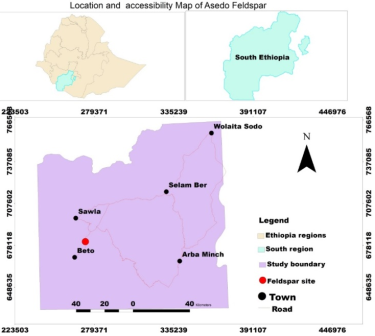
Figure 1. Location map of the study area.
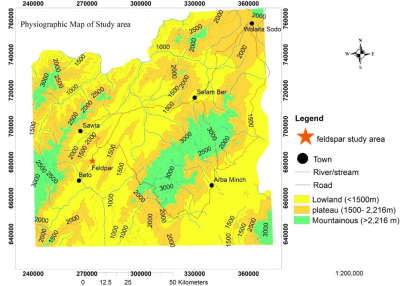
Figure 2. Physiographic map of the Asedo study area.
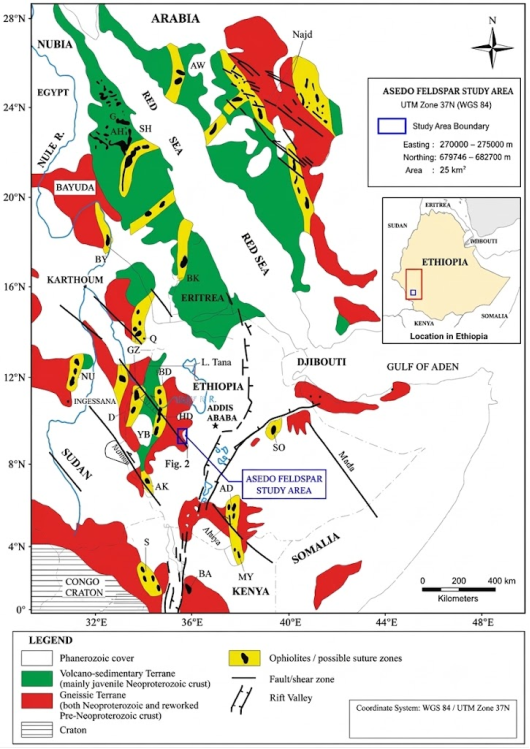
Figure 3. Regional geology and tectonic setting of Ethiopia. Source: Modified after Beyth et al. [18] and Geological Survey of Ethiopia (GSE).
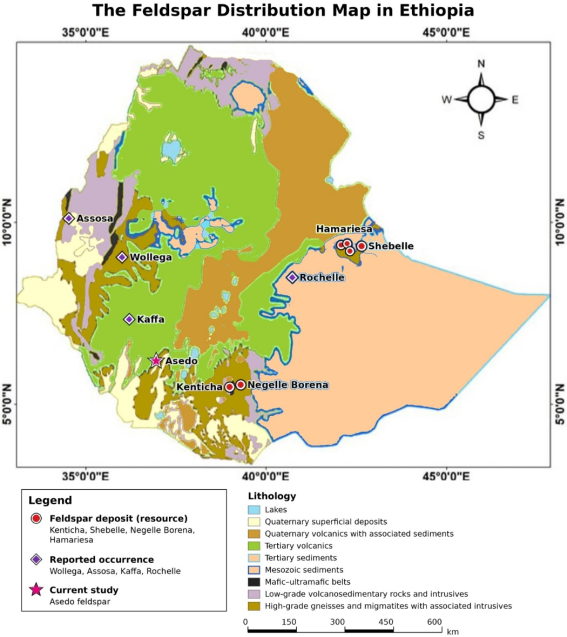
Figure 4. Feldspar distribution map in Ethiopia.
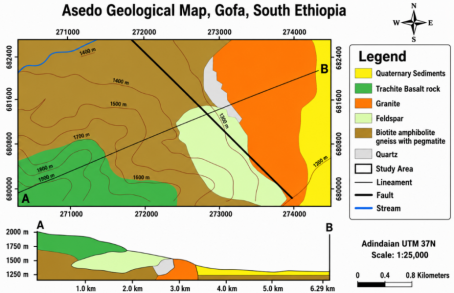
Figure 5. Geological map and cross-section of the Asedo feldspar deposit. Source: Authors’ field mapping and geological interpretation.
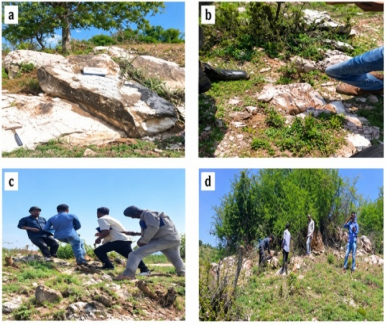
Figure 6. Representative feldspar sample collection locations. (a) Huge massive feldspar exposure; (b) Feldspar exposure in granite-pegmatite weathered; (c) Feldspar exposure in granitic–pegmatite weathered; (d) Feldspar exposure at hill side.
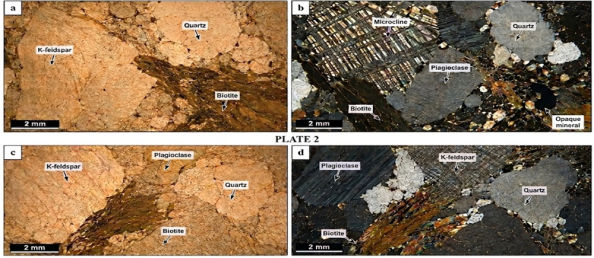
Figure 7. The photomicrographs of the pegmatite-hosted granite source of feldspar minerals.
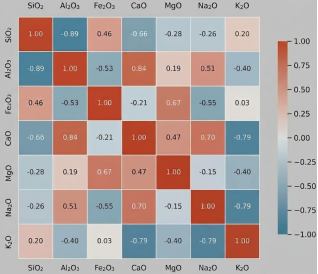
Figure 8. Pearson correlation matrix of major oxides for Asedo feldspar samples.

Information



 Share This Article
 Twitter
 Linked In
 Facebook

 Copy
 Download