Research Article | | Peer-Reviewed

Building Climate Resilient Food Systems Through Oyster Mushroom Cultivation Using Organic Waste in Fragile Settings

Received: 17 February 2026     Accepted: 4 March 2026     Published: 16 March 2026
Views:       Downloads:
Abstract

Conflicts, climate shocks, and limited agricultural inputs remain the primary drivers of food insecurity, malnutrition, and environmental degradation that constrain sustainable food production in South Sudan. Oyster mushroom cultivation offers low-cost, climate-resilient strategy for enhancing food security, improving livelihoods, and promoting sustainable waste management. However, evidence on the sustainable use of locally available organic wastes as substrates for mushroom production is currently lacking. This study evaluated the suitability of ten substrates derived from four organic biomass wastes-peanut shells, water hyacinth, cotton husks, and sawdust-and their 50:50 combinations for mushroom cultivation under resource-limited settings. Using a completely randomized experimental design, key growth, yield, efficiency and economic parameters were assessed. The results showed significant influences of substrate type on all parameters (p < 0.05). Peanut shells supported the fastest colonization period (21.0 ±1.58 days) and shortest growth cycle (30 ± 1.58 days), while sawdust had the slowest (36.0 ± 1.58 days) and (58.0 ± 2.00 days) respectively. Water hyacinth produced the highest total yields (375.2 ± 33.6 g) and biological efficiencies (25.01 ± 2.24%), with the greatest production rate (3.98 ± 0.41 g·day-1). Cotton husks showed moderate performance across all indicators. Economic analysis revealed water hyacinth having a strong profitability (BCR 3.67; ROI 267%), while water hyacinth–cotton husk combination performed moderately and remained profitable even at low break-even prices. These findings demonstrate that oyster mushroom cultivation using locally available biomass wastes, especially water hyacinth is viable, economically profitable, and capable of diversifying livelihoods, strengthening food security resilience, and supporting sustainable waste management in fragile and resource-limited settings.

Published in American Journal of Agriculture and Forestry (Volume 14, Issue 2)
DOI 10.11648/j.ajaf.20261402.13
Page(s) 98-110
Creative Commons

This is an Open Access article, distributed under the terms of the Creative Commons Attribution 4.0 International License (http://creativecommons.org/licenses/by/4.0/), which permits unrestricted use, distribution and reproduction in any medium or format, provided the original work is properly cited.

Copyright

Copyright © The Author(s), 2026. Published by Science Publishing Group

Keywords

Oyster Mushroom Cultivation, Organic Biomass Wastes, Biological Efficiency, Food Security, Conflict-affected Settings, Climate-resilience

1. Introduction
Despite commitment to the United Nations’ 2030 Agenda for Sustainable Development, countries in fragile and conflict situations like South Sudan are falling behind in achieving most of the Sustainable Development Goals (SDGs) targets . These countries continue to face some of the world’s worst incidences of food insecurity, economic crisis, and malnutrition. Recurrent conflict, climate shocks, displacement, and rudimentary agricultural systems in South Sudan remain the leading drivers of food insecurity and malnutrition . According to the Food and Agriculture Organization (FAO) and the World Food Programme (WFP), over 57 percent of South Sudan's population face acute food insecurity, with approximately 2.3 million children under 5 years acutely malnourished and about 1.2 million pregnant and breastfeeding women needing treatment . Addressing these systemic challenges to sustainable food production requires innovative and cost-effective strategies that can operate reliably within South Sudan’s fragile context to improve dietary diversity and strengthen livelihood resilience.
Mushroom cultivation has emerged as an important farming strategy for addressing food and nutritional security, youth unemployment, poverty, economic challenges, and environmental degradation . Edible mushrooms, particularly oyster mushrooms (Pleurotus ostreatus) have gained global recognition as valuable dietary supplements due to their rich nutritional profile, low input requirements, and capacity to thrive under a wide range of environmental conditions common in tropical Africa, such as temperatures (10-30°C) and pH (6-8) . Several studies have documented the high concentration of vitamins (including B-complex), proteins, minerals, dietary fiber, and bioactive compounds (i.e., polysaccharides) in edible mushrooms . These nutritional attributes position edible mushrooms as important component of rural food systems in areas facing chronic food insecurity, such as South Sudan, where they could also be used to supplement cereal-based diets that are low in essential micronutrients .
Beyond their nutritional value, mushrooms possess several medicinal properties, including anti-inflammatory, antimicrobial, antioxidant, antidiabetic, and immunomodulatory effects, which make them valuable therapeutic food supplements in low-resource settings . Studies have reported over 130 bioactive compounds in edible mushrooms, including anti-tumor phytochemicals, antioxidant activity, and compounds with inhibitory effects against various forms of cancer, including breast, leukemia, cervix, uterine, and brain cancer .
Among the various agricultural systems, mushroom farming is one of the most sustainable food production systems that requires a minimal amount of water, land area, simple technology, and low starting capital, making it accessible to smallholder farmers and youth . Given their efficient use of resources, mushroom farming plays a critical role in achieving SDGs, particularly SDG 1 (No Poverty), SDG 2 (Zero Hunger), SDG 12 (Responsible Consumption and Production), and SDG 13 (Climate Action), with additional co-benefits for SDG 6, 11, 14, 15, and 17 . Despite these benefits, mushroom productivity is highly influenced by substrate composition and environmental factors, such as pH and temperature. Substrates rich in complex organic compounds, such as cellulose, hemicelluloses, and lignin with a balanced carbon-to-nitrogen (C/N) ratio are considered the best for mushroom cultivation.
Oyster mushrooms possess enzymatic capabilities for degrading different lignocellulosic biomass, common in agricultural waste streams. Several studies have evaluated the composition and performance of different biomass types as substrates for oyster mushroom cultivation, with a particular focus on productivity, nutritional quality, and economic return . Although South Sudan generates huge quantities of lignocellulosic wastes, such as cereal straws, cotton husks, sawdust, peanut shells, and water hyacinth, among others, there is no documented evidence on the suitability of these materials as substrates for producing high-quality oyster mushrooms to support sustainable and nutritious food production, as well as youth unemployment and poverty reduction. This gap is mainly driven by limited technical knowledge, low public awareness, weak value chains, and lack of research and extension services. Therefore, this study aimed to evaluate the suitability of four locally available organic biomass wastes, including peanut shells, water hyacinth, sawdust, and cotton husks, for oyster mushroom cultivation in the context of fragility and resource limitation in Juba, South Sudan. The inclusion of water hyacinth offers an additional environmental benefit, as this invasive species is spreading rapidly and poses significant threats to fishing activities and waterway navigation in the country.
2. Materials and Methods
2.1. Study Area and Research Design
This study was conducted in Juba, the capital of South Sudan, located at 4.85°N, 31.60°E. Juba experiences a tropical wet and dry climate, with average temperatures ranging from 25-35°C and relative humidity between 40-85%. The presence of agricultural activities around the city , coupled with readily available sawdust and water hyacinth, including market demand for nutritious food, makes Juba an ideal location for evaluating low-cost substrates for oyster mushroom production. A completely randomized design was adopted for evaluating the four substrates over a period of three months between March and June 2025, with each constituting one treatment group, replicated five times (Table 1).
2.2. Substrate Collection and Preparation
2.2.1. Substrate Collection
The organic biomass wastes used for this study were obtained within the vicinity of Juba at no charge. Fresh water hyacinth plants were harvested from the River Nile, cotton husks and peanut shells were obtained from a local farm, and sawdust was obtained from a local carpentry workshop. A commercial Pleurotus ostreatus grain spawn was purchased from a local supplier and kept in a clean and sterilized bottle covered with cotton wool to prevent moisture from entering, which was then stored at room temperature until the time for inoculation into the different substrates.
Table 1. Different substrate types used in this study; each replicated five times.

Treatments

Substrates type

Composition (%)

T1

Water hyacinth (WH)

100

T2

Peanut hulls (PS)

100

T3

Sawdust (SD)

100

T4

Cotton husk (CH)

100

T5

WH + PS

50 +50

T6

WH + CH

50 +50

T7

WH + SD

50 +50

T8

CH + SD

50 +50

T9

PS + SD

50 +50

T10

PS + CH

50 +50

2.2.2. Substrate Preparation
The materials were first washed with clean water to remove debris, soil particles, and contaminated parts, followed by drying in open air. Water hyacinth was pre-fermented for seven days and then chopped into small pieces (4-6 cm) as described by Ejigu and colleagues . Peanut shells and cotton husks were pounded using a traditional mortar and pestle into fine particles and then sun-dried. This process enhances lignocellulose degradation and promotes efficient mycelium growth by increasing the surface area and density of the materials, creating more capillary spaces between them for improved aeration.
Following the above step, each of the four substrates was pretreated with 3% lime (CaCO₃) and soaked in cold water for 12 hours to breakdown hemicellulose and reduce contaminants. Excess water was then drained off from the substrates and dried in the shade until the required moisture content was achieved. The prepared substrates were packed tightly into small heat-resistant bags (each weighing 1500g), with five replicates. The bags were then loaded into a locally available metallic drum and boiled at 100°C for 3 hours, followed by slow cooling for 24 hours.
2.3. Substrates Inoculation, Mushroom Growth, and Harvesting
Inoculation of the substrates with mycelium was carried out aseptically to prevent contamination. A completely dark incubation room was prepared by blocking light penetration, reducing the temperature by sprinkling water, and installing fly traps. After cooling, each substrate bag was inoculated with 7% spawn (70g per bag, w/w), following the approach of Mesele and colleagues . Each bag opening was plugged with cotton, covered with newspaper, and secured with a rubber band to allow adequate aeration, and then placed in the incubation room for colonization. Temperature (25-30°C) and humidity (70-80%) in the incubation room were maintained by sprinkling water three times a day (morning, afternoon, and evening), as recommended by Ejigu and colleagues . Inspections were conducted weekly for mycelial colonization and any contamination.
Once fully colonized, bags were transferred to a sufficiently lit room for fruiting and arranged in a random pattern, spaced 15–25cm apart. The temperature and the humidity of the fruiting room were also maintained within recommended ranges (i.e., 20-25°C and 80-90%) by regularly sprinkling with water and proper ventilation according to Mesele and colleagues . Pinhead formation was induced by puncturing each bag with a sterilized iron rod. Mature mushrooms were carefully harvested when the caps were fully opened, ensuring that the mycelium remained undamaged. The harvested mushrooms were immediately weighed using a digital scale, and the parameters studied were recorded.
2.4. Data Collection
The study assessed four major development parameters, including mycelial colonization period (MC), pinhead formation period (PF), time to first harvest since inoculation (FH), and total yield. Biological efficiency (BE) and production rates (PRs) were calculated using equations 1-2 , where BE represents yield relative to substrate dry weight, and PR as the ratio of fresh oyster mushroom yield (g·day-1) and biological efficiency (%·day-1) relative to the time (days) from spawning to first harvest. Additionally, economic returns (ER) on all substrates were determined by calculating the cost components of several economic indicators, including benefit-cost ratio (BCR), gross return (GR), net return (NR), break-even production (BEPd), break-even price (BEP), and return on investment (ROI), from each treatment replicate (i.e., 1000g dry weight) using equations 3-7 .
BE %=TWDW x 100(1)
PR %=BE %TS x 100(2)
GR=TW x P(3)
NR=GR-TPC(4)
BCR=GRTPC(5)
ROI=NRTPC x 100(6)
BEPd=TPCP(7)
BEP=TPCBEPd(8)
Where, TW is the total weight of fresh mushrooms, DW is the dry weight of the substrate, TS is the time (days) from spawning to harvest, P is the unit price of mushrooms kg-1, and TPC is the total production cost.
2.5. Data Analysis
Data was analyzed using one-way analysis of variance (ANOVA) analytical method in Microsoft Excel to evaluate the effect of substrate type on oyster mushroom growth parameters. Where significant differences were detected, means were compared using Tukey’s HSD test at a 5% significance level in R software . The results were then presented as mean ± standard deviation (SD) in tables and a figure to comparatively illustrate oyster mushroom performance across the different substrates.
3. Results
3.1. Impact of Substrates on Mycelial Colonization, Pinhead Formation, and Time to First Harvest
The time required for mycelium to complete colonization of the substrates (MC) in each of the bags after inoculation differed significantly across the treatments (P < 0.05) and ranged from an average of 21.0 to 36.0 days (Table 2). The fastest and the slowest MC period were observed in T2 (21 days) and T3 (36.0 days) respectively. The speed at which T2 completed colonization was statistically significant and faster than all other treatments except T10. There were no significant differences between T1 and T6, T4 and T6, T5 and T10, T7 and T8, and T1, T6, T9. The longest MC period was 36.0 days, which was observed in T3, and was significantly different from all other treatments, followed by T7.
The time (days) required for pinhead formation (PF) after mycelium colonization differed significantly (p < 0.05) among all treatments. The shortest average time for PF was observed in T2 (3.0 ± 0.71 days), which was statistically different from all other treatments except T10. In comparison, T1, T6, T8, and T9 did not differ and were faster than T3 and T7. Further statistical observation revealed no significant differences between T3 and T7 and between T4, T5, T6 and T9; however, T3 was significantly slower than the rest of the treatments, which confirms that it had the longest PF time (9.0 ± 1.58 days).
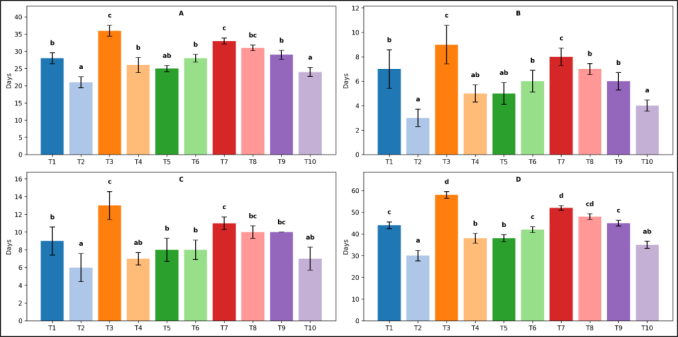
The time (days) from pinhead formation to the first harvest (FH) differed significantly among all treatments (P ≤ 0.05). The average time ranged from 6.0 ± 1.58 to 13.0 ± 1.58 days, with the shortest time observed in T2 (6.0 ± 1.58 days) followed by T10 (6.8 ± 1.30 days), while the longest was in T3 (13.0 days) followed by T7 (11.4 ± 0.55). Statistical analysis showed that T2 was significantly faster than all other treatments except with T4 and T10, where there were no significant differences. Conversely, T3 was significantly slower than all other treatments. The cumulative production time (days) from mycelial inoculation to the first harvest differed significantly across all treatments (p < 0.05), ranging from 30.0 ± 1.58 days for T2 to 58.0 ± 2.00 days for T3 (Figure 1), and the time efficiency was in the order T2 < T10 < T5 < T4 < T6 < T1 < T9 < T8 < T7 < T3 (i.e., lower value means faster overall production time).
Table 2. Influence of substrates on mycelial colonization, pinhead formation, and time to first harvest.

Treatment

MI-M ± SD (days)

PF-M ± SD (days)

FH-M ± SD (days)

Total-M ± SD (days)

T1

28.0 ± 1.58ᵈ

7.0 ± 1.58ᵈᵉ

9.0 ± 1.58ᵈ

44.0 ± 2.12ᵉ

T2

21.0 ± 1.58ᵃ

3.0 ± 0.71ᵃ

6.0 ± 1.58ᵃ

30.0 ± 1.58ᵃ

T3

36.0 ± 1.58ᵍ

9.0 ± 1.58ᶠ

13.0 ± 1.58ᵍ

58.0 ± 2.00ʰ

T4

26.0 ± 2.24ᶜ

5.0 ± 0.71ᵇᶜ

7.0 ± 0.71ᵃᵇ

38.0 ± 2.45ᶜᵈ

T5

24.6 ± 0.89ᵇ

5.2 ± 0.84ᵇᶜ

7.6 ± 1.52ᵇᶜ

37.4 ± 1.67ᶜ

T6

27.2 ± 1.92ᶜᵈ

6.2 ± 0.84ᶜᵈ

8.2 ± 1.30ᶜᵈ

41.6 ± 2.07ᵈ

T7

32.4 ± 0.55ᶠ

8.4 ± 0.55ᵉᶠ

11.4 ± 0.55ᶠ

52.2 ± 0.84ᵍ

T8

31.4 ± 0.89ᵉᶠ

7.2 ± 0.45ᵈᵉ

10.2 ± 0.84ᵉ

48.8 ± 1.48ᶠ

T9

29.0 ± 1.41ᵈᵉ

6.2 ± 0.84ᶜᵈ

10.0 ± 0.00ᵉ

45.2 ± 1.30ᵉᶠ

T10

23.6 ± 1.52ᵃᵇ

4.2 ± 0.45ᵃᵇ

6.8 ± 1.30ᵃᵇ

34.6 ± 1.52ᵇ

Means sharing a letter in the same column and row are not significantly different (p < 0.05) by Tukey’s HSD test.
3.2. Impact of Substrates on Oyster Mushroom Yield
Yield is the best performance indicator in mushroom cultivation. In this study, four flushes/harvests were recorded for the ten treatments. The results showed significant differences (P < 0.05) in fresh oyster mushroom yield among the different treatments across the four flushes, as well as in the total yield. In Flush 1, the highest mean yield (175.2 ± 17.7g) was recorded in T1, which was significantly higher than all other treatments, followed by T6 (117.0 ± 10.7 g) and T7 (104.2 ± 9.3 g). T2 and T3 recorded comparatively lower yields (22.2 ± 3.6 and 33.2 ± 3.4 g), respectively. In Flush 2, yield patterns shifted, with T2 producing significantly higher yield (181.0 ± 32.6 g) than the rest of the treatments. In Flush 3 and 4, T4 dominated yield outputs, producing 75.6 ± 11.8 g and 30.8 ± 8.2 g, respectively, followed by T10 (63.6 ± 11.6 g) in Flush 3 and T6 (23.6 ± 6.1 g) in Flush 4. Although low yields were observed in all treatments during Flush 4, T3 consistently recorded the lowest yields in all flushes throughout the study. Overall, there was a progressive decline in fresh mushroom yields for most treatments from one flush to the next, which may be related to nutrient depletion and reduced physiological capacity for further growth in the successive flushes.
3.3. Impact of Substrates on Oyster Mushroom Productivity
Oyster mushroom productivity, expressed in terms of biological efficiency (BE) and production rates (PRs), was evaluated to determine both the efficiency of substrate conversion and the speed of mushroom production. These parameters are critical in mushroom production in order to maximize returns (profits, nutrition) while ensuring consistent product quality standards.
The effect of different substrates on BE in this study showed significant differences (P < 0.05) across all flushes and between treatments (Table 3). The BE rate (%) was systematically calculated on the basis of the dry weight of 1500 g per replicate (n=5). The highest mean biological efficiencies were recorded in T2 (12.07 ± 2.17%) and T1 (11.68 ± 1.18%) in Flush 2 and Flush 1, while the lowest BEs were recorded in T3 (0.68 ± 0.32%) and T9 (0.83 ± 0.23%) in Flush 4, respectively. T1, T4, T5, and T6 also recorded moderately higher BE values (9.16 ± 1.53%, 9.44 ± 0.34%, 10.63 ± 1.26%, and 9.31 ± 0.69%, respectively) in Flush 2 with no statistical differences among them. Cumulative yield and BE values across all flushes showed that T1 and T6 produced the highest cumulative fresh mean yields (375.2 ± 33.6 g and 341.8 ± 23.1 g) and BE (25.01 ± 2.24% and 22.79 ± 1.54%), respectively, with no significant differences between them. In contrast, T3 consistently exhibited the lowest cumulative yield and BE (110.2 ± 27.6 g and 7.35 ± 1.84%).
Production rates were calculated as the ratio of fresh yield (g·day-1) and as biological efficiency per day (%·day-1) from mycelium inoculation to first harvest (FH) to quantify production speed and substrate conversion efficiency, as shown in Table 4. The results revealed varied differences among all treatments. A combined evaluation of productivity indicators, including yield, BE, PR and an BE-based PR revealed clear substrate-dependent differences in both turnover and conversion efficiency. The highest production rate (3.98 ± 0.41 0.41 g·day-1 and 0.266 ± 0.027%·day-1) was observed in T1, which also combines with the highest total yield, BE and BE-based PR, while the lowest was observed in T3 (0.57 ± 0.05g·day-1), followed by T9 (0.62 ± 0.05 g·day-1 and 0.041 ± 0.004%·day-1). T4 and its treatment combinations demonstrated moderate performance in all indicators. These values were consistent with the BE results, indicating that substrate composition, nutrient content, and environmental factors are critical in enhancing mycelial colonization, which determines mushroom productivity.
3.4. Impact of Substrates on Economic Return from Oyster Mushroom Production
Table 3. Impact of different substrates on yield and biological efficiency of oyster mushroom production.

Treatment

Mean of weight (yield) in grams ± standard deviation (n=5)

Total Yield

Flush 1

Flush 2

Flush 3

Flush 4

T1

175.2 ± 17.7ᵃ

137.4 ± 22.9ᵇ

46.8 ± 10.6ᵇᶜ

15.8 ± 5.6ᵇ

375.2 ± 33.6ᵃ

T2

22.2 ± 3.6ᵈ

181.0 ± 32.6ᵃ

51.4 ± 25.0ᵇ

14.2 ± 5.2ᵇ

268.8 ± 55.3ᶜ

T3

33.2 ± 3.3ᵈ

46.2 ± 13.8ᶜ

20.6 ± 9.3ᶜ

10.2 ± 4.8ᵇ

110.2 ± 27.6ᵉ

T4

58.4 ± 7.9ᶜ

141.6 ± 5.1ᵇ

75.6 ± 11.8ᵃ

30.8 ± 8.2ᵃ

306.4 ± 29.9ᵇ

T5

98.8 ± 10.1ᵇ

159.4 ± 18.9ᵃᵇ

49.4 ± 14.6ᵇ

15.2 ± 5.0ᵇ

322.8 ± 33.6ᵃᵇ

T6

117.0 ± 10.7ᵇ

139.6 ± 10.4ᵇ

61.6 ± 10.4ᵃᵇ

23.6 ± 6.1ᵃᵇ

341.8 ± 23.1ᵃ

T7

104.2 ± 9.3ᵇ

92.2 ± 9.3ᶜ

33.8 ± 6.0ᵇᶜ

13.2 ± 4.4ᵇ

243.4 ± 13.2ᵈ

T8

46.0 ± 3.4ᶜᵈ

94.2 ± 8.6ᶜ

48.4 ± 7.9ᵇ

20.6 ± 5.9ᵃᵇ

209.2 ± 22.3ᵈ

T9

27.8 ± 2.0ᵈ

113.8 ± 12.1ᵇᶜ

36.2 ± 10.2ᵇᶜ

12.4 ± 3.5ᵇ

190.2 ± 18.5ᵈ

T10

40.6 ± 5.7ᶜᵈ

161.4 ± 16.0ᵃᵇ

63.6 ± 11.6ᵃᵇ

22.6 ± 5.5ᵃᵇ

288.2 ± 29.2ᵇᶜ

Treatment

Mean of biological efficiency (%) ± standard deviation (n=5 bags)

Total Yield

Flush 1

Flush 2

Flush 3

Flush 4

T1

11.68 ± 1.18ᵃ

9.16 ± 1.53ᵇ

3.12 ± 0.71ᵇᶜ

1.05 ± 0.37ᵇ

25.01 ± 2.24ᵃ

T2

1.48 ± 0.24ᵈ

12.07 ± 2.17ᵃ

3.43 ± 1.67ᵇ

0.95 ± 0.35ᵇ

17.92 ± 3.69ᶜ

T3

2.21 ± 0.22ᵈ

3.08 ± 0.92ᶜ

1.37 ± 0.62ᶜ

0.68 ± 0.32ᵇ

7.35 ± 1.84ᵉ

T4

3.89 ± 0.53ᶜ

9.44 ± 0.34ᵇ

5.04 ± 0.79ᵃ

2.05 ± 0.55ᵃ

20.43 ± 1.99ᵇ

T5

6.59 ± 0.67ᵇ

10.63 ± 1.26ᵃᵇ

3.29 ± 0.97ᵇ

1.01 ± 0.33ᵇ

21.52 ± 2.24ᵃᵇ

T6

7.80 ± 0.71ᵇ

9.31 ± 0.69ᵇ

4.11 ± 0.69ᵃᵇ

1.57 ± 0.41ᵃᵇ

22.79 ± 1.54ᵃ

T7

6.95 ± 0.62ᵇ

6.15 ± 0.62ᶜ

2.25 ± 0.40ᵇᶜ

0.88 ± 0.29ᵇ

16.23 ± 0.88ᵈ

T8

3.07 ± 0.23ᶜᵈ

6.28 ± 0.57ᶜ

3.23 ± 0.53ᵇ

1.37 ± 0.39ᵃᵇ

13.95 ± 1.49ᵈ

T9

1.85 ± 0.13ᵈ

7.59 ± 0.81ᵇᶜ

2.41 ± 0.68ᵇᶜ

0.83 ± 0.23ᵇ

12.68 ± 1.23ᵈ

T10

2.71 ± 0.38ᶜᵈ

10.76 ± 1.07ᵃᵇ

4.24 ± 0.77ᵃᵇ

1.51 ± 0.37ᵃᵇ

19.21 ± 1.95ᵇᶜ

Means with different letters in the same column indicate significant difference (P<0.05) by Tukey HSD test, n = 5 bags
Table 4. Production Rate (% per day) of mushrooms under different treatments.

Treatment

Total Yield (g)

BE (%)

PR (g·day-1)

PR_BE (%·day-1)

T1

375.2 ± 33.6ᵃ

25.01 ± 2.24ᵃ

3.98 ± 0.41ᵃ

0.266 ± 0.027ᵃ

T2

268.8 ± 55.3ᶜ

17.92 ± 3.69ᶜ

0.75 ± 0.18ᵈ

0.050 ± 0.012ᵈ

T3

110.2 ± 27.6ᵉ

7.35 ± 1.84ᵉ

0.57 ± 0.05ᵉ

0.038 ± 0.003ᵉ

T4

306.4 ± 29.9ᵇ

20.43 ± 1.99ᵇ

1.54 ± 0.17ᶜ

0.102 ± 0.011ᶜ

T5

322.8 ± 33.6ᵃᵇ

21.52 ± 2.24ᵃᵇ

2.65 ± 0.33ᵇ

0.177 ± 0.022ᵇ

T6

341.8 ± 23.1ᵃ

22.79 ± 1.54ᵃ

2.81 ± 0.26ᵇ

0.188 ± 0.017ᵇ

T7

243.4 ± 13.2ᵈ

16.23 ± 0.88ᵈ

2.00 ± 0.17ᶜ

0.133 ± 0.011ᶜ

T8

209.2 ± 22.3ᵈ

13.95 ± 1.49ᵈ

0.94 ± 0.07ᵈ

0.063 ± 0.005ᵈ

T9

190.2 ± 18.5ᵈ

12.68 ± 1.23ᵈ

0.62 ± 0.05ᵉ

0.041 ± 0.004ᵉ

T10

288.2 ± 29.2ᵇᶜ

19.21 ± 1.95ᵇᶜ

1.18 ± 0.18ᵈ

0.078 ± 0.012ᵈ

Means within a column followed by the same superscript letter are not significantly different (Tukey HSD, p ≤ 0.05).
In this study, the economic return was evaluated by calculating several indicators, including benefit-cost ratio (BCR), gross return (GR), net return (NR), return on investment (ROI), and break-even indicators. The economic analysis revealed significant differences in profitability among treatments. At a prevailing market price of United States dollars (USD) 6.36 kg-1 of fresh oyster mushroom in Juba and production unit costs of USD 0.43, USD 0.49, USD 0.43 and USD 0.46 for T1-T4, respectively, T1 and T6 achieved higher net returns (USD 1.74 and USD 1.49 per bag of substrate, respectively) and the greatest returns on investment, coupled with a strong BCR (Table 5). While T5 showed moderate economic benefits with a net return of USD 1.36 per bag and a BCR of 2.95, T3 generated marginal net returns (USD 0.05 per bag), making it not financially attractive as it offers a weak return relative to investment. Further break-even price analysis of all treatments confirmed that T1 and T6 profits are sustainable even at lower prices (e.g., USD 1.80 kg-1), making them suitable for mushroom cultivation in the fragile situation of South Sudan.
4. Discussion
Several studies have been conducted to evaluate different organic biomass as standalone substrates or substrate combinations for oyster mushroom cultivation . However, there has been no similar study conducted in South Sudan where fragility and resource limitation drive catastrophic food and nutrition insecurity and local economic crisis. Hence, this study was aimed at evaluating the potential of four organic wastes (Table 1) as oyster mushroom substrates based on selected developmental and yield parameters as well as economic return indicators.
Table 5. Economic analysis of mushroom production under different treatments.

Treatment

Yield (kg/bag)

TPC (USD/bag)

Gross Return (USD)

Net Return (USD)

BCR

ROI (%)

BEPd (USD/kg)

BEP (USD/kg)

T1

0.38

0.65*

2.39

1.74

3.67

267.12

0.10

1.73

T2

0.27

0.74*

1.71

0.97

2.31

130.71

0.12

2.76

T3

0.11

0.65*

0.70

0.05

1.08

7.83

0.10

5.90

T4

0.31

0.69

1.95

1.26

2.84

183.65

0.11

2.24

T5

0.32

0.70

2.05

1.36

2.95

194.97

0.11

2.16

T6

0.34

0.67

2.16

1.49

3.23

223.23

0.11

1.97

T7

0.24

0.65

1.55

0.90

2.38

137.77

0.10

2.67

T8

0.21

0.67

1.33

0.66

1.99

98.88

0.11

3.20

T9

0.19

0.70

1.21

0.51

1.74

73.80

0.11

3.66

T10

0.29

0.71

1.83

1.12

2.57

156.72

0.11

2.48

*Materials were obtained free of charge due to availability as waste. Associated costs were only for transportation
4.1. Impact of Substrates on Mycelial Colonization, Pinhead Formation, and Time to First Harvest
When evaluating different substrates for use in mushroom production, shorter periods for mycelial colonization, pinhead formation, and time until the first harvest are the most preferred developmental outcomes that determine substrate selection . This study observed that substrate type significantly (p < 0.05) influenced mycelial colonization, pinhead formation, and time to the first harvest in all treatments. Shorter mean periods (days) for mycelial colonization (MC) were recorded in T2 (100% peanut shells, 21.0 ± 1.58 days), followed by T10 (50% peanut shells and 50% cotton husks, 23.6 ± 1.52 days), and T5 (50% water hyacinth and 50% peanut shells, 24.6 ± 0.89 days), while a longer mycelial colonization period was recorded in T3 (100% sawdust, 37.0 ± 1.58 days), followed by T7 (50% water hyacinth and 50% sawdust, 32.4 ± 0.55 days). These differences may be attributed to substrate structural and biochemical composition. Earlier studies reported that high porosity and presence of degradable carbohydrates from the degradation of lignin, cellulose, hemicelluloses, and tannin in peanut hull and cotton husk residues facilitated rapid hyphal penetration during mushroom cultivation, thereby reducing the cropping period . On the other hand, sawdust is highly rich in lignin and cellulose, which may require longer enzymatic degradation time, leading to prolong mycelial colonization period, while water hyacinth's high moisture content may present developmental challenges, unless pretreatment steps are taken to make the biomass more available to mycelium growth . These findings are consistent with the shorter colonization time observed in T2 and T10, as well as longer period observed in T3.
Similarly, it was observed that substrates with a shorter period to pinhead formation (PF) also have a shorter colonization period. Hence, the mean PF period after MC ranged from 3.0 ± 0.71 days for 100% peanut shells to 9.0 ± 0.71 days for 100% sawdust. T10 ranked second (4.2 ± 0.45 days), followed by T4 (5.0 ± 0.71 days) and T5 (50% water hyacinth and 50% peanut, 5.2 ± 0.84 days) in terms of fruiting initiation, with no significant difference (p < 0.05) observed between them (Table 2). Different nitrogen-rich substrates with a balanced C/N ratio, such as peanut shells, are known to provide faster pinhead formation . It is essential to note that quick pinhead-forming substrates are beneficial for market-oriented oyster mushroom production, especially for small-scale farmers seeking fast returns on investments or food security during moments of crisis.
Regarding the time until the oyster mushroom first harvest (FH), there were significant differences among all substrates (Figure 1), with periods since PF ranging from an average of 6.0 to 13.0 days. In line with the results of MC and PF, T2 (100% peanut shells) substrate showed the shortest mean time (6.0 ± 1.58 days), followed by T10 (6.8 ± 1.30 days), and T4 (7.0 ± 0.71 days), while sawdust (100%) showed significantly longer period (13.0 ± 1.58 days), followed by T7 (50% water hyacinth and 50% sawdust, 11.4 ± 0.55 days). These overall differences reflect the influence of substrates and substrate composition on mycelial colonization and pinhead formation, which directly affect the production rate and income generation potential of mushroom farming . All sawdust combinations (T7, T8 and T9) showed improved performance across the entire lifecycle compared to the 100% sawdust substrate (T3).
Figure 1. Time impact of substrates (T1-T10) on oyster mushroom cultivation: (A) mycelial colonization, (B) pinhead formation, (C) time to first harvest, and (D) total time from spawning to first harvest.
The bars represent mean ± SD and mean followed by the same superscript letter within each panel are not significantly different according to Tukey’s HSD test (p ≤ 0.05).). Lower bars denote faster overall lifecycle timing.
4.2. Impact of Substrates on Oyster Mushroom Yield
Oyster mushroom yields are influenced by substrate type and composition, particularly their lignin contents and structural properties (e.g., fiber density, particle size), resulting in varied yield distribution from one flush to the next. Mushroom substrate composition not only dictates yield but also the timing of higher yield, because mycelial degradation efficiency of lignocellulosic components may occur at a slow rate, releasing nutrients at different stages .
The highest yields recorded in T1 (100% water hyacinth) and in all water hyacinth combinations (T5, T6 and T7) in Flush 1, may indicate an early-stage substrate conversion attributed to their rich protein contents estimated at 50% of their nutrients . In agreement with these results, early studies stated that higher productivity might be attributed to substrates’ high amounts of crude protein, which may have stimulated the growth of mushroom . Furthermore, the high amount of lignocellulose components present in water hyacinth, coupled with the pretreatment carried out during material preparation stage, might have also played a crucial role in oyster mushrooms' high yield, in line with Ejigu and colleagues’ recommendation for water hyacinth pretreatment to help break down lignin content and create an easily degradable structure, making nutrients accessible for rapid colonization and fruiting .
Conversely, T2 (100% peanut shells) showed higher yields in Flush 2, suggesting a substrate slow nutrient release pattern for mycelial growth attributed to the slow breakdown of cellulose and lignin before making nutrients available for conversion into fresh mushrooms . Similar results were previously reported by Zeid and colleagues as well as Gerber and Roberts, who observed high mushroom yields on peanut shells . Ahmed and colleagues as well as Gebru and colleagues also reported that nitrogen-rich substrates with a balanced C/N ratio and high degradability were key determinants of oyster mushroom yield performance in every flush . Cotton husks (T4-100%) showed high yield in Flush 3 and Flush 4, followed by all its combinations, indicating sustained productivity capacity over time, making cotton husks as a substrate of choice for sustained production over an extended period. These results are in agreement with previous studies which reported high mushroom yields from a mixture of cotton husks with other agricultural wastes and further noted that some substrate combinations can sustain strong production over time by controlling the rate at which nutrients are released, thereby improving total productivity .
Mushroom yields from different substrates are prone to slight decline from the first flush to the successive flushes. This study observed a declining yield across all treatments from Flush 1 to 4, which may indicate depletion in the amount of nutrients available and reduced substrate structural quality. In agreement with our findings, Ejigu and colleagues also reported a declining trend of harvested fresh mushroom yields from the first to third oyster mushroom harvesting stages . The consistent low yields observed in Flush 4 further align with previous reports which showed that later flushes of oyster mushroom often contribute less to total yield unless substrates are highly optimized or supplemented with other materials .
4.3. Impact of Substrates on Oyster Mushroom Productivity
Biological efficiency (BE) is the most important and straightforward indicator in mushroom cultivation used for evaluating substrate's conversion efficiency relative to fresh yields, with additional application in assessing the economic viability of substrates . In this study, the BE differed significantly in all flushes and among treatments. The highest values were recorded in T1 (100% water hyacinth, 25.01 ± 2.24%). This was followed by T6 (water hyacinth and cotton husks, 22.79 ± 1.54%) and T5 (water hyacinth and peanut shells. 21.52 ± 3.43), while T3 (100% sawdust) had the lowest BE (9.98 ± 1.46), followed T9 (peanut shells and sawdust, 12.68 ± 1.23%). These findings indicate that there were better substrates conversion efficiencies in all water hyacinth-based substrates (with exception in sawdust) and poor conversion efficiencies in all sawdust-based substrates, with no significant differences among them, respectively (Table 3). These results confirm that efficient substrate conversion into mushroom yields is determined by substrate type. The BE scores in this study are consistent within the 10.0% to 29.6% range of oyster mushroom cultivation under low resource conditions as reported by Hoa and colleagues .
Meanwhile, the production rate, which was calculated at both the yield and biological efficiency levels relative to the ratios of mushroom fresh yield and biological efficiency to the time (days) from mycelial inoculation to the first harvest, revealed significant differences among substrates. Water hyacinth-based substrates produced the highest production and the lowest combined indicators (i.e. Yield, BE, PR, and BE-based PR), while sawdust-based substrates produced the lowest (Table 4). Since BE reflects the fresh yield of harvested mushrooms as a percentage of the substrate’s dry mass across all flushes, a higher BE score combined with moderate time results in a high production rate, indicating a greater likelihood of efficient substrate utilization for mushroom growth . In contrast, low BE scores combined with longer times are associated with low production rates .
The higher performance of water hyacinth-based substrates may indicate a rapid mycelial colonization of the substrates and conversion, leading to fast turnover, making it a best substrates option of early return in short time. Similarly, the moderate performance of cotton husks-based substrates may suggest sustained conversion efficiency over time and may be a good choice for sustained production through multiple flushes. However, the low production rates observed in peanut shells and sawdust may be due to nutrient deficiencies or imbalances, particularly with sawdust, which is rich in lignocellulosic content, known to lengthen fruiting period and reduce BE . When evaluating substrates for oyster mushroom production at scale, our findings showed that biological efficiency alone is not sufficient to infer accurate cultivation efficiency, unless integrated with the time factor to reveal the actual speed of substrate conversion.
4.4. Impact of Substrates on Economic Return from Oyster Mushroom Production
The economics of mushroom cultivation varies across regions with a significant bearing on the substrate and economic indicators such as the benefit-cost ratio . The analysis of the economic performance of the ten treatments in this study revealed variation in each individual substrate’s profitability potential, with water hyacinth and cotton husk substrates being the most economically viable options. We observed a direct correlation between higher yields and net returns, including a stronger benefit-cost ratio (BCR), which, according to Gebru and colleagues underscores the close link between mushroom biological performance and financial outcomes .
Water hyacinth-based substrates and cotton husks-based substrates generated high net returns, greater ROI values, and strong BCRs, indicating potential financial gains for every dollar invested. Their comparable low break-even prices range (USD 1.73 and USD 2.48) further demonstrate potential for wider profit margins and low financial risk. Our findings agree with previous studies showing a strong association between higher biological efficiency and greater profitability in mushroom cultivation . Other studies have also indicated that substrates with balanced nutrient composition, particularly a carbon-to-nitrogen (C/N) ratio, are known to enhance mycelial colonization, increase mushroom yields, and BE, and accelerate biomass conversion rates, thereby reducing time to fruiting, resulting in greater financial returns .
Unlike water hyacinth and cotton husks-based substrates, which showed strong economic viability, peanut shells-based substrates and especially sawdust-based substrates have low economic performance characterized by low ROI and higher break-even prices. To make any financial gain or maintain profits in a mushroom production enterprise, lower-yielding substrates like peanut shells and sawdust require higher market prices, and this makes both substrates financially sensitive to yield and price fluctuations . The low economic viability of peanut shells is consistent with the findings of Zeid and colleagues, which showed that peanut substrates have the lowest mushroom yield compared to when supplemented with peanut seeds in a 1:4 ratio . Due to low yield, sawdust gross returns barely exceeded its production cost, with most of the economic indicators, such as the break-even price, nearly three times higher than those of water hyacinth and cotton husks, clearly confirming its non-financial attractiveness. This indicates the high lignocellulosic content of sawdust, which delays rapid mycelial colonization and conversion into mushroom biomass. According to Assan and Mpofu, substrates with poor quality, characterized by a low C/N imbalance, often have low BE and extended fruiting cycles, resulting in minimal economic feasibility .
In order of their financial superiority, economic indicators analyzed in this study ranked the treatments as water T1 > T6 > T5 > T4 > T10 > T2 > T7 > T8 > TT9 >> T3, which directly corresponds with their higher yield and biological efficiency as determinants.
4.5. Implications for Food Security, Waste Management, and Small-scale Farming Systems
Considering the current global food and nutrition security and agricultural waste management challenges, access to sufficient and high-quality food and clean environment is essential in the fight against malnutrition, poverty, and worsening public health. Mushroom farming not only has the potential to utilize unwanted agro-waste materials from the environment, but it also has the potential to alleviate poverty, local economic crises, hunger, and malnutrition, given its high nutritious medicinal content .
From a food, economic, and environmental security perspective, the results of our study have important implications for oyster mushroom farming in fragile and conflict-affected situations where resources are limited. Substrates that maximize early yields, such as water hyacinth-based, or sustain production through multiple harvests, like cotton husks-based, offer sustainable livelihood options. To address immediate food and nutrition security challenges, including income needs, commonly experienced in fragile countries, water hyacinth-based substrates may be beneficial as it could support rapid early yield production. Ejigu and colleagues, as well as Megarsa and colleagues have reported above-average yield performance of oyster mushrooms cultivated on a mixed substrate containing 80% water hyacinth residue . The extensive use of water hyacinth has positive environmental sustainability outcomes as it can contribute to the management of this invasive species.
On the other hand, substrates with a balanced nutrient composition and reduced nutrient release characteristics, as observed with the cotton husks-based substrates in this study, can sustain yields and support long-term households’ food and income needs. This makes these substrates more favorable in low-resource settings, such as South Sudan, where agricultural inputs are scarce, and conflicts limit access to agricultural lands. Sustained higher yields of oyster mushrooms have been reported in several studies, where the highest biological and economic yield, as well as the highest percentage of biological efficiency, was obtained from either pure cotton seed wastes or a high cotton substrate composition .
5. Conclusions
Organic biomasses are abundantly available throughout South Sudan and remain underutilized. This study evaluated the potential of four biomass including cotton husks, peanut shells, water hyacinth, and sawdust, including their combinations (n=10) as substrates for the cultivation of oyster mushroom under resource-limited conditions relevant to South Sudan’s context. The findings demonstrate that substrate type and composition have significant influence on oyster mushroom developmental (mycelial colonization, pinhead formation), biological (yield, biological efficiency), and economic (BCR, ROI) parameters. Substrates known to have balanced nutrient compositions, such as cotton husks-based and peanut shells, supported faster mycelial colonization, early fruiting, and higher biological efficiencies. Water hyacinth-based exhibited a high early-stage yield performance pattern and showed potential as a low-cost substrate, especially given its abundance as an invasive species in South Sudan. Meanwhile, sawdust-based remains low performers with weak indicators across all parameters, which may require supplementation with other substrates to improve its future performance.
The study underscores the importance of oyster mushroom farming as a sustainable, low-input livelihood option with a high potential in enhancing food security, promoting environmental sustainability, and diversifying income sources for youth, women, and smallholder farmers in South Sudan. The results of the study further provide evidence for scaling mushroom farming using locally available biomass wastes and integrating mushroom production into national food system strategies.
Abbreviations

BE

Biological Efficiency

BCR

Benefit-Cost-Ratio

BEP

Break-Even Price

BEPd

Break-Even Production

C/N

Carbon to Nitrogen

ER

Economic Return

FAO

Food and Agriculture Organization

FH

First Harvest

GR

Gross Return

MC

Mycelial Colonization

NR

Net Return

PF

Pinhead Formation

PR

Production Rate

ROI

Return on Investment

SDGs

Sustainable Development Goals

USD

United States Dollars

WFP

World Food Programme

Acknowledgments
The authors thank Mr. Solomon Swaka Kamilo and Mrs. Emmanuella Peter for allowing this study to be conducted at their farm and for providing suggestions on dark room preparations and the cotton husk materials.
Author Contributions
Laku Gore Wani: Conceptualization, Formal Analysis, Investigation, Methodology, Visualization, Writing – original draft
Ladu David Morris Lemi: Conceptualization, Formal Analysis, Investigation, Methodology, Supervision, Visualization, Writing – original draft, Writing – review & editing
Data Availability Statement
The data is available from the corresponding author upon reasonable request.
Conflicts of Interest
The authors declare no conflicts of interest.
References
[1] Bousquet, F. (2025) 7. The IMF Strategy for Fragile and Conflict-affected States. In: Trade for Peace: Pathways to Sustainable Trade and Peace, 89.
[2] Ma, F., Wang, H., Tzachor, A., Hidalgo, C. A., Schandl, H., Zhang, Y.,... and Fu, B. (2025). The disparities and development trajectories of nations in achieving the sustainable development goals. Nature Communications, 16(1), 1107.
[3] Abdullahi, A. M., Kalengyo, R. B., and Warsame, A. A. (2024). The unmet demand of food security in East Africa: review of the triple challenges of climate change, economic crises, and conflicts. Discover Sustainability, 5(1), 244.
[4] FAO and WFP. 2025. Hunger Hotspots. FAO–WFP early warnings on acute food insecurity: November 2025 to May 2026 outlook. Rome.
[5] Jayaraman, S., Yadav, B., Dalal, R. C., Naorem, A., Sinha, N. K., Rao, C. S.,... and Rao, A. S. (2024). Mushroom farming: A review Focusing on soil health, nutritional security and environmental sustainability. Farming System, 2(3), 100098.
[6] Khan, A., Murad, W., Ali, S., Shah, S. S., Halim, S. A., Khalid, A.,... and Al-Harrasi, A. (2024). Contribution of mushroom farming to mitigating food scarcity: Current status, challenges and potential future prospects in Pakistan. Heliyon, 10(23).
[7] Itubochi, C. O., Ugwuanyi, J. O., and Ezea, I. B. (2025). Advancing Sustainable Mushroom Production in Developing Countries: A Pathway to Nutritional Security and Economic Growth.
[8] Mesele, E., Yaekob, A. T., and Zeslassie, A. (2024). Valuation of the growth response of oyster (Pleurotus ostreatus) mushroom on partially composted sesame stalk with different blends of wheat straw. Discover Food, 4(1), 80.
[9] Zhang, Y., Wang, D., Chen, Y., Liu, T., Zhang, S., Fan, H. and Li, Y. (2021). Healthy function and high valued utilization of edible fungi. Food Science and Human Wellness, 10(4), 408-420.
[10] Mishra, A., and Shankar, S. (2025). Edible mushrooms for improved human health, food security and environmental sustainability: A critical review. Science of the Total Environment, 995, 180093.
[11] Yilmaz, H., and Yilmaz, A. (2025). Hidden hunger in the age of abundance: the nutritional pitfalls of modern staple crops. Food Science and Nutrition, 13(2), e4610.
[12] El-Ramady, H., Abdalla, N., Badgar, K., Llanaj, X., Törős, G., Hajdú, P. and Prokisch, J. (2022). Edible mushrooms for sustainable and healthy human food: nutritional and medicinal attributes. Sustainability, 14(9), 4941.
[13] Li, X., Yadav, R., and Siddique, K. H. (2020). Neglected and underutilized crop species: the key to improving dietary diversity and fighting hunger and malnutrition in Asia and the Pacific. Frontiers in Nutrition, 7, 593711.
[14] Avnee, Sood, S., Chaudhary, D. R., Jhorar, P., and Rana, R. S. (2023). Biofortification: an approach to eradicate micronutrient deficiency. Frontiers in Nutrition, 10, 1233070.
[15] Poutanen, K. S., Kårlund, A. O., Gómez-Gallego, C., Johansson, D. P., Scheers, N. M., Marklinder, I. M. and Landberg, R. (2022). Grains–a major source of sustainable protein for health. Nutrition reviews, 80(6), 1648-1663.
[16] Zhao, S., Gao, Q., Rong, C., Wang, S., Zhao, Z., Liu, Y., and Xu, J. (2020). Immunomodulatory effects of edible and medicinal mushrooms and their bioactive immunoregulatory products. Journal of Fungi, 6(4), 269.
[17] Zade, S., Upadhyay, T. K., Rab, S. O., Sharangi, A. B., Lakhanpal, S., Alabdallah, N. M., and Saeed, M. (2025). Mushroom-derived bioactive compounds pharmacological properties and cancer targeting: a holistic assessment. Discover Oncology, 16(1), 654.
[18] Naim, M. J. (2024). A review on mushrooms as a versatile therapeutic agent with emphasis on its bioactive constituents for anticancer and antioxidant potential. Exploration of Medicine, 5(3), 312-330.
[19] Stringer, L. C., Fraser, E. D., Harris, D., Lyon, C., Pereira, L., Ward, C. F., and Simelton, E. (2020). Adaptation and development pathways for different types of farmers. Environmental Science and Policy, 104, 174-189.
[20] Sharma, N., Vaidya, M. K., Dixit, B., and Sood, Y. (2021). Mushrooms contribution to farm income and the socio-economic conditions analysis of the growers. International Journal of Environment and Climate Change, 11(12), 466-473.
[21] Okuda, Y. (2022). Sustainability perspectives for future continuity of mushroom production: The bright and dark sides. Frontiers in Sustainable Food Systems, 6, 1026508.
[22] Ejigu, N., Sitotaw, B., Girmay, S., and Assaye, H. (2022). Evaluation of oyster mushroom (Pleurotus ostreatus) production using water hyacinth (Eichhornia crassipes) biomass supplemented with agricultural wastes. International Journal of Food Science, 2022(1), 9289043.
[23] Mayele, J. M., and Sakurai, T. (2025). The adoption of agroforestry practices: the determinants and constraints among smallholder farmers in Juba County, South Sudan. Agroforestry Systems, 99(8), 237.
[24] Gebru, H., Belete, T., and Faye, G. (2024). Growth and Yield Performance of Pleurotus ostreatus Cultivated on Agricultural Residues. Mycobiology, 52(6), 388-397.
[25] Rawat, N., Negi, R. S., and Singh, S. (2020). Cost-benefit analysis of different mushroom production for diversification of income in Srinagar Garhwal valley, Uttarakhand. Journal of science and technological researches, 2(4), 1-6.
[26] Galeh, M. S., Ghasemi-Nejad-Raeini, M., and Taki, M. (2025). From production to market; enhancing food security through efficient mushroom distribution: A study of energy and economic evaluations. Results in Engineering, 26, 105442.
[27] Lee, S., and Lee, D. K. (2018). What is the proper way to apply the multiple comparison test? Korean journal of anesthesiology, 71(5), 353-360.
[28] Zied, D. C., Prado, E. P., Dias, E. S., Pardo, J. E., and Pardo-Gimenez, A. (2019). Use of peanut hulls waste for oyster mushroom substrate supplementation—oyster mushroom and peanut hulls waste. Brazilian Journal of Microbiology, 50(4), 1021-1029.
[29] Sardar, A., Satankar, V., Jagajanantha, P., and Mageshwaran, V. (2020). Effect of substrates (cotton stalks and cotton seed hulls) on growth, yield and nutritional composition of two oyster mushrooms (Pleurotus ostreatus and Pleurotus florida).
[30] Hoa, H. T., Wang, C. L., and Wang, C. H. (2015). The effects of different substrates on the growth, yield, and nutritional composition of two oyster mushrooms (Pleurotus ostreatus and Pleurotus cystidiosus). Mycobiology, 43(4), 423-434.
[31] Megersa, S., and Tolessa, A. (2024). Enhancing yields of Pleurotus ostreatus and Lentinula edodes mushrooms using water hyacinth (Eichhornia crassipes [Mart.] Solms) supplemented with locally available feedstock as substrate. Heliyon, 10(20).
[32] Tekeste, N., Dessie, K., Taddesse, K., and Ebrahim, A. (2020). Evaluation of different substrates for yield and yield attributes of oyster mushroom (Pleurotus ostreatus) in crop-livestock farming system of northern Ethiopia. The Open Agriculture Journal, 14(1).
[33] Adeyemi, O., and Osubor, C. C. (2016). Assessment of nutritional quality of water hyacinth leaf protein concentrate. Egyptian Journal of Aquatic Research, 42(3), 269-272.
[34] Ahmed, R., Niloy, M. A. H. M., Islam, M. S., Reza, M. S., Yesmin, S., Rasul, S. B., and Khandakar, J. (2024). Optimizing tea waste as a sustainable substrate for oyster mushroom (Pleurotus ostreatus) cultivation: a comprehensive study on biological efficiency and nutritional aspects. Frontiers in Sustainable Food Systems, 7, 1308053.
[35] Gerber, S., and Roberts, S. B. (2024). Peanut hulls, an underutilized nutritious culinary ingredient: valorizing food waste for global food, health, and farm economies—a narrative review. Frontiers in Nutrition, 11, 1453315.
[36] Girmay, Z., Gorems, W., Birhanu, G., and Zewdie, S. (2016). Growth and yield performance of Pleurotus ostreatus (Jacq. Fr.) Kumm (oyster mushroom) on different substrates. Amb Express, 6(1), 87.
[37] Rusu, I. C., Pascariu, O. E., Popa, A., Diguță, C. F., Apostol, L., Nicolcioiu, M. B. and Israel-Roming, F. (2025). The Influence of Substrate Composition on Nutritional Content and Biological Activity of Some Pleurotus Mushrooms Extracts. Agriculture, 15(7), 791.
[38] Assan, N., and Mpofu, T. (2014). The influence of substrate on mushroom productivity: A review. Scientific Journal of Crop Science, 3(7), 86–91.
[39] Bellettini, M. B., Fiorda, F. A., Maieves, H. A., Teixeira, G. L., Ávila, S., Hornung, P. S. and Ribani, R. H. (2019). Factors affecting mushroom Pleurotus spp. Saudi Journal of Biological Sciences, 26(4), 633-646.
[40] Abdelgalil, S. H., Mohamed, E., Teiba, I. I., Lamlom, S. F., Abdelghany, A. M., and Shalaby, M. E. (2025). Enhancing Pearl oyster mushroom (Pleurotus ostreatus (Jacq.) P. Kumm) performance by evaluating the influence of potassium humate and wheat straw on yield and biochemical attributes. BMC Plant Biology, 25(1), 930.
Cite This Article
  • APA Style

    Wani, L. G., Lemi, L. D. M. (2026). Building Climate Resilient Food Systems Through Oyster Mushroom Cultivation Using Organic Waste in Fragile Settings. American Journal of Agriculture and Forestry, 14(2), 98-110. https://doi.org/10.11648/j.ajaf.20261402.13

    Copy | Download

    ACS Style

    Wani, L. G.; Lemi, L. D. M. Building Climate Resilient Food Systems Through Oyster Mushroom Cultivation Using Organic Waste in Fragile Settings. Am. J. Agric. For. 2026, 14(2), 98-110. doi: 10.11648/j.ajaf.20261402.13

    Copy | Download

    AMA Style

    Wani LG, Lemi LDM. Building Climate Resilient Food Systems Through Oyster Mushroom Cultivation Using Organic Waste in Fragile Settings. Am J Agric For. 2026;14(2):98-110. doi: 10.11648/j.ajaf.20261402.13

    Copy | Download

  • @article{10.11648/j.ajaf.20261402.13,
      author = {Laku Gore Wani and Ladu David Morris Lemi},
      title = {Building Climate Resilient Food Systems Through Oyster Mushroom Cultivation Using Organic Waste in Fragile Settings},
      journal = {American Journal of Agriculture and Forestry},
      volume = {14},
      number = {2},
      pages = {98-110},
      doi = {10.11648/j.ajaf.20261402.13},
      url = {https://doi.org/10.11648/j.ajaf.20261402.13},
      eprint = {https://article.sciencepublishinggroup.com/pdf/10.11648.j.ajaf.20261402.13},
      abstract = {Conflicts, climate shocks, and limited agricultural inputs remain the primary drivers of food insecurity, malnutrition, and environmental degradation that constrain sustainable food production in South Sudan. Oyster mushroom cultivation offers low-cost, climate-resilient strategy for enhancing food security, improving livelihoods, and promoting sustainable waste management. However, evidence on the sustainable use of locally available organic wastes as substrates for mushroom production is currently lacking. This study evaluated the suitability of ten substrates derived from four organic biomass wastes-peanut shells, water hyacinth, cotton husks, and sawdust-and their 50:50 combinations for mushroom cultivation under resource-limited settings. Using a completely randomized experimental design, key growth, yield, efficiency and economic parameters were assessed. The results showed significant influences of substrate type on all parameters (p -1). Cotton husks showed moderate performance across all indicators. Economic analysis revealed water hyacinth having a strong profitability (BCR 3.67; ROI 267%), while water hyacinth–cotton husk combination performed moderately and remained profitable even at low break-even prices. These findings demonstrate that oyster mushroom cultivation using locally available biomass wastes, especially water hyacinth is viable, economically profitable, and capable of diversifying livelihoods, strengthening food security resilience, and supporting sustainable waste management in fragile and resource-limited settings.},
     year = {2026}
    }
    

    Copy | Download

  • TY  - JOUR
    T1  - Building Climate Resilient Food Systems Through Oyster Mushroom Cultivation Using Organic Waste in Fragile Settings
    AU  - Laku Gore Wani
    AU  - Ladu David Morris Lemi
    Y1  - 2026/03/16
    PY  - 2026
    N1  - https://doi.org/10.11648/j.ajaf.20261402.13
    DO  - 10.11648/j.ajaf.20261402.13
    T2  - American Journal of Agriculture and Forestry
    JF  - American Journal of Agriculture and Forestry
    JO  - American Journal of Agriculture and Forestry
    SP  - 98
    EP  - 110
    PB  - Science Publishing Group
    SN  - 2330-8591
    UR  - https://doi.org/10.11648/j.ajaf.20261402.13
    AB  - Conflicts, climate shocks, and limited agricultural inputs remain the primary drivers of food insecurity, malnutrition, and environmental degradation that constrain sustainable food production in South Sudan. Oyster mushroom cultivation offers low-cost, climate-resilient strategy for enhancing food security, improving livelihoods, and promoting sustainable waste management. However, evidence on the sustainable use of locally available organic wastes as substrates for mushroom production is currently lacking. This study evaluated the suitability of ten substrates derived from four organic biomass wastes-peanut shells, water hyacinth, cotton husks, and sawdust-and their 50:50 combinations for mushroom cultivation under resource-limited settings. Using a completely randomized experimental design, key growth, yield, efficiency and economic parameters were assessed. The results showed significant influences of substrate type on all parameters (p -1). Cotton husks showed moderate performance across all indicators. Economic analysis revealed water hyacinth having a strong profitability (BCR 3.67; ROI 267%), while water hyacinth–cotton husk combination performed moderately and remained profitable even at low break-even prices. These findings demonstrate that oyster mushroom cultivation using locally available biomass wastes, especially water hyacinth is viable, economically profitable, and capable of diversifying livelihoods, strengthening food security resilience, and supporting sustainable waste management in fragile and resource-limited settings.
    VL  - 14
    IS  - 2
    ER  - 

    Copy | Download

Author Information
  • Abstract
  • Keywords
  • Document Sections

    1. 1. Introduction
    2. 2. Materials and Methods
    3. 3. Results
    4. 4. Discussion
    5. 5. Conclusions
    Show Full Outline
  • Abbreviations
  • Acknowledgments
  • Author Contributions
  • Data Availability Statement
  • Conflicts of Interest
  • References
  • Cite This Article
  • Author Information