
 ,
Ali Oura,
Edouard Drabo,
Koi Wenceslas Kam,
Antoine Waongo,
Antoine Sanon,
Zakaria Ilboudo
,
Ali Oura,
Edouard Drabo,
Koi Wenceslas Kam,
Antoine Waongo,
Antoine Sanon,
Zakaria Ilboudo
Spermophagus niger L. is the main insect pest of stored Hibiscus sabdariffa seeds, causing significant damage through seed perforation. This study aimed to enhance our understanding of the biology and management of this pest by evaluating the influence of female age on reproductive performance, and assessing the insecticidal effect of Cymbopogon nardus essential oil (EO). The influence of females age was assessed through several reproductive and developmental parameters, including egg size, hatching rate, and development time, among other factors. The insecticidal activity of the EO was evaluated against both adults and freshly laid eggs. Increasing female age negatively affected offspring performance, resulting in smaller eggs, higher larval mortality, extended development time, and reduced adult size at emergence. Chemical characterization of C. nardus EO has shown a predominance of monoterpenes, with citronellal (23.61%), geraniol (11.63%), citronellol (9.63%), and D-limonene (1.99%). This EO exhibited significant insecticidal activity against adult S. niger, reducing both fertility and egg hatching rates. The median lethal concentration (LC₅₀) and the concentration causing 90% mortality (LC₉₀) values were estimated at 4.29 µL/L (95% CI: 3.96-4.62) and 10.52 µL/L (95% CI: 9.44-11.87), respectively. These results provide valuable insights into the biology of S. niger and demonstrate the potential of C. nardus EO as an alternative to chemical insecticides for protecting stored H. sabdariffa seeds.
| Published in | American Journal of Entomology (Volume 10, Issue 3) |
| DOI | 10.11648/j.aje.20261003.12 |
| Page(s) | 62-72 |
| Creative Commons |
This is an Open Access article, distributed under the terms of the Creative Commons Attribution 4.0 International License (http://creativecommons.org/licenses/by/4.0/), which permits unrestricted use, distribution and reproduction in any medium or format, provided the original work is properly cited. |
| Copyright |
Copyright © The Author(s), 2026. Published by Science Publishing Group |
Hibiscus sabdariffa, Spermophagus niger, Control, Cymbopogon nardus, Reproductive Performance
Number of Peaks | Retention time | Compounds | % |
|---|---|---|---|
Monoterpenoid | 61.83 | ||
70 | 8.66 | ß-Myrcene | 1.89 |
75 | 8.99 | Pseudolimonene | 0.13 |
79 | 9.44 | D-Limonene | 1.99 |
80 | 9.56 | trans-ß-Ocimene | 0.81 |
83 | 9.76 | ß-Ocimene | 1.19 |
91 | 10.51 | Isoterpinolene | 0.18 |
94 | 10.74 | Linalool | 0.74 |
104 | 11.66 | Citronellal | 23.61 |
105 | 11.82 | (-)-Neoisopulegol | 1.19 |
108 | 12.17 | Isopulegol | 0.13 |
114 | 12.88 | Citronellol | 9.63 |
115 | 13.07 | Neral | 0.30 |
116 | 13.26 | Geraniol | 11.63 |
119 | 13.53 | α-Citral | 1.27 |
123 | 13.89 | Thymol | 0.11 |
132 | 14.73 | Citronellol acetate | 2.94 |
133 | 14.83 | Eugenol | 0.41 |
135 | 15.14 | Geranyl acetate | 2.80 |
147 | 16.22 | Copaen-4-α-ol | 0.19 |
149 | 16.40 | α-Himachalene | 0.23 |
150 | 16.47 | Bicyclosesquiphellandrene | 0.12 |
208 | 21.95 | Neodihydrocarveol | 0.34 |
Sesquiterpenoids | 31.87 | ||
138 | 15.42 | Elemene | 3.78 |
142 | 15.9 | Caryophyllene | 0.17 |
151 | 16.61 | Muurolene | 0.52 |
152 | 16.73 | Germacrene D | 0.36 |
154 | 16.93 | a-Muurolene | 1.52 |
156 | 17.19 | Cadina-1(6), 4-diene | 4.09 |
158 | 17.44 | (-)-α-cadinene | 0.40 |
159 | 17.57 | β-Elemol | 11.20 |
162 | 17.98 | Germacrene-4-ol | 0.15 |
166 | 18.32 | (-)-Globulol | 0.38 |
170 | 18.58 | epi-γ-Eudesmol | 0.13 |
171 | 18.67 | epi-γ-Eudesmol | 1.66 |
172 | 18.77 | α-Cadinol | 7.2 |
181 | 19.58 | Germacra-4(15), 5, 10 (14)-trien-1α-ol | 0.14 |
204 | 21.41 | Diepicedrene-1-oxide | 0.17 |
others | 2.18 | ||
7 | 3.80 | 3-Methyl-3-pentano | 0.33 |
32 | 5.58 | 3-Methylcyclopentanol | 0.51 |
62 | 7.97 | 2-Nitrohexane | 0.61 |
248 | 25.14 | Docosane | 0.21 |
276 | 26.86 | Heneicosane | 0.52 |
Total identified | 95.88 | ||
Parameters | Value (µL/L of air) | CI 95% |
|---|---|---|
Slope | 3.29 | |
LC50 | 4.29 | 3.96-4.62 |
LC90 | 10.52 | 9.44-11.87 |
LC50 | Lethal Concentration 50% |
LC90 | Lethal Concentration 90% |
CI | Confidence Interval |
GC–MS | Gas Chromatography–Mass Spectrometry |
ANOVA | Analysis of Variance |
| [1] | Schippers, R. R. African Indigenous Vegetable: an Overview of the Cultivated Species. Natural Resources Institute/ACP-EU. Technical Center for Agricultural and Rural Cooperation, Chatam, U. K. 2000, 1-124. |
| [2] | Lépengué, A. N., M’batchi, B., Aké, S. Impact de Phoma sabdariffae Sacc. sur la croissance et la valeur marchande de la roselle (Hibiscus sabdariffa L. var. sabdariffa) au Gabon. Revue Ivoirienne des Sciences et Technologie. 2007, 10, 207-216, |
| [3] | Mahadevan, N., Shivali, K. P. Hibiscus sabdariffa Linn. An overview. Natural Product Radiance. 2009, 8(1), 77-83. |
| [4] | Bako, I. G., Mabrouk, M. A., Abubakar, A. Antioxidant effect of ethanolic seed extract of Hibiscus sabdariffa Linn (Malvaceae) alleviate the toxicity induced by chronic administration of sodium nitrate on some haematological parameters in Wistars rats. Advance Journal of Food Science and Technology. 2009, 1(1), 39-42. |
| [5] | Bolade, M. K., Oluwalana, I. B., Ojo, O. Commercial practice of roselle (Hibiscus sabdariffa L.) beverage production: Optimization of hot water extraction and sweetness level. World Journal of Agricultural Sciences. 2009, 5(1), 126-131. |
| [6] | Ismail, A., Ikram, E. H. K., Nazri, H. S. M. Roselle (Hibiscus sabdariffa L.) seeds nutritional composition protein quality and health benefits. Food. 2008, 2(1), 1-16. |
| [7] | Cisse, M., Dornier, M., Sakho, Ndiaye, A., Reynes, M., Sock, O. Le Bissap (Hibiscus sabdariffa L.): Composition et Principales Utilisations. Fruits. 2008, 64(3), 179–193, |
| [8] | Bengaly, M., Béré, A., Traoré, A. The chemical composition of bikalga, a traditional fermented roselle (Hibiscus sabdariffa L.) seeds condiment. Part II: evaluation of mineral, total polyphenols and phytic acid content, predicting the iron bioavailability. Electronic Journal of Food and Plants Chemistry. 2006, 1, 7–11. |
| [9] | Atta, S., Sarr, B., Diallo, A. B., Bakasso, Y., Lona, I., Saadou, M. Nutrients composition of calyces and seeds of three Roselle (Hibiscus sabdariffa L.) ecotypes from Niger. African Journal of Biotechnology. 2013, 12, 4174- 4178. |
| [10] | Amadou, L., Baoua, I. B., Baributsa, D., Williams, S. B., Murdoch, L. L. Triple bag hermetic technology for controlling a bruchid (Spermophagus sp.) (Coleoptera, Chrysomelidae) in stored Hibiscus sabdariffa grain. Journal of Stored Product Research. 2016, 69, 22–25. |
| [11] | Koussoubé, J. C., Mbaye, F., Mbacké Dia, C. A. K., Mbacké, S., Sanon, A. Genetic characterization of Spermophagus niger (Coleoptera: Chrysomelidae: Bruchinae: Amblycerini) pest associated to seeds of Sorrel (Hibiscus sabdariffa L.) in Burkina Faso. South Asian Journal of Experimental Biology. 2016, 6, 7–14. |
| [12] | Sanon, A., Koussoube, J. C., Ba, M. N., Dabire-Binso, L. C., Sembene, M. Report on Spermophagus niger Motschulsky, 1866 (Coleoptera: Chrysomelidae: Bruchinae: Amblycerini) infesting the seeds of roselle, Hibiscus sabdariffa L. (Malvaceae) during post-harvest storage in Burkina Faso. Journal of Stored Products Research. 2017, 72, 64–67. |
| [13] | Kabore, E., Kambou, S. F., Kam, K. W., Koussoube, J. C., Ki, K. F. M., Sanon, A., Ilboudo, Z. Post-Harvest Management and Phytosanitary Practices Used to Preserve Sorrel Seeds, Hibiscus sabdarffa L. In Burkina Faso. International Journal of Innovation and Applied Studies. 2024, 43, 685–695. |
| [14] | Boyer, S., Zhang, H., Lemperiere, G. A review of control methods and resistance mechanisms in stored-product insects. Bulletin of Entomological Research. 2012, 102, 213 229. |
| [15] | Bumbrah, G. S., Krishan, K., Kanchan, T., Sharma, M., Sodhi, G. S. Phosphide poisoning: a review of literature. Forensic Science International. 2012, 214, 1-6. |
| [16] | Adler, L. S., Hazzard, R. V. Comparison of perimeter trap crop varieties: Effects on herbivory, pollination, and yield in butternut squash. Environmental Entomology. 2009, 38, 207-215. |
| [17] | Karl, I., Stoks, R., De Block, M., Janowitz, S. A., Fischer, K. (2011). Temperature extremes and butterfly fitness: conflicting evidence from life history and immune function. Global Change Biology. 2011, 17(2), 676-687. |
| [18] | Nyamukondiwa, C., Weldon, C. W., Chown, S. L., le Roux, P. C., Terblanche, J. S. (2013). Thermal biology, population fluctuations and implications of temperature extremes for the management of two globally significant insect pests. Journal of Insect Physiology. 2013, 59(12), 1199-1211. |
| [19] | Chapman, T., Miyatake, T., Smith, H. K., Partridge, L. (1998). Interactions of mating, egg production and death rates in females of the Mediterranean fruit fly, Ceratitis capitata. Proceedings of the Royal Society B. 1998, 265, 1879–1894. |
| [20] | Koussoube, J. C., Yamkoulga, M., Waongo, A., Ilboudo, Z., Sanon, A. How the increase in temperatures impact the development of Spermophagus niger (Motschulsky) (Coleoptera: Chrysomelidae) a major pest of stored sorrel seeds, in a context of climate change. African Association of Insects Scientists (AAIS) Book of Proceedings: 18-22 Nov. Lusaka, Zambia. 2024, pp. 213-220. |
| [21] | Fox, C. W., Dingle, H. Dietary mediation of maternal age effects on offspring performance in a seed beetle (Coleoptera: Bruchidae). Functional Ecology. 1994, 8, 600-606. |
| [22] | Fox, C. W., Bush, M. L., Wallin, W. G. Maternal age affects offspring lifespan of the seed beetle, Callosobruchus maculatus. Functional Ecology. 2003, 17, 811-820. |
| [23] | Mishra, G., Omkar, O. Influence of parental age on reproductive performance of an aphidophagous ladybird, Propylea dissecta (Mulsant). Journal of Applied Entomology. 2004, 128 (9-10), 605-609. |
| [24] | Howe, R. W. A Parameter for Expressing the Suitability of the Environment for Insect Development. Journal of Stored Products Research. 1971, 7 (1), 63–65, |
| [25] | Mousseau, T. A., Dingle, H. Maternal effects in insect life histories. Annual Review of Entomology. 1991, 36, 511-534. |
| [26] | Jones, R. E., Hart, J. R., Bull, G. D. Temperature, size and egg production in the cabbage butterfly, Pieris rapae L. Australian Journal of Zoology. 1982, 30, 223-232. |
| [27] | Wiklund, C., Persson, B. Fecundity, and the relation of egg weight to offspring fitness in the speckled wood butterfly Pararge aegeria, or why don't butterfly females lay more eggs? Oikos. 1983, 40, 53-63. |
| [28] | Wasserman, S. S., Asami, T. The effect of maternal age upon fitness of progeny in the southern cowpea weevil, Callosobruchus maculatus. Oikos. 1985, 45, 191-196. |
| [29] | Fox, C. W. A quantitative genetic analysis of oviposition preference and larval performance on two hosts in the bruchid beetle, callosobruchus maculatus. Evolution. 1993a, 47(1), 166-175. |
| [30] | Richards, L. J., Myers, J. H. Maternal influences on size and emergence time of the cinnabar moth. Canadian Journal of Zoo1ogy. 1980, 58, 1452-1457. |
| [31] | Wiklund, C., Karlsson, B. Egg size variation in satyrid butterflies: adaptive vs. historical, "Bauplan", and mechanistic explanations. Oikos. 1984, 43(3), 391-400. |
| [32] | Fox, C. W. The influence of maternal age and mating frequency on egg size and offspring performance in Callosobruchus maculatus (Coleoptera: Bruchidae). Oecologia. 1993, 96, 139 146. |
| [33] | Harvey, G. T. Environmental and genetic effects on mean egg weight in spruce budworm (Lepidoptera: Tortricidae). The Canadian Entomologist. 1983, 115, 1109-1117. |
| [34] | Murphy, D. D., Launer, A. E., Ehrlich, P. R. The role of adult feeding in egg production and population dynamics of the checkerspot butterfly Euphydryas editha. Oecologia. 1983, 56, 257-263. |
| [35] | Steinwascher, K. Egg size variation in Aedes aegypti: relationship to body size and other variables. The American Midland Naturalist. 1984, 112, 76-84. |
| [36] | Wallin, H., Chiverton, P. A., Ekbom, B. S., Borg, A. Diet, fecundity and egg size in some polyphagous predatory carabid beetles. Entomologia Experimentalis and Applicata. 1992, 65, 129-140. |
| [37] | Nyamador, S. W., Ketoh, G. K., Koumaglo, H. K., Glitho, I. A. Activités Ovicide et Larvicide des Huiles Essentielles de Cymbopogon giganteus Chiov. et de Cymbopogon nardus L. Rendle sur les stades immatures de Callosobruchus maculatus F. et de Callosobruschus subinnotatus Pic. (Coleoptera: Bruchidae). Journal de la Société Ouest Africaine de Chimie. 2010, 29, 67-79. |
| [38] | Ouedraogo, I., Sawadogo, A., Nebie, R. C., Dakouo, D. Evaluation de la toxicité des huiles essentielles de Cymbopogon nardus (L) et Ocimum gratissimum (L) contre Sitophilus zeamais Motsch et Rhyzopertha dominica F, les principaux insectes nuisibles aux maïs en stockage au Burkina Fasso. International Journal of Biological and Chemical Sciences. 2016, 10 (2), 695-705. |
| [39] | Alassane, A. N., Amidou, K., Zannou, E. T., Salifou, S. Efficacité insecticide in vitro et in vivo de l’huile essentielle de Cymbopogon nardus (Poaceae) sur les poux Menopon gallinae, parasites des volailles. Journal of Animal and Plant Sciences. 2023, 56(2), 10320- 10326. |
| [40] | Gnamkoulamba, A. Etude agronomique et chimique de Aoellanthus pubescens Benth. Et évaluation des propriétés germicides et insecticides de son huile essentielle. Mémoire d'Ingénieur Agronome, Ecole Supérieure d’Agriculture, Université du Bénin, Lomé. 1999, 74 p. |
| [41] | Seri-Kouassi, B. P. Entomofaune du Niébé (Vigna unguiculata L. WALP) et impact des huiles essentielles extraites de neuf plantes locales sur la reproduction de Callosobruchus maculatus FAB. (Coleoptera Bruchidae) en Côte d’Ivoire. Thèse de Doctorat d’Etat ès sciences naturelles, UFR Biosciences, Univ. Cocody Abidjan, Côte d’Ivoire. 2004, 199 p. |
| [42] | Walla, B. Mémoire d’Ingénieur Agronome. École Supérieure d’Agronomie (ESA), Université du Bénin, Lomé, Togo. 1996, 54 p. |
| [43] | Sanda, K., Koba, K., Nambo, P., Gaset, A. Chemical investigation of Ocimum species growing in Togo. Flavour and Fragrance Journal. 1998, 13(4), 226-232. 10.1002/(SICI)1099-1026(199807)13:4<226::AID-FFJ717>3.0.CO;2-H |
| [44] | Koumaglo, H. K., Akpangana, K., Glitho, A. I., Garneau, F. X., Gagnon, H., Jean, F. I., Moudachirou, M., Addae-Mensah, I. Geranial and neral, major components of Lippia multiflora Mold. leaf oil. Journal of Essential Oil Research. 1996, 8, 237-240. |
| [45] | Ketoh, K. Utilisation des huiles essentielles de quelques plantes aromatiques du Togo comme biopesticides dans la gestion des stades de développement de Callosobruchus maculatus. Thèse de Doctorat, Université du Bénin, Lomé (Togo). 1998. |
| [46] | Ketoh, K. G., Glitho, I. A., Koumaglo, H. K. Activité comparée des huiles essentielles de trois espèces du genre Cymbopogon (Poaceae). Journal de la Société Ouest-Africaine de Chimie. 2004, 18, 21-34. |
| [47] | López, M. D., Pascual-Villalobos, M. J. Mode of inhibition of acetylcholinesterase by monoterpenoids and implications for pest control. Industrial Crops Products. 2010, 31, 284-288. |
| [48] | Visakh, N. U., Pathrose, B., Chellappan, M., Ranjith, M. T., Sindhu, P. V., Mathew, D. Extraction and chemical characterization of agro-waste from turmeric leaves as a source of bioactive essential oils with insecticidal and antioxidant activities. Waste Management. 2023, 69, 1-10. |
| [49] | Nerio, L. S., Olivero-Verbel, J., Stashenko, E. Repellent activity of essential oils: A review. Bioresource Technology. 2010, 101, 372-378. |
APA Style
Koussoube, J. C., Oura, A., Drabo, E., Kam, K. W., Ouedraogo, M. R., et al. (2026). Influence of Female Age on the Reproductive Performance of Spermophagus niger Motschulsky and the Insecticidal Activity of Cymbopogon nardus (L.) Rendle Essential Oil. American Journal of Entomology, 10(3), 62-72. https://doi.org/10.11648/j.aje.20261003.12
ACS Style
Koussoube, J. C.; Oura, A.; Drabo, E.; Kam, K. W.; Ouedraogo, M. R., et al. Influence of Female Age on the Reproductive Performance of Spermophagus niger Motschulsky and the Insecticidal Activity of Cymbopogon nardus (L.) Rendle Essential Oil. Am. J. Entomol. 2026, 10(3), 62-72. doi: 10.11648/j.aje.20261003.12
AMA Style
Koussoube JC, Oura A, Drabo E, Kam KW, Ouedraogo MR, et al. Influence of Female Age on the Reproductive Performance of Spermophagus niger Motschulsky and the Insecticidal Activity of Cymbopogon nardus (L.) Rendle Essential Oil. Am J Entomol. 2026;10(3):62-72. doi: 10.11648/j.aje.20261003.12
@article{10.11648/j.aje.20261003.12,
  author = {Jean Christophe Koussoube and Ali Oura and Edouard Drabo and Koi Wenceslas Kam and Mouniratou Rahmat Ouedraogo and Antoine Waongo and Antoine Sanon and Zakaria Ilboudo},
  title = {Influence of Female Age on the Reproductive Performance of Spermophagus niger Motschulsky and the Insecticidal Activity of Cymbopogon nardus (L.) Rendle Essential Oil},
  journal = {American Journal of Entomology},
  volume = {10},
  number = {3},
  pages = {62-72},
  doi = {10.11648/j.aje.20261003.12},
  url = {https://doi.org/10.11648/j.aje.20261003.12},
  eprint = {https://article.sciencepublishinggroup.com/pdf/10.11648.j.aje.20261003.12},
  abstract = {Spermophagus niger L. is the main insect pest of stored Hibiscus sabdariffa seeds, causing significant damage through seed perforation. This study aimed to enhance our understanding of the biology and management of this pest by evaluating the influence of female age on reproductive performance, and assessing the insecticidal effect of Cymbopogon nardus essential oil (EO). The influence of females age was assessed through several reproductive and developmental parameters, including egg size, hatching rate, and development time, among other factors. The insecticidal activity of the EO was evaluated against both adults and freshly laid eggs. Increasing female age negatively affected offspring performance, resulting in smaller eggs, higher larval mortality, extended development time, and reduced adult size at emergence. Chemical characterization of C. nardus EO has shown a predominance of monoterpenes, with citronellal (23.61%), geraniol (11.63%), citronellol (9.63%), and D-limonene (1.99%). This EO exhibited significant insecticidal activity against adult S. niger, reducing both fertility and egg hatching rates. The median lethal concentration (LC₅₀) and the concentration causing 90% mortality (LC₉₀) values were estimated at 4.29 µL/L (95% CI: 3.96-4.62) and 10.52 µL/L (95% CI: 9.44-11.87), respectively. These results provide valuable insights into the biology of S. niger and demonstrate the potential of C. nardus EO as an alternative to chemical insecticides for protecting stored H. sabdariffa seeds.},
 year = {2026}
}
TY  - JOUR
T1  - Influence of Female Age on the Reproductive Performance of Spermophagus niger Motschulsky and the Insecticidal Activity of Cymbopogon nardus (L.) Rendle Essential Oil
AU  - Jean Christophe Koussoube
AU  - Ali Oura
AU  - Edouard Drabo
AU  - Koi Wenceslas Kam
AU  - Mouniratou Rahmat Ouedraogo
AU  - Antoine Waongo
AU  - Antoine Sanon
AU  - Zakaria Ilboudo
Y1  - 2026/09/09
PY  - 2026
N1  - https://doi.org/10.11648/j.aje.20261003.12
DO  - 10.11648/j.aje.20261003.12
T2  - American Journal of Entomology
JF  - American Journal of Entomology
JO  - American Journal of Entomology
SP  - 62
EP  - 72
PB  - Science Publishing Group
SN  - 2640-0537
UR  - https://doi.org/10.11648/j.aje.20261003.12
AB  - Spermophagus niger L. is the main insect pest of stored Hibiscus sabdariffa seeds, causing significant damage through seed perforation. This study aimed to enhance our understanding of the biology and management of this pest by evaluating the influence of female age on reproductive performance, and assessing the insecticidal effect of Cymbopogon nardus essential oil (EO). The influence of females age was assessed through several reproductive and developmental parameters, including egg size, hatching rate, and development time, among other factors. The insecticidal activity of the EO was evaluated against both adults and freshly laid eggs. Increasing female age negatively affected offspring performance, resulting in smaller eggs, higher larval mortality, extended development time, and reduced adult size at emergence. Chemical characterization of C. nardus EO has shown a predominance of monoterpenes, with citronellal (23.61%), geraniol (11.63%), citronellol (9.63%), and D-limonene (1.99%). This EO exhibited significant insecticidal activity against adult S. niger, reducing both fertility and egg hatching rates. The median lethal concentration (LC₅₀) and the concentration causing 90% mortality (LC₉₀) values were estimated at 4.29 µL/L (95% CI: 3.96-4.62) and 10.52 µL/L (95% CI: 9.44-11.87), respectively. These results provide valuable insights into the biology of S. niger and demonstrate the potential of C. nardus EO as an alternative to chemical insecticides for protecting stored H. sabdariffa seeds.
VL  - 10
IS  - 3
ER  -
Department of Plant Production and Agronomy, Tenkodogo University Center, Tenkodogo, Burkina Faso;Department of Animal Biology and Physiology, Joseph Ki-Zerbo University, Ouagadougou, Burkina Faso
Department of Animal Biology and Physiology, Joseph Ki-Zerbo University, Ouagadougou, Burkina Faso
Department of Animal Biology and Physiology, Joseph Ki-Zerbo University, Ouagadougou, Burkina Faso;Department of Plant Production, Institute of Environment and Agricultural Research, Ouagadougou, Burkina Faso
Department of Animal Biology and Physiology, Joseph Ki-Zerbo University, Ouagadougou, Burkina Faso;Department of Forest Engineering, Yembila Abdoulaye Toguyeni University, Fada N'Gourma, Burkina Faso
Department of Animal Biology and Physiology, Joseph Ki-Zerbo University, Ouagadougou, Burkina Faso;Department of Plant Production, Institute of Environment and Agricultural Research, Ouagadougou, Burkina Faso
Department of Animal Biology and Physiology, Joseph Ki-Zerbo University, Ouagadougou, Burkina Faso
Department of Animal Biology and Physiology, Joseph Ki-Zerbo University, Ouagadougou, Burkina Faso
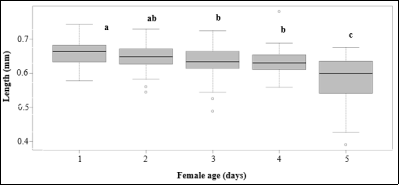
Figure 1. Mean size (mm) of Spermophagus niger eggs by female age. Bars represent means; error bars correspond to standard errors. Different alphabetic letters on the error bars indicate significant differences between means according to Fischer’s LSD test at the 5% threshold.
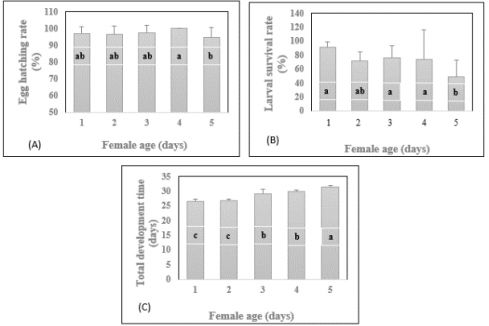
Figure 2. Effect of female age on the reproductive performance of Spermophagus niger (A: mean egg hatchability (%); B: mean larval survival rate (%); C: mean development time (days)). Bars correspond to means, and error bars correspond to standard errors. Different alphabetic letters above the bars indicate significant differences between the means according to Fischer’s LSD test at the 5% significant level.
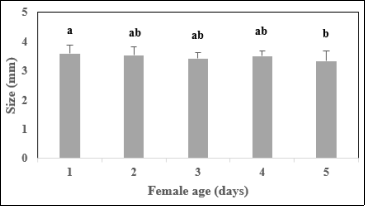
Figure 3. Effect of female age on the mean size (mm) of emerged Spermophagus niger adults. Bars correspond to means, and error bars correspond to standard errors. Different alphabetic letters above the bars indicate significant differences between the means according to Fischer’s LSD test at the 5% significant level.
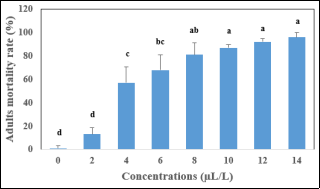
Figure 4. Effect of Cymbopogon nardus essential oil on adult Spermophagus niger after 24 hours of exposure in 1-liter glass jars. Bars correspond to means, and error bars correspond to standard errors. Different alphabetic letters above the bars indicate significant differences between the means according to Fischer’s LSD test at the 5% significant level.
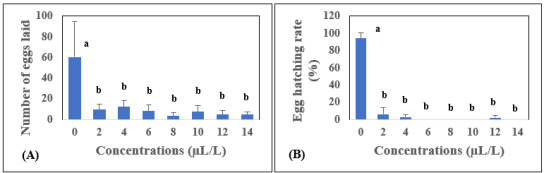
Figure 5. Effect of Cymbopogon nardus essential oil on the number of eggs laid (A) and the hatching rate (B) in Spermophagus niger after 24 hours of exposure in 1-liter glass jars. Bars correspond to means, and error bars correspond to standard errors. Different alphabetic letters above the bars indicate significant differences between the means according to Fischer’s LSD test at the 5% significant level.

Information


 Share This Article
 Twitter
 Linked In
 Facebook
 Copy
Copy Download