Research Article | | Peer-Reviewed

Research on Revitalization Strategies for Existing Commercial Real Estate Assets: A Case Study of Company A

Received: 23 October 2025     Accepted: 5 December 2025     Published: 27 December 2025
Views:       Downloads:
Abstract

After years of development, China's real estate industry has seen the commercial real estate market gradually become saturated, with the market experiencing overdevelopment and excess capacity. Commercial real estate companies lack the ability to offload and revitalize assets. Therefore, revitalizing existing assets to make commercial real estate more competitive and adapt to changing market demands has become a widely concerned issue in the industry. This study takes Company A as an example, through research and analysis, this paper summarizes various problems existing in the revitalization of commercial real estate assets, including defects in initial planning and design, difficulties in asset transformation, high vacancy rates, high capital demands, discrepancies between expectations and actual results, and challenges in property management. This study takes Company A as a case example to examine the lessons learned from revitalizing existing commercial real estate assets, primarily focusing on the following aspects: (1) summarizing the management challenges encountered by Company A in the process of commercial real estate revitalization; (2) proposing feasible solutions for revitalizing existing commercial real estate assets; and (3) exploring strategies and methods for revitalizing existing commercial real estate assets to identify optimal solutions, thereby providing useful references for the industry. Based on the analysis, show the company has achieved asset appreciation through precise market positioning analysis, adjustment of new business formats, optimization of rental strategies, operational management enhancement, and asset securitization measures. This paper takes the specific management practices of Company A as a case study, conducts a detailed data-driven analysis of the effectiveness in revitalizing commercial real estate assets, and provides certain references for the revitalization of existing assets in other commercial real estate projects.

Published in American Journal of Management Science and Engineering (Volume 10, Issue 6)
DOI 10.11648/j.ajmse.20251006.16
Page(s) 169-176
Creative Commons

This is an Open Access article, distributed under the terms of the Creative Commons Attribution 4.0 International License (http://creativecommons.org/licenses/by/4.0/), which permits unrestricted use, distribution and reproduction in any medium or format, provided the original work is properly cited.

Copyright

Copyright © The Author(s), 2025. Published by Science Publishing Group

Keywords

Commercial Real Estate, Existing Assets, Revitalization Strategies, Asset Securitization

1. Research Background
1.1. Research Background
In recent years, unlocking the value of existing commercial real estate assets has emerged as a key industry focus, playing a pivotal role in restructuring and advancing the sector.
Many regions across China are accelerating the rollout of policies focused on revitalizing existing land and real estate resources, promoting the optimization of the real estate market supply structure, the renewal of industrial spaces, and the high-quality development of cities. Governments have established coordination mechanisms, flexibly adopted various approaches to advance implementation, and strengthened support through supporting policies . The government encourages the renovation and redevelopment of aged commercial properties to enhance their utilization efficiency and added value. To guide investors and developers in participating in urban renewal, corresponding support policies such as land and tax incentives are provided. Through fiscal subsidies, tax reductions, and fee exemptions, the government promotes the transformation and upgrading of commercial real estate enterprises, thereby increasing the added value and competitiveness of commercial properties . The state also promotes cross-sector collaboration and innovation in commercial real estate, while guiding financial institutions to support its revitalization. Under the current market conditions, the revitalization of commercial real estate stock assets faces multiple challenges: declining market demand, financial strain on developers, high transformation difficulty, poor tenant stability, geographical constraints, and project complexity.
1.2. Research Significance
The study of strategies for commercial real estate stock revitalization carries considerable theoretical value and practical implications. The revitalization of existing stock in commercial real estate is of great significance for enhancing asset value, optimizing resource allocation, and promoting regional economic development. Real estate resources are not only economic assets for enterprises but also crucial elements related to the future development of cities .
This paper, through a specific case study, provides a detailed analysis of the strategies and methods employed by Company A to revitalize its commercial real estate stock assets. As these strategies and methods are derived from practical experience, they can help fill the theoretical gap in this field. The related commercial practices can also offer valuable insights for the industry.
By revitalizing stock assets, commercial real estate enterprises can better adapt to market changes, enhance their market competitiveness, and achieve brand value elevation and business model innovation.
From a societal perspective, the revitalization of commercial real estate stock assets can contribute to urban environmental improvement, promote the aggregation and efficient utilization of urban resources, and drive economic development.
2. A Case Study in Stock Asset Revitalization: An Overview of Company A
2.1. Overview and Present Development of Company A
Founded in 1993, Company A underwent a restructuring and was listed on the Shanghai Stock Exchange on April 16, 2015. Its stock was subsequently delisted on June 6, 2023.
Headquartered in Chengdu, Sichuan Province, Company A primarily operates in the business services industry. The company oversees a portfolio of more than 390 controlling and participating interests, with its business layout spanning real estate, digital construction, internet technology, and beverage sectors.
The revitalization of Company A's commercial real estate stock assets faces numerous difficulties and challenges. These are primarily reflected in the following aspects: the existing assets suffer from issues such as aging, functional obsolescence, or poor maintenance; market demand for specific types of commercial real estate has declined, impacting the ability to revitalize stock assets and achieve investment returns; revitalizing these assets requires additional financing support, increasing financial pressure; effective management and execution capabilities are essential for the revitalization process; and during the revitalization, there may be legal and regulatory constraints related to land use rights, environmental protection, urban planning, and building permits.
2.2. Company a Project Analysis
2.2.1. Introduction to the Project
Crown International is the premier commercial-residential complex in Southern Beijing, boasting a highly developed transportation network. It is a vibrant community that seamlessly integrates a BLOCK-style commercial street, an international five-star hotel, upscale serviced apartments, high-end offices, and an IMAX cinema.
2.2.2. Analysis of the Project
Project Positioning:
The Phase I, II, and III developments of Company A's Haiyue City project are conceived as an integrated organic entity, positioned to evolve into a comprehensive and dynamic new community. The specific positioning strategy is delineated as follows:
Overall Property Positioning:
a) An industrial development platform;
b) A business exchange hub;
c) A commercial support service platform;
d) A residential support facility platform.
Office Space Positioning:
a) Multi-format office spaces supporting work-life integration;
b) High-quality, cost-effective headquarters offices;
c) Provision of premises for community-serving micro and small enterprises;
d) Generation of new demand for flexible office solutions in the region.
Commercial Space Positioning:
a) A multi-functional service-oriented vibrant district, establishing a new urban landmark for cultural and leisure activities;
b) Creation of new experiences in regional dining and cultural events;
c) Emphasis on comprehensive life and business service.
Residential Apartment Positioning:
a) Diversified categories of professionally operated quality apartments addressing long-term rental demand in the region;
b) Primarily small and medium-sized units, strategically targeting young demographic segments;
c) Senior housing facilities catering mainly to independent and semi-independent elderly populations, fostering interactive community environments for older adults.
2.3. Implementation Strategy
2.3.1. Placement and Adjustment of New Business Formats
1. Reasons for the New Business Format Layout Adjustment
Following the mobilization of the architectural design team for the Crowne Plaza Hotel, communication regarding the intensive block planning for the hotel functions in Building #1 commenced. Due to the building's height restriction of 24 meters and the requirement to meet five-star hotel standards, the resulting room layout accommodated approximately 138 guest rooms. This quantity rendered the hotel's operation and investment return economically unviable.
Table 1. Business Format Layout of the Adjusted Plan.

Category

Area(m²)

Percentage

Category

Area(m²)

Percentage

Crowne Plaza Hotel

15489.51

18.00%

Crown Apartments

10301.46

12.00%

Holiday Inn Express

9730.89

11.30%

Grade A Office Tower

13539.28

15.70%

Holiday Apartments

31032.67

36.10%

Neighborhood Retai

5901.25

6.90%

Source: Proprietary data and analysis
2. Adjusted Plan
On one hand, the company's technical team, the design firm, and the IHG Design Team collaborated to optimize the building's floor-to-ceiling height based on project feasibility, aiming to increase the number of rooms to meet operational requirements.
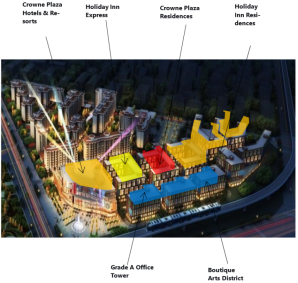
On the other hand, additional analysis was conducted to study the business format layout adjustment. The decision was made to reassign the metrics of Building #2-1 to the Crowne Plaza Hotel, while the Holiday Inn Express Hotel was repositioned based on the revised architectural conditions.
The scheme is based on the project's original planning, presenting a traditional business format layout that encompasses hotel, apartment, office, and retail formats. It is essential to focus on the provision of public services and the development of public spaces in the revitalization of entire districts, so as to fully unlock the comprehensive value of spatial resources and assets .
Figure 1. Layout of the Proposed Scheme Source: Proprietary data and analysis.
3. Effectiveness of the Adjustments
1) Operating Pricing and Occupancy Rate Forecast
Table 2. Operating Pricing and Occupancy Rate Forecast.

Category Mix

Total GFA

Y1 Rate

Y1 Occupancy

Crowne Plaza Hotel

15489.51

¥800/room/night

0.5

Holiday Inn Express

9730.89

¥450/room/night

0.6

Crown Apartments

31032.67

¥118/m²/month

0.65

Holiday Apartments

10301.46

¥128/m²/month

0.6

Grade A Office Tower

13539.28

¥120/m²/month

0.6

Neighborhood Retai

5901.25

¥150/m²/month

0.7

Back of House

5600

-

-

Service Area

2500

-

-

Serviced Apartment Amenities

2000

-

-

Total

96095.06

-

-

2) Revising the Commercial Layout
Table 3. Operational Performance Forecast for Project Format Adjustments.

Revenue vs. Budget (To 2030)

Cost vs. Budget (To 2030)

Profit vs. Budget (To 2030)

Avg. Profit vs. Budget (2022-2030)

Crowne Plaza Hotel

43348

42909

439

49

Holiday Inn Express

32807

26421

6386

639

Holiday Apartments

43433

29461

13972

1397

Crown Apartments

17095

12001

5094

509

Grade A Office Tower

20249

12230

8019

802

Retail District

11249

3320

7929

793

Total

168181

126343

41839

4189

Source: Proprietary data and analysis
3) Project Format Repositioning Cost
Table 4. Direct Cost Breakdown for Project A.

No.

1

2

3

4

5

6

7

Total

Name

Crowne Plaza Hotel

Holiday Inn Express

Crown Apartments

Holiday Apartments

Business Office

Commercial Street

Service/ Support Area

Area (m²)

15490

9731

10301

33033

13539

5901

8100

96095

Original Construction Cost/m²

6163

8398

8395

8368

7208

4160

4765

Original Direct Cost (Discounted)

9546

8172

8648

27642

9759

2455

3860

70082

New Unit Price (rmb/m²)

12957

12448

12927

11094

8748

5526

7565

Construction Cost

20070

12113

13316

36646

11844

3261

6128

103378

Land Cost

9272

5825

6166

19774

8104

3532

4849

57522

Period Costs

3335

2095

2218

7112

2915

1270

1744

20689

Total

32678

20033

21700

63532

22863

8063

12720

181590

Increase vs. Original Target: 339M

Source: Proprietary data and analysis
4) Valuation of Project Business Format Adjustment
Table 5. Schedule of Master Plan Valuation Unit: 10,000 CNY.

Category

GFA (m²)

Valuation

Cost (Incl. Retrofit)

Premium

hotel

25220.4

53711

53711

0

Holiday Apartments

33032.67

81782

62532

19250

Crown Apartments

10301.46

28944

21700

7244

Retail District

5901.25

18758

8063

10695

Grade A Office Tower

13539.28

35409

22863

12546

total

87995.06

218605

168869

49736

Source: Proprietary data and analysis
Due to the change in the assessed area, the project's valuation has appreciated by approximately RMB 497 million after-tax, under equivalent leasing market conditions.
2.3.2. Rental Strategy Optimization
1) Optimization Principles
The strategy aims to enhance the value of lower-value shops by considering both the shop layout and the sales mix of business formats.
2) Rental Pricing
The base rent for standard office space is set at RMB 120 per square meter per month. For co-working spaces, the base rent is RMB 3,000 per workstation per month. Rental incentives are offered for tenants requiring large areas and long lease terms, complemented by a range of value-added services.
3) Rental Growth Targets
Under this strategy, the project's rental income targets from 2020 to 2024 are RMB 500,000, RMB 600,000, RMB 700,000, RMB 1.5 million, and RMB 2.5 million, respectively. The 2024 target represents a fourfold increase compared to 2020.
2.3.3. Management and Operations Optimization
Despite numerous challenges in repositioning commercial real estate portfolios, property management can achieve greater success by adopting a multifaceted approach encompassing specialized teams, financial resources, technology, tenant relations, compliance, and market strategies.
1) Customer Strategy
Leveraging technology, we provide attentive, round-the-clock concierge services. We also conduct a variety of offline activities to sustain high customer engagement and interest.
2) Partner Strategy
We collaborate with premium brands like URWORK, Gome Electric, NetEase Yanxuan, CaYiCa Brand, and Didi Bus, elevating our business offerings to meet a wide spectrum of customer needs.
3) Employee Optimization Strategy
A sound organizational structure and efficient, professional operations form the foundation for delivering premium services to our clients.
Project A Serviced Apartments Staffing:
Total Staff: 159
Serviced Apartments: 500 units
Staff-to-Unit Ratio: 1:0.3
2.3.4. Asset-Backed Securitization
In 2022, the General Office of the State Council of China issued the Guiding Opinions on Further Revitalizing Existing Assets to Expand Effective Investment (hereinafter referred to as the "Guiding Opinions"). The Guiding Opinions proposed initiatives to promote the healthy development of Real Estate Investment Trusts (REITs) in the infrastructure sector, precisely and effectively support the development of new projects, and strengthen complementary funding support.
The issuance of infrastructure REITs can help enterprises lower their debt-to-asset ratio and optimize their financial structure. By establishing a closed-loop process of "investment, financing, management, and exit," it revitalizes existing assets and supports enterprises in transitioning to an asset-light operation model. For the capital-intensive cultural and tourism industry, the effective application of infrastructure REITs is of great significance in promoting high-quality development within the sector . The introduction of infrastructure REITs creates a trading market for vast existing assets, enhancing liquidity and revitalizing these holdings. It provides local governments and property operators with an exit channel, reducing their leverage, while dispersing risk across the economy through public offerings.
On April 3, 2020, Company A announced that its subsidiary, Chengdu A Jiaxin Asset Management Co., Ltd., would establish an office property quasi-REITs plan to conduct asset securitization, appointing China Merchants Wealth as the issuer .
First, the project benefits from an exceptional credit enhancement entity. Company A holds a AAA issuer credit rating, providing substantial capacity to withstand cash flow volatility risks. It is an industry leader in performance, with full-caliber sales exceeding RMB 100 billion in 2019, and maintains a sound financial position.
Second, the issuance features favorable terms. With a total scale of RMB 1.065 billion and an expected tenor of 19 years (subject to open every three years), the tranche coupons are set at 6.0% for Senior A, 6.5% for Senior B, and 6.8% for Senior C. The weighted average coupon is 6.39%, effectively reducing the company's financing costs.
Third, the underlying asset is high-quality office property held by Company A. The property is valued at RMB 1.065 billion, approximately 3.33 times the issuance size of the Senior A asset-backed securities. The operating cash flow generated by the underlying asset is robust and is projected to grow at 4% annually from 2021 onward.
Fourth, comprehensive risk management measures significantly support this issuance. Company A's quasi-REITs structure incorporates multiple credit enhancement mechanisms to mitigate potential risks. These include a senior/subordinated structure, property asset mortgage, over-collateralization of operating cash flow, liquidity support arrangements, and a deficiency undertaking commitment from Company A, all serving to protect investor interests.
Fifth, this transaction represents an exploration of asset securitization under a "light-asset" model. Through REITs, the separation of asset-light and asset-heavy components is achieved. The asset-heavy portion fully unleashes property value, recovers capital, and improves Return on Equity (ROE), thereby enabling the sustained cycle of investment in and development of more high-quality projects. In recent years, through its light-asset output model, Company A's Culture, Commerce & Tourism Group has achieved long-term, sustained, and stable incremental returns via its full-cycle asset management services covering fundraising, investment, construction, management, and exit. Moving forward, the group will actively participate in issuing various securitization products, utilizing diversified financing tools to support business growth. It also aligns with national policies by adopting standardized products to continuously lower financing costs and accumulate stronger capital capacity.
3. Conclusion
3.1. Summary
The revitalization of existing commercial real estate assets plays a vital role not only in maximizing asset value and increasing revenue streams, but also in driving economic development, enhancing urban image, optimizing resource utilization, as well as promoting urban renewal and sustainable development. The core logic of revitalizing existing assets lies in asset operation. As forward-looking asset owners, they can categorize, plan, and position existing assets through precise market analysis and operational planning, thereby facilitating transformation and management in the cultural, commercial, and tourism sectors . Taking Company A as an example, by accurately identifying its market positioning, adjusting its business format mix, optimizing rental strategies, and improving management and operational efficiency, it has successfully revitalized its stock of commercial real estate assets, providing valuable experience for the industry.
3.2. Suggestions
3.2.1. Proposals for Introducing New Business Models
Introducing new business formats is a key strategy for revitalizing commercial real estate, as it can inject new vitality and appeal into existing assets. Shao Keyi stated that introducing new business formats and models into existing commercial properties can help meet market demand through emerging industries. Below are some recommendations for introducing new business formats:
1) Developing diversified business models
2) Introducing innovative technology-driven formats
3) Emphasizing cultural and creative industries
4) Incorporating community service formats
5) Focusing on sustainable development models
6) Encouraging cross-industry collaboration and innovation
3.2.2. Suggestions for Renovation and Upgrading
In the operation of commercial real estate, each project possesses unique characteristics and market demands. It is essential to select and combine targeted revitalization strategies based on the specific conditions of the project.
When choosing and integrating revitalization strategies, the following points should be emphasized. Firstly, the distinctive features of the project and market demands must be thoroughly considered to ensure the effectiveness and feasibility of the strategies. Secondly, innovation should be prioritized, with continuous exploration of new models and methods to adapt to evolving market dynamics and changing demands. Thirdly, attention must be paid to implementation and execution to guarantee that the strategies are effectively carried out and advanced.
3.2.3. Revitalization and Repositioning Suggestions
First, gain an in-depth understanding of the needs and preferences of target consumers to carry out brand upgrades and differentiated positioning. Second, enrich the business mix of the commercial property by introducing new formats and brands to attract more consumers and tenants. Third, strengthen cooperation with surrounding communities and the city to enhance the social value and influence of the commercial property. Fourth, optimize property management and services to improve tenant satisfaction and loyalty, thereby increasing stable revenue for the commercial property. Finally, enhance market research and data analysis to stay abreast of market changes and trends, providing robust support and assurance for the transformation and upgrading of the commercial property.
3.2.4. Management Optimization Recommendations
The revitalization and management optimization of commercial real estate requires a comprehensive consideration of factors such as tenant management, facilities and service levels, data-driven decision-making, brand image, collaboration and synergy, and user experience. Below are specific recommendations for the revitalization and management optimization of commercial real estate:
Strengthen tenant management, develop customized leasing strategies, enhance facilities and services, introduce a capable property management team, establish a strong brand image, foster collaboration and synergy, and prioritize user experience.
3.2.5. Asset Securitization Recommendations
Asset securitization can revitalize existing assets to a certain extent. After enterprises issue asset securitization products, their credit risk is reduced, and their operating performance and corporate value are enhanced [10].When implementing securitization to revitalize commercial real estate inventory assets, it is essential to carefully consider various factors and select the appropriate asset revitalization methods.
1) Asset Portfolio Optimization: Conduct a comprehensive evaluation and analysis of the commercial real estate inventory assets to identify those with potential and value.
2) Asset Restructuring and Packaging: Reorganize and package different types, geographic locations, or risk levels of commercial real estate assets to form a diversified asset pool.
3) Asset Rating and Tranching: Rate and tranche the asset pool, dividing it into different categories of securities based on varying levels of risk and return.
4) Issuance of Securitized Products: Issue corresponding commercial real estate asset-backed securities based on the rating and tranching results of the asset pool.
5) Optimized Capital Utilization: Through commercial real estate securitization, assets can be effectively revitalized to achieve optimal use of capital.
6) Asset Management and Operation: Implement professional asset management and operational practices for the commercial real estate securitized products.
Abbreviations

IHG

InterContinental Hotels Group

GFA

Gross Floor Area

Y1

First Year

Avg

Average

REITs

Real Estate Investment Trusts

ROE

Return on Equity

Conflicts of Interest
The authors declare that they have no competing interests.
References
[1] Li Hui, Song Shujie. Analysis of Policies and Pathways for Revitalizing State-Owned Enterprises' Existing Assets [J]. Aviation Finance and Accounting. 2023, 5(04): 8-11.
[2] Yan Min. Main Problems and Countermeasures in Asset Management of State-Owned Enterprises. Enterprise Reform and Management, 2022, 2(3), 37-39.
[3] Chen Ri. Revitalization of Existing Assets: Theoretical Framework and Practical Exploration—A Case Study of a District-Owned State Enterprise [J]. Shanghai Real Estate. 2025, (05): 11-15.
[4] Lu Fangfang. Research on the Update Policies of Existing Industrial Land in Shanghai: Process, Practice, and Recommendations [J]. Shanghai Real Estate. 2025, (11): 29-34
[5] Liu Liang. Research on the Industrial Real Estate Development Strategy of Company Z under the Asset-Light Model (Master's thesis). Northeast Agricultural University. 2021,
[6] Liao Haibo. Difficulties and Countermeasures for Cultural and Tourism Enterprises Issuing REITs [J]. Construction Economy. 2025, 46(07): 54-58,
[7] Zhao Qi.Research on the Implementation Strategies and Practice of Commercial Real Estate REITs in the Chinese Market [J]. China Journal of Commerce. 2025, 34(08): 119-122.
[8] Huang Qiang, Kan Weinan. Exploring New Approaches to Revitalizing State-Owned Enterprises' Idle Assets through Cultural-Commercial-Tourism Integration [J]. Enterprise Reform and Management. 2025, (02): 154-156.
[9] Shao Keyi and Chen Sujuan. Exploring Effective Strategies for State-Owned Enterprises to Revitalize Inventory Assets. Enterprise Reform and Management, 2019, 5(7), 170+176.
[10] Zhu Xiaoneng, Su Hao, Hao Yijun. Revitalizing Existing Assets through Asset Securitization: From a Micro-Enterprise Perspective [J]. World Economy. 2022, 45(10): 160-184.
Cite This Article
  • APA Style

    Li, L., Liu, W. (2025). Research on Revitalization Strategies for Existing Commercial Real Estate Assets: A Case Study of Company A. American Journal of Management Science and Engineering, 10(6), 169-176. https://doi.org/10.11648/j.ajmse.20251006.16

    Copy | Download

    ACS Style

    Li, L.; Liu, W. Research on Revitalization Strategies for Existing Commercial Real Estate Assets: A Case Study of Company A. Am. J. Manag. Sci. Eng. 2025, 10(6), 169-176. doi: 10.11648/j.ajmse.20251006.16

    Copy | Download

    AMA Style

    Li L, Liu W. Research on Revitalization Strategies for Existing Commercial Real Estate Assets: A Case Study of Company A. Am J Manag Sci Eng. 2025;10(6):169-176. doi: 10.11648/j.ajmse.20251006.16

    Copy | Download

  • @article{10.11648/j.ajmse.20251006.16,
      author = {Lulu Li and Wenjuan Liu},
      title = {Research on Revitalization Strategies for Existing Commercial Real Estate Assets: A Case Study of Company A},
      journal = {American Journal of Management Science and Engineering},
      volume = {10},
      number = {6},
      pages = {169-176},
      doi = {10.11648/j.ajmse.20251006.16},
      url = {https://doi.org/10.11648/j.ajmse.20251006.16},
      eprint = {https://article.sciencepublishinggroup.com/pdf/10.11648.j.ajmse.20251006.16},
      abstract = {After years of development, China's real estate industry has seen the commercial real estate market gradually become saturated, with the market experiencing overdevelopment and excess capacity. Commercial real estate companies lack the ability to offload and revitalize assets. Therefore, revitalizing existing assets to make commercial real estate more competitive and adapt to changing market demands has become a widely concerned issue in the industry. This study takes Company A as an example, through research and analysis, this paper summarizes various problems existing in the revitalization of commercial real estate assets, including defects in initial planning and design, difficulties in asset transformation, high vacancy rates, high capital demands, discrepancies between expectations and actual results, and challenges in property management. This study takes Company A as a case example to examine the lessons learned from revitalizing existing commercial real estate assets, primarily focusing on the following aspects: (1) summarizing the management challenges encountered by Company A in the process of commercial real estate revitalization; (2) proposing feasible solutions for revitalizing existing commercial real estate assets; and (3) exploring strategies and methods for revitalizing existing commercial real estate assets to identify optimal solutions, thereby providing useful references for the industry. Based on the analysis, show the company has achieved asset appreciation through precise market positioning analysis, adjustment of new business formats, optimization of rental strategies, operational management enhancement, and asset securitization measures. This paper takes the specific management practices of Company A as a case study, conducts a detailed data-driven analysis of the effectiveness in revitalizing commercial real estate assets, and provides certain references for the revitalization of existing assets in other commercial real estate projects.},
     year = {2025}
    }
    

    Copy | Download

  • TY  - JOUR
    T1  - Research on Revitalization Strategies for Existing Commercial Real Estate Assets: A Case Study of Company A
    AU  - Lulu Li
    AU  - Wenjuan Liu
    Y1  - 2025/12/27
    PY  - 2025
    N1  - https://doi.org/10.11648/j.ajmse.20251006.16
    DO  - 10.11648/j.ajmse.20251006.16
    T2  - American Journal of Management Science and Engineering
    JF  - American Journal of Management Science and Engineering
    JO  - American Journal of Management Science and Engineering
    SP  - 169
    EP  - 176
    PB  - Science Publishing Group
    SN  - 2575-1379
    UR  - https://doi.org/10.11648/j.ajmse.20251006.16
    AB  - After years of development, China's real estate industry has seen the commercial real estate market gradually become saturated, with the market experiencing overdevelopment and excess capacity. Commercial real estate companies lack the ability to offload and revitalize assets. Therefore, revitalizing existing assets to make commercial real estate more competitive and adapt to changing market demands has become a widely concerned issue in the industry. This study takes Company A as an example, through research and analysis, this paper summarizes various problems existing in the revitalization of commercial real estate assets, including defects in initial planning and design, difficulties in asset transformation, high vacancy rates, high capital demands, discrepancies between expectations and actual results, and challenges in property management. This study takes Company A as a case example to examine the lessons learned from revitalizing existing commercial real estate assets, primarily focusing on the following aspects: (1) summarizing the management challenges encountered by Company A in the process of commercial real estate revitalization; (2) proposing feasible solutions for revitalizing existing commercial real estate assets; and (3) exploring strategies and methods for revitalizing existing commercial real estate assets to identify optimal solutions, thereby providing useful references for the industry. Based on the analysis, show the company has achieved asset appreciation through precise market positioning analysis, adjustment of new business formats, optimization of rental strategies, operational management enhancement, and asset securitization measures. This paper takes the specific management practices of Company A as a case study, conducts a detailed data-driven analysis of the effectiveness in revitalizing commercial real estate assets, and provides certain references for the revitalization of existing assets in other commercial real estate projects.
    VL  - 10
    IS  - 6
    ER  - 

    Copy | Download

Author Information