Research Article | | Peer-Reviewed

Unravelling Motivational Trajectories: A Retrodictive Study of Underachieving EFL Learners in Chinese Universities

Received: 16 May 2026     Accepted: 29 May 2026     Published: 18 June 2026
Views:       Downloads:
Abstract

This study explores the dynamic changes in second language (L2) motivation and their underlying causes among underachieving English as a foreign language (EFL) learners in Chinese universities. Grounded in CDST, the research employs methodological triangulation—combining retrospective motivational trajectory graphs, semi-structured interviews, and written narratives—to investigate three non-English major underachievers from top-tier Chinese universities. The findings revealed that the motivational trajectories of these learners exhibited four core characteristics: non-linearity, complexity, dynamics, and self-organization. Furthermore, their motivation levels were significantly influenced by a continuous interplay of internal and external factors, primarily categorized into the L2 learning environment, attribution, and social and parental influence. The study highlights that underachievers often rely on external pressures (e.g., high-stakes exams) for temporary motivational boosts, but suffer from a lack of sustained intrinsic drive due to low self-confidence, ineffective learning strategies, and a critical lack of perceived value in English learning. Based on these insights, the study offers targeted pedagogical implications for students, teachers, parents, and institutions to collaboratively foster sustainable L2 motivation and improve English proficiency. This research broadens the understanding of L2 motivational dynamics among underrepresented learner groups and provides practical guidance for educational interventions.

Published in English Language, Literature & Culture (Volume 11, Issue 2)
DOI 10.11648/j.ellc.20261102.14
Page(s) 45-56
Creative Commons

This is an Open Access article, distributed under the terms of the Creative Commons Attribution 4.0 International License (http://creativecommons.org/licenses/by/4.0/), which permits unrestricted use, distribution and reproduction in any medium or format, provided the original work is properly cited.

Copyright

Copyright © The Author(s), 2026. Published by Science Publishing Group

Keywords

Motivation, Complex Dynamic Systems Theory, Underachieving Learners

1. Introduction
Within the context of globalisation and information technology, English is increasing in prominence as a lingua franca, influencing academic research, international trade, and cross-cultural communication. In China, according to the Guidelines for College English Teaching , most non-English majors should achieve basic competencies by the time they graduate from undergraduate programmes, including proficiency in basic English listening, speaking, reading, writing, and translation skills, as well as the ability to handle daily life and general academic communication tasks. Nevertheless, some students still face significant difficulties learning the language, as evidenced by their failure to meet the university’s graduation requirements for English language proficiency (such as passing compulsory English courses and the College English Test Band 4). This negatively affects students’ academic performance and their prospects for graduation, while also hindering their competitiveness in job markets.
Motivation, an important individual difference in second language learning, has attracted considerable scholarly attention for decades. The concept of motivation has developed from an early social psychological perspective into a multidimensional and dynamic framework, in which CDST provides a new theoretical foundation for studying second language (L2) motivation. This theory suggests that L2 motivation is a complex system shaped by multiple elements, such as the learner’s individual traits, educational context, and social and cultural background, all of which are interconnected and constantly evolving. Therefore, to fully understand the development and shifts in L2 motivation, it is crucial to adopt a dynamic and systematic analytical approach.
Despite growing recognition of motivation as a crucial factor in L2 learning and the adoption of dynamic frameworks such as CDST, significant gaps remain in understanding the motivational dynamics of Chinese L2 learners. Existing research mainly focuses on high-achieving learners; little attention has been paid to the L2 motivation of underachieving learners (i.e., those who fail to meet the language requirements for college graduation in this study) in Chinese universities. Furthermore, some existing studies lack methodological triangulation, such as incorporating narrative methods to complement interviews and gain deeper insights into motivational changes. To fill these gaps, this study employs a retrospective graphing approach, combining interviews and narrative analysis within the CDST framework, to systematically explore the motivational trajectories and influencing factors among underachieving EFL learners in Chinese universities, providing a more comprehensive understanding of their distinct challenges.
2. Literature Review
2.1. L2 Motivation
Motivation theory has evolved from a social perspective to a cognitive and process-oriented research paradigm and has been integrated with self-systems theory to produce a more complex theoretical framework in SLA research. The early stages of bilingual motivation research were largely influenced by social psychology. The theory of L2 motivation was first proposed by Canadian scholars Gardner and Lambert , who regarded the motivation to learn the language of the other community as a primary force that can enhance or hinder intercultural communication. Later, Gardner defined L2 motivation as ‘the combination of effort plus desire to achieve the goal of learning the language plus favourable attitudes towards learning the language.’ Motivation was once thought to be a static mental or emotional state or a drive to achieve a goal.
By the end of the twentieth century, researchers argued that motivation was more than an external stimulus to behaviour and involved a variety of psychological processes that initiated and sustained action. Pintrich and Schunk defined motivation as ‘the process whereby goal-directed activity is instigated and sustained.’ Self-determination theory divides motivation into intrinsic and extrinsic forms and highlights how autonomy, competence, and relatedness affect motivation and action.
L2 motivation research has shifted to a process-oriented paradigm in the 21st century, focusing on changes in motivation and the factors that shape them during learning. Motivation in a single class can shift in response to task difficulty, teacher feedback, or peer interaction , as well as to external pressures, learning challenges, or a lack of support . Process-oriented research has also examined how internal factors such as goal setting and self-regulation , and external factors such as teacher behaviour and the learning environment affect motivation. The L2 Motivational Self System by Dörnyei and Ushioda emphasises that motivation is influenced by the “Ideal L2 Self” (the learner’s vision of their future self as fluent in the second language).
Following the introduction of CDST into the field of applied linguistics, motivation research has paid greater attention to other characteristics of motivational systems, such as dynamics and non-linearity. This new perspective represents the latest direction in motivation research. This research follows Ellis and Larsen-Freeman ’s description of motivation as a fluid experience that occurs when the learner is in a complex world of dynamic change, where many internal and external influences interact.
2.2. Complex Dynamic Systems Theory
Complex Dynamic Systems Theory (CDST) is an interdisciplinary theoretical framework for studying the dynamics of complex systems. The humanities and social sciences have used CDST since the 20th century . CDST was first introduced to the field of applied linguistics by Larsen-Freeman . CDST studies systems with resources that contribute to and deplete one another, driving system change and development. In 2014, Dörnyei, MacIntyre, and Henry ’s landmark book Motivational Dynamics in Language Learning explicitly included CDST in the landscape of L2 motivation research.
Characteristics of CDST include non-linearity, complexity and dynamics, self-organisation, and adaptation .
The “non-linearity” property of CDST is that system variables vary in a non-linear and proportionate manner, i.e., the sum of the changes of each section does not equal the overall development . In particular, system factors and their degrees of action are unpredictable, and L2 motivation changes are non-linear. A minor occurrence, like a successful classroom presentation or a negative assessment, can motivate a student. Motivation might change suddenly. A student may abruptly get demotivated after a failure and then feel motivated after passing an important exam.
Complex dynamic systems develop and change over time, meaning their factors, relationships, and ratios evolve. SLA development is complicated and ever-changing, with heterogeneous, external and internal components interacting. The interaction of heterogeneous elements determines the complex trajectory of SLA development . As Hao said, “this may suggest that certain L2 learners have strong motivational states, while others have lower ones, which may alter owing to internal and environmental influences”.
The system self-organises without external intervention, creating an unanticipated order from its constituents . In L2 motivation, internal and external components, such as learners’ beliefs, emotions, attitudes, goals, needs, and external environments, contribute to a natural, orderly state of motivation through complex interactions .
CDST is ideal for modelling L2 motivational dynamics since it is a dynamic, open system that changes continually under numerous circumstances and has non-linear development. Instead of linear causality research, CDST research focuses on motivation development and change, intrinsic and extrinsic factors and their correlations, and the characteristics of motivational dynamics, factors, and system-environment interaction .
2.3. Studies on L2 Motivation from CDST
Most CDST-based L2 motivation research stresses that internal and external factors influence motivation.
Intrinsic factors include self-efficacy , attributions , interest , ideal L2 self , ought-to L2 self , learning experience , etc. Individual learners’ psychological, emotional, and cognitive traits affect their motivation and change. Busse and Walter examined a generalized decline in motivation levels of 142 British learners of German after one year, mainly due to reduced levels of intrinsic motivation and self-efficacy. Song and Kim found that goal awareness (e.g., passing examinations or advancing one's career) affected learners’ motivation. High self-efficacy helped learners stay motivated when overcoming learning difficulties, according to Chang and Zhang . Dai also found that Chinese university students’ intrinsic motivation (e.g., interest in English culture) was favourably associated with their motivation levels. Positive affective experiences (e.g., achievement) drove learners’ recovery of motivation, according to Hao .
Extrinsic factors contain the instructor’s teaching style , educational resources , study methods , social pressure , parental influence , and so on. The environment and culture in which students live affect their motivation indirectly. Dörnyei claimed that teaching styles and task design affect classroom motivation. Chinese high school students’ motivation fluctuated due to high-stakes exams like China’s college entrance exam, according to Chen et al. . Waninge et al. found that course, professors, and classroom environment affected fluctuations in four students’ micro-motivation over two weeks. Most Korean high school students are motivated by instructional methods, learning difficulty, social pressure, peer influence, and study strategies . Castro observed that “the language adviser had a pivotal role in disturbing this particular participant’s motivational system so that [students’] language learning trajectory could follow more favorable paths”. Chang and Zhang tracked five foreign language learners’ listening learning process for nearly three years and found that individual differences show up in the dynamic ebbs and flows of EFL listeners’ motivation, which is affected by both internal (e.g., learners’ goals) and external (e.g., learning contexts) factors. Dai used triangulation to show that interest, sense of achievement, future visions, language tools, and the environment affect good Chinese L2 learners’ motivation. Fu and Liu discovered that urban students were more motivated than rural students because they had more educational resources and social support.
From the CDST perspective, motivation comes from intricate interactions between internal and external elements. CDST provides a useful theoretical framework for analyzing these components’ dynamic interplay.
2.4. Research Gaps and Questions
While L2 motivation research has been fruitful, Chinese learners’ L2 motivation differs from that of other countries due to the Chinese environment and culture . Li discovered that Confucian ideals, including diligence, perseverance, and academic performance, affected Chinese students’ instrumental motivation for tests and vocational expectations. Thus, Chinese L2 learners must be taken into account. SLA research has concentrated on Chinese learners’ learning strategies and efficacy, but most studies have focused on high-achieving learners, with far less attention given to underachieving EFL learners. Among the existing studies on this topic , very few have explored their motivational trajectories based on the CDST.
In other respects of research methodology, there is a general lack of triangulation validation in related studies at home and abroad, especially in narrative research. The greater degree of freedom in the presentation of narrative research outputs helps explore in depth the wider range of factors that drive changes in motivation , complementing the interview findings and enabling cross-validation.
Therefore, this study focuses on underachieving EFL learners in Chinese universities as research participants. Based on the CDST, the study adopts the retrospective motivational trajectory graphs, combined with interviews and narratives for triangulation. The current study aims to answer the following research questions:
1. What are the characteristics of the motivational dynamics of underachieving EFL learners?
2. What influences the motivational dynamics of underachieving EFL learners?
3. Methodology
3.1. Participants
Three participants were purposively selected for the current study. They are underachieving EFL learners who share the following characteristics: (1) All of them study at top universities in China (“985 Project” universities), performed well in the college entrance exams, and possess normal Intelligence Quotient (IQ) levels with no physical defects. (2) They are all non-English major undergraduates. (3) Despite multiple attempts during their university years, they consistently scored below 425 on the CET-4, failing to meet the mandatory English proficiency requirement for graduation. It is important to note that the participants are classified as underachieving EFL learners based on their failure to meet the English proficiency requirements for graduation, which does not necessarily characterise their entire language-learning history. Though a three-participant sample is small, it is typical for qualitative case studies, and the main aim is to describe and interpret their unique motivational trajectories rather than generalise the findings. To protect participant privacy, pseudonyms were used in place of real names throughout this study. The basic information of the three study participants is shown in Table 1.
Table 1. Basic Information on the Research Subjects.

Participants

Major

Year

Highest CET-4 scores

A

Marine Chemistry

University year 3

411

B

Marketing

University year 3

376

C

Music Performance

University year 2

390

3.2. Instruments
This study combines three research methods: retrospective motivational trajectory graphs, interviews, and narratives. First, the research participants drew a motivational trajectory graph. Then, the author asked interview questions based on each participant’s retrospective graph and conducted the interviews. Finally, the participants described the process of English learning and the changes in L2 motivation, and completed the narratives.
3.2.1. Retrospective Motivational Trajectory Graphs
Within the framework of CDST, retrospective motivational trajectory graphs have become a common methodological approach in L2 motivation research For instance, Jung demonstrated the utility of such graphs in charting students’ motivational changes from kindergarten through college. Furthermore, these graphs are frequently combined with interviews and other methods to visually depict learners’ motivational development . The present study utilized similar graphs to examine changes in L2 motivation. To accurately capture these motivational dynamics, participants were asked to recall their past foreign language learning experiences and rate their L2 English motivation levels at various time points, ranging from the third grade of primary school to their third year of university. On these graphs, the horizontal axis represents the chronological time points, while the vertical axis indicates the motivation level on a scale of 1 to 6 (with higher scores reflecting stronger motivation).
3.2.2. Interviews
Semi-structured interviews were conducted to explore the underlying reasons for the L2 motivational fluctuations at key time points identified in the retrospective graphs. The interview protocols were individualized, with questions specifically tailored to each participant’s retrospective chart, such as “I noticed a sharp increase in your motivation on the graph during Grade 9. Can you describe what happened during that period?” and “What caused your motivation level to decline starting in your second year, and subsequently hit a peak during your third year?”. Each interview lasted between 20 and 30 minutes.
3.2.3. Narratives
Written narratives were employed for methodological triangulation to corroborate the data obtained from the graphs and interviews. Through the detailed reflections of the participants, the researcher sought to uncover additional, latent factors influencing their motivation. Participants were asked to write a 700-1000-word narrative detailing their L2 learning journey and changes in L2 motivation. These narratives centred on two primary prompts: (1) What specific person or event had the most profound impact on your L2 motivation? and (2) How did this affect your subsequent L2 motivation and learning trajectory?
3.3. Data Collection
All data collection sessions took place in a quiet, private room on an individual, one-on-one basis to minimize distractions and ensure confidentiality. To investigate L2 motivational changes, each participant was first asked to draw a motivational trajectory graph, mapping their motivation levels from the third grade of primary school (the onset of their English learning) to their junior year of university. Immediately following the drawing task, an interview was conducted using the participant's newly completed graph as a visual reference to guide the discussion. Prior to the interviews, participants were encouraged to share their genuine thoughts and experiences, with the assurance that there were no right or wrong answers. With the interviewees’ informed consent, all sessions were audio-recorded, and supplementary field notes were taken. One week later, the participants submitted their narrative essays, which served to triangulate and validate the findings from the graphs and interviews. By synthesizing the interview transcripts and narrative texts, the researcher identified and categorized the key factors influencing L2 motivation.
3.4. Data Analysis
The researcher manually transcribed the audio recordings and aligned the participants’ responses with the specific time points on their retrospective graphs. Following an initial examination of the fluctuations in the motivational graphs, the researcher analyzed the interview transcripts and narrative texts using Barkhuizen et al.’s thematic analysis framework. This approach was chosen to systematically categorize the factors influencing motivational changes in alignment with the research questions. Thematic analysis is a widely recognized qualitative method used for identifying, analyzing, and reporting patterns (themes) within a dataset. The process generally involves five iterative phases: familiarization with the data, generating initial codes, searching for themes, reviewing the themes, and defining and naming the themes.
The analysis commenced with repeated readings of the interview transcripts and narratives to identify salient patterns. For instance, Participant B’s remarks regarding a strict teacher diminishing their motivation were noted. Initial codes, such as “instructor’s personality” or “instructor’s teaching method,” were generated from these patterns. Subsequently, these codes were aggregated into broader themes, such as “learning environment,” which encompassed sub-themes like school facilities, study content, and study methods. These themes underwent an iterative review process to ensure they accurately reflected the dataset. Finally, the themes were clearly defined and substantiated with direct quotes from the participants to systematically address the research questions concerning motivational dynamics and their underlying determinants. This structured approach ensured a rigorous and transparent analysis of the qualitative data.
4. Results
4.1. Motivational Graphs
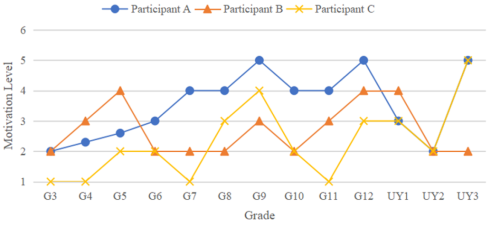
The retrospective motivational graph depicting the participants’ L2 motivational dynamics is presented in Figure 1. The horizontal axis represents the various time points (from Grade 3 to the third year of university), while the vertical axis indicates the motivation level on a scale of 1 to 6 (with higher scores representing greater motivation).
Note. X-axis labels: G3-G12 = Grade 3 to Grade 12; UY1-UY3 = University Year 1 to Year 3.

Download: Download full-size image

Figure 1. Motivational dynamics of the participants.
Figure 1 provides a detailed overview of the participants’ L2 motivational trajectories across different educational stages. During primary school, initial motivation levels were relatively low from Grade 3 (G3) to G5, yet they exhibited a general upward trend with fluctuations in intensity and duration. However, a notable divergence emerged in G6: Participant A’s motivation increased, Participant B’s declined, and Participant C’s remained stable.
Throughout junior high school, all three participants demonstrated an overall upward trajectory in motivation, reaching their peak levels by G9. Interestingly, variations were observed in G7, with Participant A’s motivation continuing to rise, Participant B’s staying constant, and Participant C’s decreasing.
The high school period revealed a slight motivational decline in G10 across all participants, followed by a resurgence in G12. In G11, significant individual differences were identified, with Participant A maintaining stable motivation, Participant B experiencing an increase, and Participant C showing a decrease.
At the university level, all participants experienced a motivational downturn in their second year (UY2), with Participants A and B reaching their lowest points. Notably, Participant A’s motivation had already begun a sharp decline in the first year (UY1), while both Participants A and C exhibited a motivational recovery by their third year (UY3). These patterns collectively illustrate the dynamic and non-linear nature of L2 motivation development among the participants.
4.2. Interview and Narrative
Through a thematic analysis of the interviews and narrative accounts of the three participants, three primary themes affecting L2 motivation were identified: the L2 learning environment, attribution, and social and parental influence. The theme of the “L2 learning environment” encompasses learners’ perceptions of external elements, including instructors, school facilities, peers, other academic subjects or extracurricular activities, study methods, textbooks, and the curriculum. The “Attribution” theme includes learners’ overconfidence or lack thereof, their experiences of success or failure in studying English, and their degree of willpower in executing study plans. Finally, the theme of “Social and parental influence” captures learners’ perceptions of societal pressure and parental expectations regarding their English studies. These factors significantly impacted the participants‘ L2 motivation levels across different learning stages.
As emphasized in previous research by Kim and Lee , learners’ perceptions determine whether a motivation-related episode or factor is motivating or demotivating. Building on this framework, we coded a factor as demotivating if participants perceived it as having a negative effect, and as remotivating if it contributed to the recovery of motivation. The frequency of these occurrences was calculated to identify the factors most frequently cited as demotivating or remotivating by the participants. The results of this analysis are presented in Table 2.
Table 2. The Influencing Factors of Participants’ Motivational Dynamics.

Major Category

Minor Category

Remotivation

Demotivation

L2 Learning Environment

Instructor’s teaching method

12

12

Instructor’s personality

4

1

Educational resources

1

1

Classmates

1

6

Other subjects

-

6

Content /Curriculum

3

5

Study method

4

5

Attribution

(Over-Lack of) Confidence

1

4

Success/Failure experience

1

6

Strong/Weak willpower

5

1

Social & Parental Influence

Social pressure

8

3

Parental influence

1

2

As shown in Table 2, the participants primarily attributed their demotivation to the learning environment, particularly concerning learning content, textbooks, instructional methods, and their own study strategies. These issues, largely external factors, reportedly rendered English an unstimulating and difficult subject for these learners compared to other academic disciplines.
Consistent with earlier studies conducted in Asian contexts , participants cited ineffective teaching techniques and negative teacher personality traits, such as being overly strict or lacking empathy. Reflecting on their junior high school years, the participants noted that their English classes were excessively teacher-centered and exam-focused. Teachers frequently required rote memorization for exams, an instructional approach that left the participants bored and disinterested in the subject. For example, participant B mentioned:
My elementary English teacher sang the alphabet, and I rapidly learned the 26 letters. She then publicly acknowledged my English studying abilities and made me feel good about it. In sixth grade, a strict English teacher made me copy a word 100 times after I made a mistake. I disliked her rigid teaching style and resisted English learning. My English learning motivation declined.
(Participant B)
Ineffective study methods were also identified by the participants as a significant demotivating factor. Driven by the pressure to pass secondary school exams, they often resorted to rote memorization of every English vocabulary word and grammatical structure in their textbooks. The absence of effective learning strategies ultimately compromised their learning efficacy and diminished their motivation. For instance, Participant A recalled:
In high school, I was akin to a machine, mechanically memorizing words and rote learning grammar rules. I knew my excellent marks were a result of test-taking, not English proficiency. After graduating from university, I found that many jobs required English ability. Even though I wanted to enhance my language skills, I was apprehensive and confused where to start.
(Participant A)
Classmates and other subjects were listed as environmental variables. Participant B recalled that “every subject in high school was difficult,” making it challenging for her to focus on English. Furthermore, all three participants expressed frustration when they struggled to keep pace with their classmates. As shown in Table 2, in addition to external issues, the participants also attributed their demotivation to their failed language learning experiences. As Dörnyei found, learning experiences are the most powerful predictor of motivated behavior. All participants noted that experiences of failure significantly undermined their motivation. For instance, Participant B commented, “I scored too low on my first CET-4 and felt I had no aptitude for learning English.” Such failures severely diminished the participants’ confidence and drive to learn English.
Table 2 further reveals that perceived social pressure also significantly impacted motivation. All participants indicated that external demands, such as high school admission exams, the national college entrance examination, and job hunting, temporarily boosted their motivation to study. However, excessive societal pressure ultimately served as a demotivating factor. Participant A stated, “Once there are no exams, I don’t want to read English at all.” The findings indicate that these underachieving learners did not recognize the importance of English. This lack of perceived value marks the primary difference between their motivational profiles and those of successful L2 learners, a finding that contrasts with Dai’s (2023) study. Driven by exam pressure, exam-oriented education has become a prevalent practice, causing students to lose sight of the value of studying another language.
In summary, the results demonstrated multiple factors contributed to the decline in English learning motivation, and these findings generally align with previous research. However, the current study also suggests that, compared to high-achieving learners, underachieving learners rarely recognize the significance of English learning for their future aspirations. While social pressures, such as exam performance or external expectations, may temporarily elevate their motivation, this effect is typically short-lived. Once the immediate pressure (e.g., an exam) is removed, their motivation declines sharply because they do not intrinsically value English or perceive it as relevant to their long-term goals. This lack of perceived value, coupled with reliance on temporary external pressures, generates a cycle of fluctuating and ultimately decreasing motivation. These characteristics, combined with primary external factors (e.g., teaching methods, classroom atmosphere, and peer influence), provide a comprehensive explanation for demotivation among underachieving EFL learners. Consequently, this study highlights the necessity of helping underachievers align English learning with their personal goals, thereby reducing their reliance on external pressures to sustain motivation.
5. Discussion
5.1. Characteristics of the Motivational Dynamics of Underachieving EFL Learners
From the perspective of CDST, the changes in the participants’ L2 motivation levels exhibit four core features: non-linearity, complexity, dynamics, and self-organization.
5.1.1. Non-linearity
Non-linearity was evident in the participants’ fluctuating motivation levels. Rather than increasing or decreasing in a simple linear way, their motivation was characterized by constant fluctuations and sudden shifts . For instance, Participant A’s motivation peaked in junior high school (G9) due to teacher encouragement and exam pressure, declined sharply in high school (G10) as a result of learning difficulties, and resurged during university (UY3) while preparing for postgraduate entrance exams. These non-linear trajectories demonstrate that L2 motivation is highly sensitive to temporal, environmental, and experiential factors. Recognizing this non-linearity can help educators and researchers view motivational fluctuations as a natural aspect of the language learning process, rather than an indicator of learning failure. By identifying motivational peaks and troughs, educators can implement timely interventions and adapt instructional practices. This approach enables them to support learners in navigating periods of demotivation while capitalizing on motivational peaks to maximize learning potential.
5.1.2. Complexity and Dynamics
Complexity and dynamics were evident in the continuous interplay of multiple factors driving the participants' motivation. Their motivational trajectories fluctuated significantly from elementary school through university, with each shift triggered by evolving learning environments and personal goals. For instance, Participant B’s motivation plummeted in the sixth grade due to a strict teacher, yet rebounded in junior high (G9) under the combined pressures of parental expectations and high-stakes exams. This trajectory illustrates how environmental, social, and personal elements interact in highly unpredictable ways. As posited by CDST, motivation is governed by a complex system of interconnected variables that continuously evolve over time . This dynamic was further corroborated by Participant C, whose motivation fluctuated in response to changing classroom environments. For example, stratified teaching in eighth grade (G8) boosted her engagement, whereas a fast-paced instructional approach in high school (G10) led to disengagement. L2 learners’ motivation is contingent upon a myriad of dynamic internal and external factors, including personal interest, self-efficacy, instructional styles, learning environments, exam pressure, and family support. Recognizing this complexity enables educators to assess learners’ motivational dynamics holistically, rather than attributing them to a single, isolated variable. Furthermore, it empowers teachers to provide tailored, adaptive support, acknowledging that different combinations of factors drive motivational development for each individual learner.
5.1.3. Self-organization and Adaptation
Self-organization was evident in the participants’ capacity to restore motivational equilibrium in the face of academic challenges. For instance, despite her initial struggles in high school, Participant C actively sought tutoring and adjusted her study strategies to meet the rigorous demands of the college entrance examination (G12). This refletcs CDST in that the motivational system “adapts to an ever-changing environment” across different developmental stages . Similarly, Participant A’s motivational recovery (UY3), achieved through structured planning, highlighted her adaptive response to external pressures, such as job market requirements. Recognizing this capacity for self-organization enables educators to appreciate learners’ agency in regulating their own motivation. Teachers can facilitate this process by equipping students with essential self-regulatory skills, such as goal-setting, self-monitoring, and self-reflection. However, while the motivational system possesses an inherent capacity for self-organization, external scaffolding remains crucial. Providing positive feedback, fostering constructive teacher-student interactions, and implementing other supportive strategies are vital for empowering students to successfully navigate their motivational shifts.
In summary, the qualitative data revealed that the motivational trajectories of these underachieving EFL learners were characterized by non-linearity, complexity, dynamics, and self-organization, aligning with the CDST framework. These findings underscore the need for educators to conceptualize motivation not as a static trait, but as a dynamic system that necessitates flexible and adaptive support strategies.
5.2. Causes of the Motivational Dynamics of Underachieving EFL Learners
The low motivation and limited English proficiency observed among the participants can be attributed to a confluence of the following factors.
5.2.1. Learning Environment Challenges
Participant A came from the area with poor educational resources, leading to a lack of foundational training in phonetics and grammar. This hindered her progress and motivation. Furthermore, teachers’ teaching styles and attitudes significantly impacted motivation. For instance, strict or non-interactive teaching methods reduced interest, while encouragement and support had positive effects. Moreover, high exam pressure, particularly in senior high school, initially boosted motivation but eventually led to anxiety and boredom with English learning. The pressure from multiple subjects further distracted students from focusing on improving their English, causing fatigue and reduced motivation.
5.2.2. Confidence and Value Perception Issues
Early gaps in foundational training (e.g., phonetics, grammar, etc.) made advanced English learning difficult, leading to low self-efficacy. Participants often felt incapable of mastering English, especially when comparing themselves to more proficient peers, which further diminished their confidence and motivation. Additionally, learners did not recognize the importance of English for future career development until later stages (e.g., Participant A realized the importance of English proficiency in future development only when she was at university), leading to low motivation outside exam contexts. The perceived distance between English and Chinese language structures and cultures also made English seem irrelevant, further reducing interest.
5.2.3. Ineffective Learning Methods
Reliance on rote memorization for exams provided short-term score improvements but failed to enhance actual proficiency. This approach, along with a lack of effective learning strategies, led to frustration and decreased motivation when faced with learning difficulties. For example, Participant B reported that as the difficulty of English escalated during her first year of high school, her inability to identify and adapt to suitable learning strategies left her feeling overwhelmed and demotivated.
5.3. Implications
Enhancing students’ learning motivation and English proficiency requires colloborative efforts by students, teachers, parents, and schools.
On the part of the students, they can establish short-term goals (e.g., vocabulary acquisition) alongside long-term visions (e.g., enhancing workplace English proficiency). Furthermore, they can leverage AI-driven platforms for oral practice and writing refinement , while utilizing digital tools to maintain reflective learning journals. This practice allows them to systematically analyze their learning processes and adjust their strategies accordingly .
Teachers also play a pivotal role in fostering motivation. In alignment with the English Curriculum Standards for Senior High Schools , implementing a portfolio assessment system can effectively track students’ progress while encouraging self-reflection. Within this system, teachers can provide regular, personalized feedback that acknowledges students’ efforts and outlines actionable next steps. Additionally, teachers should develop students’ self-efficacy through prompt and specific praise. Furthermore, as digital technology has demonstrated a positive impact on language teaching and learning , multimedia and immersive teaching approaches hold the potential to stimulate students’ interest and engagement through multi-sensory input .
Parents can assist students in navigating academic stress by providing emotional support, such as emphasizing effort over academic grades , and by actively participating in the learning process (e.g., hosting weekly family movie nights to watch English films with subtitles).
At the institutional level, schools and universities should provide regular professional development for teachers to enhance their pedagogical competence in supporting students’ motivation . Concurrently, schools must offer mental health services to alleviate exam-induced anxiety. They should also cultivate a positive atmosphere for language acquisition by organizing English language and cultural activities, such as English corners and speech contests.
6. Conclusions
In conclusion, through retrospective graph-drawing, interviews, and narrative inquiry, this study investigated the motivational trajectories of three underachieving EFL learners in Chinese universities, uncovering the defining characteristics of their motivational shifts and their primary causes. The findings revealed that the motivational development of these underachievers were characterized by non-linearity, complex dynamics, and self-organization. The internal learner factors shaping L2 motivational development primarily encompassed self-confidence, prior learning experiences, and grit. Meanwhile, the external factors included the learning environment, social pressure, and family expectations. These factors are intricately interconnected and interact synergistically to drive motivational fluctuations; it is the confluence and continuous interplay of these multiple variables that constitute the complex dynamic system of L2 motivation.
Future research could, firstly, expand the sample size to verify the generalizability of the current findings. Second, researchers could adopt a mixed-methods approach that integrates quantitative and qualitative analyses to enhance the objectivity and reliability of the research outcomes. Third, further research should explore specific, effective pedagogical strategies and interventions to assist underachieving learners in developing both their motivation for English learning and overall language proficiency.
Abbreviations

L2

Second Language

EFL

English as a Foreign Language

CDST

Complex Dynamic Systems Theory

G

Grade

UY

University Year

AI

Artificial Intelligence

Acknowledgments
The authors would like to express their sincere gratitude to the three participants for their time, cooperation, and willingness to openly share their personal language learning experiences.
Author Contributions
Helu Wang: Conceptualization, Data curation, Formal analysis, Investigation, Writing – original draft
Shiwei Qi: Conceptualization, Methodology, Supervision, Writing – review & editing
Funding
This work is supported by the Fundamental Research Funds for the Central Universities (Grant No. 310425209523), Beijing Normal University.
Data Availability Statement
The data presented in this study are not publicly available due to privacy and ethical restrictions to protect the anonymity of the participants.
Conflicts of Interest
The authors declare no conflicts of interest.
References
[1] University Foreign Language Teaching Steering Committee of the Ministry of Education. College English Teaching Guide. Beijing: Higher Education Press; 2020.
[2] Gardner, R. C., Lambert, W. E. Attitudes and motivation in second-language learning. Rowley, MA: Newbury House; 1972.
[3] Gardner, R. C. Social psychology and second language learning: The role of attitudes and motivation. Edward Arnold; 1985.
[4] Pintrich, P. R., Schunk, D. H. Motivation in education: Theory, research, and applications. London: Edward Arnold; 1996.
[5] Ryan, R. M., Deci, E. L. Self-determination theory and the facilitation of intrinsic motivation, social development, and well-being. American Psychologist. 2000, 55(1), 68-78.
[6] Dörnyei, Z., Ottó, I. Motivation in action: A process model of L2 motivation. Working Papers in Applied Linguistics. 1998, 4, 43-69.
[7] Ushioda, E. Language learning at university: Exploring the role of motivational thinking. In Motivation and second language acquisition. University of Hawaii Press; 2001, pp. 93-125.
[8] Wolters, C. A. Regulation of motivation: Evaluating an underemphasized aspect of self-regulated learning. Educational Psychologist. 2003, 38(4), 189-205.
[9] Noels, K. A., Pelletier, L. G., Clément, R., Vallerand, R. J. Why are you learning a second language? Motivational orientations and self-determination theory. Language Learning. 2000, 50(1), 57-85.
[10] Dörnyei, Z., Ushioda, E. Motivation, language identity and the L2 self. Bristol: Channel View Publications; 2009.
[11] Ellis, N. C., Larsen-Freeman, D. Language emergence: Implications for applied linguistics—Introduction to the special issue. Applied Linguistics. 2006, 27(4), 558-589.
[12] Morin, E. Seven complex lessons in education for the future. Unesco; 2001.
[13] Larsen-Freeman, D. On the complementarity of chaos/ complexity theory and dynamic systems theory in understanding the second language acquisition process. Bilingualism: Language and Cognition. 2008, 10(1), 35-37.
[14] Dörnyei, Z., MacIntyre, P., Henry, A. Motivational dynamics in language learning. Bristol: Multilingual Matters; 2014.
[15] Larsen-Freeman, D., Cameron, L. Complex systems and applied linguistics. Oxford University Press; 2008.
[16] Liang, A., Zhang, X. An overview of studies on second language dynamic development under complexity system theory. Ludong University Journal (Philosophy and Social Sciences Edition). 2017, 34(6), 30-36.
[17] Hao, D. A Study on the Trajectories and Differences of Directed Motivational Currents in Junior High School Students' English Learning from the Perspective of Complex Dynamic Systems Theory. Master's Thesis, Qufu Normal University, Qufu, 2024.
[18] Luo, S. The empirical evidence to the self-adaptive dynamic system of second language acquisition. Journal of Shaoguan University. 2018, 39(1), 101-104.
[19] Busse, V., Walter, C. Foreign language learning motivation in higher education: A longitudinal study of motivational changes and their causes. The Modern Language Journal. 2013, 97(2), 435-456.
[20] Waninge, F., Dörnyei, Z., De Bot, K. Motivational dynamics in language learning: Change, stability, and context. The Modern Language Journal. 2014, 98(3), 704-723.
[21] Castro, E. Complex adaptive systems, language advising, and motivation: A longitudinal case study with a Brazilian student of English. System. 2018, 74, 138-148.
[22] Trujillo, G., Tanner, K. D. Considering the role of affect in learning: monitoring students’ self-efficacy, sense of belonging, and science identity. CBE life sciences education. 2014, 13(1), 6-15.
[23] Lu, X. C. The Influence of Students’ Learning Motivation and Achievement Attribution on English Scores and Countermeasures: A Case Study of a Middle School in Zhengzhou. Henan Education (Higher Education). 2018, (11), 110-113.
[24] Hu, Y. C., Zhu, F., Kang, D. W. A Qualitative Study on the Influencing Mechanism of Learning Motivation of Outstanding Students in Higher Vocational Colleges: Based on Interview Analysis of Scholarship Winners in Guangxi L Vocational College. Vocational and Technical Education. 2025, 46(8), 42-47.
[25] Tahmouresi, S., Papi, M. Future selves, enjoyment and anxiety as predictors of L2 writing achievement. Journal of Second Language Writing. 2021, 53, 100837.
[26] Kwon, E. Ought-to L2 self and its influence on L2 motivation and demotivation: A case of college English majors. English Teaching. 2023, 78(4), 165-189.
[27] Saito, K., Dewaele, J.-M., Abe, M., In’nami, Y. Motivation, emotion, learning experience, and second language comprehensibility development in classroom settings: A cross-sectional and longitudinal study. Language Learning. 2018, 68, 709-743.
[28] Song, B., Kim, T. The dynamics of demotivation and remotivation among Korean high school EFL students. System. 2017, 65, 90-103.
[29] Chang, P. Y., Zhang, J. A Micro-change Study of Directed Motivational Currents in College Students' English Listening. Modern Foreign Languages. 2020, 43(2), 200-212.
[30] Dai, Y. C. A Retrospective and Tracking Study of Changes in L2 Learning Motivation. Beijing: Science Press; 2021.
[31] Gentrup, S., Lorenz, G., Kristen, C., Kogan, I. Self-fulfilling prophecies in the classroom: Teacher expectations, teacher feedback and student achievement. Learning and Instruction. 2020, 66, 101296.
[32] Huang, Y. S. A Heterogeneity Study on the Influence of Learning Motivation and Self-confidence on Academic Achievement of Urban and Rural Junior High School Students. Shanghai Educational Research. 2023, (2), 43-50.
[33] Rezai, A., Ahmadi, R., Ashkani, P., Hosseini, G. H. Implementing active learning approach to promote motivation, reduce anxiety, and shape positive attitudes: A case study of EFL learners. Acta psychologica. 2025, 253, 104704.
[34] Liu, M. An overview on the impact of the exam-oriented education in China. SHS Web of Conferences. 2023, 180.
[35] Affuso, G., Zannone, A., Esposito, C., Pannone, M., Miranda, M. C., Angelis, G. D., Aquilar, S., Dragone, M., Bacchini, D. The effects of teacher support, parental monitoring, motivation and self-efficacy on academic performance over time. European Journal of Psychology of Education. 2023, 38, 1-23.
[36] Dörnyei, Z. Motivational strategies in the language classroom. Cambridge University Press; 2001.
[37] Chen, J., Warden, C., Chang, H. Motivators that do not motivate: The case of Chinese EFL learners and the influence of culture and motivation. TESOL Quarterly. 2005, 39(4), 609-633.
[38] Dai, Y. C. A Retrospective Study of Motivational Changes in Excellent L2 Learners: Triangulation Based on Graph-drawing, Interviews and Narrative Inquiry. Foreign Language World. 2023, (2), 80-87.
[39] Fu, H., Liu, H. A comparative study of learners’ conceptions of and approaches to learning English between high school students in urban and rural areas of China. Frontiers in Psychology. 2024, 15.
[40] Gao, Y. H. College Students' English Learning Motivation and Self-identity Development: A Four-year Tracking Study in Five Universities. Beijing: Higher Education Press; 2013.
[41] Li, W. Researching Chinese learners: skills, perceptions and intercultural adaptations. Language, Culture and Curriculum. 2012, 25(2), 211–214.
[42] Gan, Z., Humphreys, G., Hamp-Lyons, L. Understanding Successful and Unsuccessful EFL Students in Chinese Universities. The Modern Language Journal. 2004, 88, 229-244.
[43] Ma, L., Jiao, Y., Xiao, L., Liu, Q., Liu, J. Patterns of motivational beliefs among high-, medium-, and low-achieving English learners in China. International Review of Applied Linguistics in Language Teaching. 2024, 62(2), 747-773.
[44] Dai, Y., Yu, H. A retrodictive study of second language motivational dynamics: A complex dynamic systems perspective. Modern Foreign Languages. 2022, 45(3), 357-368.
[45] Chan, L., Dörnyei, Z., Henry, A. Learner archetypes and signature dynamics in the language classroom: A retrodictive qualitative modeling approach to studying L2 motivation. In Motivational Dynamics in Language Learning. Bristol: Multilingual Matters; 2014, pp. 238-259.
[46] Jung, S. K. Demotivating and remotivating factors in learning English: A case of low level college students. English Teaching. 2011, 66(2), 47-72.
[47] Barkhuizen, G., Benson, P., Chik, A. Narrative inquiry in language teaching and learning research. London: Routledge; 2014.
[48] Kim, T. Y., Lee, Y. J. Constructs of Korean graduate students’ English learning motivation, demotivation, and remotivation through analyzing retrospective essays. The Sociolinguistic Journal of Korea. 2013, 21(1), 27-47.
[49] Kim, T. Y., Lee, Y. J. Korean students’ English learning motivation and demotivation through autographic essays: Retrospective reconstruction. Korean Journal of Applied Linguistics. 2013, 29(1), 37-68.
[50] Kim, T. Y., Kim, Y., Kim, J. Y. Structural relationship between L2 learning (de)motivation, resilience, and L2 proficiency among Korean college students. Asia-pacific Education Researcher. 2017, 26(6), 397-406.
[51] Dörnyei, Z. Towards a better understanding of the L2 learning experience, the Cinderella of the L2 motivational self system. Studies in Second Language and Teaching. 2019, 9(1), 19-30.
[52] Chang, P. Y. Research on Learner Individual Differences and L2 Listening Learning from the Perspective of Complex Dynamic Systems Theory. Beijing: Intellectual Property Publishing House; 2019.
[53] Wei, L. Artificial intelligence in language instruction: Impact on English learning achievement, L2 motivation, and self-regulated learning. Frontiers in Psychology. 2023, 14.
[54] Chen, X. Language motivated strategies, altruistic behavior and blended learning environment of Chinese EFL undergraduates. International Journal of Research Studies in Language Learning. 2024, 10(3), 75-89.
[55] Ministry of Education of the People's Republic of China. English Curriculum Standards for Senior High Schools (2017 Edition, 2020 Revision). Beijing: People's Education Press; 2020.
[56] Zhang, R., Zou, D. Types, features, and effectiveness of technologies in collaborative writing for second language learning. Computer Assisted Language Learning. 2021, 35(9), 2391-2422.
[57] Xu, H., Yao, Y. Research on multimedia technology-assisted college English grammar teaching. Wireless Communications and Mobile Computing. 2022, (15), 1-10.
[58] Hao, Y., Zhao, J., Liang, K. Comparative analysis of the effect of immersive English teaching. International Journal of Emerging Technologies in Learning. 2021, 16(23), 98-110.
[59] Zhang, J., Liu, Z. The effects of parental emotional support, life and discipline involvement on adolescents’ intrinsic motivation in learning: The mediating role of goal concentration. Social Construction. 2024, 11(6), 142-160.
[60] Liu, Y., Li, X., Ma, S., Li, M. A chain mediation model of entrepreneurial teachers’ experience and teaching competency-- evidence from China. International Journal of Management Education. 2024, 22(1).
Cite This Article
  • APA Style

    Wang, H., Qi, S. (2026). Unravelling Motivational Trajectories: A Retrodictive Study of Underachieving EFL Learners in Chinese Universities. English Language, Literature & Culture, 11(2), 45-56. https://doi.org/10.11648/j.ellc.20261102.14

    Copy | Download

    ACS Style

    Wang, H.; Qi, S. Unravelling Motivational Trajectories: A Retrodictive Study of Underachieving EFL Learners in Chinese Universities. Engl. Lang. Lit. Cult. 2026, 11(2), 45-56. doi: 10.11648/j.ellc.20261102.14

    Copy | Download

    AMA Style

    Wang H, Qi S. Unravelling Motivational Trajectories: A Retrodictive Study of Underachieving EFL Learners in Chinese Universities. Engl Lang Lit Cult. 2026;11(2):45-56. doi: 10.11648/j.ellc.20261102.14

    Copy | Download

  • @article{10.11648/j.ellc.20261102.14,
      author = {Helu Wang and Shiwei Qi},
      title = {Unravelling Motivational Trajectories: A Retrodictive Study of Underachieving EFL Learners in Chinese Universities},
      journal = {English Language, Literature & Culture},
      volume = {11},
      number = {2},
      pages = {45-56},
      doi = {10.11648/j.ellc.20261102.14},
      url = {https://doi.org/10.11648/j.ellc.20261102.14},
      eprint = {https://article.sciencepublishinggroup.com/pdf/10.11648.j.ellc.20261102.14},
      abstract = {This study explores the dynamic changes in second language (L2) motivation and their underlying causes among underachieving English as a foreign language (EFL) learners in Chinese universities. Grounded in CDST, the research employs methodological triangulation—combining retrospective motivational trajectory graphs, semi-structured interviews, and written narratives—to investigate three non-English major underachievers from top-tier Chinese universities. The findings revealed that the motivational trajectories of these learners exhibited four core characteristics: non-linearity, complexity, dynamics, and self-organization. Furthermore, their motivation levels were significantly influenced by a continuous interplay of internal and external factors, primarily categorized into the L2 learning environment, attribution, and social and parental influence. The study highlights that underachievers often rely on external pressures (e.g., high-stakes exams) for temporary motivational boosts, but suffer from a lack of sustained intrinsic drive due to low self-confidence, ineffective learning strategies, and a critical lack of perceived value in English learning. Based on these insights, the study offers targeted pedagogical implications for students, teachers, parents, and institutions to collaboratively foster sustainable L2 motivation and improve English proficiency. This research broadens the understanding of L2 motivational dynamics among underrepresented learner groups and provides practical guidance for educational interventions.},
     year = {2026}
    }
    

    Copy | Download

  • TY  - JOUR
    T1  - Unravelling Motivational Trajectories: A Retrodictive Study of Underachieving EFL Learners in Chinese Universities
    AU  - Helu Wang
    AU  - Shiwei Qi
    Y1  - 2026/06/18
    PY  - 2026
    N1  - https://doi.org/10.11648/j.ellc.20261102.14
    DO  - 10.11648/j.ellc.20261102.14
    T2  - English Language, Literature & Culture
    JF  - English Language, Literature & Culture
    JO  - English Language, Literature & Culture
    SP  - 45
    EP  - 56
    PB  - Science Publishing Group
    SN  - 2575-2413
    UR  - https://doi.org/10.11648/j.ellc.20261102.14
    AB  - This study explores the dynamic changes in second language (L2) motivation and their underlying causes among underachieving English as a foreign language (EFL) learners in Chinese universities. Grounded in CDST, the research employs methodological triangulation—combining retrospective motivational trajectory graphs, semi-structured interviews, and written narratives—to investigate three non-English major underachievers from top-tier Chinese universities. The findings revealed that the motivational trajectories of these learners exhibited four core characteristics: non-linearity, complexity, dynamics, and self-organization. Furthermore, their motivation levels were significantly influenced by a continuous interplay of internal and external factors, primarily categorized into the L2 learning environment, attribution, and social and parental influence. The study highlights that underachievers often rely on external pressures (e.g., high-stakes exams) for temporary motivational boosts, but suffer from a lack of sustained intrinsic drive due to low self-confidence, ineffective learning strategies, and a critical lack of perceived value in English learning. Based on these insights, the study offers targeted pedagogical implications for students, teachers, parents, and institutions to collaboratively foster sustainable L2 motivation and improve English proficiency. This research broadens the understanding of L2 motivational dynamics among underrepresented learner groups and provides practical guidance for educational interventions.
    VL  - 11
    IS  - 2
    ER  - 

    Copy | Download

Author Information
  • Shenyang No.126 Middle School, Shenyang, China

  • Faculty of Arts and Sciences, Beijing Normal University, Zhuhai, China

  • Abstract
  • Keywords
  • Document Sections

    1. 1. Introduction
    2. 2. Literature Review
    3. 3. Methodology
    4. 4. Results
    5. 5. Discussion
    6. 6. Conclusions
    Show Full Outline
  • Abbreviations
  • Acknowledgments
  • Author Contributions
  • Funding
  • Data Availability Statement
  • Conflicts of Interest
  • References
  • Cite This Article
  • Author Information