Abstract
This study examines the enhancement of the outdoor visual identity system at the Xuhui Campus of East China University of Science and Technology. University visual identity systems serve as essential mediums for conveying cultural values and strengthening community identity. However, many systems, including that of ECUST, remain underdeveloped—characterized by fragmented cultural expression, inconsistent signage, and a general lack of engaging user experience. The research employs a mixed-method approach, incorporating historical analysis, field surveys, questionnaire data from 512 respondents, and 28 in-depth interviews. Findings reveal a rich cultural foundation rooted in chemical engineering heritage, a spirit of diligence and truth-seeking, and a tradition of national service. Yet, these elements are poorly translated into the physical environment, resulting in low cultural recognition and user satisfaction. In response, the study proposes a comprehensive enhancement strategy guided by four principles: integrating history with modernity, unifying institutional spirit and disciplinary identity, balancing science with humanistic values, and asserting identity with openness. Core strategies include cultural integration through systematic naming, event-related visual interventions, semantic coordination across spaces, and public participation mechanisms. Specific design measures range from renewing road names with scientific and cultural meanings, to embedding interactive installations and revitalizing historical structures such as the water tower. The proposed redesign aims to transform the campus into an open-air history museum that embodies a distinctive ECUST rhythm—blending historical legacy, industrial aesthetic, and forward-looking engagement. This study provides a practical and culturally grounded framework for visual identity enhancement in academic settings, with implications for both cultural branding and campus planning. Further implementation and evaluation across multiple campuses are recommended.
Keywords
Campus Visual Identity System, Cultural Genes, Naming Strategy, Spatial Narrative, Brand Identity
1. Introduction
The outdoor visual identity system (VIS) of a university serves as a critical carrier for shaping the campus cultural brand. It translates abstract cultural concepts and values into a visual symbolic system through the naming of roads, buildings, and public spaces, along with supporting signage. As Chen Zhengxiang noted in Chinese Cultural Geography, “Place names are symbols representing a locality or landform; their origins and evolution are influenced not only by the natural environment but also by cultural contacts.” This implies that the construction of a campus VIS must not only harmonize with the physical environment but also profoundly embody and communicate the core spiritual and cultural ethos of the institution.
The development of university VIS and campus cultural branding has become a significant issue within higher education. A review of existing literature reveals a substantial body of consensus, providing a solid foundation for this research. Scholars have moved beyond viewing university VIS merely as instrumental signage, recognizing it instead as a core vehicle for cultural transmission, fostering community identity among students and faculty, and enhancing institutional soft power
| [1] | Wang, C. M., Jin, X. Cultural Orientation, Naming Principles, and Value Realization of University Campus Roads: Based on the Naming Practice at Minhang Campus of Shanghai Jiao Tong University [J]. Journal of Higher Education Research, 2023, 46(03): 19-25+63.
https://doi.org/10.3969/j.issn.1672-8874.2023.03.004 |
| [2] | Cai, L. Y., Zhou, P. Functional Characteristics and Pragmatic Rules of University Campus Road Names [J]. Rhetoric Learning, 2005, (04): 60-61.
https://doi.org/10.16027/j.cnki.cn31-2043/h.2005.04.022 |
[1, 2]
. Further studies reinforce this view: Han Tingting (2018) demonstrated that a well-designed VIS enhances brand shaping, cultural vitality, community cohesion, and managerial effectiveness
; Qi Linlin (2013) emphasized its role in reflecting cultural development achievements and meeting internal and external institutional needs through enhanced branding and standardization
. Studies have systematically summarized the cultural principles and pragmatic rules of campus naming practices
, further calling theoretically for a “cultural consciousness” in university naming—advocating for a unified approach that integrates functionality, humanistic values, and artistry
. At the strategic level, Zhang Lu et al. (2022) proposed integrating ideological education into VIS design to achieve educational and cultural inheritance goals
| [7] | Zhang, L., Jia, J., Song, M. Design and Analysis of the “Red Fire Route” Logo System of Dalian University of Technology—Case of Ideological and Political Teaching in Curriculum Design Based on Visual System [J]. Design. 2022, 35(4): 146–148. https://doi.org/10.3969/j.issn.1003-0069.2022.04.042 |
[7]
, while Cheng Ruodan (2016) and Shen Chuhao (2024) highlighted design approaches emphasizing simplicity, innovation, and systematic integration of visual elements to strengthen cultural identity and brand value
Case studies of institutions like Harvard University and City University of Hong Kong offer valuable lessons emphasizing systematic planning, standardization, and strategic brand alignment, underscoring that VIS development should be a strategic process deeply integrated with a university’s unique identity
. Moreover, Chen Bohan (2021) extended the application of VIS to campus landscape design, illustrating how visual communication techniques optimize environmental quality and support educational functions
| [12] | Chen, B. Application of Visual Communication Design in Campus Landscape Design [J]. Environmental Engineering. 2021, 39(7), Insert Page 55. |
[12]
. Furthermore, the value of campus VIS extends beyond cultural branding into the core of educational practice; from the perspective of individualized teaching, visual culture construction plays orienting, motivating, and cohesive roles in teaching and learning
.
However, a synthesis of existing research identifies three prominent limitations. Firstly, there is a lack of a systemic perspective. Most studies tend to focus on naming theories or single elements like roads or buildings, failing to address the outdoor VIS as an integrated organic whole encompassing roads, buildings, public spaces, landscapes, and signage. This often results in fragmented strategic recommendations that lack synergistic impact. Secondly, prevalent research methods suffer from insufficient empiricism. Relying heavily on qualitative analysis, textual analysis, or case comparisons from a management perspective, existing work often neglects to incorporate first-hand empirical data on user perceptions, needs, and experiences—such as those of students and faculty. This risk creating a disconnect between proposed principles/strategies and actual user expectations, hindering effective optimization of existing issues. Lastly, while macro-level principles and their importance are well-articulated, translating these universal guidelines into concrete design strategies deeply bound to a specific university’s cultural genes remains underexplored.
Since its relocation in 1954, the Xuhui Campus (formerly Meilong Campus) of East China University of Science and Technology has long prioritized disciplinary development, resulting in relatively lagging campus cultural development. It was not until 1994, through a campus-wide naming initiative, that main roads were formally named and signposted, marking the beginning of organized cultural efforts. However, akin to many domestic universities, its current outdoor VIS suffers from inadequate cultural mining, lack of systematic interconnection among elements, and weak interactive engagement with users
, failing to fully realize its potential as a field for “cultural education.”
This study focuses on the holistic enhancement of the outdoor VIS at ECUST’s Xuhui Campus, targeting its road names, building names, public space nomenclature, and signage systems. It directly responds to the university’s “15th Five-Year Plan” initiative to strengthen cultural branding and represents an active practice of the educational philosophy to “cultivate people through culture, temper people through culture, and educate people through culture.” Aiming to address the weak cultural narrative of the current system through systematic diagnosis and strategy formulation, this research seeks to provide a concrete pathway for transforming the campus into an “open-air history museum” characterized by “historical depth, industrial aesthetic, futuristic vision, and ECUST charm,” ultimately realizing the vision where “campus buildings are readable, campus landscapes are meaningful, and the university's way possesses soul.”
2. Materials and Methods
2.1. Study Areas
The study area is located on the Xuhui Campus of East China University of Science and Technology, situated at coordinates 31°14′N, 121°42′E. As the oldest and core campus of ECUST, the Xuhui Campus possesses a rich spatial layout and cultural heritage, making it a representative sample for researching outdoor VIS in higher education institutions. This study focuses on all outdoor visual identity elements within the campus, including roads, buildings, public spaces, and signage systems.
2.2. Overall Research Framework
The campus wayfinding system encompasses the identification of the campus philosophy, which includes the university’s educational mission, pedagogical principles, campus culture, and humanistic environment. These elements fall within the ideological domain of institutional culture, with the most prominent external manifestation being the school motto
. The enhancement of the outdoor visual identity system on the Xuhui Campus of East China University of Science and Technology will be grounded in inheriting its chemical engineering heritage, with the aim of creating an atmosphere of a “temple of science,” enriching the cultural environment, and strengthening the sense of identity among students and faculty.
A strong and well-developed campus culture is not only an essential resource and intangible asset for delivering high-quality education, but also a valuable spiritual wealth within the broader achievements of societal cultural development. Moreover, it reflects the distinctive characteristics of its era
. Guided by the overarching goal of “shaping the campus cultural brand,” this study constructs a research framework comprising “three-dimensional analysis—four-dimensional strategy—five-step pathway.” The three-dimensional analysis refers to the analysis of cultural genes, spatial status, and user needs; the four-dimensional strategy encompasses symbol translation, scenario activation, digital empowerment, and collaborative governance; and the five-step pathway includes gene decoding, problem diagnosis, solution design, pilot implementation, and model promotion.
2.3. Data Collection
This study employs a mixed-methods approach for data collection, primarily including three categories: literature data, field survey data, and questionnaire and interview data. Additionally, the outdoor visual identity systems of Harvard University and Shanghai Jiao Tong University were selected as case studies for comparative analysis.
2.3.1. Literature Data
This category of data was acquired through documentary research. Key sources included
The Centennial History of China's Chemical Industry | [16] | China Museum of Chemical Industry. Centennial History of China’s Chemical Industry [M]. Beijing: Chemical Industry Press, 2021. |
[16]
,
A Concise History of East China University of Science and Technology| [17] | Wang, H. W., Duan, Y. Y. A Concise History of East China University of Science and Technology [M]. Shanghai: East China University of Science and Technology Press, 2023. |
[17]
,
Illustrated Biographies of Historical Figures of ECUST | [18] | Wang, H. W., Luo, X. X. Illustrated Biographies of Historical Figures of East China University of Science and Technology [M]. Shanghai: East China University of Science and Technology Press, 2022. |
[18]
, and
Perseverance: Brief Biographies of ECUST Scholars | [19] | Lu, X. L., Hou, Y. M., et al. Perseverance: Brief Biographies of ECUST Scholars [M]. Shanghai: East China University of Science and Technology Press, 2017. |
[19]
, which were used to excavate the campus’s distinctive characteristics. The analysis covered three levels: macro industrial context, historical events and cultural evolution of the university, and the distillation of character spirit and cultural symbols. This in-depth exploration revealed the unique historical and cultural connotations of ECUST, providing a solid textual foundation for subsequent current situation analysis and strategy formulation. Furthermore, a systematic review of the university’s historical and cultural elements—integrated with the theoretical framework of Chinese modernization—was conducted to extract core cultural components, thereby establishing a theoretical basis for this study.
2.3.2. Field Survey Data
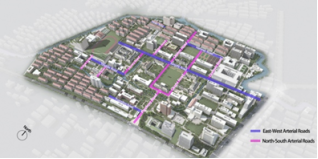
To conduct a comprehensive assessment of the current state of the outdoor VIS on the Xuhui Campus, this study carried out systematic field observations. The survey focused primarily on 13 major campus roads. Each of the 13 roads was meticulously documented using high-resolution photography to capture their physical conditions, existing signage, spatial context, and relationship with the surrounding architectural environment. The documentation also included evaluations of naming status, signage condition, cultural expression, and functional guidance (
Figure 1).
Figure 1. Surveyed roads, redrawn by the author; base map from the WeChat public account “Beimen Intelligence Station”.
2.3.3. Questionnaire and Interview Data
To systematically gather insights into the user experience, cultural perception, and improvement expectations regarding the campus outdoor visual identity system, this study employed a questionnaire-based survey for data collection. The questionnaire was structured into four main sections: basic personal information, road recognition and usage experience, perception of architecture and spatial culture, and optimization expectations for the future campus outdoor VIS. The survey was conducted in April 2025, during which 587 questionnaires were collected. After excluding 75 invalid responses, 512 valid questionnaires were retained, resulting in an effective response rate of 87.2%.
To complement the breadth of the questionnaire survey and gain in-depth understanding of individual experiences, deeper perceptions, and qualitative suggestions from students, faculty, and staff regarding the campus VIS, this study also adopted a semi-structured in-depth interview approach. Interviewees were selected using a purposive sampling strategy to ensure the representation of diverse perspectives from different groups. Ultimately, a total of 28 key individuals were successfully interviewed, including 8 current students, 10 frontline teachers and researchers, 6 administrative staff members, and 4 alumni representatives.
3. Results
3.1. Findings from Historical and Cultural Connotation Mining
Based on an in-depth analysis of historical documents, the origins of road names, and historical architecture, the cultural gene of the Xuhui Campus of East China University of Science and Technology can be distilled into three core elements.
3.1.1. Chemical Engineering Heritage: Foundation and Mission
An investigation into the campus road names reveals that the ethos of “Diligence Road” and “Truth-seeking Road” originates from Professor Zhang Jiangshu, the first president of the university and a distinguished chemical educator. His philosophy of “the laboratory as a battlefield” reflects the determined spirit of the early faculty and students, who tackled critical challenges—such as developing synthetic ammonia catalyst technology—to support China’s chemical industry.
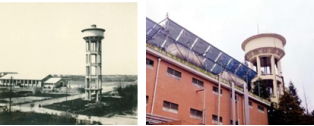
The campus retains numerous historical buildings whose functions embody ECUST’s educational tradition of “emphasizing practice and serving the nation through engineering.” The Engineering Training Center (including the former chemical experiment building complex) serves as a vital space where students transform theoretical knowledge into practical skills and innovative engineering capabilities. It represents a tangible extension of the “chemical engineering heritage” from academic knowledge to industrial application. A notable example is the water tower (
Figure 2), located in the northwest corner of the Meilong Campus. Constructed in 1954, this structure stands as an iconic early industrial artifact of the university. With a height of 28.15 meters and six floors capable of storing 100,000 kilograms of water, the tower features a robust hexagonal structure supported by six square columns, each approximately 10 meters in diameter. Above the second floor, a maintenance ladder is installed, and the lower section of the tower is decorated with architectural patterns, conveying a historic and dignified aesthetic. As an industrial relic from the initial relocation of the campus to Meilong, the water tower has witnessed ECUST’s developmental journey from its inception. It remains standing quietly in a corner of the campus, adjacent to Huali Court and the bathhouse, serving as a tangible landmark of historical memory that warrants preservation.
At the level of cultural genes, from the merger of five chemistry departments at its founding, to breakthroughs in key technologies contributing to national initiatives like “Two Bombs, One Satellite,” and to current leadership in frontiers such as new energy and biomedicine, ECUST has consistently oriented its efforts toward addressing major national strategic needs. This profound “chemical engineering heritage” constitutes the most fundamental element of the university’s identity and historical origin.
Figure 2. Old Photos and Current Status of the Water Tower.
3.1.2. Diligence and Truth-Seeking: The Spirit of Scholarship and Institutional Ethos
As an essential medium reflecting campus culture, the road names “Diligence Road” and “Truth-Seeking Road” spatially embody the institutional ethos advocated by President Zhang Jiangshu, serving as daily reminders for both students and faculty. “Diligence” represents the relentless and hardworking spirit of the ECUST community in tackling academic and technological challenges, while “Truth-Seeking” reflects their practical, authentic, and rigorous approach to scientific research. This ethos permeates all aspects from basic research to industrial applications, shaping the distinctive character of ECUST members—pragmatic, resilient, and action-oriented. Roads such as “Winter Sweet Plum Road” and “Striving Road” further extend and complement this institutional ethos.
3.1.3. The “Red Gene”: Origin of Founding Ideals and Tradition of Serving the Nation
At the level of road naming, “Pandeng Road” and “Tuanjie 1st & 2nd Road” implicitly convey a spirit of collectivism and relentless upward striving.
Among historical architecture and landscapes, the statue of Chairman Mao and the Central Green Space, located on the central axis of the campus, serve as physical remnants of a specific historical period, bearing collective memory and reflecting the ideology and collective identity of their time. The Pandeng Monument, shaped as an abstract chemical tower, symbolizes scaling scientific heights and integrates the mission of “industrial service to the nation” with scientific spirit. The “Silent Song” ox sculpture represents graduates’ dedication and innovative ethos, embody their gratitude and pride in the university.
Culturally, ECUST was founded in response to China’s industrialization strategy, adhering from the beginning to the ideal of “serving the country through industry.” From solving key technological challenges for national industrialization to breaking foreign monopolies and serving major strategic fields like aerospace and life sciences, the university’s development has always been closely tied to the nation’s destiny. It maintains the practical tradition of “writing papers on the motherland’s vast land,” perpetuating this “Red gene.”
The “Chemical Engineering Heritage,” “Diligence and Truth-Seeking,” and the “Red Gene” are interwoven, forming ECUST’s unique cultural identity: mission-driven by national strategic needs, grounded in chemical engineering, and characterized by a pragmatic and hardworking spirit.
3.2. Current Situation Research and Analysis Results
3.2.1. Systemic Deficiencies in the Visual Identity System
Field studies indicate that the outdoor signaging system at Xuhui Campus suffers from several structural and functional shortcomings.
The road naming system remains underdeveloped.
Many key vehicle and pedestrian routes are still unnamed, often referred to by improvised terms such as “the road north of Building Three.” Naming conventions are inconsistent, drawing from unrelated sources including campus motto, sculptures, and building functions without a unifying theme or narrative. Furthermore, naming does not differentiate between functional road types through the use of terms such as road, avenue, or path.
Historical interpretation is notably absent. Significant industrial heritage structures, including the water tower and the electrical workshop, lack explanatory signage, leaving their historical and cultural value unrecognized. Many buildings are designated through purely functional names like First Teaching Building, which strips them of historical context and diminishes their cultural resonance.
Visual inconsistency is evident across signage types. Road signs, building nameplates, and informational panels installed in different periods vary considerably in materials, color schemes, typography, and layout, resulting in a fragmented and unprofessional visual environment.
The system also lacks modern interactive elements. Information is presented primarily through static media such as metal plates and stone engravings, with no integration of digital interfaces—including QR codes, augmented reality, light projections, or audio interactions—failing to support contemporary expectations for interactive and immersive experiences.
Lastly, public spaces offer limited cultural engagement. The Youth River, a central ecological corridor, has not been developed as a narrative landscape; its banks remain unnamed and devoid of thematic segmentation or interpretive nodes. With few exceptions such as the donated Cibotium Garden, most green spaces are monofunctional, poorly equipped, and lack cultural atmosphere, reducing their potential as meaningful social or reflective destinations.
3.2.2. Cognitive Ambiguity and Rising Expectations
Analysis of 512 valid surveys and 28 interviews reveals clear limitations in the outdoor visual identity system from a user perspective.
There is widespread ambiguity regarding historical and cultural meanings. Only 29% of surveyed students could accurately explain the connection between road names such as Diligence Road and Truth-Seeking Road and the university motto advocated by former President Zhang Jiangshu. Most respondents viewed road names merely as functional markers, paying little attention to the historical narratives and cultural symbolism behind them. Interviews further revealed that this cognitive gap stems from a lack of effective cultural dissemination. The current visual identity system fails to provide modern, accessible narrative channels, resulting in a disconnect between the campus’s rich history and its everyday environment.
Satisfaction with cultural spaces is also poor. 73% of respondents reported a lack of distinctive cultural resting areas on campus. Key spaces such as the central lawn and areas along Youth River are underused due to inadequate cultural design and amenities. Many consider the campus more functional than cultural, with few spaces that foster emotional connection or interaction.
However, there is strong interest in an upgraded wayfinding system. 68% of participants support road names that reflect disciplinary strengths or contemporary themes—such as Carbon Neutrality Avenue—indicating a desire for more innovative cultural expression. Users consistently expressed a need for a redesigned visual system that combines clear navigation, cultural meaning, modern aesthetics, and interactive features.
In summary, while Xuhui Campus possesses a rich cultural heritage rooted in chemical engineering, diligent pragmatism, and historical legacy, its current visual identity system fails to convey these values effectively. The user study confirms a broad desire for a coherent and culturally expressive visual environment that supports both wayfinding and immersive experience. These findings provide a clear basis for strategic improvements.
3.3. Case Study
This study draws insights from the visual identity systems of Harvard University and Shanghai Jiao Tong University. Both institutions exemplify success through strong cultural distinctiveness, systematic coherence, deep emotional resonance, extensive brand permeation, and enduring evolutionary vitality.
Building on these references, East China University of Science and Technology can develop an outdoor visual identity system that integrates its unique characteristics—chemical engineering heritage, scientific spirit, and historical legacy—into a culturally rich and contemporarily vibrant framework. The goal is to realize a new cultural ecosystem where “architecture becomes legible, landscapes convey meaning, and road names tell stories.”
4. Discussion
4.1. The Silence of Cultural Symbols and the Branding Gap
A clear disconnect exists between the outdoor visual identity system at Xuhui Campus and the university’s strategic branding objectives, rooted in the systematic underutilization of its cultural symbols. These symbols are not absent, but rather remain fragmented, obscured, and ineffective.
Systemic gaps have resulted in symbolic fragmentation. Meaningfully named roads such as Diligence Road and Truth-Seeking Road lack narrative cohesion, while many other pathways and spaces remain unnamed. Cultural markers like the Water Tower and Monument of Endeavor stand as isolated points, disconnected by any unifying storyline, which weakens the overall cultural image and prevents a cohesive brand identity.
Inadequate interpretation has hidden these symbols from view. Key historic sites lack visual and explanatory signage. The industrial significance of the Water Tower and the educational spirit of the Engineering Training Center remain buried in archives—invisible to the campus community and thus symbolically silent.
Outdated experiential design further diminishes their impact. Static, passive signs do not align with contemporary expectations for interactive and immersive engagement. Without modern forms of communication, cultural symbols fail to resonate or inspire, ultimately falling short of building a deeply recognized and outwardly visible brand.
This silence reflects a broader failure to revitalize cultural assets through modern design and systematic strategy. As a result, ECUST’s distinctive identity—built upon its chemical engineering legacy, diligent and truth-seeking ethos, and historical roots—remains largely unexpressed and imperceptible across the campus.
4.2. Enhancement Strategy Framework
4.2.1. Design Principles
The optimization strategy is guided by the following four core principles, which serve as a foundation throughout the design process.
Integrating History and Modernity. The design should preserve historical continuity by retaining classic names such as “Diligence Road,” which carry collective memory, while also providing contemporary interpretive layers. Digital technologies, for instance, could offer immersive narratives for historic structures like the Water Tower, allowing heritage to resonate through modern design expression without falling into mere nostalgia or arbitrary novelty.
Unifying University Spirit and Disciplinary Identity. Visual design should transcend superficial aesthetics to embody institutional values. Elements such as the university spirit of “diligence and truth-seeking” and disciplinary features exemplified by chemical engineering should be integrated into design details. For example, “Crystal Avenue” could incorporate crystalline patterns, while “Polymer Road” reflects molecular aggregation, making the visual system a tangible declaration of ECUST’s identity.
Balancing Science and Humanism. The design must reflect both scientific advancement and humanistic care. While adopting new materials and technologies such as LEDs and AR, it should also create empathetic spatial experiences—such as thoughtfully designed riverside seating or installations inscribed with quotes from renowned academics—blending technological innovation with emotional engagement.
Asserting Identity with Openness. The design should be rooted in ECUST’s cultural distinctiveness while embodying an inclusive academic atmosphere. Naming and visual strategies must reflect institutional tradition yet remain welcoming to diverse cultures and visitors. Names like “Harmony Road” could convey both cultural confidence and openness.
4.2.2. Core Strategies
Cultural Integration: Systemic Naming under the “ECUST Cultural Project”. Unify roads, buildings, landscapes, and sculptures into a coherent cultural ecosystem through holistic naming and design. “Xingzhi Road” serves as the central cultural axis, linking major landmarks to form a continuous narrative from educational tradition to academic spirit. Themed naming zones—such as leisure-oriented titles in residential areas and concept-driven names in research districts—strengthen the tie between space function and cultural identity.
Event Correlation: Ritual-Bound Visual Interventions. Connect the VIS to key university events to enhance symbolic meaning and emotional engagement. Temporary installations—thematic signage, light projections, or narrative exhibits—are deployed during occasions like graduation or anniversaries, reinforcing collective memory. Commemorative displays honor influential scholars or alumni in relevant spaces, integrating personal stories into the campus’s historical narrative.
Semantic Coordination: A Logically Connected Cultural Network. Create meaningful linkages between spatial elements through conceptual, thematic, and sequential strategies. Names such as “Polymer Road” and “Harmony Road” echo both scientific concepts and cultural values. A unified naming matrix based on the university motto ensures consistency in symbolic messaging. Spatial sequences—from entrance to academic to leisure zones—guide movement and enrich experiential continuity.
Public Participation: A Co-Creation Mechanism. Involve the campus community through participatory naming and design. Crowdsource proposals and feedback via digital platforms and workshops, followed by public voting. Continuous input is facilitated through physical suggestion installations. This open process fosters shared ownership, aligns outcomes with user expectations, and sustains cultural relevance.
4.3. Design Proposal
4.3.1. Road Naming System
Road naming is a central component of enhancing the campus VIS. This plan adopts a cultural and systematic approach to renaming both vehicular and pedestrian pathways, integrating the university motto, disciplinary characteristics, and chemical imagery to create a naming system rich in cultural meaning and functional clarity.
The longitudinal vehicular roads are reorganized around the motto “Diligence and Truth-Seeking,” originally advocated by former President Zhang Jiangshu. While preserving historically significant names such as Diligence Road and Truth-Seeking Road, the system incorporates new semantically rich extensions including Inspiration Road, Virtue Road, Quest Road, and Pragmatism Road, collectively reinforcing the institution’s values. Polymer Road introduces a chemical metaphor for polymerization, symbolizing both the university’s engineering identity and its multicultural community.
The transverse road system is anchored by “Xingzhi Road,” which continues to honor educator Tao Xingzhi while serving as a cultural spine. Each transverse name reflects local function and thematic relevance: Dingxin Road echoes innovation near administrative areas; Dingli Road enhances the ceremonial role of the auditorium; Harmony Road reinterprets “welcome” with a metaphor of cultural integration; Education Road injects a “catalytic” symbolism into the educational mission; and Aromatic Road—a phonetic nod to “aromatic compound”—evokes youth and vibrancy in residential zones. Winter Plum Road and Endeavor Drive retain their established motivational connotations.
For pedestrian pathways, Bondwalk merges “chemical bond” with a sense of kinetic movement along the sports corridor, while Crystal Walk draws on crystalline transparency and elegance to shape the riverside experience. Both names adopt the suffix “walk” to emphasize pedestrian scale and thematic consistency.
The naming system as a whole integrates cultural, historical, and spatial elements through chemical metaphors, historical continuity, and contextual appropriateness. Chemical terminology—such as polymerization, aromatic compounds, molecular bonds, and crystal structures—pervades the naming logic. Historical references are thoughtfully updated: Education Road preserves the educational legacy with a fresh disciplinary twist, while Harmony Road transforms a traditional concept into one of intercultural dialogue. Each name is carefully suited to its context, enhancing both functionality and cultural meaning across campus zones.
4.3.2. Cultural Integration
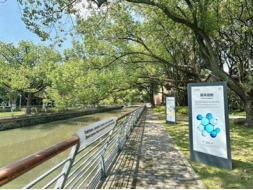
This strategy enhances the campus environment through disciplinary symbolism and spatial storytelling. Along the “Crystal Walk” on Youth River, interpretive signs and sculptural elements—such as molecular light installations, “chemical bond” sculptures, and interactive innovation displays—blend scientific concepts with physical space (
Figure 3).
Figure 3. Conceptual Rendering of Crystal Walk.
“Bondwalk” in the sports zone incorporates chemical equations into pavement design, linking movement with molecular energy. Green spaces are thematic: the “Catalysis Garden” is an interactive maze based on molecular structures, while “Polymer Grove” features rubber trees and materials science explanations.
Major roads are enriched with culturally resonant features. Xingzhi Road now includes an “Educational Philosophy Walk” with embedded quotations and an “Industry-Academia Integration Corridor.” Diligence Road displays engraved pledges of dedication, and Winter Plum Road hosts winter-themed art aligning tenacity with scientific spirit.
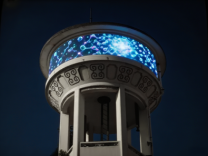
The historic Water Tower is repurposed as “Origin Tower,” with an LED exterior simulating molecular movement (
Figure 4). Its ground floor becomes an exhibition hall on chemical engineering history, and the top floor offers a panoramic “Disciplinary Outlook,” transforming the structure into a symbol of institutional heritage and scientific vision.
Figure 4. Conceptual Rendering of the Water Tower.
4.4. Expected Outcomes and Value
This strategy aims to deliver multifaceted value to ECUST’s Xuhui Campus. A more coherent and engaging visual identity system will deepen the campus community’s connection to institutional culture, turning everyday spaces into venues for meaningful experience and strengthening collective identity.
Beyond mere functionality, the campus will begin to serve as an open-air repository of institutional memory—where paths, buildings, and landscapes convey narrative meaning, enabling architecture to be “read” and scenery to be felt.
The resulting environment will embody a unique brand character: one rooted in historical legacy through preserved industrial heritage, expressed in an industrial-design aesthetic inspired by chemistry, and forward-looking through interactive technology and scientific storytelling. Together, these layers will form a distinctive “ECUST rhythm”—enhancing the university's cultural soft power and institutional identity.
5. Conclusions
This study proposed enhancement strategies for the outdoor visual identity system of the Xuhui Campus at ECUST. Analysis across cultural, spatial, and user dimensions revealed issues such as fragmented cultural narratives, inconsistent visuals, and a lack of engaging experiences—reflecting a broader disconnect between the university's core identity and its physical environment.
In response, the study introduced four design principles and core strategies—cultural integration, event correlation, semantic coordination, and public participation—culminating in a concrete proposal covering renewed road naming, cultural scenography, heritage reactivation, and digital integration. The plan aims to reshape the campus into an open-air history museum blending a sense of history, industrial aesthetic, futuristic engagement, and a distinctive “ECUST rhythm.”
This research provides a systematic and actionable framework for campus visual identity design, supporting cultural branding and community identity building. Future work should expand to multi-campus coordination, deepen digital application, and implement evaluation mechanisms to assess real-world impact.
Abbreviations
VIS | Visual Identity System |
ECUST | East China University of Science and Technology |
Author Contributions
Liyan Liu: Writing-original draft,Conceptualization, Methodology
Zigang Yao: Resources,Supervision, Project administration
Xintian Lyu: Investigation, Writing – review & editing
Yuwei Zhai: Investigation, Writing – review & editing
Zhimou Fang: Investigation, Writing – review & editing
Funding
This work is supported by ECUST 15th Five-Year Plan Development Research Project (2026-2030). The research topic is Enhancement Strategies for the Outdoor Visual Identity System of the Xuhui Campus of East China University of Science and Technology from the Perspective of Campus Cultural Branding.
Data Availability Statement
The data is available from the corresponding author upon reasonable request.
Conflicts of Interest
The authors declare no conflicts of interest.
References
| [1] |
Wang, C. M., Jin, X. Cultural Orientation, Naming Principles, and Value Realization of University Campus Roads: Based on the Naming Practice at Minhang Campus of Shanghai Jiao Tong University [J]. Journal of Higher Education Research, 2023, 46(03): 19-25+63.
https://doi.org/10.3969/j.issn.1672-8874.2023.03.004
|
| [2] |
Cai, L. Y., Zhou, P. Functional Characteristics and Pragmatic Rules of University Campus Road Names [J]. Rhetoric Learning, 2005, (04): 60-61.
https://doi.org/10.16027/j.cnki.cn31-2043/h.2005.04.022
|
| [3] |
Han, T. Research on the Role of Visual Recognition System on Campus Culture Construction in Colleges and Universities [J]. Design, 2018, (16): 132-133.
https://doi.org/10.3969/j.issn.1003-0069.2018.16.034
|
| [4] |
Qi, L. Research on the Influence of Visual Identity Systems on University Campus Culture Construction [J]. Popular Science, 2013, (11): 152.
https://doi.org/10.16728/j.cnki.kxdz.2013.11.141
|
| [5] |
Wu, Y., Xiao, Y. Naming of University Roads and Landscapes from a Historical and Cultural Perspective [J]. Jiangxi Social Sciences, 2006, (08): 179-182.
https://doi.org/10.3969/j.issn.1004-518X.2006.08.035
|
| [6] |
Yin, D. Z. Cultural Consciousness in Naming University Buildings, Roads, and Landscapes [J]. Academic Exploration, 2012, (01): 113-116.
https://doi.org/10.3969/j.issn.1006-723X.2012.01.027
|
| [7] |
Zhang, L., Jia, J., Song, M. Design and Analysis of the “Red Fire Route” Logo System of Dalian University of Technology—Case of Ideological and Political Teaching in Curriculum Design Based on Visual System [J]. Design. 2022, 35(4): 146–148.
https://doi.org/10.3969/j.issn.1003-0069.2022.04.042
|
| [8] |
Cheng, R. An Analysis of Visual Identity System Design in German Universities: A Case Study of the Technical University of Munich [J]. Art and Literature for the Masses, 2016, (23): 118–119.
https://doi.org/10.20112/j.cnki.issn1007-5828.2016.23.192
|
| [9] |
Shen, C. Research on the Construction of Visual Image Recognition System in Colleges and Universities: Taking Miami Dade College as an Example [J]. Hunan Packaging, 2024, 39(5): 187–191.
https://doi.org/10.19686/j.cnki.issn1671-4997.2024.05.041
|
| [10] |
Tan, Y. The Construction of Harvard University’s Visual Identity System and Its Implications for the Brand Image of Shanghai Universities [J]. Zhuangshi, 2015, (10): 140-141.
https://doi.org/10.16272/j.cnki.cn11-1392/j.2015.10.039
|
| [11] |
Fan, Z. Z., Dai, R. Research on the Application of Visual Identity System (VIS) in the Cultural Image Building of Universities [J]. Art Education Research, 2018, (20): 57.
https://doi.org/10.3969/j.issn.1674-9286.2018.20.039
|
| [12] |
Chen, B. Application of Visual Communication Design in Campus Landscape Design [J]. Environmental Engineering. 2021, 39(7), Insert Page 55.
|
| [13] |
Wu, L. L., Dai, J. J., Zhang, H. Y. Campus Visual Culture Construction from the Perspective of Personalized Teaching [J]. Journal of Jiangsu Normal University (Educational Science Edition), 2013, 4(S1): 42-44.
https://doi.org/10.16095/j.cnki.cn32-1833/c.2013.s1.010
|
| [14] |
Li, J. University Identity System in Campus Brand Building [J]. Modern Education Management, 2012, (06), 49–53.
https://doi.org/10.16697/j.cnki.xdjygl.2012.06.010
|
| [15] |
Shi, J., Ji, L., Zhu, X. The Connotation and Structure of Campus Culture [J]. China Higher Education Research , 2005, (05): 84–85.
https://doi.org/10.16298/j.cnki.1004-3667.2005.05.035
|
| [16] |
China Museum of Chemical Industry. Centennial History of China’s Chemical Industry [M]. Beijing: Chemical Industry Press, 2021.
|
| [17] |
Wang, H. W., Duan, Y. Y. A Concise History of East China University of Science and Technology [M]. Shanghai: East China University of Science and Technology Press, 2023.
|
| [18] |
Wang, H. W., Luo, X. X. Illustrated Biographies of Historical Figures of East China University of Science and Technology [M]. Shanghai: East China University of Science and Technology Press, 2022.
|
| [19] |
Lu, X. L., Hou, Y. M., et al. Perseverance: Brief Biographies of ECUST Scholars [M]. Shanghai: East China University of Science and Technology Press, 2017.
|
Cite This Article
-
APA Style
Liu, L., Lyu, X., Zhai, Y., Fang, Z., Yao, Z. (2025). Enhancing University Outdoor Visual Identity Systems:
A Case Study of ECUST's Xuhui Campus. Humanities and Social Sciences, 13(6), 581-589. https://doi.org/10.11648/j.hss.20251306.18
 Copy
|
Copy
|
 Download
ACS Style
Liu, L.; Lyu, X.; Zhai, Y.; Fang, Z.; Yao, Z. Enhancing University Outdoor Visual Identity Systems:
A Case Study of ECUST's Xuhui Campus. Humanit. Soc. Sci. 2025, 13(6), 581-589. doi: 10.11648/j.hss.20251306.18
Copy
|
Download
AMA Style
Liu L, Lyu X, Zhai Y, Fang Z, Yao Z. Enhancing University Outdoor Visual Identity Systems:
A Case Study of ECUST's Xuhui Campus. Humanit Soc Sci. 2025;13(6):581-589. doi: 10.11648/j.hss.20251306.18
Copy
|
Download
-
@article{10.11648/j.hss.20251306.18,
  author = {Liyan Liu and Xintian Lyu and Yuwei Zhai and Zhimou Fang and Zigang Yao},
  title = {Enhancing University Outdoor Visual Identity Systems:
A Case Study of ECUST's Xuhui Campus},
  journal = {Humanities and Social Sciences},
  volume = {13},
  number = {6},
  pages = {581-589},
  doi = {10.11648/j.hss.20251306.18},
  url = {https://doi.org/10.11648/j.hss.20251306.18},
  eprint = {https://article.sciencepublishinggroup.com/pdf/10.11648.j.hss.20251306.18},
  abstract = {This study examines the enhancement of the outdoor visual identity system at the Xuhui Campus of East China University of Science and Technology. University visual identity systems serve as essential mediums for conveying cultural values and strengthening community identity. However, many systems, including that of ECUST, remain underdeveloped—characterized by fragmented cultural expression, inconsistent signage, and a general lack of engaging user experience. The research employs a mixed-method approach, incorporating historical analysis, field surveys, questionnaire data from 512 respondents, and 28 in-depth interviews. Findings reveal a rich cultural foundation rooted in chemical engineering heritage, a spirit of diligence and truth-seeking, and a tradition of national service. Yet, these elements are poorly translated into the physical environment, resulting in low cultural recognition and user satisfaction. In response, the study proposes a comprehensive enhancement strategy guided by four principles: integrating history with modernity, unifying institutional spirit and disciplinary identity, balancing science with humanistic values, and asserting identity with openness. Core strategies include cultural integration through systematic naming, event-related visual interventions, semantic coordination across spaces, and public participation mechanisms. Specific design measures range from renewing road names with scientific and cultural meanings, to embedding interactive installations and revitalizing historical structures such as the water tower. The proposed redesign aims to transform the campus into an open-air history museum that embodies a distinctive ECUST rhythm—blending historical legacy, industrial aesthetic, and forward-looking engagement. This study provides a practical and culturally grounded framework for visual identity enhancement in academic settings, with implications for both cultural branding and campus planning. Further implementation and evaluation across multiple campuses are recommended.},
 year = {2025}
}
Copy
|
Download
-
TY  - JOUR
T1  - Enhancing University Outdoor Visual Identity Systems:
A Case Study of ECUST's Xuhui Campus
AU  - Liyan Liu
AU  - Xintian Lyu
AU  - Yuwei Zhai
AU  - Zhimou Fang
AU  - Zigang Yao
Y1  - 2025/12/27
PY  - 2025
N1  - https://doi.org/10.11648/j.hss.20251306.18
DO  - 10.11648/j.hss.20251306.18
T2  - Humanities and Social Sciences
JF  - Humanities and Social Sciences
JO  - Humanities and Social Sciences
SP  - 581
EP  - 589
PB  - Science Publishing Group
SN  - 2330-8184
UR  - https://doi.org/10.11648/j.hss.20251306.18
AB  - This study examines the enhancement of the outdoor visual identity system at the Xuhui Campus of East China University of Science and Technology. University visual identity systems serve as essential mediums for conveying cultural values and strengthening community identity. However, many systems, including that of ECUST, remain underdeveloped—characterized by fragmented cultural expression, inconsistent signage, and a general lack of engaging user experience. The research employs a mixed-method approach, incorporating historical analysis, field surveys, questionnaire data from 512 respondents, and 28 in-depth interviews. Findings reveal a rich cultural foundation rooted in chemical engineering heritage, a spirit of diligence and truth-seeking, and a tradition of national service. Yet, these elements are poorly translated into the physical environment, resulting in low cultural recognition and user satisfaction. In response, the study proposes a comprehensive enhancement strategy guided by four principles: integrating history with modernity, unifying institutional spirit and disciplinary identity, balancing science with humanistic values, and asserting identity with openness. Core strategies include cultural integration through systematic naming, event-related visual interventions, semantic coordination across spaces, and public participation mechanisms. Specific design measures range from renewing road names with scientific and cultural meanings, to embedding interactive installations and revitalizing historical structures such as the water tower. The proposed redesign aims to transform the campus into an open-air history museum that embodies a distinctive ECUST rhythm—blending historical legacy, industrial aesthetic, and forward-looking engagement. This study provides a practical and culturally grounded framework for visual identity enhancement in academic settings, with implications for both cultural branding and campus planning. Further implementation and evaluation across multiple campuses are recommended.
VL  - 13
IS  - 6
ER  -
Copy
|
Download





 Share This Article
 Twitter
 Linked In
 Facebook