Abstract
In the rapidly urbanizing city of Dhaka, the availability of open play spaces within private apartment complexes represents a critical yet systematically overlooked dimension of urban residential planning. With the rapid expansion of urban infrastructure and increasing land scarcity, unstructured outdoor play opportunities for children have significantly diminished. Bangladesh's National Children's Policy (BNCP) explicitly recognizes play as a fundamental right of children, stipulating that all environments inhabited by children should meet child-friendly standards. Existing regulations under Bangladesh National Building Code (BNBC) 2020 and Dhaka Imarat Nirman Bidhimala (DINB) 2008 mandate that private apartment complexes constructed on a minimum of 20 katha of land must allocate designated portions for children's open play areas. However, despite these regulatory frameworks, the degree to which these play areas satisfy child-friendly criteria remains largely unexplored, and the perspectives of primary users—parents and children—are seldom integrated into planning and evaluation processes. This study critically assesses the current state of children's open play spaces across three private apartment complexes in three distinct residential areas of Dhaka city. Employing a mixed-method approach, the research combines structured questionnaires administered to parents, focus group discussions with children, and a checklist-based physical assessment aligned with established child-friendly criteria. Furthermore, this study examines the degree of compliance with existing regulations governing children’s play spaces in apartment complexes. Findings reveal systemic deficiencies across physical, environmental, cognitive, and social parameters—including inadequate safety measures, restricted accessibility, poor hygiene management, and insufficient play equipment. No complex fully complied with the minimum regulatory requirement of allocating 10% of total land area to children's play space. These findings offer crucial insights into existing gaps in play area provision and inform the design of more effective strategies for future urban and residential development in Dhaka.
Keywords
Child-friendly Environment, Open Play Space, Private Apartment Complex, Urban Children, Dhaka,
Mixed-methods Evaluation
1. Introduction
The right of children to play is universally recognized as a fundamental human right, enshrined under Article 31 of the United Nations (UN) Convention on the Rights of the Child
, which asserts that every child has the right to rest, leisure, play, and engage in recreational activities appropriate to their age. This right is essential not only for the physical and mental well-being of children but also for fostering their social and cognitive development. In the context of urban environments, child-friendly open play areas are defined as spaces designed specifically to support children's physical, social, and emotional growth, offering a safe, accessible, and stimulating environment for play
| [2] | K. Chen, R. B. Roosli, Y. Zhao, and D. Wang, “A Literature Review on the Design of Children’s Outdoor Play Spaces from a Child-Friendly Perspective Combining Biomechanics,” Mol. Cell. Biomech., vol. 22, no. 2, p. 1422, Feb. 2025,
https://doi.org/10.62617/mcb1422 |
| [3] | M. J. N. Han and M. J. Kim, “A Critical Review of Child-Friendly Environments, Focusing on Children’s Experiential Perspectives on the Physical World for Sustainability,” Sustainability, vol. 10, no. 10, p. 3725, Oct. 2018,
https://doi.org/10.3390/su10103725 |
| [4] | UNICEF, “Building Child Friendly Cities : a Framework for Action,” United Nations Children’s Fund (UNICEF), UNICEF Innocenti Research Centre; Child Friendly Cities Initiative, 2004. Available: cfc-framework-eng – PDF. |
| [5] | UNICEF, “Unicef’s Programme Guidance for Early Childhood Development,” United Nations Children’s Fund (UNICEF), New York, NY 10017, USA, UNICEF Programme Division, 2017]. Available:
https://www.unicef.org/media/107616/file/UNICEF-Programme-%20Guidance-for-Early-Childhood-Development-2017.pdf |
[2-5]
. These spaces should be equipped with age-appropriate facilities, free from hazards, and conducive to both structured and unstructured play
| [6] | M. Gao, X. Zhu, and X. Cheng, “Safety – Premise for Play: Exploring how Characteristics of Outdoor Play Spaces in Urban Residential Areas Influence Children’s Perceived Safety,” Cities, vol. 152, p. 105236, Sep. 2024,
https://doi.org/10.1016/j.cities.2024.105236 |
| [7] | N. J. Harper, “Outdoor Risky Play and Healthy Child Development in The Shadow of the ‘Risk Society’: A Forest and Nature School Perspective,” Child Youth Serv., vol. 38, no. 4, pp. 318–334, Oct. 2017,
https://doi.org/10.1080/0145935X.2017.1412825 |
[6, 7]
. However, in rapidly urbanizing cities such as Dhaka, Bangladesh, the availability of such spaces has become increasingly threatened by land scarcity, urban population growth, and the prioritization of economic development over child welfare in urban planning.
Private apartment complexes, which have become the dominant residential typology for middle- and upper-income families in Dhaka, are frequently designed with open play areas for children. However, despite the inclusion of these spaces, the quality, accessibility, and overall child-friendliness of these areas often fail to meet international standards. Bangladesh’s National Children’s Policy (BNCP)
| [8] | BNCP, “Bangladesh National Children’s Policy,” Ministry of Women and Children Affairs, Government of Bangladesh., 2011. |
[8]
sets out a legislative framework mandating child-friendly environments in residential spaces; however, the implementation and enforcement of this policy are inconsistent, and the voices of children and their caregivers, the primary users of these spaces, are rarely incorporated into urban planning or evaluation frameworks.
Urban planning regulations in Bangladesh, particularly the Bangladesh National Building Code (BNBC)
and Dhaka Imarat Nirman Bidhimala (DINB)
| [10] | DINB, “Dhaka Imarat Nirman Bidhimala,” Ministry of Housing and Public Works, Government of Bangladesh., 2008. |
[10]
, stipulate that apartment complexes situated on plots larger than 20 katha must allocate a designated portion of land for children’s open play areas. Despite these regulatory mandates, there is a lack of empirical research on the actual compliance with these requirements, as well as a gap in the understanding of how effectively these spaces meet child-friendly criteria. Furthermore, while these regulations aim to promote child welfare, little research has been conducted to explore whether the play areas in private apartment complexes are truly supportive of children’s developmental needs.
This study seeks to evaluate the child-friendliness of existing open play spaces within private apartment complexes in Dhaka city. By assessing these spaces against established child-friendly criteria and relevant regulations, this research aims to provide valuable insights into the gaps between regulatory intentions and real-world outcomes. It also seeks to offer evidence-based recommendations that can inform urban planning practices, policy development, and the design of future residential spaces to better accommodate the needs of children in urban environments.
2. Literature Review
2.1. The Importance of Play in Child Development
Play is universally acknowledged as a critical component of children's holistic development. It is not only a fundamental right but also serves as the primary mechanism through which children explore, learn, and engage with the world around them
. Through various forms of play, children develop crucial skills in physical coordination, social interaction, cognitive flexibility, and emotional resilience
| [11] | A. Ahmed, “Factors and Issues Related to Children’s Play and their Implications on Play and Recreation Provision in Dhaka City,” A Doctoral Thesis, Architecture, Building and Civil Engineering, Loughborough University, 2011.
https://hdl.handle.net/2134/7819 |
[11]
. Gray
| [12] | P. Gray, Free to Learn: Why Unleashing the Instinct to Play will Make Our Children Happier, More Self-reliant, and Better Students for Life, First paperback edition. New York: Basic Books, 2015. |
[12]
further highlights the essence of authentic play, describing it as self-chosen, self-directed, intrinsically motivated, and free from external stress. These conditions, which are vital for meaningful play, are increasingly difficult to provide in contemporary urban settings where built environments often prioritize economic and infrastructural growth over the well-being of children.
The developmental benefits of outdoor play extend across multiple domains. Physical play fosters motor development, cardiovascular health, and the maintenance of healthy weight
| [6] | M. Gao, X. Zhu, and X. Cheng, “Safety – Premise for Play: Exploring how Characteristics of Outdoor Play Spaces in Urban Residential Areas Influence Children’s Perceived Safety,” Cities, vol. 152, p. 105236, Sep. 2024,
https://doi.org/10.1016/j.cities.2024.105236 |
| [7] | N. J. Harper, “Outdoor Risky Play and Healthy Child Development in The Shadow of the ‘Risk Society’: A Forest and Nature School Perspective,” Child Youth Serv., vol. 38, no. 4, pp. 318–334, Oct. 2017,
https://doi.org/10.1080/0145935X.2017.1412825 |
[6, 7]
. Social play, meanwhile, encourages communication, conflict resolution, and the development of cooperative behaviors, which are essential for lifelong social competence. Additionally, engaging in outdoor play, particularly in natural and unstructured environments, supports cognitive development, creativity, and psychological well-being
| [13] | P. H. Kahn and S. R. Kellert, Eds., Children and Nature: Psychological, Sociocultural, and Evolutionary Investigations. Cambridge, Massachusetts London, England: The MIT Press, 2002. |
[13]
. However, the erosion of such opportunities in densely urbanized contexts like Dhaka represents a significant public health concern, as children are increasingly deprived of environments that nurture their physical, social, and cognitive growth.
2.2. Child-friendly Environments: Conceptual Framework
The concept of a child-friendly environment extends beyond physical infrastructure to include governance, community engagement, and inclusive design, with an overarching goal of creating spaces where children feel safe, emotionally secure, and supported in their development
| [4] | UNICEF, “Building Child Friendly Cities : a Framework for Action,” United Nations Children’s Fund (UNICEF), UNICEF Innocenti Research Centre; Child Friendly Cities Initiative, 2004. Available: cfc-framework-eng – PDF. |
[4]
. A child-friendly open play area, in particular, is characterized by an environment that prioritizes children’s safety, accessibility, engagement, and well-being while allowing them the freedom to explore, socialize, and develop physically and cognitively.
Several studies on playground design and outdoor spaces emphasize the importance of various physical and programmatic criteria for creating child-friendly environments. Chawla
, Malone and Tranter
| [15] | K. Malone and P. Tranter, ““Children’s Environmental Learning and the Use, Design and Management of Schoolgrounds,” Child. Youth Environ., vol. 13, no. 2, pp. 87–137, 2003,
https://doi.org/10.1353/cye.2003.0040 |
[15]
, Norazlan and Said
| [16] | S. A. Norazlan and I. Said, “Understanding Children’s Preferences: Developing Ecological Literacy in the Village Landscape,” J. Adventure Educ. Outdoor Learn., vol. 23, no. 4, pp. 394–415, Oct. 2023,
https://doi.org/10.1080/14729679.2022.2027794 |
[16]
highlight key elements such as location, accessibility, material safety, spatial organization, and the scale of play equipment. These criteria ensure that play areas are not only safe and inviting but also conducive to diverse forms of play that support children's developmental needs. Chen et al.
| [2] | K. Chen, R. B. Roosli, Y. Zhao, and D. Wang, “A Literature Review on the Design of Children’s Outdoor Play Spaces from a Child-Friendly Perspective Combining Biomechanics,” Mol. Cell. Biomech., vol. 22, no. 2, p. 1422, Feb. 2025,
https://doi.org/10.62617/mcb1422 |
[2]
, Han and Kim
| [3] | M. J. N. Han and M. J. Kim, “A Critical Review of Child-Friendly Environments, Focusing on Children’s Experiential Perspectives on the Physical World for Sustainability,” Sustainability, vol. 10, no. 10, p. 3725, Oct. 2018,
https://doi.org/10.3390/su10103725 |
[3]
and synthesizing findings from numerous studies, further categorize these factors into comprehensive frameworks for establishing child-friendly environments. These frameworks have been widely adopted in designing urban spaces that cater to the developmental needs of children across diverse contexts.
In Dhaka, where urban density is rising and green spaces are limited, ensuring the creation of child-friendly spaces is more crucial than ever. The existing literature stresses that such spaces should be inclusive, providing a variety of activities that cater to different age groups and abilities, while also maintaining flexibility to allow for spontaneous play
| [6] | M. Gao, X. Zhu, and X. Cheng, “Safety – Premise for Play: Exploring how Characteristics of Outdoor Play Spaces in Urban Residential Areas Influence Children’s Perceived Safety,” Cities, vol. 152, p. 105236, Sep. 2024,
https://doi.org/10.1016/j.cities.2024.105236 |
| [7] | N. J. Harper, “Outdoor Risky Play and Healthy Child Development in The Shadow of the ‘Risk Society’: A Forest and Nature School Perspective,” Child Youth Serv., vol. 38, no. 4, pp. 318–334, Oct. 2017,
https://doi.org/10.1080/0145935X.2017.1412825 |
[6, 7]
.
2.3. Regulatory Context in Bangladesh
In Bangladesh, the legal framework governing children’s play spaces in residential developments is primarily established through the BNBC
and the DIMB
| [10] | DINB, “Dhaka Imarat Nirman Bidhimala,” Ministry of Housing and Public Works, Government of Bangladesh., 2008. |
[10]
. These regulations require that private apartment complexes on plots of 20 katha or more allocate at least 10% of the total land area to children’s open play spaces, with at least 50% of this area left uncovered and open to the sky. While these regulatory frameworks are a step in the right direction, enforcement by the Rajdhani Unnayan Kartripakkha (RAJUK) has been inconsistent, and penalties for non-compliance are rarely imposed
| [17] | S. Hossain and Z. Tasnim, “Study on the Importance of Open Space Due to Create Dhaka as a Child Friendly City,” Asian J. Soc. Sci. Leg. Stud., vol. 2, no. 5, pp. 96–103, Sep. 2020,
https://doi.org/10.34104/ajssls.020.0960103 |
| [18] | S. Sharmin, Children in Urban Parks: A Case Study of Dhaka, Bangladesh. LAP LAMBERT Academic Publishing, 2012. |
[17, 18]
.
The Bangladesh's National Children's Policy (BNCP)
| [8] | BNCP, “Bangladesh National Children’s Policy,” Ministry of Women and Children Affairs, Government of Bangladesh., 2011. |
[8]
further reinforces the right of children to have safe, accessible, and stimulating play environments, aligning national policies with international standards such as those outlined in the UN Convention on the Rights of the Child. However, despite the existence of these policies, a significant gap persists between the policy intentions and the real-world implementation of child-friendly play spaces in urban residential areas. Many private apartment complexes, despite meeting basic regulatory requirements, fail to provide play areas that are truly child-friendly in terms of safety, accessibility, and developmental support
| [11] | A. Ahmed, “Factors and Issues Related to Children’s Play and their Implications on Play and Recreation Provision in Dhaka City,” A Doctoral Thesis, Architecture, Building and Civil Engineering, Loughborough University, 2011.
https://hdl.handle.net/2134/7819 |
[11]
.
2.4. Child-friendly Assessment Criteria
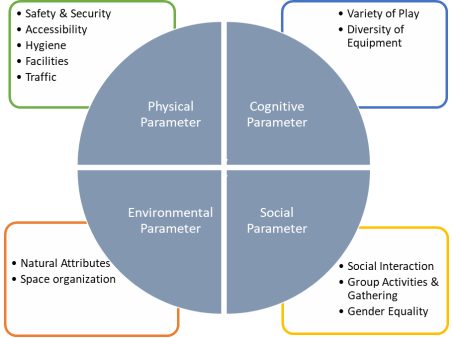
Drawing from the literature review and consultations with built environment professionals, this study has identified twelve criteria to evaluate child-friendly open play spaces. These criteria have been grouped under four broad parameters: Physical, Cognitive, Environmental, and Social, as shown in
Figure 1. The development of these criteria was informed by a combination of international research Chen et al.
| [2] | K. Chen, R. B. Roosli, Y. Zhao, and D. Wang, “A Literature Review on the Design of Children’s Outdoor Play Spaces from a Child-Friendly Perspective Combining Biomechanics,” Mol. Cell. Biomech., vol. 22, no. 2, p. 1422, Feb. 2025,
https://doi.org/10.62617/mcb1422 |
[2]
, Han and Kim
| [3] | M. J. N. Han and M. J. Kim, “A Critical Review of Child-Friendly Environments, Focusing on Children’s Experiential Perspectives on the Physical World for Sustainability,” Sustainability, vol. 10, no. 10, p. 3725, Oct. 2018,
https://doi.org/10.3390/su10103725 |
[3]
, and discussions with experts in child-friendly design and residential development.
The Physical parameter encompasses criteria such as safety and security, accessibility, hygiene, and the provision of necessary facilities such as seating, drinking water, and lighting. Research has shown that safety and security are critical factors in ensuring that play areas are both welcoming and protective of children’s well-being
| [19] | S. Atmakur-Javdekar, “Childrens Play in Urban Areas,” in Play and Recreation, Health and Wellbeing, B. Evans, J. Horton, and T. Skelton, Eds., Singapore: Springer Singapore, 2016, pp. 109–133. https://doi.org/10.1007/978-981-4585-51-4_3 |
| [20] | G. Katsavounidou, “Child, Play, and Urban Space: A Historical Overview and a Holistic Paradigm for Child-Centered Urbanism,” J. Urban. Int. Res. Placemaking Urban Sustain., vol. 16, no. 4, pp. 430–446, Oct. 2023,
https://doi.org/10.1080/17549175.2021.2005120 |
[19, 20]
. The Cognitive parameter addresses the variety and diversity of play options available, promoting not just physical engagement but also cognitive and imaginative development through sensory and creative play
| [13] | P. H. Kahn and S. R. Kellert, Eds., Children and Nature: Psychological, Sociocultural, and Evolutionary Investigations. Cambridge, Massachusetts London, England: The MIT Press, 2002. |
[13]
. The Environmental criteria focus on the integration of natural elements, such as sunlight, fresh air, and plants, all of which contribute to a more stimulating and healthier environment for children
| [3] | M. J. N. Han and M. J. Kim, “A Critical Review of Child-Friendly Environments, Focusing on Children’s Experiential Perspectives on the Physical World for Sustainability,” Sustainability, vol. 10, no. 10, p. 3725, Oct. 2018,
https://doi.org/10.3390/su10103725 |
[3]
. Finally, the Social parameters emphasize the importance of social interaction, group activities, and gender equality, which help children develop social skills and a sense of belonging within their communities
| [6] | M. Gao, X. Zhu, and X. Cheng, “Safety – Premise for Play: Exploring how Characteristics of Outdoor Play Spaces in Urban Residential Areas Influence Children’s Perceived Safety,” Cities, vol. 152, p. 105236, Sep. 2024,
https://doi.org/10.1016/j.cities.2024.105236 |
[6]
. The complete list of criteria and their associated variables, which were used in the assessment checklist and survey instruments for this study, is presented in
Table 1.
Figure 1. Framework of Child-Friendly Criteria and Parameters (Source: Authors).
Table 1. Child-Friendly Criteria and Assessment Variables.
Parameter | Criteria | Variables |
Physical | Safety and Security | Type of surface; security cameras; visual obstructions; guard post visibility |
Accessibility | Proximity to residential units; presence of ramps and accessible pathways; sidewalk continuity |
Hygiene | Drainage system effectiveness; availability of wash zones; presence of cleaning staff; overall cleanliness |
Facilities | Shade structures; parents' seating; drinking water; first aid kit; night lighting |
Traffic | Physical barriers; signage; traffic calming measures |
Cognitive | Variety of Play | Arrangements for active, creative, and sensory play |
Diversity of Equipment | Age-appropriate equipment (slides, swings, sandboxes, textured surfaces) |
Environmental | Natural Attributes | Adequate sunlight; availability of plants; fresh air; absence of noise |
Space Organization | Zoning and arrangement of facilities |
Social | Social Interaction | Presence of gathering spaces |
Group Activities | Group activities; frequency of organized events |
Gender Equality | Equal access and facilities for boys and girls |
Source: Authors, adapted from Chen et al.
| [2] | K. Chen, R. B. Roosli, Y. Zhao, and D. Wang, “A Literature Review on the Design of Children’s Outdoor Play Spaces from a Child-Friendly Perspective Combining Biomechanics,” Mol. Cell. Biomech., vol. 22, no. 2, p. 1422, Feb. 2025,
https://doi.org/10.62617/mcb1422 |
[2]
, Han and Kim
| [3] | M. J. N. Han and M. J. Kim, “A Critical Review of Child-Friendly Environments, Focusing on Children’s Experiential Perspectives on the Physical World for Sustainability,” Sustainability, vol. 10, no. 10, p. 3725, Oct. 2018,
https://doi.org/10.3390/su10103725 |
[3]
,
and literature review 3. Methodology
This study employs a mixed-method research design, integrating quantitative and qualitative data collection and analysis to provide a comprehensive assessment of child-friendly open play spaces in selected private apartment complexes.
3.1. Study Sites
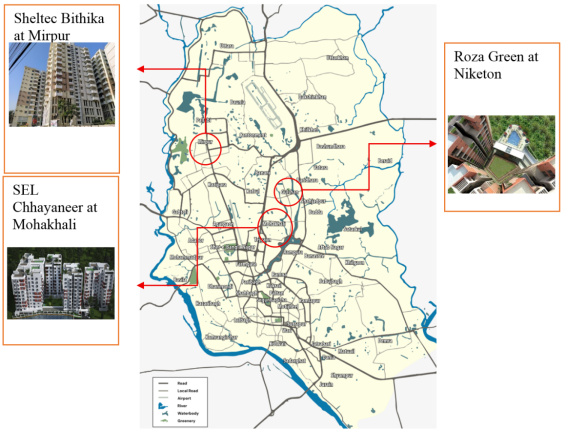
Figure 2. Location of Sites of Three Selected Apartment Complexes.
Three private apartment complexes have been chosen based on their reputation, accessibility, approval of authority, and compliance with the law of BNBC
and DINB
| [10] | DINB, “Dhaka Imarat Nirman Bidhimala,” Ministry of Housing and Public Works, Government of Bangladesh., 2008. |
[10]
, having a minimum land area of 20 Katha, and availability of open play areas for children to assess child-friendliness. RAJUK and BNBC
do not mandate the provision of a children’s play area for plots smaller than 20 kathas. Three apartment complexes from three different residential areas in Dhaka city have been selected for the case study (
Figure 2). This approach ensures a detailed evaluation of child-friendly criteria without compromising research quality. A smaller sample size enables a more thorough investigation while maintaining feasibility within the study's scope. Three selected private apartment complexes are:
a) Sheltec Bithika at Mirpur area
b) Roza Green at Gulshan, Niketon
c) Chayaneer at Dokkhin para, Mohakhali
All the RAJUK-approved plans and existing plans have been collected from the developers of these three apartment complexes for comparative analysis. Child-friendliness data has been collected through observations and interviews. For observation, a checklist has been used.
3.2. Data Collection
3.2.1. Physical Assessment-checklist Based Observation
A structured checklist operationalizing the twelve child-friendly criteria (
Table 1) was developed and applied through direct observation at each site. Photographic documentation and physical measurement of play areas were conducted to supplement checklist data. Observed areas were cross-checked against RAJUK-approved plans obtained from each complex’s developer. A color-coded system was employed in analysis: green indicating the presence and red indicating the absence of each criterion.
3.2.2. Parent Questionnaire Survey
Structured questionnaires were administered to 15 parents at each complex (n = 45 total). All respondents were residents actively using the play area at the time of data collection, ensuring responses reflected real-time experience rather than retrospective recall. Questions were framed as positive statements aligned with the child-friendly criteria, measured on a five-point Likert scale from ‘Strongly Disagree’ to ‘Strongly Agree’. Two survey rounds were conducted at each site in November 2024 — one on a weekday and one on a weekend — across morning (10: 00 – 13: 00) and evening (16: 00 – 21: 00) sessions to capture variation in use patterns.
3.2.3. Focus Group Discussions with Children
Focus group discussions (FGDs) were conducted with five randomly selected children at each complex (n = 15 total) while they were engaged in play. Sessions were conducted separately from parents to avoid adult influence on children’s responses. As a supplementary elicitation method, children were invited to draw their ‘dream play area,’ providing insight into latent preferences and unmet needs. FGD transcripts were subjected to content analysis to identify recurring themes.
3.2.4. Professional Consultations
Informal semi-structured discussions were conducted with nine key informants: four private sector apartment developers, three registered architects, and two RAJUK-authorized planning officers. Each session lasted approximately 45 minutes and was conducted at the respective informant's office. All professionals had a minimum of 20 years of relevant experience. These consultations informed the assessment framework and the interpretation of findings.
3.2.5. Survey Schedule
Two survey visits were conducted at each site in November 2024: one on a weekday and one on a weekend. Observation periods covered 10: 00 am–1: 00 pm and 4: 00 pm–9: 00 pm to capture variation in use patterns across times of day.
3.3. Data Analysis
Quantitative data from the parent survey were analyzed using descriptive statistics (frequencies, percentages, means). Checklist data were coded using a binary color system: green indicating the presence of a child-friendly criterion and red indicating its absence, enabling rapid visual comparison across complexes. Qualitative data from focus group discussions and professional consultations were subjected to thematic content analysis to identify recurring patterns, concerns, and recommendations. Play area dimensions were calculated from site surveys and compared against regulatory requirements.
4. Findings and Analysis
A comparative analysis of the children's open play areas in three selected apartment complexes is conducted based on collected data of a structured checklist, physical observations, questionnaire survey, and discussion with parents, group discussion with children. This analysis provides valuable insights into the children's open play areas in private apartment complexes in Dhaka city.
4.1. Regulatory Compliance: Area Allocation
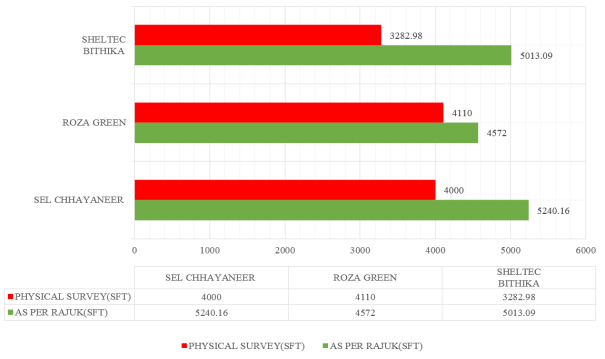
Physical surveys confirmed that none of the three selected apartment complexes meets the minimum regulatory requirement of allocating 10% of total land area to children's open play space, as stipulated by the DINB
| [10] | DINB, “Dhaka Imarat Nirman Bidhimala,” Ministry of Housing and Public Works, Government of Bangladesh., 2008. |
[10]
. However, all three complexes satisfy the secondary requirement that a minimum of 50% of the designated play area must be uncovered and open to the sky (
Figure 3). This pattern suggests selective compliance with measurable physical requirements while failing to meet more substantive area allocation mandates.
Figure 3. Presenting differences between the Rajuk-approved children's play area and the existing children’s open play area of three selected private apartment complexes.
4.2. Overall Checklist Performance
Based on the checklist observations detailed in the previous chapter, this section presents an analysis of the collected data. Through this analysis, statistical findings will be derived to assess the level of child-friendliness of children's open play areas, focusing on the criteria from the checklist in the three selected private apartment complexes.
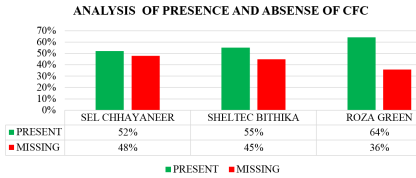
Figure 4. Analysis of the checklist in the selected case study buildings.
Aggregated checklist results indicate that, on average, 57% of child-friendly criteria are present across the three complexes, while 43% are absent. This finding reflects a marginally above-average level of provision against the established framework (
Figure 4), but conceals significant variation both between complexes and across parameters. The physical parameter—encompassing safety, accessibility, hygiene, facilities, and traffic management—recorded the most consistent deficiencies.
4.3. Physical Parameter
4.3.1. Safety and Security
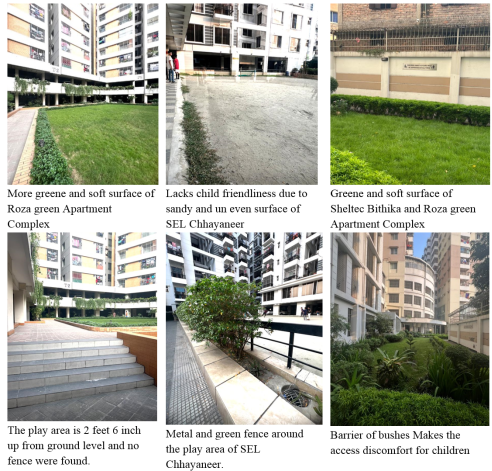
The level of child-friendliness under safety and security criteria varied considerably across the three sites. Roza Green and Sheltec Bithika provided well-maintained surface conditions but offered no play equipment, limiting children’s engagement and developmental benefit. SEL Chhayaneer provided play equipment but its maintenance had been neglected for an extended period, generating parental safety concerns. Roza Green’s play area is elevated 2 feet 6 inches above the surrounding ground level without adequate perimeter fencing, creating a fall risk. Both Sheltec Bithika and Roza Green were found to prioritize aesthetic landscaping over functional design, with the effect of restricting children’s freedom of movement. Security camera coverage was incomplete at all three sites. FGD data revealed that most children preferred to have a parent present during play, suggesting a perceived insecurity in the current provision.
Figure 5 demonstrates the observed and identified the several safety security criteria among the case study residential complexes.
Figure 5. Showing different criteria under safety security among the case study buildings.
4.3.2. Accessibility
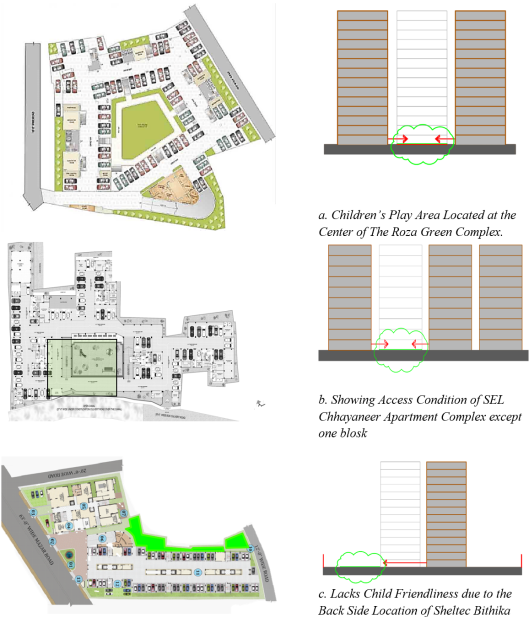
Overall physical accessibility to play areas is adequate across the three complexes, with all providing direct lobby-level access and an average walking time of approximately two minutes from residential units — findings corroborated by parent questionnaire responses. Roza Green and SEL Chhayaneer position their play areas at the building frontage, enhancing visibility and passive supervision, though one block within SEL Chhayaneer lacks direct access (
Figure 6a and b). Sheltec Bithika's rear-located play area is consistently associated with reduced attractiveness and lower use rates (
Figure 6c)
| [15] | K. Malone and P. Tranter, ““Children’s Environmental Learning and the Use, Design and Management of Schoolgrounds,” Child. Youth Environ., vol. 13, no. 2, pp. 87–137, 2003,
https://doi.org/10.1353/cye.2003.0040 |
| [16] | S. A. Norazlan and I. Said, “Understanding Children’s Preferences: Developing Ecological Literacy in the Village Landscape,” J. Adventure Educ. Outdoor Learn., vol. 23, no. 4, pp. 394–415, Oct. 2023,
https://doi.org/10.1080/14729679.2022.2027794 |
[15, 16]
. A notable safety concern at SEL Chhayaneer is the unmitigated intersection of the primary pedestrian access route with the vehicular driveway.
More consequential are the institutional barriers to access. Across all three complexes, a majority of surveyed parents reported that children are prohibited from using play areas outside management-prescribed time schedules. At Sheltec Bithika, this restriction is explicitly aesthetic in motivation — children's play is perceived by residents as incompatible with the space's visual upkeep. At SEL Chhayaneer, spatial insufficiency has necessitated an age-group rotation system, with afternoon play further prohibited due to noise concerns and restrictions intensifying during examination periods. At Roza Green, intermittent restrictions are imposed to protect ornamental vegetation. These schedule-bound access constraints limit children's opportunities for spontaneous play, physical activity, and the development of social and cognitive competencies
| [6] | M. Gao, X. Zhu, and X. Cheng, “Safety – Premise for Play: Exploring how Characteristics of Outdoor Play Spaces in Urban Residential Areas Influence Children’s Perceived Safety,” Cities, vol. 152, p. 105236, Sep. 2024,
https://doi.org/10.1016/j.cities.2024.105236 |
| [12] | P. Gray, Free to Learn: Why Unleashing the Instinct to Play will Make Our Children Happier, More Self-reliant, and Better Students for Life, First paperback edition. New York: Basic Books, 2015. |
[6, 12]
.
The most critical deficiency is the complete absence of disability-inclusive infrastructure across all three sites. No ramps, accessible pathways, or adapted entry points were identified, effectively excluding children with physical disabilities from the play environment and contravening internationally recognized inclusive design standards
| [2] | K. Chen, R. B. Roosli, Y. Zhao, and D. Wang, “A Literature Review on the Design of Children’s Outdoor Play Spaces from a Child-Friendly Perspective Combining Biomechanics,” Mol. Cell. Biomech., vol. 22, no. 2, p. 1422, Feb. 2025,
https://doi.org/10.62617/mcb1422 |
| [4] | UNICEF, “Building Child Friendly Cities : a Framework for Action,” United Nations Children’s Fund (UNICEF), UNICEF Innocenti Research Centre; Child Friendly Cities Initiative, 2004. Available: cfc-framework-eng – PDF. |
[2, 4]
.
Figure 6. Accessibility to the children play area in the case study buildings.
4.3.3. Hygine
Hygiene conditions vary considerably across the three complexes. SEL Chhayaneer presents the most significant deficiencies: persistent waterlogging from an inadequate drainage system, an absence of dedicated maintenance staff, and no provision of waste receptacles or a designated wash zone. When wash facilities are required, children must independently source a portable water pipe — an improvised arrangement reflecting a fundamental absence of planned hygiene infrastructure. These conditions were consistently corroborated by negative parent questionnaire responses and directly observable children's dissatisfaction during site visits.
Roza Green and Sheltec Bithika demonstrate comparatively higher standards, supported by dedicated maintenance personnel and functional drainage. Roza Green is the only complex to provide both a designated wash zone and waste receptacles — basic amenities absent from the remaining two sites.
These deficiencies carry measurable consequences. Inadequate hygiene increases children's exposure to infectious pathogens, allergens, and environmental contaminants, with documented implications for immune function and respiratory health
| [3] | M. J. N. Han and M. J. Kim, “A Critical Review of Child-Friendly Environments, Focusing on Children’s Experiential Perspectives on the Physical World for Sustainability,” Sustainability, vol. 10, no. 10, p. 3725, Oct. 2018,
https://doi.org/10.3390/su10103725 |
[3]
. Unhygienic conditions also suppress children's willingness to engage freely in play, reducing the physical, social, and cognitive developmental benefits that outdoor play environments are intended to deliver.
4.3.4. Facilities
Facility provision is inadequate across all three complexes in several key respects. No complex provides dedicated shade structures for children or parents; shade is incidentally obtained from adjacent parking overhangs and lobbies, which parents considered functionally sufficient. Seating for parents is provided only at SEL Chhayaneer, though respondents rated it as insufficient; Roza Green and Sheltec Bithika offer none. First-aid provision and dedicated drinking water stations are absent from all three sites — deficiencies explicitly flagged by parents as priority needs.
Night lighting is adequate at SEL Chhayaneer and Roza Green based on observation and parent feedback, but insufficient at Sheltec Bithika — a concern of particular significance given that evening play is the primary option for children of working parents.
Play area size was rated insufficient by the majority of parents across all sites. Sheltec Bithika received uniformly negative responses, its linear configuration rendering the space functionally unsuitable. Spatial constraints at SEL Chhayaneer have necessitated age-group rotation scheduling, while children at Roza Green have been observed appropriating the driveway as supplementary play space — an informal adaptation that highlights the severity of the spatial deficit and introduces unnecessary safety risks.
4.3.5. Traffic
All three complexes achieve a degree of physical separation between play areas and vehicular traffic. SEL Chhayaneer employs planted borders and metal fencing as barriers, though 60% of parent respondents expressed concern about an unsecured opening onto the ground-floor driveway. Sheltec Bithika's play area is shielded by a building overhang and supplementary planting. Roza Green's elevated position — 2 feet 6 inches above parking level — prevents direct vehicle intrusion, though the absence of a pedestrian barrier at the driveway crossing remains a parental concern.
While baseline traffic separation is satisfactory across all sites, unresolved access-point vulnerabilities temper this finding.
4.4. Environmental Parameter
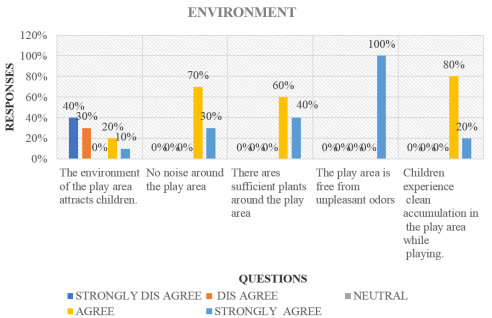
All three complexes satisfy foundational environmental conditions: play areas are free from malodour, shielded from arterial road noise, and open to the sky, ensuring adequate natural daylight. Ambient sound across all sites was limited to birdsong and children's voices — conditions conducive to focused, uninterrupted play. Night lighting is provided at SEL Chhayaneer and Roza Green, an important provision given that the majority of surveyed parents are employed during the day and rely on evening hours for quality time with their children. Sheltec Bithika's absence of night lighting is therefore a meaningful functional deficit for this user demographic (
Figure 7).
Vegetation management reflects divergent institutional priorities across the three sites. SEL Chhayaneer's management committee has deliberately minimized planting to reduce mosquito breeding and dust accumulation; however, this approach generated predominantly negative responses from both parents and children who valued greenery as an environmental quality indicator. Roza Green's committee demonstrates a stronger aesthetic orientation, actively supporting planting around the play area. Sheltec Bithika contains the densest vegetation of the three sites, though parents expressed the view that planting has been prioritized at the expense of usable play space. Critically, the combination of Sheltec Bithika's rear location, linear spatial configuration, and dense surrounding vegetation was found to reduce the play area's attractiveness and perceived child-friendliness — children reported feeling uncomfortable playing in this setting. As
Figure 7 indicates, parent dissatisfaction with environmental conditions at Sheltec Bithika was comparatively lower, reflecting the positive reception of its landscape management approach, though satisfaction with vegetation provision at SEL Chhayaneer and Roza Green was notably higher.
Figure 7. Parents' Responses on Environment Parameter at Sheltec Bithika.
4.5. Cognitive Parameter
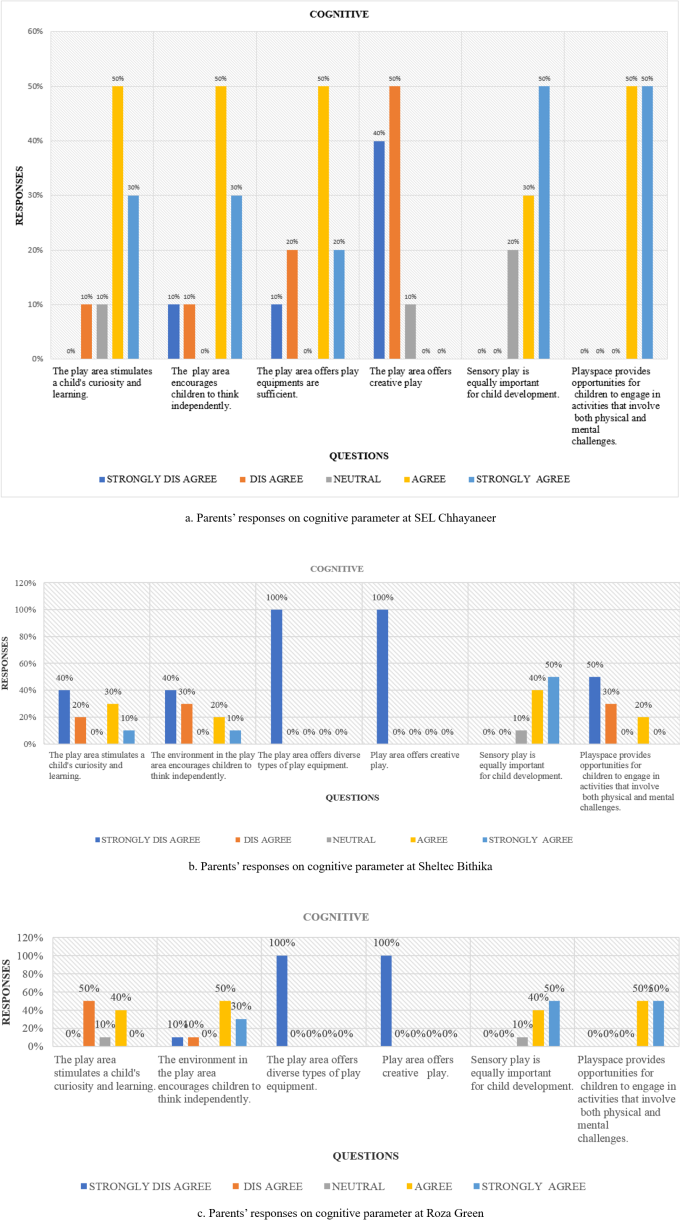
Cognitive provision is an area of consistent underperformance across all three complexes, despite high parental awareness of play's developmental value. At Roza Green, parents expressed concern about the limited variety of play opportunities and the insufficiency of equipment, recognizing that diversified play — encompassing active, creative, and sensory modes — is essential for cognitive growth. As shown in
Figure 8c, a significant proportion of Roza Green parents acknowledged awareness of different play types while simultaneously reporting dissatisfaction with current provision.
At Sheltec Bithika, 60% of surveyed parents disagreed that the existing play area stimulates curiosity and learning (
Figure 8b) — a finding that points to a critical gap between the space's physical configuration and its intended developmental function. The absence of varied, age-appropriate equipment directly constrains children's opportunities for reasoning, independent thinking, and exploratory behaviour.
SEL Chhayaneer presents a more nuanced picture. All surveyed parents recognized the importance of play for psychological and physical development, and 80% agreed that the play area encourages independent thinking — an encouraging finding (
Figure 8a). However, management-imposed time restrictions and uncertainty over equipment expansion — driven by concern that additional installations would reduce space for active play — introduce constraints that limit the realization of these developmental benefits in practice.
Across all three sites, the pattern is consistent: strong parental awareness of cognitive benefits is not matched by adequate spatial or equipment provision. The absence of creative, sensory, and imaginative play infrastructure represents the most significant cognitive gap identified in this study.
Figure 8. Parents’ responses on cognitive parameter in the case study buildings.
4.6. Social Parameter
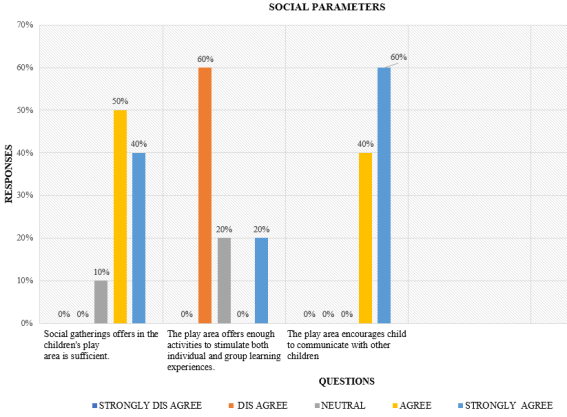
Social provision varies markedly across the three complexes. Roza Green achieves the highest social satisfaction, with 90% of surveyed parents expressing approval of organized social events, including cultural programmes, sports activities, and celebrity-attended award ceremonies. All Roza Green parents agreed that such activities positively support children's social learning and development, though parents noted that increased frequency and broader community participation would further strengthen outcomes (
Figure 9).
SEL Chhayaneer demonstrates a satisfactory level of social programming, with 70% of parents satisfied with organized gatherings. Resident-led sports and cultural events foster a tangible sense of community ownership, and all parents affirmed these activities' contribution to children's communicative and interactional development. Scope remains, however, to broaden participation across the resident community.
Figure 9. Parents' Responses on Social Parameter at Roza Green.
Sheltec Bithika presents the weakest social provision of the three sites. All surveyed parents expressed dissatisfaction with the complete absence of group activities and social gatherings within the play area. While some community events are organized in shared indoor spaces, no structured child-directed social programming occurs in the play area itself. This absence directly impairs children's opportunities to develop teamwork, peer communication, and collaborative skills — competencies that organized group play is uniquely positioned to cultivate
| [7] | N. J. Harper, “Outdoor Risky Play and Healthy Child Development in The Shadow of the ‘Risk Society’: A Forest and Nature School Perspective,” Child Youth Serv., vol. 38, no. 4, pp. 318–334, Oct. 2017,
https://doi.org/10.1080/0145935X.2017.1412825 |
[7]
.
5. Discussion
The findings of this study reveal a persistent and multi-dimensional gap between the regulatory intent of Bangladesh's residential planning frameworks and the reality of children's play environments in private apartment complexes in Dhaka. Despite legal mandates requiring minimum play area allocations, no complex in the sample fully complied with the 10% land area requirement—a finding consistent with broader patterns of selective regulatory enforcement in rapidly urbanizing contexts
| [17] | S. Hossain and Z. Tasnim, “Study on the Importance of Open Space Due to Create Dhaka as a Child Friendly City,” Asian J. Soc. Sci. Leg. Stud., vol. 2, no. 5, pp. 96–103, Sep. 2020,
https://doi.org/10.34104/ajssls.020.0960103 |
[17]
.
The physical parameter analysis highlights systemic deficiencies in safety infrastructure, accessible design, hygiene management, and functional facilities. The complete absence of disability-inclusive design features across all three sites is particularly concerning, reflecting a broader failure to operationalize inclusive design principles in Bangladesh's residential building sector. This finding aligns with UNICEF’s
| [4] | UNICEF, “Building Child Friendly Cities : a Framework for Action,” United Nations Children’s Fund (UNICEF), UNICEF Innocenti Research Centre; Child Friendly Cities Initiative, 2004. Available: cfc-framework-eng – PDF. |
[4]
assessment that child-friendly environments must be explicitly designed to accommodate children with diverse physical capacities.
The cognitive parameter findings underscore the risk that play areas function primarily as aesthetically managed green spaces rather than developmentally stimulating environments. The prioritization of beautification over functional play provision—observed most starkly at Roza Green and Sheltec Bithika—reflects a misalignment between management priorities and the developmental needs of child residents. Gray
| [12] | P. Gray, Free to Learn: Why Unleashing the Instinct to Play will Make Our Children Happier, More Self-reliant, and Better Students for Life, First paperback edition. New York: Basic Books, 2015. |
[12]
and Harper
| [7] | N. J. Harper, “Outdoor Risky Play and Healthy Child Development in The Shadow of the ‘Risk Society’: A Forest and Nature School Perspective,” Child Youth Serv., vol. 38, no. 4, pp. 318–334, Oct. 2017,
https://doi.org/10.1080/0145935X.2017.1412825 |
[7]
emphasize that the developmental benefits of play are contingent on children having access to varied, self-directed, and appropriately challenging environments—conditions that uniform, underequipped play areas cannot provide.
The social parameter findings illustrate those programmatic interventions—organized events, parental engagement, and community activity—can partially compensate for physical deficiencies, as evidenced by the higher satisfaction scores at Roza Green and SEL Chhayaneer. However, these interventions cannot substitute for adequate physical infrastructure and remain vulnerable to changes in management priorities.
Children's active coping behaviors—including the appropriation of driveways for play at Roza Green and the age-segregated time-slot system at SEL Chhayaneer—provide vivid evidence of the inadequacy of existing provision and the ingenuity with which children navigate spatial constraints. These adaptations, however, introduce safety risks and reflect institutional failures rather than child agency.
6. Recommendations
Based on the findings, the following evidence-based recommendations are offered for policymakers, planners, developers, and building management.
6.1. Policy and Regulatory Reform
1) The government should integrate mandatory child-friendly design standards into BNBC
and DINB
| [10] | DINB, “Dhaka Imarat Nirman Bidhimala,” Ministry of Housing and Public Works, Government of Bangladesh., 2008. |
[10]
, encompassing safety, accessibility, inclusivity, and developmental stimulation criteria.
2) RAJUK should conduct regular compliance monitoring of play area provisions and enforce penalties for violations to prevent regulatory circumvention.
3) Bangladesh should develop nationally adapted playground safety standards, drawing on established frameworks such as European EN 1176/1177 Standards
, and the American Disabilities Act (ADA)
, tailored to the local context.
4) The minimum uncovered play area requirement should be increased to improve access to natural light and ventilation.
5) Private developers should be required to prohibit post-handover modifications to play areas by residents or management committees that reduce the functional play area.
6.2. Physical Design
1) Play area surfaces should be safe, impact-absorbing, non-toxic, slip-resistant, and easy to maintain; hard materials such as concrete or ceramic tiles should be avoided.
2) All play areas must incorporate ramps, accessible pathways, and inclusive play opportunities for children with physical disabilities.
3) Play areas should be located at the front or center of complexes to maximize visibility, accessibility, and user engagement.
4) Shaded zones, parent seating, first aid facilities, and potable water stations must be provided as standard amenities.
5) Drainage systems should be designed with adequate slopes, covered drains, and rapid runoff capacity to prevent waterlogging and maintain hygiene.
6) Dedicated maintenance personnel and regular cleaning schedules are essential to sustain safe and hygienic conditions.
7) Designated wash zones with accessible handwashing facilities should be located adjacent to every play area.
8) Physical separation from vehicular traffic should be ensured through bollards, speed bumps, and continuous fencing or planting barriers.
9) Adequate nighttime lighting should be provided to support use by children of working parents and ensure safety during evening hours.
6.3. Cognitive and Play Design
1) Play areas should offer a diverse range of age-appropriate equipment and spaces supporting active, creative, and sensory play modalities.
2) Dedicated zones for imaginative and constructive play—including art areas, sensory gardens, and loose-parts play spaces—should be incorporated.
3) Equipment selection and layout should reflect children's input, as evidenced by participatory drawing activities and focus group findings.
4) Flexible use schedules should be established to allow children to access play areas at times of their own choosing.
6.4. Environmental Design
1) Planting schemes should balance aesthetic value with functionality, avoiding excessive vegetation that reduces usable play space or creates mosquito habitat.
2) Play areas should be designed with distinct activity zones to accommodate diverse play forms simultaneously.
3) Residents and management should be encouraged to prioritize children's functional use of green spaces over purely ornamental landscaping.
6.5. Community and Social Programming
1) Management committees should organize regular age-appropriate social events and collaborative activities to support children's social development.
2) Parent involvement in planning and participating in play area programming should be actively cultivated to build community ownership.
3) Awareness campaigns should be developed to inform residents of the long-term developmental benefits of child-friendly play provision.
7. Conclusion
This study provides a systematic, mixed-method evaluation of children's open play spaces in three private apartment complexes in Dhaka, Bangladesh. The findings reveal a consistent pattern of regulatory non-compliance, physical inadequacy, and developmental insufficiency in the provision of child-friendly play environments. None of the assessed complexes met the minimum land area allocation required by national building regulations, and systemic deficiencies were identified across safety, accessibility, hygiene, cognitive stimulation, and inclusive design dimensions.
These findings underscore the urgency of strengthening both the regulatory framework governing residential play provision and the enforcement mechanisms that give it operational effect. Bangladesh's National Children's Policy (BNCP)
| [8] | BNCP, “Bangladesh National Children’s Policy,” Ministry of Women and Children Affairs, Government of Bangladesh., 2011. |
[8]
articulates clear commitments to child-friendly environments, but the translation of this policy into built environment outcomes requires sustained attention from developers, planners, regulatory authorities, and resident communities alike.
This study is subject to limitations arising from its sample size of three complexes and 45 parent respondents, which constrains the generalizability of findings. Future research should expand the sample across a broader range of apartment complexes, residential zones, and socioeconomic profiles in Dhaka, and employ longitudinal methods to assess the impact of design and management interventions on children's play behavior and well-being. Participatory design approaches that meaningfully integrate children's voices in the planning and redesign of play spaces represent a particularly promising direction for future inquiry.
Ultimately, ensuring that children in Dhaka's apartment complexes have access to safe, stimulating, and inclusive play environments requires a collective commitment from all stakeholders in the residential development ecosystem. The creation of child-friendly cities begins with the spaces that children inhabit every day.
Abbreviations
ADA | American Disabilities Act |
BNBC | Bangladesh National Building Code |
BNCP | Bangladesh’s National Children’s Policy |
DINB | Dhaka Imarat Nirman Bidhimala |
EN | European Norms |
FGD | Focus Group Discussions |
RAJUK | Rajdhani Unnayan Kartripakkha |
SEL | Structural Engineers Limited |
UN | United Nations |
UNICEF | United Nations Children's Fund |
Acknowledgments
This paper is derived in part from the Master's thesis of the second author, submitted to the Department of Architecture, Ahsanullah University of Science and Technology, Dhaka, Bangladesh. The authors acknowledge the use of AI-assisted tools for sentence structuring and formatting during the preparation of this manuscript. The authors retain full responsibility for the intellectual content, analysis, and conclusions presented herein.
Author Contributions
Jasmin Ara Begum: Conceptualization, Supervision, Writing – original draft
Humayra Morshed: Conceptualization, Formal Analysis, Investigation, Methodology, Writing – original draft
Ayasha Siddiqua: Supervision, Validation, Writing – review & editing
Conflicts of Interest
The authors declare no conflicts of interest.
References
| [1] |
UN General Assembly, “Convention on the Rights of the Child,” United Nations, Treaty Series, 1577, 3., 1989. Available:
https://www.unicef.org/child-rights-convention
|
| [2] |
K. Chen, R. B. Roosli, Y. Zhao, and D. Wang, “A Literature Review on the Design of Children’s Outdoor Play Spaces from a Child-Friendly Perspective Combining Biomechanics,” Mol. Cell. Biomech., vol. 22, no. 2, p. 1422, Feb. 2025,
https://doi.org/10.62617/mcb1422
|
| [3] |
M. J. N. Han and M. J. Kim, “A Critical Review of Child-Friendly Environments, Focusing on Children’s Experiential Perspectives on the Physical World for Sustainability,” Sustainability, vol. 10, no. 10, p. 3725, Oct. 2018,
https://doi.org/10.3390/su10103725
|
| [4] |
UNICEF, “Building Child Friendly Cities : a Framework for Action,” United Nations Children’s Fund (UNICEF), UNICEF Innocenti Research Centre; Child Friendly Cities Initiative, 2004. Available: cfc-framework-eng – PDF.
|
| [5] |
UNICEF, “Unicef’s Programme Guidance for Early Childhood Development,” United Nations Children’s Fund (UNICEF), New York, NY 10017, USA, UNICEF Programme Division, 2017]. Available:
https://www.unicef.org/media/107616/file/UNICEF-Programme-%20Guidance-for-Early-Childhood-Development-2017.pdf
|
| [6] |
M. Gao, X. Zhu, and X. Cheng, “Safety – Premise for Play: Exploring how Characteristics of Outdoor Play Spaces in Urban Residential Areas Influence Children’s Perceived Safety,” Cities, vol. 152, p. 105236, Sep. 2024,
https://doi.org/10.1016/j.cities.2024.105236
|
| [7] |
N. J. Harper, “Outdoor Risky Play and Healthy Child Development in The Shadow of the ‘Risk Society’: A Forest and Nature School Perspective,” Child Youth Serv., vol. 38, no. 4, pp. 318–334, Oct. 2017,
https://doi.org/10.1080/0145935X.2017.1412825
|
| [8] |
BNCP, “Bangladesh National Children’s Policy,” Ministry of Women and Children Affairs, Government of Bangladesh., 2011.
|
| [9] |
BNBC, “Bangladesh National Building Code,” Housing and Building Research Institute, Ministry of Housing and Public Works, Government of Bangladesh., 2020. Available:
https://mccibd.org/wp-content/uploads/2021/09/Bangladesh-National-Building-Code-2020.pdf
|
| [10] |
DINB, “Dhaka Imarat Nirman Bidhimala,” Ministry of Housing and Public Works, Government of Bangladesh., 2008.
|
| [11] |
A. Ahmed, “Factors and Issues Related to Children’s Play and their Implications on Play and Recreation Provision in Dhaka City,” A Doctoral Thesis, Architecture, Building and Civil Engineering, Loughborough University, 2011.
https://hdl.handle.net/2134/7819
|
| [12] |
P. Gray, Free to Learn: Why Unleashing the Instinct to Play will Make Our Children Happier, More Self-reliant, and Better Students for Life, First paperback edition. New York: Basic Books, 2015.
|
| [13] |
P. H. Kahn and S. R. Kellert, Eds., Children and Nature: Psychological, Sociocultural, and Evolutionary Investigations. Cambridge, Massachusetts London, England: The MIT Press, 2002.
|
| [14] |
L. Chawla, “Childhood Place Attachments,” in Place Attachment, I. Altman and S. M. Low, Eds., Boston, MA: Springer US, 1992, pp. 63–86.
https://doi.org/10.1007/978-1-4684-8753-4_4
|
| [15] |
K. Malone and P. Tranter, ““Children’s Environmental Learning and the Use, Design and Management of Schoolgrounds,” Child. Youth Environ., vol. 13, no. 2, pp. 87–137, 2003,
https://doi.org/10.1353/cye.2003.0040
|
| [16] |
S. A. Norazlan and I. Said, “Understanding Children’s Preferences: Developing Ecological Literacy in the Village Landscape,” J. Adventure Educ. Outdoor Learn., vol. 23, no. 4, pp. 394–415, Oct. 2023,
https://doi.org/10.1080/14729679.2022.2027794
|
| [17] |
S. Hossain and Z. Tasnim, “Study on the Importance of Open Space Due to Create Dhaka as a Child Friendly City,” Asian J. Soc. Sci. Leg. Stud., vol. 2, no. 5, pp. 96–103, Sep. 2020,
https://doi.org/10.34104/ajssls.020.0960103
|
| [18] |
S. Sharmin, Children in Urban Parks: A Case Study of Dhaka, Bangladesh. LAP LAMBERT Academic Publishing, 2012.
|
| [19] |
S. Atmakur-Javdekar, “Childrens Play in Urban Areas,” in Play and Recreation, Health and Wellbeing, B. Evans, J. Horton, and T. Skelton, Eds., Singapore: Springer Singapore, 2016, pp. 109–133.
https://doi.org/10.1007/978-981-4585-51-4_3
|
| [20] |
G. Katsavounidou, “Child, Play, and Urban Space: A Historical Overview and a Holistic Paradigm for Child-Centered Urbanism,” J. Urban. Int. Res. Placemaking Urban Sustain., vol. 16, no. 4, pp. 430–446, Oct. 2023,
https://doi.org/10.1080/17549175.2021.2005120
|
| [21] |
CEN, “EN 1176 & EN 1177: European Standards for Playground Safety,” European Committee for Standardization, Brussels, 2018. Available:
https://www.scribd.com/document/439763324/PIC-Brochure2018-Final-pdf
|
| [22] |
ADA, “ACCESSIBLE PLAY AREAS: A Summary of Accessibility Guidelines for Play Areas,” United States Access Board, Department of Justice, Washington, DC: U.S.A., Americans with Disabilities Act (ADA), 2005. Available:
https://www.access-board.gov/files/ada/guides/play-areas.pdf
|
Cite This Article
-
APA Style
Begum, J. A., Morshed, H., Siddiqua, A. (2026). Assessing Child-friendliness of Open Play Areas in Dhaka's Private Apartment Complexes. International Journal of Architecture, Arts and Applications, 12(2), 71-84. https://doi.org/10.11648/j.ijaaa.20261202.13
 Copy
|
Copy
|
 Download
ACS Style
Begum, J. A.; Morshed, H.; Siddiqua, A. Assessing Child-friendliness of Open Play Areas in Dhaka's Private Apartment Complexes. Int. J. Archit. Arts Appl. 2026, 12(2), 71-84. doi: 10.11648/j.ijaaa.20261202.13
Copy
|
Download
AMA Style
Begum JA, Morshed H, Siddiqua A. Assessing Child-friendliness of Open Play Areas in Dhaka's Private Apartment Complexes. Int J Archit Arts Appl. 2026;12(2):71-84. doi: 10.11648/j.ijaaa.20261202.13
Copy
|
Download
-
@article{10.11648/j.ijaaa.20261202.13,
  author = {Jasmin Ara Begum and Humayra Morshed and Ayasha Siddiqua},
  title = {Assessing Child-friendliness of Open Play Areas in Dhaka's Private Apartment Complexes},
  journal = {International Journal of Architecture, Arts and Applications},
  volume = {12},
  number = {2},
  pages = {71-84},
  doi = {10.11648/j.ijaaa.20261202.13},
  url = {https://doi.org/10.11648/j.ijaaa.20261202.13},
  eprint = {https://article.sciencepublishinggroup.com/pdf/10.11648.j.ijaaa.20261202.13},
  abstract = {In the rapidly urbanizing city of Dhaka, the availability of open play spaces within private apartment complexes represents a critical yet systematically overlooked dimension of urban residential planning. With the rapid expansion of urban infrastructure and increasing land scarcity, unstructured outdoor play opportunities for children have significantly diminished. Bangladesh's National Children's Policy (BNCP) explicitly recognizes play as a fundamental right of children, stipulating that all environments inhabited by children should meet child-friendly standards. Existing regulations under Bangladesh National Building Code (BNBC) 2020 and Dhaka Imarat Nirman Bidhimala (DINB) 2008 mandate that private apartment complexes constructed on a minimum of 20 katha of land must allocate designated portions for children's open play areas. However, despite these regulatory frameworks, the degree to which these play areas satisfy child-friendly criteria remains largely unexplored, and the perspectives of primary users—parents and children—are seldom integrated into planning and evaluation processes. This study critically assesses the current state of children's open play spaces across three private apartment complexes in three distinct residential areas of Dhaka city. Employing a mixed-method approach, the research combines structured questionnaires administered to parents, focus group discussions with children, and a checklist-based physical assessment aligned with established child-friendly criteria. Furthermore, this study examines the degree of compliance with existing regulations governing children’s play spaces in apartment complexes. Findings reveal systemic deficiencies across physical, environmental, cognitive, and social parameters—including inadequate safety measures, restricted accessibility, poor hygiene management, and insufficient play equipment. No complex fully complied with the minimum regulatory requirement of allocating 10% of total land area to children's play space. These findings offer crucial insights into existing gaps in play area provision and inform the design of more effective strategies for future urban and residential development in Dhaka.},
 year = {2026}
}
Copy
|
Download
-
TY  - JOUR
T1  - Assessing Child-friendliness of Open Play Areas in Dhaka's Private Apartment Complexes
AU  - Jasmin Ara Begum
AU  - Humayra Morshed
AU  - Ayasha Siddiqua
Y1  - 2026/06/18
PY  - 2026
N1  - https://doi.org/10.11648/j.ijaaa.20261202.13
DO  - 10.11648/j.ijaaa.20261202.13
T2  - International Journal of Architecture, Arts and Applications
JF  - International Journal of Architecture, Arts and Applications
JO  - International Journal of Architecture, Arts and Applications
SP  - 71
EP  - 84
PB  - Science Publishing Group
SN  - 2472-1131
UR  - https://doi.org/10.11648/j.ijaaa.20261202.13
AB  - In the rapidly urbanizing city of Dhaka, the availability of open play spaces within private apartment complexes represents a critical yet systematically overlooked dimension of urban residential planning. With the rapid expansion of urban infrastructure and increasing land scarcity, unstructured outdoor play opportunities for children have significantly diminished. Bangladesh's National Children's Policy (BNCP) explicitly recognizes play as a fundamental right of children, stipulating that all environments inhabited by children should meet child-friendly standards. Existing regulations under Bangladesh National Building Code (BNBC) 2020 and Dhaka Imarat Nirman Bidhimala (DINB) 2008 mandate that private apartment complexes constructed on a minimum of 20 katha of land must allocate designated portions for children's open play areas. However, despite these regulatory frameworks, the degree to which these play areas satisfy child-friendly criteria remains largely unexplored, and the perspectives of primary users—parents and children—are seldom integrated into planning and evaluation processes. This study critically assesses the current state of children's open play spaces across three private apartment complexes in three distinct residential areas of Dhaka city. Employing a mixed-method approach, the research combines structured questionnaires administered to parents, focus group discussions with children, and a checklist-based physical assessment aligned with established child-friendly criteria. Furthermore, this study examines the degree of compliance with existing regulations governing children’s play spaces in apartment complexes. Findings reveal systemic deficiencies across physical, environmental, cognitive, and social parameters—including inadequate safety measures, restricted accessibility, poor hygiene management, and insufficient play equipment. No complex fully complied with the minimum regulatory requirement of allocating 10% of total land area to children's play space. These findings offer crucial insights into existing gaps in play area provision and inform the design of more effective strategies for future urban and residential development in Dhaka.
VL  - 12
IS  - 2
ER  -
Copy
|
Download





 Share This Article
 Twitter
 Linked In
 Facebook