Abstract
Digital transformation has emerged as a critical strategic challenge for organizations due to its profound implications for value creation, operational processes, and organizational structures. This article examines how organizations translate the promise of digital business models into effective operational practices by considering the interplay among digital technologies, collective routines, governance mechanisms, and industry-specific constraints. Drawing on an integrative review of the literature, the study synthesizes key conceptualizations of digital transformation and identifies limitations in prevailing approaches, which have largely emphasized technological and process-related dimensions while overlooking broader organizational dynamics. The analysis suggests that digital transformation extends beyond the adoption of digital technologies and should be understood as a systemic process involving the simultaneous reconfiguration of strategy, value creation mechanisms, organizational structures, and collective capabilities. Findings highlight the central role of the operating model as a critical mechanism through which the strategic intent embedded in digital business models is translated into coordinated organizational action. The study further emphasizes the importance of collective technology appropriation, organizational learning, governance arrangements, and the co-construction of practices in shaping transformation outcomes. By adopting a socio-technical perspective, the article develops an integrative framework that links strategy, business models, operating models, and human capabilities. This framework underscores that value creation and transformation success depend on the continuous interaction between technological systems, organizational actors, and contextual conditions. The article contributes to the digital transformation literature by advancing a more holistic understanding of its organizational determinants and by providing a conceptual foundation for future research and the effective implementation of digital initiatives in complex organizational environments.
1. Introduction
Digital transformation is now a key issue for organizations, whether they are public institutions, large corporations, or small and medium-sized enterprises. Academic and managerial discourse focuses on how digital technologies are changing value creation, business models, and operational processes. Discussions address both the effects of infrastructure and information systems and the implications for skills, organizational culture, and governance
| [3] | Bharadwaj, A., El Sawy, O. A., Pavlou, P. A., & Venkatraman, N. V. (2013). Digital business strategy: Toward a next generation of insights. MIS Quarterly, 37(2), 471–482. |
| [21] | Teece, D. J. (2018). Business models and dynamic capabilities. Long Range Planning, 51(1), 40–49. |
[3, 21]
. The growing importance of digital technology in contemporary strategies reflects the need to understand these transformations not merely as technological projects, but as systemic and socio-technical reconfigurations within organizations.
The existing literature has helped clarify several fundamental concepts. Yoo et al.
| [24] | Yoo, Y., Henfridsson, O., & Lyytinen, K. (2012). Research commentary—The new organizing logic of digital innovation: An agenda for information systems research. Information Systems Research, 21(4), 724–735. |
[24]
clearly distinguish between digitization—which involves converting analog media into digital formats—digitalization—focused on improving or automating existing processes—and digital transformation, which entails a simultaneous restructuring of strategy, value models, and organizational structures
| [9] | Gong, C., Parisot, X., & Reis, D. (2024). The evolution of digital transformation. In D. Schallmo, A. Baiyere, F. Gertsen, C. A. F. Rosenstand, & C. A. Williams (Eds.), Digital disruption and transformation: Case studies, approaches and tools (pp. 1–32). Springer. |
| [13] | Luppicini, R. (2020). Digital transformation and innovation explained: A scoping review of an evolving interdisciplinary field. In R. Luppicini (Ed.), Interdisciplinary approaches to digital transformation and innovation (pp. 1–21). IGI Global. |
[9, 13]
. This research has helped establish the constituent dimensions of digital transformation: the technological and informational dimensions, value models, and action structures, as well as the importance of strategic alignment and collective learning
| [22] | Vial, G. (2019). Understanding digital transformation: A review and a research agenda. The Journal of Strategic Information Systems, 28(2), 118–144. |
| [23] | Westerman, G., Bonnet, D., & McAfee, A. (2015). Leading digital: Turning technology into business transformation. Harvard Business Review Press. |
[22, 23]
.
Recent studies highlight the role of organizational competencies, culture, and routines as drivers of success, and identify the operational model as the key infrastructure that translates the promise of digital business models into concrete practices.
| [17] | Porter, M. E., & Heppelmann, J. E. (2014). How smart, connected products are transforming competition. Harvard Business Review, 92(11), 64–88. |
| [18] | Reix, R., Lebraty, J.-F., & Thibault, F. (2016). |
[17, 18]
.
However, certain dimensions remain under-explored or insufficiently integrated into current theoretical models. Existing research tends to prioritize technological and process-related aspects, at the expense of collective interactions, strategic trade-offs in the face of sectoral constraints, and the symbolic and political dimensions of transformations.
| [1] | Akrich, M., Callon, M., & Latour, B. (2006). Sociology of Translation: Founding Texts. |
| [7] | Crozier, M., & Friedberg, E. (1977). L’acteur et le système. Seuil. |
| [15] | Orlikowski, W. J., & Scott, S. V. (2008). 10 Sociomateriality: Challenging the separation of technology, work and organization. Academy of Management Annals, 2(1), 433–474. |
[1, 7, 15]
. This narrow focus can lead to incomplete interpretations of digital transformation, in which technology is perceived as an isolated driver rather than as an element integrated into a complex system combining actors, routines, governance, and organizational culture.
To overcome these limitations, it is necessary to adopt an explanatory framework capable of linking technological, informational, organizational, and human dimensions. The socio-technical approach, which considers the interaction between technological artifacts and groups of actors, offers a relevant theoretical framework for analyzing how organizations translate their digital ambitions into sustainable and adaptive operational practices
| [1] | Akrich, M., Callon, M., & Latour, B. (2006). Sociology of Translation: Founding Texts. |
| [4] | Bounfour, A. (Ed.). (2008). Organisational Capital. Taylor & Francis. |
[1, 4]
. This perspective allows for the integration of digital infrastructures and systems, decision-making processes, routines, and collective competencies, while also considering the feedback effects of usage and the co-construction of operational models.
Based on these observations, the central research question that this article seeks to address can be formulated as follows: “How do organizations translate the promise of their digital business model into effective operational practices, taking into account the interactions between technology, collective routines, governance, and sector-specific constraints? This question allows the analysis to focus on the systemic reconfiguration of technological, informational, and organizational dimensions, while emphasizing collective ownership and the sustainability of digital transformations.
By adopting this approach, the article aims to clarify concepts, elucidate the constituent dimensions of digital transformation, and identify theoretical gaps that offer avenues for future research. It proposes moving beyond the fragmented view of existing models by integrating strategy, business model, operational model, and human capabilities. This integrative framework not only offers an analytical perspective on digital transformations but also provides guidance for the effective implementation of digital initiatives in diverse and complex organizational contexts.
2. Digital Transformation: Definitions and Constituent Dimensions
2.1. Conceptual Framework
The literature on digital technology emphasizes that a thorough understanding of the concepts of digitization, digitalization, and digital transformation is essential for analyzing the organizational changes driven by technology. As Yoo et al.
| [24] | Yoo, Y., Henfridsson, O., & Lyytinen, K. (2012). Research commentary—The new organizing logic of digital innovation: An agenda for information systems research. Information Systems Research, 21(4), 724–735. |
[24]
point out, digitization refers to the simple conversion of analog media into digital formats. It is a technical process that formalizes information and facilitates its storage and dissemination, but does not affect organizational processes or value creation. Thus, digitization represents a necessary starting point for any digital initiative, but it remains limited to improving data management without producing strategic or structural changes.
Building on this, digitalization focuses on the use of technology to improve or automate existing processes. Bharadwaj et al.
| [3] | Bharadwaj, A., El Sawy, O. A., Pavlou, P. A., & Venkatraman, N. V. (2013). Digital business strategy: Toward a next generation of insights. MIS Quarterly, 37(2), 471–482. |
[3]
emphasize that digitalization increases operational efficiency, reduces costs, and improves service quality, while leaving the fundamental value model unchanged. Luppicini
| [13] | Luppicini, R. (2020). Digital transformation and innovation explained: A scoping review of an evolving interdisciplinary field. In R. Luppicini (Ed.), Interdisciplinary approaches to digital transformation and innovation (pp. 1–21). IGI Global. |
[13]
emphasizes that these initiatives—such as implementing a CRM system or automating administrative tasks—represent significant improvements but do not transform customer relationships, revenue streams, or organizational structures. From this perspective, digitization is clearly distinct from digital transformation due to its primarily incremental and functional focus.
Digital transformation, on the other hand, involves a simultaneous and systemic restructuring of multiple dimensions of the organization. Gong et al.
| [9] | Gong, C., Parisot, X., & Reis, D. (2024). The evolution of digital transformation. In D. Schallmo, A. Baiyere, F. Gertsen, C. A. F. Rosenstand, & C. A. Williams (Eds.), Digital disruption and transformation: Case studies, approaches and tools (pp. 1–32). Springer. |
[9]
note that this process is not limited to the introduction of technologies, but profoundly transforms strategy, value models, governance, and organizational structures. Digital transformation leverages technology as a strategic tool to redesign offerings and services, create new revenue streams, and adapt processes in an integrated manner. Luppicini
| [13] | Luppicini, R. (2020). Digital transformation and innovation explained: A scoping review of an evolving interdisciplinary field. In R. Luppicini (Ed.), Interdisciplinary approaches to digital transformation and innovation (pp. 1–21). IGI Global. |
[13]
emphasizes that the success of this process depends on aligning strategic vision, organizational capabilities, and control over information flows, thereby strengthening the creation of sustainable value.
It is important to consider the progressive trajectory of digital adoption to understand the conceptual positioning. According to Vial
| [22] | Vial, G. (2019). Understanding digital transformation: A review and a research agenda. The Journal of Strategic Information Systems, 28(2), 118–144. |
[22]
, organizations often begin their journey with digitization, proceed to digitalization, and achieve full digital transformation when they combine technology, strategy, and governance. This trajectory can vary, however: some companies stagnate at the digitization stage, while others directly adopt hybrid models, integrating digital platforms and ecosystems. Elia et al.
| [8] | Elia, G., Solazzo, G., Lerro, A., Pigni, F., & Tucci, C. L. (2024). The digital transformation canvas: A conceptual framework for leading the digital transformation process. Business Horizons, 67(4), 381–398. |
[8]
emphasize the central role of organizational competencies and corporate culture in the success of transformations, demonstrating that technology alone is never enough.
Finally, this conceptual framework highlights the systemic and socio-technical nature of digital transformation. Digital transformation does not consist merely of adopting digital tools, but rather of the simultaneous restructuring of strategies, processes, structures, and social practices within the organization. As Teece
| [21] | Teece, D. J. (2018). Business models and dynamic capabilities. Long Range Planning, 51(1), 40–49. |
[21]
notes, this reconfiguration has a lasting impact on value creation, organizational performance, and the learning capacity of groups. Adopting this narrative perspective helps clarify conceptual distinctions and guide academic and managerial analysis of digital initiatives by placing the organization, its practices, and its structures at the center of attention.
To better illustrate the progression of digital maturity within organizations,
Table 1 provides a comparative overview of the three key stages: digitization, digitalization, and digital transformation. This table highlights the specific technological tools, process adaptations, organizational impacts, and value creation mechanisms unique to each stage. By synthesizing these dimensions, it clarifies how organizations evolve, moving from simple data conversion to fully integrated digital strategies that enable both efficiency gains and systemic value creation. This comparative perspective underscores the growing complexity and interdependence of technological, organizational, and strategic factors as digital maturity progresses.
Table 1. Comparative Overview of Digital Maturity Stages and Their Organizational implications.
Maturity Stage | Technology | Processes | Organizational Impact | Value Proposition |
Digitization | Conversion of analog to digital formats | No major changes | Minimal impact on structure | Basic efficiency gains, data storage |
Digitalization | Use of digital tools for process improvement | Automation and optimization of workflows | Some process adjustments, functional focus | Cost reduction, service quality improvement |
Digital Transformation | Advanced technologies (AI, IoT, Cloud) integrated strategically | Reconfiguration and integration of processes | Structural and cultural changes, cross-functional coordination | New revenue streams, enhanced customer experience, systemic value creation |
Source: elaborated based on Yoo et al., 2012; Vial, 2019; Gong et al., 2024.
2.2. Key Dimensions of Digital Transformation
The first dimension technology forms the hardware and software foundation of digital transformation. Modern digital infrastructures, including the cloud, the Internet of Things (IoT), and artificial intelligence (AI), enable the reconfiguration of organizational assets and processes. According to Bharadwaj et al.
| [3] | Bharadwaj, A., El Sawy, O. A., Pavlou, P. A., & Venkatraman, N. V. (2013). Digital business strategy: Toward a next generation of insights. MIS Quarterly, 37(2), 471–482. |
[3]
, these technologies are not limited to automating tasks; rather, they offer new levers for designing innovative services, optimizing workflows, and reducing costs. Vial
| [22] | Vial, G. (2019). Understanding digital transformation: A review and a research agenda. The Journal of Strategic Information Systems, 28(2), 118–144. |
[22]
emphasizes that the ability to integrate these technologies in a manner consistent with existing business operations determines the depth and effectiveness of the transformation.
The second dimension, the informational dimension, relies on the collection, integration, and analysis of data to support decision-making and create value. Yoo et al.
| [24] | Yoo, Y., Henfridsson, O., & Lyytinen, K. (2012). Research commentary—The new organizing logic of digital innovation: An agenda for information systems research. Information Systems Research, 21(4), 724–735. |
[24]
emphasize the role of data as the central driver of transformation, enabling the identification of opportunities, the personalization of offerings, and the anticipation of customer needs. This dimension also involves building robust analytical infrastructures and developing data literacy skills within teams, so that information can be interpreted and translated into concrete actions;
| [8] | Elia, G., Solazzo, G., Lerro, A., Pigni, F., & Tucci, C. L. (2024). The digital transformation canvas: A conceptual framework for leading the digital transformation process. Business Horizons, 67(4), 381–398. |
[8]
.
The third dimension concerns value models, which are evolving toward hybrid, modular, and multifaceted configurations. Digital transformation is changing the way organizations capture and create value by integrating recurring revenue streams, digital services, and interactions with partner ecosystems.
| [16] | Osterwalder, A., & Pigneur, Y. (2011). Aligning profit and purpose through business model innovation. In Responsible management practices for the 21st century (pp. 61–76). |
| [21] | Teece, D. J. (2018). Business models and dynamic capabilities. Long Range Planning, 51(1), 40–49. |
[16, 21]
. This evolution requires rethinking the traditional offer–customer–revenue triad to ensure alignment between value propositions, financial flows, and stakeholder expectations.
The fourth dimension, action structures, encompasses the routines, coordination, and organizational culture that enable the implementation of technological and informational changes. As noted by Orlikowski
| [14] | Orlikowski, W. J. (2000). Using technology and constituting structures: A practice lens for studying technology in organizations. Organization Science, 11(4), 404–428. |
[14]
and Leonardi
| [12] | Leonardi, P. M. (2011). When flexible routines meet flexible technologies: Affordance, constraint, and the imbrication of human and material agencies. MIS Quarterly, 35(1), 147–167. |
[12]
, technology alone is not enough: its adoption depends on teams’ ability to adjust practices, collaborate, and integrate new routines into daily operations. Digital transformation thus involves a simultaneous restructuring of roles, responsibilities, and decision-making processes to stabilize new practices and reduce organizational friction.
Recent literature emphasizes strategic alignment and dynamic coherence among these four dimensions. Teece
| [21] | Teece, D. J. (2018). Business models and dynamic capabilities. Long Range Planning, 51(1), 40–49. |
[21]
and Vial
| [22] | Vial, G. (2019). Understanding digital transformation: A review and a research agenda. The Journal of Strategic Information Systems, 28(2), 118–144. |
[22]
stress that the success of digital transformation depends on the ability to simultaneously orchestrate technologies, data, value models, and operational structures. High-performing companies combine a clear strategic vision, a coherent organizational architecture, and learning mechanisms, which enables them to maintain flexibility in the face of rapid market changes.
Certain dimensions, often implicit, are essential to ensuring the effectiveness of digital transformation. The formalization of learning routines, the collective adoption of digital tools, and the alignment between operational objectives and institutional constraints determine the sustainability of change. As Westerman et al.
| [23] | Westerman, G., Bonnet, D., & McAfee, A. (2015). Leading digital: Turning technology into business transformation. Harvard Business Review Press. |
[23]
, the integration of human practices, a culture of experimentation, and the governance of information systems help transform technology adoption into a sustainable strategic advantage by strengthening the organization’s dynamic capabilities.
3. The Operational Model: Translating the Digital Business Model
3.1. Components and Socio-technical Infrastructure of the Operational Model
The operational model is defined as the central socio-technical infrastructure that enables the promise made by a digital business model to be fulfilled. It translates strategic choices into concrete practices, simultaneously integrating technologies, human resources, routines, and organizational processes. As Porter and Heppelmann
| [17] | Porter, M. E., & Heppelmann, J. E. (2014). How smart, connected products are transforming competition. Harvard Business Review, 92(11), 64–88. |
[17]
point out, the value of an operational model lies not only in its individual components, but in how they interact to stabilize collective action, ensure the repeatability of tasks, and enable adaptation to technological and contextual changes.
The first component, processes, encompasses all the sequences of activities and operational routines that orchestrate the production and delivery of value. Process-based governance enables the formalization of responsibilities, interdependencies, and decision-making flows, while integrating digital tools such as BPM (Business Process Management) and RPA (Robotic Process Automation) to automate and track operations end-to-end. Reix et al.
| [18] | Reix, R., Lebraty, J.-F., & Thibault, F. (2016). |
[18]
demonstrate that the robustness of digital processes determines the effectiveness of digital transformation and the ability to simultaneously manage standardization and flexibility.
Resources and skills form the second pillar, encompassing technical expertise, organizational routines, and the analytical capabilities of teams. The adoption of advanced technologies requires strengthening digital skills and “data literacy,” as well as the gradual adoption of new practices. As Westerman et al.
| [23] | Westerman, G., Bonnet, D., & McAfee, A. (2015). Leading digital: Turning technology into business transformation. Harvard Business Review Press. |
[23]
, the sustainable performance of an operational model depends on the interaction between individual and collective skills and technological systems, enabling the transformation of knowledge into effective action and supporting continuous innovation.
Information systems, governance, and management are essential levers for coordination and performance measurement. Information systems ensure cross-functional integration of workflows and the traceability of activities, while governance—structured through decision-making channels, business committees, and principles such as “privacy by design”—guarantees compliance, security, and the legitimacy of decisions. Steering mechanisms, through digital dashboards and financial, operational, and customer experience indicators, create learning loops that enable the adjustment of practices and maintain the dynamic coherence of the operational model.
| [17] | Porter, M. E., & Heppelmann, J. E. (2014). How smart, connected products are transforming competition. Harvard Business Review, 92(11), 64–88. |
| [18] | Reix, R., Lebraty, J.-F., & Thibault, F. (2016). |
[17, 18]
.
Together, these components form an integrated system that translates strategic intentions into concrete actions, ensuring consistent execution while maintaining the ability to adapt to technological and organizational uncertainties.
3.2. Digitalization and Organizational Restructuring
Digitalization, beyond the mere adoption of technologies, acts as a catalyst for organizational restructuring. Organizations facing digital transformation are compelled to rethink their traditional structures to better align internal capabilities with the demands of new digital business models. Traditional functional units are gradually giving way to product- or service-centric structures, promoting modularity and a more distributed hierarchy. This structural evolution, described by Teece
| [20] | Teece, D. J. (2010). Business models, business strategy and innovation. Long Range Planning, 43(2-3), 172–194. |
[20]
, enables not only better resource allocation but also greater responsiveness to market dynamics and customer expectations, strengthening the organization’s ability to translate its strategic promises into tangible results.
At the same time, organizational governance is undergoing a significant restructuring. Polycentric approaches, which distribute decision-making among various specialized entities or sector-specific committees, offer greater flexibility and the ability to make quicker decisions on issues related to data, technological priorities, and strategic initiatives. Westerman and colleagues
| [23] | Westerman, G., Bonnet, D., & McAfee, A. (2015). Leading digital: Turning technology into business transformation. Harvard Business Review Press. |
[23]
emphasize that these adjustments help reconcile local autonomy with overall consistency, guiding innovation while preventing the fragmentation of decisions and practices. Digital governance thus involves creating new coordination mechanisms, where data committees, product councils, and cross-functional forums become essential tools for steering and oversight, while supporting experimentation and organizational learning.
Digitalization is embodied in the integration of digital processes at the heart of operational activities. Advanced analytics tools, such as machine learning or A/B testing, are not limited to optimizing operations but transform the way the organization makes decisions and adjusts its offerings. This process integration simultaneously improves efficiency, the quality of the customer experience, and the ability to adapt to market disruptions. Teece
| [20] | Teece, D. J. (2010). Business models, business strategy and innovation. Long Range Planning, 43(2-3), 172–194. |
[20]
and Westerman et al.
| [23] | Westerman, G., Bonnet, D., & McAfee, A. (2015). Leading digital: Turning technology into business transformation. Harvard Business Review Press. |
[23]
emphasize that the effectiveness of the digital operating model depends on this integration of structure, governance, and processes, which determines value creation, continuous innovation, and the long-term sustainability of transformations.
3.3. Skills, Roles, and Adoption
Digital transformation cannot be achieved without harnessing human skills within organizational teams. As Argyris and Schön
| [2] | Argyris, C., & Schön, D. A. (1996). Organizational learning II: Theory, method, and practice. Addison-Wesley. |
[2]
emphasized, organizational learning is a fundamental driver for adapting routines and embedding new practices. Collectives play a central role in the adoption of digital tools, as they are the ones who translate technological innovations into operational uses that are relevant and consistent with strategic objectives. Without this collective adoption, technologies remain underutilized, and the promises of digital business models risk failing to materialize.
The rise of hybrid roles is a direct response to this need for an interface between technology and business. Data analysts, product owners, and UX researchers combine analytical, technical, and organizational skills, enabling them to link data, information systems, and operational processes to business needs
| [5] | Cardon, D. (2015). What Algorithms Dream Of: Our lives in the Age of Big Data. Media Diffusion. |
[5]
. These emerging roles facilitate the design of tailored solutions, the prioritization of digital initiatives, and the promotion of a shared digital culture, while reducing risks associated with misunderstanding or underutilization of technological tools.
Adoption of digital technologies also relies on mechanisms of situated learning and co-design. Orlikowski
| [14] | Orlikowski, W. J. (2000). Using technology and constituting structures: A practice lens for studying technology in organizations. Organization Science, 11(4), 404–428. |
[14]
has shown that the successful integration of information systems depends less on the technology itself than on the daily practices and routines developed by users. By experimenting, adjusting, and discussing uses, groups gradually build shared knowledge that stabilizes adoption and facilitates the spread of innovations. This approach highlights teams’ ability to explore the tools’ possibilities while respecting organizational and operational constraints.
Managing zones of uncertainty is another key factor in adoption. Groups faced with rapidly evolving technologies must learn to manage ambiguity, risks, and potential errors while maintaining business continuity
| [2] | Argyris, C., & Schön, D. A. (1996). Organizational learning II: Theory, method, and practice. Addison-Wesley. |
[2]
. On-the-job training programs, mentoring sessions, and internal discussion forums help reduce these uncertainties and build user confidence in the relevance and reliability of digital solutions. Cardon
| [5] | Cardon, D. (2015). What Algorithms Dream Of: Our lives in the Age of Big Data. Media Diffusion. |
[5]
emphasizes the role of reflective practices, where teams step back to assess their actions and adjust strategies and behaviors in real time.
Digital adoption involves a normative and social dimension that goes beyond mere technical proficiency. As Orlikowski
| [14] | Orlikowski, W. J. (2000). Using technology and constituting structures: A practice lens for studying technology in organizations. Organization Science, 11(4), 404–428. |
[14]
points out, the integration of tools into routines also depends on shared perceptions, the meaning attributed to technologies, and the legitimacy of emerging practices. Groups that co-create uses and participate in defining hybrid roles not only promote operational efficiency but also foster the consolidation of a sustainable digital culture capable of supporting continuous transformation and innovation within the organization.
4. Governance, Learning, and Performance
Governance is a key driver of successful digital transformations, as it defines the rules, responsibilities, and coordination mechanisms necessary to align technology, strategy, and operations. As Leite et al.
| [11] | Leite, C. M., Figueiredo, P. S., & Maravilhas-Lopes, S. (2024). Conceptualizing digital transformation: Base dimensions for building a framework. In Digital transformation initiatives for agile marketing (pp. 43–66). IGI Global. |
[11]
, governance is not limited to steering committees or decision-making charters: it also encompasses the ability to balance security, innovation, and experimentation, and to ensure the consistency of initiatives across all units of the organization. Effective governance thus promotes the convergence of objectives and reduces conflicts between operational and strategic priorities, while facilitating the adoption of digital practices.
Management systems and data analytics play a complementary role by translating strategy into operational metrics and learning loops. Kaplan and Norton
| [10] | Kaplan, R. S., & Norton, D. P. (1998). The balanced scorecard: Translating strategy into action. Harvard Business School Press. |
[10]
demonstrated that balanced scorecards help link financial performance, service quality, and organizational learning, providing a framework for measuring the value generated by digital initiatives. Integrating these tools with real-time analytics systems enables the tracking of operational flows and customer interactions, while providing teams with benchmarks to adjust their actions and strengthen alignment between value propositions and execution.
The effectiveness of these tools depends largely on teams’ ability to interpret and integrate information into adaptive routines. Westerman et al.
| [23] | Westerman, G., Bonnet, D., & McAfee, A. (2015). Leading digital: Turning technology into business transformation. Harvard Business Review Press. |
[23]
have shown that organizations where teams actively analyze data, discuss results, and review practices derive greater benefits from digitalization. In this context, managerial routines—such as regular committee meetings, performance reviews, and process adjustment sessions—become mechanisms for learning and stabilizing practices, transforming raw data into concrete decisions and actions.
Human and social dimensions emerge as key determinants of the sustainability of digital transformations. Buy-in, trust, and collective learning help build the dynamic capabilities needed to adapt to ongoing change
| [2] | Argyris, C., & Schön, D. A. (1996). Organizational learning II: Theory, method, and practice. Addison-Wesley. |
[2]
. As Cardon
| [5] | Cardon, D. (2015). What Algorithms Dream Of: Our lives in the Age of Big Data. Media Diffusion. |
[5]
observes, these dimensions are often absent from technology-centric frameworks, yet they determine organizations’ ability to stabilize new routines and ensure that teams sustainably adopt digital tools.
Organizational learning plays a dual role: it supports teams’ development of technical and methodological skills while strengthening reflexivity regarding practices and decisions. According to Orlikowski
| [14] | Orlikowski, W. J. (2000). Using technology and constituting structures: A practice lens for studying technology in organizations. Organization Science, 11(4), 404–428. |
[14]
, successful digital transformation relies on a combination of individual and collective learning, where employees interpret signals from the digital system, adjust their practices, and contribute to the evolution of routines. Discussion forums, communities of practice, and structured feedback sessions are thus key instruments for transforming information into actionable organizational knowledge.
The long-term success of digital transformation depends on the interplay between governance, tools, and the human element. Teece
| [21] | Teece, D. J. (2018). Business models and dynamic capabilities. Long Range Planning, 51(1), 40–49. |
[21]
emphasizes that strategic alignment and process consistency are not enough if teams lack the capabilities to leverage systems and translate data into action. High-performing organizations succeed in combining appropriate control structures, relevant measurement tools, and strong collective commitment, ensuring not only the achievement of immediate objectives but also the consolidation of a capacity for continuous adaptation in the face of technological advancements and market changes.
Following this analysis, it becomes clear that digital transformation and the operational implementation of business models cannot be understood in isolation. Technological, informational, organizational, and human dimensions interact dynamically, shaped by sector-specific constraints, governance, and collective ownership.
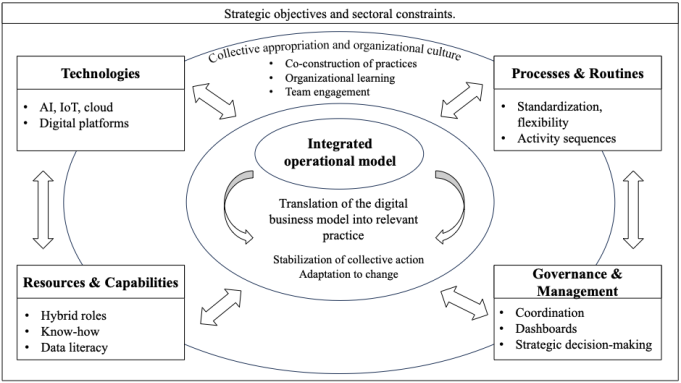
Figure 1 illustrates an integrated model synthesizing these interactions: it highlights how digital artifacts, collective routines, and steering mechanisms combine to stabilize operational practices and support the creation of sustainable value. This diagram illustrates the overall architecture of digital transformation and serves as a conceptual framework to guide both academic discourse and the practical implementation of digital initiatives within organizations.
Figure 1. Integrated Model of Digital Transformation and the Operational Translation of Digital Business Models.
5. Discussion
5.1. Under-explored Theoretical Dimensions
The conceptual overview presented above highlights the wealth of research on digital transformation and the digitization of business models. However, despite the abundance of research on technologies, processes, and business models, several dimensions remain insufficiently explored. Existing analyses often focus on digital infrastructure, process reconfiguration, or organizational performance measured by financial and operational indicators. They tend to overlook collective dynamics, socio-technical interactions, institutional constraints, and the symbolic dimension of these transformations. These omissions reveal significant gaps in understanding how organizations translate the promise of the digital business model into sustainable practices tailored to each organization’s specific context.
1) Collective ownership and governance of routines
The collective ownership of technologies is a central yet largely under-theorized factor. The work of Orlikowski
| [14] | Orlikowski, W. J. (2000). Using technology and constituting structures: A practice lens for studying technology in organizations. Organization Science, 11(4), 404–428. |
[14]
and Argyris and Schön
| [2] | Argyris, C., & Schön, D. A. (1996). Organizational learning II: Theory, method, and practice. Addison-Wesley. |
[2]
suggests that digital transformation is not merely the introduction of new tools: it implies that groups adapt, reinterpret, and consolidate organizational routines to integrate these technologies. However, current literature focuses primarily on process formalization or individual competencies, neglecting group dynamics, implicit negotiations, and how teams build shared practices. Cardon
| [5] | Cardon, D. (2015). What Algorithms Dream Of: Our lives in the Age of Big Data. Media Diffusion. |
[5]
emphasizes that situated learning and collective experimentation are essential for digital routines to become effective, yet these aspects are rarely operationalized in existing models.
A second critical perspective concerns the governance of routines. Routines are not neutral entities; they reflect strategic choices, organizational trade-offs, and compromises between exploration and exploitation Teece,
| [20] | Teece, D. J. (2010). Business models, business strategy and innovation. Long Range Planning, 43(2-3), 172–194. |
[20]
. Reix et al.
| [18] | Reix, R., Lebraty, J.-F., & Thibault, F. (2016). |
[18]
highlight that teams’ ability to maintain the consistency of routines in the face of technological changes depends on appropriate steering tools and flexible coordination mechanisms. The current literature offers little conceptual framework for analyzing these interactions, leaving a theoretical gap regarding how the collective governance of routines contributes to the success of digital transformation.
2) Socio-technical co-construction
Co-construction between actors and technical artifacts represents another under-explored dimension. Akrich et al.
| [1] | Akrich, M., Callon, M., & Latour, B. (2006). Sociology of Translation: Founding Texts. |
[1]
and Bounfour
| [4] | Bounfour, A. (Ed.). (2008). Organisational Capital. Taylor & Francis. |
[4]
point out that digital artifacts are not merely tools: they structure practices, create constraints, and open up opportunities for action. The interaction between users and systems thus shapes the operational model and directly influences the effectiveness of the digital business model. However, most research focuses on technology as a given or a resource, without examining the processes of appropriation and local modification of tools.
A second aspect concerns the feedback effects of this co-construction. Westerman et al.
| [23] | Westerman, G., Bonnet, D., & McAfee, A. (2015). Leading digital: Turning technology into business transformation. Harvard Business Review Press. |
[23]
have shown that groups that adapt and customize systems create feedback loops that modify processes, culture, and organizational structures alike. These mechanisms are essential for explaining why some transformation initiatives succeed while others fail, and they remain insufficiently integrated into current theoretical models.
Socio-technical co-construction has implications for the formation of professional identities and communities of practice. Argyris and Schön
| [2] | Argyris, C., & Schön, D. A. (1996). Organizational learning II: Theory, method, and practice. Addison-Wesley. |
[2]
emphasize that the dynamics between technical artifacts and human actors influence reflexivity, trust, and commitment in digital projects. This perspective highlights the need for an integrative analysis that simultaneously considers technology, processes, and communities as co-actors in digital transformation.
3) Alignment between strategic objectives and sector-specific constraints
Regulations, standards, and legacy systems constitute structural and institutional constraints that few studies systematically take into account. Vial
| [22] | Vial, G. (2019). Understanding digital transformation: A review and a research agenda. The Journal of Strategic Information Systems, 28(2), 118–144. |
[22]
emphasizes that digital transformation trajectories depend on adapting strategic objectives to sectoral contexts, which involves balancing organizational ambitions against external constraints. Most existing models assume a certain neutrality of the context, which limits our understanding of the feasibility and relevance of operational choices.
A second critical point concerns the translation of strategic objectives into concrete practices. Colli et al.
| [6] | Colli, M., Cavalieri, S., Cimini, C., Madsen, O., & Wæhrens, B. V. (2020). Digital transformation strategies for achieving operational excellence: A cross-country evaluation. In Proceedings of the 53rd Hawaii International Conference on System Sciences (HICSS). |
[6]
have shown that legacy organizations often must contend with existing systems, which necessitates adjustments in process planning and in the sequencing of digital projects. Few studies provide frameworks for integrating these dimensions, leaving a gap in our understanding of how sector-specific constraints influence the effective implementation of digital business models.
The strategic-institutional nexus is also linked to innovation capacity. Sebastian et al.
| [19] | Sebastian, I. M., Ross, J. W., Beath, C., Mocker, M., Moloney, K., & Fonstad, N. (2017). How big old companies navigate digital transformation. MIS Quarterly Executive, 16(3), 197–213. |
[19]
note that companies that successfully combine regulatory constraints with strategic ambitions exploit room for maneuver in the design of processes, information systems, and decision-making flows. The literature remains fragmented regarding the mechanisms for navigating these constraints while maintaining the effectiveness and coherence of the operational model.
4) Symbolic and Political Dimension
Digital transformation is not limited to technical or economic aspects; it also has a symbolic and political dimension. As Crozier and Friedberg
| [7] | Crozier, M., & Friedberg, E. (1977). L’acteur et le système. Seuil. |
[7]
have shown, organizational and technological choices influence the legitimization of professional identities, the distribution of power, and internal trade-offs. This dimension is rarely conceptualized in existing models, which tend to treat technology and processes as neutral entities.
A second point concerns the impact of this dimension on collective ownership and engagement. Digital tools become vehicles for recognition and status within teams, influencing motivation, trust, and cooperation
| [15] | Orlikowski, W. J., & Scott, S. V. (2008). 10 Sociomateriality: Challenging the separation of technology, work and organization. Academy of Management Annals, 2(1), 433–474. |
[15]
. Taking these symbolic and political effects into account is therefore crucial for understanding the success or failure of digital transformation initiatives and for designing truly inclusive operational models.
The gaps identified in the literature represent not only theoretical limitations; they also constitute significant research opportunities. Collective ownership and the governance of routines offer a field of investigation to explore how collectives adapt and stabilize practices in the face of technological change. Socio-technical co-construction suggests studying the feedback loops between actors and artifacts and their impact on organizational performance. An analysis of the relationship between strategic objectives and sectoral constraints could shed light on how companies navigate between ambition and regulations, while the symbolic and political dimension opens the way for research on the legitimization of professional identities and internal governance.
Thus, these gaps highlight the need for an integrative approach that combines strategy, business model, operational model, and human capabilities. Future research could adopt in-depth qualitative methods, such as participant observation or longitudinal case studies, to capture the complexity of these interactions and propose more comprehensive and actionable analytical frameworks
| [22] | Vial, G. (2019). Understanding digital transformation: A review and a research agenda. The Journal of Strategic Information Systems, 28(2), 118–144. |
| [23] | Westerman, G., Bonnet, D., & McAfee, A. (2015). Leading digital: Turning technology into business transformation. Harvard Business Review Press. |
[22, 23]
. In this sense, the identified theoretical gaps constitute not only a critical observation but also a lever for advancing the understanding of digital transformation and its effective implementation in contemporary organizations.
5.2. Limitations
Despite the analytical interest and conceptual richness of this article, several limitations must be highlighted. The first limitation concerns the theoretical nature of the study. Relying primarily on a literature review and existing models, the article does not provide empirical data from the field to validate the proposed hypotheses or interactions. This lack of direct observation limits the generalizability of the results and does not allow for a concrete assessment of the implementation of the identified dimensions in specific organizational contexts
| [24] | Yoo, Y., Henfridsson, O., & Lyytinen, K. (2012). Research commentary—The new organizing logic of digital innovation: An agenda for information systems research. Information Systems Research, 21(4), 724–735. |
[24]
.
A second limitation lies in the exploratory and synthetic nature of the discussion on the under-explored dimensions. While the identification of theoretical gaps—collective appropriation, socio-technical co-construction, strategic-sectoral articulation, and the symbolic dimension—opens up avenues for research, it is based on conceptual inferences and an analysis of the existing literature. No empirical methodology was applied to test the relevance or priority of these dimensions across different sectors or types of organizations
| [22] | Vial, G. (2019). Understanding digital transformation: A review and a research agenda. The Journal of Strategic Information Systems, 28(2), 118–144. |
| [23] | Westerman, G., Bonnet, D., & McAfee, A. (2015). Leading digital: Turning technology into business transformation. Harvard Business Review Press. |
[22, 23]
.
Third, the article focuses on a dominant organizational and managerial perspective, which may limit consideration of certain sector-specific or cultural nuances. For example, institutional constraints, local legislation, or managerial practices specific to certain countries or sectors are addressed in general terms, without a detailed analysis of contextual variations. This limitation implies that the conclusions may not apply uniformly to highly regulated organizations or emerging contexts
| [6] | Colli, M., Cavalieri, S., Cimini, C., Madsen, O., & Wæhrens, B. V. (2020). Digital transformation strategies for achieving operational excellence: A cross-country evaluation. In Proceedings of the 53rd Hawaii International Conference on System Sciences (HICSS). |
| [19] | Sebastian, I. M., Ross, J. W., Beath, C., Mocker, M., Moloney, K., & Fonstad, N. (2017). How big old companies navigate digital transformation. MIS Quarterly Executive, 16(3), 197–213. |
[6, 19]
.
A fourth limitation relates to the choice of conceptual frameworks employed. The article favors models widely recognized in Western and Anglo-Saxon academic literature
| [16] | Osterwalder, A., & Pigneur, Y. (2011). Aligning profit and purpose through business model innovation. In Responsible management practices for the 21st century (pp. 61–76). |
| [20] | Teece, D. J. (2010). Business models, business strategy and innovation. Long Range Planning, 43(2-3), 172–194. |
[16, 20]
, which may introduce a theoretical bias and limit the incorporation of alternative approaches, such as those focused on microsocial interactions or on the dynamics of interorganizational networks
| [2] | Argyris, C., & Schön, D. A. (1996). Organizational learning II: Theory, method, and practice. Addison-Wesley. |
| [15] | Orlikowski, W. J., & Scott, S. V. (2008). 10 Sociomateriality: Challenging the separation of technology, work and organization. Academy of Management Annals, 2(1), 433–474. |
[2, 15]
.
A practical limitation concerns the implementation of the recommendations derived from the synthesis. Translating the identified dimensions into concrete actions remains hypothetical and does not account for available organizational resources, team competencies, or individual resistance. Without complementary empirical studies, it is difficult to determine how these dimensions can be prioritized or adapted according to a company’s size, its level of digital maturity, or its competitive environment
| [18] | Reix, R., Lebraty, J.-F., & Thibault, F. (2016). |
| [23] | Westerman, G., Bonnet, D., & McAfee, A. (2015). Leading digital: Turning technology into business transformation. Harvard Business Review Press. |
[18, 23]
.
These limitations underscore the need for further research that combines theoretical approaches with empirical investigations in order to validate the proposed models, explore the complex interactions between human and technological dimensions, and offer operational recommendations tailored to the real-world contexts of organizations.
6. Conclusion
This article has explored how organizations translate the promise of their digital business model into effective operational practices. The analysis shows that digital transformation goes beyond mere technological adoption and constitutes a systemic process, mobilizing strategy, value models, organizational structures, and collective competencies. The operational model proves to be central, integrating processes, resources, and coordination to stabilize collective action while enabling adaptation to technological changes and market demands.
The study highlights the fundamental role of human and social dimensions. Collective ownership, organizational learning, and the co-construction of practices are essential levers for transforming digital tools into sustainable operational routines. Governance and steering mechanisms play a key role in aligning strategic objectives with organizational constraints, enabling teams to manage uncertainty and capitalize on opportunities for innovation.
Furthermore, this analysis highlights the need to adopt an integrative perspective that combines technological artifacts, human groups, and organizational contexts. It shows that the success of digital transformations depends as much on social practices as on technical systems, and that the interplay between these dimensions determines value creation and the sustainability of change.
Finally, despite the conceptual contribution of this study, the generalizability of the conclusions remains limited by the absence of direct empirical investigation. Future directions include in-depth empirical research, which would provide a better understanding of the mechanisms of collective adoption, the co-construction of practices, and the adaptation of operational models to the specific contexts of organizations. This approach offers a framework to guide both academic reflection and the practical implementation of digital initiatives.




 Share This Article
 Twitter
 Linked In
 Facebook
 Copy
Copy Download