Currently, a lot of data is accumulating on the distant effects of some biological objects on others. The concentration of this effect is of key importance. For this purpose, devices called Biotron or Longevitron have been invented. They concentrate and thereby enhance the effect of young seedlings of cereal plants on the human body and experimental animals. As a result, experimental animals such as mice live 25% longer and even in old age remain young and physically active, unlike decrepit and sedentary control animals. EKOM biotrons of various sizes and efficiencies are available. There are Biotrons the size of a room, there are professional and personal Biotrons specifically for the home. The session time varies from 20 minutes in a Sedentary 8-reflex Biotron to 8 hours (night) in a Personal Biotron. The effect of the concentrated biological action of the sprouts of the oat cereal plant on BALB/C mice was studied using the well-known Biotron EKOM or Longevitron healing unit. Biological radiation from plants concentrated by Biotron on mice increased the average and maximum duration of these mice by 17.0 and 14.4%, respectively, compared with the control. The increase in the average expected lifespan was 81.9% compared to the control. The differences in the lifespan of Biotron-treated and control mice are highly reliable. Biotron also preserves the motor activity of mice by an average of 53.6% higher, compared with the activity of control mice outside the Biotron installation.
This is an Open Access article, distributed under the terms of the Creative Commons Attribution 4.0 International License (http://creativecommons.org/licenses/by/4.0/), which permits unrestricted use, distribution and reproduction in any medium or format, provided the original work is properly cited.
Ultra-weak radiation from various biological objects was discovered back in the early 20th century. However, it has only recently become technically possible to capture this radiation
[1]
Mould R. R., Mackenzie A. M., Kalampouka I., Nunn A. V. W., Thomas E. L., Bell J. D., Botchway S. W. Ultra weak photon emission-a brief review. 2024. Front Physiol. 2024; 15: 1348915.
Currently, the existence of bio-radiation from living organisms, animals and plants has already been proven. Moreover, it has been shown that this radiation is observed precisely from living organisms, and if the body dies, then bio-radiation disappears. Radiation occurs as a result of metabolic processes in the body. When the body stops living, the metabolism stops, and the radiation disappears
[3]
Salari V., Seshan V, Frankle L., England D., Simon C., Oblak D. Imaging Ultraweak Photon Emission from Living and Dead Mice and from Plants under Stress. J. Phys. Chem. Lett. 2025; 16 (17): 4354–4362.
Similar radiation has been recorded even from the skin of human hands as a reaction to oxidative stress caused by the action of a mixture of lipids, melanin and water
[4]
Poplova M, Prasad A, Van Wijk E, Pospisil P, Cifra M. Biological Auto (Chemi) luminescence imaging of oxidative processes in human skin. Analyt Chem. 2023; 95: 14853–14860.
. Radiation from myeloid leukemia cells was also observed
[5]
Mashagi T., Griffith J., Hanekamer T., E. Wijk E., Ramautar R., Burgos R. K. R. Pharmacological manipulation of the reactive oxygen species network in myeloid leukemia cells monitored by ultraslow photon emission. Oncotarget. 2018; 9: 2028–2034.
Biological data were obtained on a small flowering plant Arabidopsis thaliana. It has been established that weak electromagnetic radiation increases with an increase in metabolic processes and oxidative-radical reactions. This ultra-weak photon radiation is considered non-thermal radiation in the wavelength range from 100-800 nm to 800-1300 nm
[7]
Prasad A., Mihacova E., Manoharan R. R., Pospisil P. J. Application of ultra-weak photon emission imaging in plant stress assessment. Plant Res. 2025; 138(2): 389-400.
This ultra-weak photon radiation from growing plants can be concentrated using special devices, Biotrons or Longevitrons, on other biological objects, for example, on mice or nematodes, or on humans. This has a positive effect, supports the metabolic processes in these organisms and prolongs their life.
In our previous studies, for the first time in the world, the impact of new Biotron devices on the vital activity of mice, their physical condition, average and maximum lifespan, as well as the average upcoming lifespan was studied. For example, this was done in a Large Biotron, the size of a room, with a mirror radius of 4 m back in 2016. Then the same parameters were evaluated on very old mice at the age of 22 months in a recumbent cylindrical Biotron
[8]
Komrakov E. V., Zinoviev S. V., Chernenko P. P., Prokhorov L. Yu., Glybin A. V. The effect of Large and Small EKOM Biotrons on the lifespan of c57bl mice and Caenorhabditis elegans nematodes, as well as on cell cultures and seed germination / Institute of Longevity and Anti-aging Researches. Moscow, 2020. 62 p. Dept. in VINITI 05.03.2020 N 14-B2020. Yk. No. 2. 2020.
Komrakov E. V., Prokhorov L. Y. Further development of the ideas of the Russian-Chinese scientist Jiang Kanchen. Rehabilitation and prolongation of human life using Biotron EKOM device. Moscow/Ekaterinburg: Publishing Solutions LLC under the license of Ridero. 2022. 270 p.
Komrakov E. V., Prokhorov L. Y. Biotron is the key to human health. The use of concentrated radiation from young organisms to improve health and prolong active life. Moscow/Ekaterinburg: Publishing Solutions LLC under the license of Ridero. 2022. 140 p.
Komrakov E. V, Prokhorov L. Yu., Chernenko P. P., Gorbunov I. I. Experimental study of EKOM Biotrons, which provide a remote effect of some biological objects on others. ILAR. Moscow. 2021. 66 p.
. In this article, we describe an experiment performed to study the effect on mice of another Biotron called the EKOM Family Biotron or Longevitron. The advantage of Biotrons is that they allow you to increase the lifespan of biological objects, and in the future, people, at the beginning of their use in adulthood, old age or senility, which distinguishes this technique from other means of prolonging life, most of which operate when they are used only from the moment of birth, for example, continuous restriction nutrition in mice or rats, and use in adulthood or old age does not lead to an increase in the lifespan of experimental animals
[12]
Prokhorov L. Y. Real and promising ways to increase human lifespan. Overcoming aging and preserving youth. Moscow/Ekaterinburg: Publishing Solutions LLC under the license of Ridero, 2021. 304 p.
. The technology is also absolutely safe for humans
[9]
Komrakov E. V., Prokhorov L. Y. Further development of the ideas of the Russian-Chinese scientist Jiang Kanchen. Rehabilitation and prolongation of human life using Biotron EKOM device. Moscow/Ekaterinburg: Publishing Solutions LLC under the license of Ridero. 2022. 270 p.
Komrakov E. V., Prokhorov L. Y. Biotron is the key to human health. The use of concentrated radiation from young organisms to improve health and prolong active life. Moscow/Ekaterinburg: Publishing Solutions LLC under the license of Ridero. 2022. 140 p.
. Although this technique has shown an increase in active lifespan by 25% so far, as shown by the first experiment on mice, it is nevertheless one of the first important steps towards achieving greater effect
[13]
Prokhorov L. Y. General theory of rejuvenation of organisms. Continuation. Moscow/Ekaterinburg: Publishing Solutions LLC under the license of Ridero, 2022. 48 p.
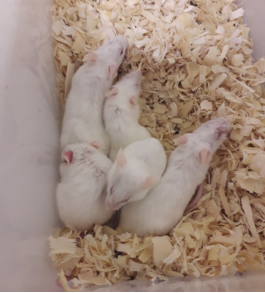
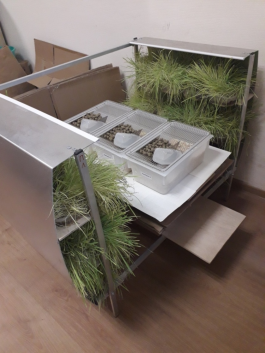
The experiment used BALB/C mice females obtained from the STEZAR nursery located in the Vladimir region (Figure 1). These inbred mice are susceptible to diseases of the cardiovascular system, but are not predisposed to cancer. The average age of the mice at the beginning of the experiment was 8 months and 16 days or 8.51 months. Date of birth from 07/03/2023 to 07/17/2023. The average date of birth is 07/10/2023. The mice were delivered from the nursery weakened after receiving a large number of offspring from them. On average, 20-25 mice were born from one mouse during 4-5 pregnancies. Because of this, there was an increased mortality rate before the start of the experiment as a result of stress during transportation from the nursery to our vivarium. Of the 39 mice placed in cages after delivery to our vivarium, 4 mice died in 4 days, 35 mice remained, 5 were kept in reserve, and 30 were sent to the experiment. The mice were housed in 6 cages of 5 mice each. 15 mice in 3 cages were periodically treated in a Family Biotron (Figure 2), the other 15 mice in the other 3 cages were control mice, they were placed at a distance of 1.5-2 m from the Biotron. For processing in a Biotron, oat seedlings were used in 24 trays from the age of 4-5 days from sowing to 12-15 days. growth. The beginning of the effect on mice in the Biotron took place immediately after the separation of the mice into experimental and control ones on 26.3.2024. The plants are 4-5 days old. Exposure time is 8 hours or more per day, 8-10 sessions per course. There were breaks from 4 to 12 days between the courses.
The principle of operation of the Biotron is based on the concentration of biological radiation from growing plants on a biological object. The plants are arranged in trays on shelves near two aluminum mirrors located opposite each other. Mirrors reflect biological radiation and concentrate it into the focal area into which the object under study is placed
[14]
Komrakov E. V. Universal device for transmitting radiation from a source to an object. International patent WO 2012/005632. 12.01.2012.
[14]
. In this experiment, such an object was BALB/C mice.
Figure 2. View of experimental BALB/C mice in cages in a Family Biotron.
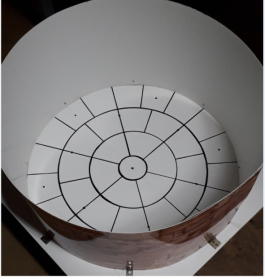
15 courses were conducted during the entire experiment. The mobility of mice was measured in a circular arena (Figure 3). The number of intersections of the arena lines, 180-degree turns, and standing on their hind legs on the wall were recorded in 2 minutes. Each 1 parameter was counted as 1 point. At the beginning of the experiment, 2-3 mice were taken from each cage so that 6 mice were examined from the experimental and control groups. Further, as the mice died, measurements were carried out on the remaining living mice in smaller numbers.
Figure 3. A type of arena for assessing the mobility (physical activity) of BALB/C mice.
3. Results
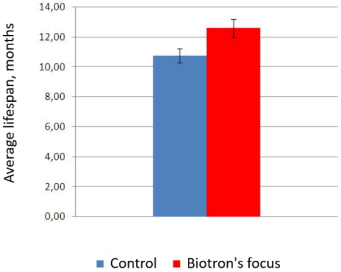
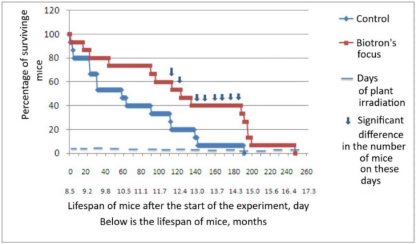
The graph of mouse survival is shown in Figure 4. Despite the initial weakness of the mice, the periodic presence in the Biotron leads to the maintenance of their viability. At several points of the survival curve, the number of live mice on certain days of life in the experiment significantly exceeds the number of live mice in the control. The average lifespan (ALS) of mice undergoing Biotron courses turned out to be 17.0% longer than in the control, while the maximum lifespan (MLS) increased by 12.4% or 56 days (Figure 4, 5 and Table 1).
From 13 to 15 months, 6 out of 15 mice (40%) remained alive during 2 months of life under the action of Biotron. Video of mice on the URL:
Figure 5. The average lifespan of BALB/C mice under the influence of Family Biotron and in the control. Arithmetic mean errors are shown.
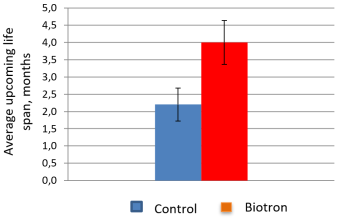
Table 1. Vital parameters of mice. ALS is the average lifespan. MLS is the maximum lifespan. A significant difference is highlighted in yellow.
Parameter
Control
Biotron’s focus
ALS, months
10.7
12.6
Arithmetic mean error, months
0.5
0.6
The difference ALS, %
17.0
The significance level of the T-test
0.018
MLS, months
14.8
16.64
The difference MLS, months
1.8
The difference MLS, %
12.4
The average upcoming lifespan (AULS) of mice was also estimated. AULS is the time that animals have lived on average from the moment of exposure to the moment of death (AULS = ALS - LS); where LS here is the lifespan before exposure. The increase in the AULS during treatment is the difference between the AULS in the experiment with irradiation of mice and the AULS of mice in the control group without irradiation. The calculation formulas are as follows:
An increase in AULS = AULS in the experiment - AULS in the control;
or as a percentage:
Increase in AULS (%) = ((AULS in the experiment − AULS in the control) / AULS in the control) x 100%.
The difference between the AULS of Biotron-treated and AULS of control mice is highly significant with a significance level of p = 0.018 (Table 2), which is significantly less than the selected limit of p=0.05.
The increase in AULS was 81.9% compared with the control (Figure 6 and Table 2).
In addition, Biotron-treated mice have greater physical, or more precisely, motor activity or mobility than control mice. The control mice scored an average of 27.9 mobility points in 2 minutes during their lifetime, while the mice taking the Biotron courses were more than 1.5 times more physically active and scored an average of 43.7 points, i.e. 15.8 points or 56.8% more. The excess relative to the control ranged from 9 to 35.4 points on different days of the mobility measurement.
Figure 6. The average upcoming lifespan of BALB/C mice when exposed to Family Biotron (in Biotron focus) and in control. Arithmetic mean errors are shown.
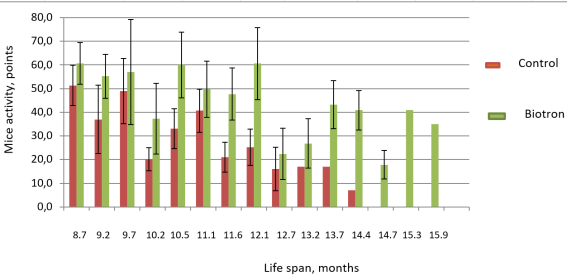
Table 2. Average upcoming lifespan (AULS) of mice and other parameters. A significant difference is highlighted in yellow.
Figure 7. Changes in the mobility of mice (in points) under the influence of Family Biotron and in the control. Arithmetic mean errors are shown. Errors are not indicated where there is 1 mouse left.
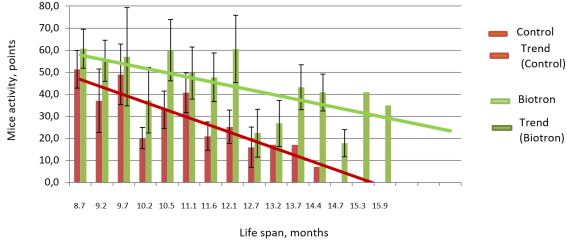
Figure 8. Histogram of mouse mobility (in points) with trend lines under the influence of Family Biotron and in control. Arithmetic mean errors are shown. Errors are not indicated where there is 1 mouse left.

Table 3. The mobility of mice in points in different periods of life of control mice and those taking courses in the Family Biotron.
Time after the start of the experiment, day
Lifespan, months
Control, points
Biotron, points
Difference, points
7
8.7
51.3
60.7
9.4
22
9.2
37.0
55.2
18.2
36
9.7
49.0
57
8.0
50
10.2
20.1
37.3
17.2
64
10.5
33.0
60
27
80
11.1
40.7
49.7
9
94
11.6
21
47.7
27
110
12.1
25.2
60.6
35.4
127
12.7
16
22.4
6.4
143
13.2
17
26.8
9.8
159
13.7
17
43.2
26.2
179
14.4
7
40.8
33.8
189
14.7
17.8
207
15.3
41.0
226
15.9
35.0
Average
27.9
43.7
15.8
Percent
56.8%
Data on the level of mobility of mice under the action of Biotron and in the control are shown in Figures 7, 8 and in Table 3. The correlation coefficient of mobility of control mice with age is (-) 0.843. The correlation coefficient of experimental mice with age is (-) 0.589. This suggests that the dependence of the viability of mice with age in experimental mice in Biotron is significantly less than in control mice by 43%. At the same time, the activity of the long-lived mouse, which still lived 56 days after all the others died, remained almost the same as in young mice. Table 3 shows that during these days, the activity of the long-lived mouse was 17.8, 41.0 and 35 points. This indicates the prolongation of active longevity, which is especially important for people.
4. Discussion
It should also be borne in mind that 8-month-old mice were used, which were used in the nursery for intensive reproduction (4-5 litters per lifetime). Therefore, they were already greatly weakened. The usual average lifespan of BALB/C mice is 20 months in females and 17 months old in males. From our experiment, it can be seen that in control mice (females), the ALS in our experiment is much less by almost 2 times, and amounts to 10.8 months, and 12.6 months under the action of Biotron. Despite this, Biotron treatment of even such weakened mice led to an increase in their average and maximum lifespan by 17% and 14.4%, respectively.
There was no increase in the number of cancer-infected mice treated in Biotron compared to control mice. The formation of tumors was observed in 2 mice in the control and in 2 mice who took courses in Biotron, which is 13.3% of the initial number of mice in both groups. That is, the main number - 87.7% of mice die not from cancer, but from other causes.
Still, more research is needed.
It should also be mentioned that mice were not the only biological objects to study the effects of the biological action of plant seedlings in Biotron. More than 30 experiments were conducted on well-studied small nematode worms of the species Caenorhabditis elegans strain No. 18. As a result, it was found that different types of Biotron or Longovitron devices act similarly positively, and if biological objects are in the focal area of the devices, the average lifespan of nematodes increases by 8.6-30.1%, and the maximum lifespan of nematodes increases by 7.1-26.7%
[15]
Prokhorov L. Yu., Komrakov E. V. Evaluation of the effectiveness of new health-improving devices Biotron EKOM in studies on mice and nematodes Caenorhabditis elegans. Russian Journal of Geriatric Medicine. 2025; 2 (22): 268-270.
1) The periodic presence of mice in the EKOM Family Biotron leads to the maintenance of the viability of mice. At several points of the survival curve, the number of live mice on certain days of life in the experiment significantly exceeds the number of live mice in the control.
2) The ALS of control mice is 10.75 months, and under the action of Biotron, it is 12.58 months.
3) There was an increase in the ALS of mice under the influence of Biotron by 17%, MLS - by 12.4% and AULS - by 81.9%.
4) Biotron-treated mice have greater mobility than control mice. The excess of the motor activity of the experimental mice over the activity of the control mice ranges from 9 to 35.4 points on different measurement days. On average, the mobility of Biotron-treated mice was higher than that of control mice by 17.5 points or 53.6%.
5) The family Biotron did not increase the incidence of cancer compared to control animals and amounted to 13.3% in both groups.
Abbreviations
LS
Lifespan
ALS
Average Lifespan
MLS
Maximum Lifespan
AULS
Average Upcoming Lifespan
Author Contributions
Leonid Yurievich Prokhorov: Conceptualization, Data curation, Formal Analysis, Investigation, Methodology, Software, Writing – original draft, Writing – review & editing
Mould R. R., Mackenzie A. M., Kalampouka I., Nunn A. V. W., Thomas E. L., Bell J. D., Botchway S. W. Ultra weak photon emission-a brief review. 2024. Front Physiol. 2024; 15: 1348915.
Salari V., Seshan V, Frankle L., England D., Simon C., Oblak D. Imaging Ultraweak Photon Emission from Living and Dead Mice and from Plants under Stress. J. Phys. Chem. Lett. 2025; 16 (17): 4354–4362.
Poplova M, Prasad A, Van Wijk E, Pospisil P, Cifra M. Biological Auto (Chemi) luminescence imaging of oxidative processes in human skin. Analyt Chem. 2023; 95: 14853–14860.
Mashagi T., Griffith J., Hanekamer T., E. Wijk E., Ramautar R., Burgos R. K. R. Pharmacological manipulation of the reactive oxygen species network in myeloid leukemia cells monitored by ultraslow photon emission. Oncotarget. 2018; 9: 2028–2034.
Prasad A., Mihacova E., Manoharan R. R., Pospisil P. J. Application of ultra-weak photon emission imaging in plant stress assessment. Plant Res. 2025; 138(2): 389-400.
Komrakov E. V., Zinoviev S. V., Chernenko P. P., Prokhorov L. Yu., Glybin A. V. The effect of Large and Small EKOM Biotrons on the lifespan of c57bl mice and Caenorhabditis elegans nematodes, as well as on cell cultures and seed germination / Institute of Longevity and Anti-aging Researches. Moscow, 2020. 62 p. Dept. in VINITI 05.03.2020 N 14-B2020. Yk. No. 2. 2020.
Komrakov E. V., Prokhorov L. Y. Further development of the ideas of the Russian-Chinese scientist Jiang Kanchen. Rehabilitation and prolongation of human life using Biotron EKOM device. Moscow/Ekaterinburg: Publishing Solutions LLC under the license of Ridero. 2022. 270 p.
Komrakov E. V., Prokhorov L. Y. Biotron is the key to human health. The use of concentrated radiation from young organisms to improve health and prolong active life. Moscow/Ekaterinburg: Publishing Solutions LLC under the license of Ridero. 2022. 140 p.
Komrakov E. V, Prokhorov L. Yu., Chernenko P. P., Gorbunov I. I. Experimental study of EKOM Biotrons, which provide a remote effect of some biological objects on others. ILAR. Moscow. 2021. 66 p.
Prokhorov L. Y. Real and promising ways to increase human lifespan. Overcoming aging and preserving youth. Moscow/Ekaterinburg: Publishing Solutions LLC under the license of Ridero, 2021. 304 p.
Prokhorov L. Y. General theory of rejuvenation of organisms. Continuation. Moscow/Ekaterinburg: Publishing Solutions LLC under the license of Ridero, 2022. 48 p.
Komrakov E. V. Universal device for transmitting radiation from a source to an object. International patent WO 2012/005632. 12.01.2012.
[15]
Prokhorov L. Yu., Komrakov E. V. Evaluation of the effectiveness of new health-improving devices Biotron EKOM in studies on mice and nematodes Caenorhabditis elegans. Russian Journal of Geriatric Medicine. 2025; 2 (22): 268-270.
Prokhorov, L. Y., Komrakov, E. V. (2026). Studying the Influence of Health-improving Device Biotron EKOM (Longevitron) on Lifespan and Physical Mobility of BALB/C Mice. International Journal of Gerontology and Geriatrics, 1(1), 35-41. https://doi.org/10.11648/j.ijgege.20260101.14
Prokhorov, L. Y.; Komrakov, E. V. Studying the Influence of Health-improving Device Biotron EKOM (Longevitron) on Lifespan and Physical Mobility of BALB/C Mice. Int. J. Gerontol. Geriatr.2026, 1(1), 35-41. doi: 10.11648/j.ijgege.20260101.14
Prokhorov LY, Komrakov EV. Studying the Influence of Health-improving Device Biotron EKOM (Longevitron) on Lifespan and Physical Mobility of BALB/C Mice. Int J Gerontol Geriatr. 2026;1(1):35-41. doi: 10.11648/j.ijgege.20260101.14
@article{10.11648/j.ijgege.20260101.14,
author = {Leonid Yurievich Prokhorov and Evgeny Vyacheslavovich Komrakov},
title = {Studying the Influence of Health-improving Device Biotron EKOM (Longevitron) on Lifespan and Physical Mobility of BALB/C Mice},
journal = {International Journal of Gerontology and Geriatrics},
volume = {1},
number = {1},
pages = {35-41},
doi = {10.11648/j.ijgege.20260101.14},
url = {https://doi.org/10.11648/j.ijgege.20260101.14},
eprint = {https://article.sciencepublishinggroup.com/pdf/10.11648.j.ijgege.20260101.14},
abstract = {Currently, a lot of data is accumulating on the distant effects of some biological objects on others. The concentration of this effect is of key importance. For this purpose, devices called Biotron or Longevitron have been invented. They concentrate and thereby enhance the effect of young seedlings of cereal plants on the human body and experimental animals. As a result, experimental animals such as mice live 25% longer and even in old age remain young and physically active, unlike decrepit and sedentary control animals. EKOM biotrons of various sizes and efficiencies are available. There are Biotrons the size of a room, there are professional and personal Biotrons specifically for the home. The session time varies from 20 minutes in a Sedentary 8-reflex Biotron to 8 hours (night) in a Personal Biotron. The effect of the concentrated biological action of the sprouts of the oat cereal plant on BALB/C mice was studied using the well-known Biotron EKOM or Longevitron healing unit. Biological radiation from plants concentrated by Biotron on mice increased the average and maximum duration of these mice by 17.0 and 14.4%, respectively, compared with the control. The increase in the average expected lifespan was 81.9% compared to the control. The differences in the lifespan of Biotron-treated and control mice are highly reliable. Biotron also preserves the motor activity of mice by an average of 53.6% higher, compared with the activity of control mice outside the Biotron installation.},
year = {2026}
}
TY - JOUR
T1 - Studying the Influence of Health-improving Device Biotron EKOM (Longevitron) on Lifespan and Physical Mobility of BALB/C Mice
AU - Leonid Yurievich Prokhorov
AU - Evgeny Vyacheslavovich Komrakov
Y1 - 2026/09/18
PY - 2026
N1 - https://doi.org/10.11648/j.ijgege.20260101.14
DO - 10.11648/j.ijgege.20260101.14
T2 - International Journal of Gerontology and Geriatrics
JF - International Journal of Gerontology and Geriatrics
JO - International Journal of Gerontology and Geriatrics
SP - 35
EP - 41
PB - Science Publishing Group
UR - https://doi.org/10.11648/j.ijgege.20260101.14
AB - Currently, a lot of data is accumulating on the distant effects of some biological objects on others. The concentration of this effect is of key importance. For this purpose, devices called Biotron or Longevitron have been invented. They concentrate and thereby enhance the effect of young seedlings of cereal plants on the human body and experimental animals. As a result, experimental animals such as mice live 25% longer and even in old age remain young and physically active, unlike decrepit and sedentary control animals. EKOM biotrons of various sizes and efficiencies are available. There are Biotrons the size of a room, there are professional and personal Biotrons specifically for the home. The session time varies from 20 minutes in a Sedentary 8-reflex Biotron to 8 hours (night) in a Personal Biotron. The effect of the concentrated biological action of the sprouts of the oat cereal plant on BALB/C mice was studied using the well-known Biotron EKOM or Longevitron healing unit. Biological radiation from plants concentrated by Biotron on mice increased the average and maximum duration of these mice by 17.0 and 14.4%, respectively, compared with the control. The increase in the average expected lifespan was 81.9% compared to the control. The differences in the lifespan of Biotron-treated and control mice are highly reliable. Biotron also preserves the motor activity of mice by an average of 53.6% higher, compared with the activity of control mice outside the Biotron installation.
VL - 1
IS - 1
ER -
Prokhorov, L. Y., Komrakov, E. V. (2026). Studying the Influence of Health-improving Device Biotron EKOM (Longevitron) on Lifespan and Physical Mobility of BALB/C Mice. International Journal of Gerontology and Geriatrics, 1(1), 35-41. https://doi.org/10.11648/j.ijgege.20260101.14
Prokhorov, L. Y.; Komrakov, E. V. Studying the Influence of Health-improving Device Biotron EKOM (Longevitron) on Lifespan and Physical Mobility of BALB/C Mice. Int. J. Gerontol. Geriatr.2026, 1(1), 35-41. doi: 10.11648/j.ijgege.20260101.14
Prokhorov LY, Komrakov EV. Studying the Influence of Health-improving Device Biotron EKOM (Longevitron) on Lifespan and Physical Mobility of BALB/C Mice. Int J Gerontol Geriatr. 2026;1(1):35-41. doi: 10.11648/j.ijgege.20260101.14
@article{10.11648/j.ijgege.20260101.14,
author = {Leonid Yurievich Prokhorov and Evgeny Vyacheslavovich Komrakov},
title = {Studying the Influence of Health-improving Device Biotron EKOM (Longevitron) on Lifespan and Physical Mobility of BALB/C Mice},
journal = {International Journal of Gerontology and Geriatrics},
volume = {1},
number = {1},
pages = {35-41},
doi = {10.11648/j.ijgege.20260101.14},
url = {https://doi.org/10.11648/j.ijgege.20260101.14},
eprint = {https://article.sciencepublishinggroup.com/pdf/10.11648.j.ijgege.20260101.14},
abstract = {Currently, a lot of data is accumulating on the distant effects of some biological objects on others. The concentration of this effect is of key importance. For this purpose, devices called Biotron or Longevitron have been invented. They concentrate and thereby enhance the effect of young seedlings of cereal plants on the human body and experimental animals. As a result, experimental animals such as mice live 25% longer and even in old age remain young and physically active, unlike decrepit and sedentary control animals. EKOM biotrons of various sizes and efficiencies are available. There are Biotrons the size of a room, there are professional and personal Biotrons specifically for the home. The session time varies from 20 minutes in a Sedentary 8-reflex Biotron to 8 hours (night) in a Personal Biotron. The effect of the concentrated biological action of the sprouts of the oat cereal plant on BALB/C mice was studied using the well-known Biotron EKOM or Longevitron healing unit. Biological radiation from plants concentrated by Biotron on mice increased the average and maximum duration of these mice by 17.0 and 14.4%, respectively, compared with the control. The increase in the average expected lifespan was 81.9% compared to the control. The differences in the lifespan of Biotron-treated and control mice are highly reliable. Biotron also preserves the motor activity of mice by an average of 53.6% higher, compared with the activity of control mice outside the Biotron installation.},
year = {2026}
}
TY - JOUR
T1 - Studying the Influence of Health-improving Device Biotron EKOM (Longevitron) on Lifespan and Physical Mobility of BALB/C Mice
AU - Leonid Yurievich Prokhorov
AU - Evgeny Vyacheslavovich Komrakov
Y1 - 2026/09/18
PY - 2026
N1 - https://doi.org/10.11648/j.ijgege.20260101.14
DO - 10.11648/j.ijgege.20260101.14
T2 - International Journal of Gerontology and Geriatrics
JF - International Journal of Gerontology and Geriatrics
JO - International Journal of Gerontology and Geriatrics
SP - 35
EP - 41
PB - Science Publishing Group
UR - https://doi.org/10.11648/j.ijgege.20260101.14
AB - Currently, a lot of data is accumulating on the distant effects of some biological objects on others. The concentration of this effect is of key importance. For this purpose, devices called Biotron or Longevitron have been invented. They concentrate and thereby enhance the effect of young seedlings of cereal plants on the human body and experimental animals. As a result, experimental animals such as mice live 25% longer and even in old age remain young and physically active, unlike decrepit and sedentary control animals. EKOM biotrons of various sizes and efficiencies are available. There are Biotrons the size of a room, there are professional and personal Biotrons specifically for the home. The session time varies from 20 minutes in a Sedentary 8-reflex Biotron to 8 hours (night) in a Personal Biotron. The effect of the concentrated biological action of the sprouts of the oat cereal plant on BALB/C mice was studied using the well-known Biotron EKOM or Longevitron healing unit. Biological radiation from plants concentrated by Biotron on mice increased the average and maximum duration of these mice by 17.0 and 14.4%, respectively, compared with the control. The increase in the average expected lifespan was 81.9% compared to the control. The differences in the lifespan of Biotron-treated and control mice are highly reliable. Biotron also preserves the motor activity of mice by an average of 53.6% higher, compared with the activity of control mice outside the Biotron installation.
VL - 1
IS - 1
ER -