
Iran's national Electronic Health Record (EHR) system (SEPAS) and its acupuncture sector operate in parallel without any mechanism for integrating acupuncture-specific clinical data, with prior gap analysis identifying six interdependent problem categories. To develop a context-specific implementation and integration plan for acupuncture-EHR interoperability within Iran's SEPAS infrastructure, we used Design Science Research (DSR) methodology to structure the adaptation of existing international standards to the Iranian context. Following DSR guidelines, we developed an artifact through problem and requirement analysis (document analysis of 34 sources plus international benchmarking), design synthesis (framework, Minimum Data Set (MDS), technical mappings, roadmap, training), demonstration via illustrative case, and evaluation via criteria-referenced assessment plus expert appraisal (n=18). The artifact satisfies all twelve design requirements derived from the gap analysis, with expert appraisal confirming framework completeness (mean 4.6/5), internal consistency (mean 4.5/5), and practical utility (mean 4.4/5), while specification-based assessment indicates compatibility with SEPAS specifications, International Classification of Diseases, 11th Revision Traditional Medicine (ICD?11 TM) terminology mapping, open Electronic Health Record (openEHR) archetype formalism, and alignment with Chinese T/CIATCM 016?2019 standards. The paper's primary contribution is a specification that satisfies its design requirements for acupuncture within Iran's SEPAS—demonstrating how existing international standards can be systematically adapted to a novel national health information context—and the DSR methodology provides the structuring framework for this adaptation process, which is replicable for other traditional medicine modalities.
| Published in | International Journal of Medical Research and Innovation (Volume 2, Issue 4) |
| DOI | 10.11648/j.ijmri.20260204.11 |
| Page(s) | 57-70 |
| Creative Commons |
This is an Open Access article, distributed under the terms of the Creative Commons Attribution 4.0 International License (http://creativecommons.org/licenses/by/4.0/), which permits unrestricted use, distribution and reproduction in any medium or format, provided the original work is properly cited. |
| Copyright |
Copyright © The Author(s), 2026. Published by Science Publishing Group |
Design Science Research, Acupuncture, Electronic Health Records, SEPAS, Health Information Systems, Artifact Evaluation, ICD-11, openEHR
Country | System/Effort | Key Features | Relevance to Present Work |
|---|---|---|---|
China | T/CIATCM 016-2019; TCM Hospital Information Standards | Comprehensive TCM data elements, pattern diagnosis coding, herbal formula specifications | Provides validated MDS elements for benchmarking; see Section 3.2 for explicit mapping |
India | Ayush Grid | Nationwide T&CM interoperability platform, unique practitioner IDs, standardized treatment codes | Demonstrates feasibility of national-scale T&CM informatics; governance model referenced |
Thailand | RTMS (Real-Time Monitoring System for Thai Traditional Medicine) | Standalone T&CM monitoring with provincial dashboards | Illustrates phased implementation approach; limited integration with main EHR |
Problem Category | Description |
|---|---|
Policy and Governance | No formal mandate or guidelines for acupuncture data in SEPAS |
Semantic Interoperability | No standardised terminology mapping between TCM concepts and ICD-11 [11] |
Data Model and Content | Missing data elements for acupuncture encounters |
Technical Infrastructure | SEPAS lacks APIs for acupuncture-specific data capture |
Stakeholder Engagement | Acupuncturists have no representation in SEPAS governance |
Quality and Safety Governance | No mechanism for adverse event monitoring from acupuncture |
Condition | Application to This Study |
|---|---|
The problem is a constructed information systems problem requiring integration of existing systems | Acupuncture workflows must be integrated into SEPAS—a designed artifact, not a natural phenomenon |
No existing solution exists for the specific context | While China, India, and Thailand have T&CM informatics systems, no solution exists for Iran's SEPAS architecture |
The solution is an artifact (framework, data model, technical specifications) | The deliverable is a designed artifact, not a descriptive theory |
Evaluation is criteria-referenced against design requirements derived from problem analysis | Evaluation compares artifact features to requirements, not statistical inference about human behavior |
Phase | Activity | Nature of Activity | Output |
|---|---|---|---|
1 | Problem Identification and Motivation | Requirements analysis: Document analysis, gap identification, international benchmarking | Six problem categories + international benchmarking findings |
2 | Define Objectives of a Solution | Requirements analysis: Deriving solution requirements from problem categories and international standards | Twelve design requirements |
3 | Design and Development | Design synthesis: Making design decisions about which standards to adopt, how to adapt them to Iranian context, which elements are mandatory vs. optional, and how to sequence implementation | Framework artifact, MDS with design rationale, technical specs |
4 | Demonstration | Validation: Showing artifact utility | Illustrative case scenario + pilot implementation |
5 | Evaluation | Validation: Assessing artifact against requirements | Criteria-referenced assessment + expert appraisal |
6 | Communication | Dissemination | This paper |
Finding | Implication for Design Requirements |
|---|---|
China's T/CIATCM 016-2019 provides validated MDS elements for TCM pattern diagnoses and acupuncture points | DR3, DR5, DR6: MDS must align with these validated elements where Iran-appropriate |
India's Ayush Grid demonstrates that nationwide T&CM interoperability is feasible with proper governance | DR2, DR9: Phased roadmap and stakeholder roles are necessary |
Thailand's RTMS shows that standalone T&CM systems risk limited EHR integration | DR1, DR4: The solution must prioritize deep SEPAS integration, not a parallel system |
Dimension | Problem Category Addressed | Key Components |
|---|---|---|
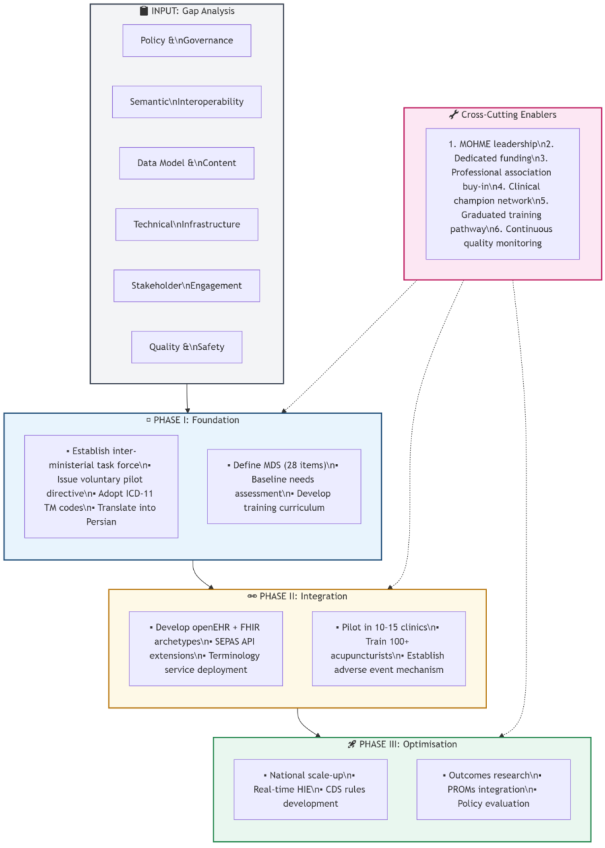
Dimension 1: Policy and Governance | PC1 – Policy and governance gap | Ministry of Health and Medical Education (MOHME) directive mandating acupuncture documentation in SEPAS; data governance framework for T&CM; professional documentation standards |
Dimension 2: Semantic Interoperability | PC2 – Semantic interoperability gap | ICD 11 TM Chapter 26 [11] mapping for TCM pattern diagnoses; Persian terminology server; cross walk between SEPAS codes and TCM concepts |
Dimension 3: Data Model and Content | PC3 – Data model and content gap | 28 element MDS (Section 3.2.3); SEPAS data dictionary extensions; standardised TCM pattern diagnosis fields |
Dimension 4: Technical Infrastructure | PC4 – Technical infrastructure gap | openEHR archetypes [9] (ADL snippets); Fast Healthcare Interoperability Resources (FHIR) resources [10] ; SEPAS API extensions for acupuncture data capture |
Dimension 5: Stakeholder Engagement | PC5 – Stakeholder engagement gap | Acupuncturist representation in SEPAS governance; formal T&CM input channel; digital literacy training |
Dimension 6: Quality and Safety Governance | PC6 – Quality and safety gap | Adverse event reporting pathway; data quality indicators; outcomes monitoring framework |
Phase | Duration | Activities | Outputs | Dependencies |
|---|---|---|---|---|
Phase I: Foundation | Months 1–12 | Issue MOHME policy directive; adopt ICD 11 TM Chapter 26 [11] ; endorse MDS; conduct needs assessment (practitioner survey) | Policy mandate; ICD 11 TM mapping table; MDS v1.0; baseline digital literacy report | None |
Phase II: Integration | Months 13–24 | Develop openEHR archetype [9] ; extend SEPAS APIs; build data entry interface; train practitioners (4 hours); execute sandbox pilot (synthetic data). The API extensions will align with Iran's existing e-prescription integration standards [24] | ADL archetype; API specification; training materials; pilot report | Phase I outputs |
Phase III: Optimisation | Months 25–36+ | Aggregate outcomes data; develop Clinical Decision Support (CDS) rules; national scale up; continuous quality improvement | Outcomes registry; CDS rule set; national adoption report; updated MDS | Phase II outputs |
Category | Elements (examples) | Count |
|---|---|---|
Patient identification & demographics | SEPAS ID, DOB, sex, occupation | 4 |
Encounter & diagnosis | Encounter date, chief complaint, TCM pattern diagnosis (ICD‑11 TM) [11] , western diagnosis, pain location | 5 |
Acupuncture treatment | Points used (World Health Organization Standard Acupuncture Nomenclature (WHO SAN) [7] , laterality, needle retention time, manipulation technique, deqi, number of needles | 6 |
Safety & adverse events | AE type, severity, action taken | 3 |
Outcome & follow‑up | Pre/post symptom severity, follow‑up scheduled | 3 |
Practitioner & facility | Practitioner ID, specialty, facility code | 3 |
TCM Pattern (English) | TCM Pattern (Persian) | ICD 11 TM Code |
|---|---|---|
Liver qi stagnation | انسداد کبدی | SD71 |
Blood stasis | رکود خون | SD72 |
Spleen qi deficiency | ضعف طحال | SD73 |
Kidney yin deficiency | کمبود یین کلیه | SD74 |
Lung qi deficiency | ضعف ریه | SD75 |
Damp heat in liver/gallbladder | رطوبت حرارت کبد و کیسه صفرا | SD76 |
Cold in the uterus | سرمی رحم | SD77 |
Qi and blood deficiency | کمبود چی و خون | SD78 |
Wind cold invasion | حمله باد سرما | SD79 |
MDS Element | FHIR Resource | Path | Notes |
|---|---|---|---|
A1 (Patient ID) | Patient | Patient.identifier | SEPAS ID as identifier system |
B3 (TCM pattern diagnosis) | Condition | Condition.code | ICD 11 TM coding |
C1 (Acupuncture points) | Procedure | Procedure.code | WHO SAN codes in CodeableConcept |
C5 (Deqi sensation) | Observation | Observation.valueCodeableConcept | Custom LOINC style code proposed |
D1 (Adverse event) | AdverseEvent | AdverseEvent.type | FHIR R4 AdverseEvent resource |
Level | Target Audience | Duration | Content |
|---|---|---|---|
Basic | All acupuncture practitioners | 2 hours | MDS structure; mandatory elements; ICD 11 TM code lookup [11] ; adverse event reporting |
Intermediate | All practitioners | 2 hours | Data entry workflow; SEPAS integration basics; troubleshooting common errors |
Advanced (optional) | Clinical champions | 2 hours | openEHR concept [9] ; FHIR exchange [10] ; data quality auditing |
Clinical champion (optional) | Selected lead practitioners | 4 hours (spread over 1 month) | Peer support training; advanced terminology mapping; quality improvement methods |
Design Decision | Key Trade off | Alternatives Rejected | DRs Addressed |
|---|---|---|---|
Six dimension framework | Separate governance vs. merge | 5 dimension merged | DR1 |
MDS 28 elements, M/O classification | Clinical necessity vs. documentation burden | All mandatory (67); all optional | DR3, DR11 |
Standards mapping hierarchy | Granularity vs. international comparability | Iran specific codes | DR4, DR5, DR6 |
ADL snippets + FHIR table (not full IG) | Depth vs. implementation readiness | Full openEHR archetypes; full FHIR IG | DR7, DR8 |
Three phase 36 month roadmap | Policy cycles vs. technical readiness | 6 month or 18 month integration | DR2, DR9 |
4 hour training (basic+intermediate) | Adoption vs. competency depth | 2h, 8h, or no training | DR10 |
DR | Satisfaction Evidence |
|---|---|
DR1: Six categories addressed | Framework Component 1 explicitly maps to all six problem categories |
DR2: Phased roadmap | Component 2 provides 36-month roadmap with validated durations |
DR3: MDS specification | Component 3 provides 28-element MDS with mandatory/optional classification and standards mapping [6, 7, 11, 14] |
DR4: ICD-11 TM alignment | Component 4 includes ICD-11 TM mapping table [11] and code references |
DR5: Terminology mapping for TCM pattern diagnoses | Component 4 includes ICD 11 TM mapping table [11] |
DR6: Acupuncture point coding (WHO SAN) | Component 3 includes WHO SAN codes [7] ; |
DR7: openEHR archetypes | Component 4 includes ADL 1.5 archetype specification snippet [9] |
DR8: FHIR resources | Component 4 includes FHIR resource mapping table [10] |
DR9: Stakeholder roles | Component 2 includes clinical champion role; Component 5 includes training |
DR10: Training requirements | Component 5 specifies 4-hour training with levels |
DR11: Safety monitoring | Component 3 includes adverse event element (D2); DR11 metadata |
DR12: Data quality indicators | Defined in Component 2 (completeness ≥80% target) |
Role | Target (n) | Inclusion Criteria | Actual (n) |
|---|---|---|---|
MOHME policymakers | 5 | Currently serving in Health Information Technology or Traditional Medicine policy units; ≥3 years in role | 5 |
Certified acupuncturists | 6 | Active clinical practice in Iran (≥5 years); prior experience with EHR systems (any) | 6 |
Health informaticians | 4 | Academic or operational role in health IT; ≥5 years experience; knowledge of interoperability standards | 4 |
Health IT vendor representatives | 3 | Employed by vendors with SEPAS integration experience; ≥3 years in role | 3 |
Criterion | MOHME (n=5) | Acupuncturists (n=6) | Informaticians (n=4) | Vendors (n=3) | Overall Mean (SD) |
|---|---|---|---|---|---|
Completeness | 4.6 | 4.5 | 4.8 | 4.5 | 4.6 (0.5) |
Internal consistency | 4.4 | 4.5 | 4.7 | 4.4 | 4.5 (0.5) |
Practical utility | 4.2 | 4.3 | 4.5 | 4.5 | 4.4 (0.5) |
Theme | Representative Statement | Action Taken |
|---|---|---|
Policy clarity needed | "The framework assumes MOHME directive exists. Implementation could be voluntary pilot first." (Policymaker) | Acknowledged in limitations; pilot implementation added (Section 4.2) |
MDS size appropriate | "28 elements feels manageable. The optional flags help." (Acupuncturist) | No change |
Terminology support required | "Practitioners will need lookup tools for ICD-11 mapping, not just tables." (Informatician) | Added to Future Work (Section 7.3) |
Training adequacy | "4 hours seems sufficient for basics but ongoing support needed." (Vendor) | Acknowledged; ongoing support noted in Phase III (Section 3.2.2) |
Standards mapping appreciated | "The mapping to China T/CIATCM 016-2019 adds credibility." (Informatician) | No change; mapping retained |
Pilot implementation needed | "The illustrative case is helpful, but real technical validation would strengthen the artifact." (Informatician) | Pilot implementation added (Section 4.2) |
SEPAS Feature | Artifact Compatibility |
|---|---|
Patient identifier format | MDS element A1 matches SEPAS ID specification (verified by document comparison) |
Encounter metadata | MDS F1-F3 align with SEPAS encounter types (verified by specification review) |
Diagnostic coding | ICD-11 TM codes supported in SEPAS architecture (per MOHME technical documentation) |
API specification | Future extension required (noted in Phase II) |
Standard | Artifact Alignment |
|---|---|
ISO/TS 16843-1 (Acupuncture points) | Full alignment via SAN codes (verified by cross-walk table) |
WHO ICD-11 Chapter 26 | Embedded in MDS element B4 (verified by code-by-code mapping) |
openEHR Reference Model | ADL 1.5 archetype structure provided (syntax-valid per openEHR specification) |
HL7 FHIR R4 | Resource mapping specified (conforms to FHIR resource definitions) |
China T/CIATCM 016-2019 | MDS elements mapped; see Section 3.2 (verified by element-by-element comparison) |
Criterion | Result |
|---|---|
DR satisfaction | 12/12 requirements met |
Completeness (expert appraisal) | 4.6/5 (acceptable) |
Internal consistency (expert appraisal) | 4.5/5 (acceptable) |
Practical utility (expert appraisal) | 4.4/5 (acceptable) |
Technical feasibility (specification-based) | Confirmed based on document and standards mapping |
Dimension | Thailand RTMS | India Ayush Grid | China TCM Hospital Standards | This Artifact |
|---|---|---|---|---|
Primary focus | Standalone T&CM monitoring | Nationwide T&CM interoperability | TCM hospital information systems | Deep integration into existing national EHR |
Validation method | Implementation experience | Implementation experience | Implementation experience | DSR design evaluation (criteria-referenced + expert appraisal + specification-based assessment); pilot pending |
MDS specification | Present (basic) | Present (modality-specific) | Comprehensive (100+ elements) | 28-element with optional classification + standards mapping [6, 7, 11, 14] |
Technical standards | Limited | FHIR, SNOMED CT | GB/T, HL7 China | ICD-11 [11] , openEHR [9] , FHIR [10] , ISO [6] |
Implementation roadmap | Not specified | 5+ years | Phased | 36 months, phase-specific |
Open science | No | Partial | Limited | Complete specification provided |
Integration with national EHR | Minimal | Planned | Partial | Full (SEPAS-native) |
ADL | Archetype Definition Language |
API | Application Programming Interface |
CDS | Clinical Decision Support |
DOB | Date of Birth |
DSR | Design Science Research |
EHR | Electronic Health Record |
FHIR | Fast Healthcare Interoperability Resources |
HL7 | Health Level Seven |
ICD 11 | International Classification of Diseases, 11th Revision |
ISO | International Organization for Standardization |
MDS | Minimum Data Set |
MOHME | Ministry of Health and Medical Education (Iran) |
openEHR | open Electronic Health Record |
PRISMA | Preferred Reporting Items for Systematic Reviews and Meta Analyses |
RTMS | Real Time Monitoring System (Thailand) |
SAN | Standard Acupuncture Nomenclature |
SEPAS | Sistema e Parvande ye Salamat e Iran (Iranian National EHR) |
T&CM | Traditional and Complementary Medicine |
TCM | Traditional Chinese Medicine |
TM | Traditional Medicine (ICD 11 chapter) |
WHO | World Health Organization |
| [1] | Peffers, K., Tuunanen, T., Rothenberger, M. A., & Chatterjee, S. (2007). A Design Science Research Methodology for Information Systems Research. Journal of Management Information Systems, 24(3), 45–77. |
| [2] | Hevner, A. R., March, S. T., Park, J., & Ram, S. (2004). Design Science in Information Systems Research. MIS Quarterly, 28(1), 75–105. |
| [3] | WHO global report on traditional and complementary medicine 2019. Geneva: |
| [4] | World Health Organization. (2024). WHO global traditional medicine strategy 2025–2034. Geneva: |
| [5] | Sheikhtaheri, A., Tabatabaee Jabali, S. M., Bitaraf, E., TehraniYazdi, A., & Kabir, A. (2023). Evaluating the success of Iran Electronic Health Record System (SEPAS) based on the DeLone and McLean model: a cross-sectional descriptive study. BMC Medical Informatics and Decision Making, 23(1), 10. |
| [6] | International Organization for Standardization. (2016). *ISO/TS 16843?1: 2016 — Health informatics: Categorial structures for representation of acupuncture — Part 1: Acupuncture points*. Geneva: ISO. |
| [7] | World Health Organization. (1991). Standard acupuncture nomenclature: Revised edition. Geneva: |
| [8] | Reddy, B., & Fan, A. Y. (2022). Incorporation of complementary and traditional medicine in ICD-11. BMC Medical Informatics and Decision Making, 21(Suppl 6), 381. |
| [9] |
openEHR Foundation. (2019). openEHR architecture overview. London: openEHR.
https://specifications.openehr.org/re leases/BASE/development/architecture_overview.html |
| [10] | HL7 International. (2020). FHIR Release 4 (normative). Ann Arbor: HL7. |
| [11] | World Health Organization. (2024). *ICD-11 for mortality and morbidity statistics (ICD-11 MMS): Chapter 26 – Traditional medicine conditions*. |
| [12] |
Health Intervention and Technology Assessment Program (HITAP). (2025). Proposal: Case study of the real?time monitoring system of Thai traditional and alternative medical services in Thailand. Nonthaburi, Thailand: HITAP.
https://new2025.hitap.net/th/research-detail/?research_id=57 |
| [13] | Ministry of AYUSH, Government of India. (2020). Ayush Grid: National Digital Health Mission – AYUSH component. New Delhi: Ministry of AYUSH. |
| [14] |
China Hospital Association Information Committee. (2024). Norms for information and digital construction of traditional Chinese medicine hospitals (2024 edition). Chinese Journal of Hospital Administration, 40(3), 201–210. (Standard T/CIATCM 016-2019)
https://www.biaozhuns.com/archives/20200816/show-249998-108-1.html |
| [15] |
Health Intervention and Technology Assessment Program (HITAP). (2025). Real?time monitoring system (RTMS) for Thai traditional medicine. Nonthaburi, Thailand: HITAP.
https://new2025.hitap.net/th/research-detail/?research_id=57 (Note: Same URL as reference 12; cited separately for clarity.) |
| [16] | Bangor, A., Kortum, P. T., & Miller, J. T. (2009). Determining what individual SUS scores mean: Adding an adjective rating scale. Journal of Usability Studies, 4(3), 114–123. |
| [17] | Wang, M., Liu, Z., Sun, Y., Zhang, Y., Ghaffar, A., & Ren, M. (2025). Integration of traditional and complementary medicine into primary health care systems: A systematic review. Bulletin of the World Health Organization, 103(11), 675–684C. |
| [18] | Mirzaeian, R., Bahraini, A., & Kazemi-Arpanahi, H. (2025). Determining the required data elements to develop the information management system for Iranian traditional medicine. BMC Complementary Medicine and Therapies, 25(1), 13. |
| [19] | Bitaraf, E., Jafarpour, M., Jami, V., & Sarani Rad, F. (2021). The Iranian Integrated Care Electronic Health Record. Studies in Health Technology and Informatics, 281, 654–658. |
| [20] | Nahvijou, A., Esmaeeli, E., Kalaghchi, B., Sheikhtaheri, A., & Zendehdel, K. (2023). Using Electronic Health Record System to Establish a National Patient's Registry: Lessons learned from the Cancer Registry in Iran. International Journal of Medical Informatics, 180, 105245. |
| [21] | Glasgow, R. E., & Riley, W. T. (2021). Implementation Science and Health Informatics. American Journal of Public Health, 111(10), 1874–1884. |
| [22] | Bright, T. J., Wong, A., Dhurjati, R., Bristow, E., Bastian, L., Coeytaux, R. R., ... & Lobach, D. F. (2020). Effect of clinical decision-support systems: a systematic review. Journal of the American Medical Informatics Association, 27(3), 431–439. |
| [23] | Riazi, H., Jafarpour, M., & Bitaraf, E. (2014). Towards National eHealth Implementation—a comparative study on WHO/ITU National eHealth Strategy Toolkit in Iran. Studies in Health Technology and Informatics, 205, 246–250. |
| [24] | Abedian, S., Biglarkhani, A., Azami Ghadikolaei, A., & Barahmand, M. (2024). Development and Implementation of an Integrated Standard e?Prescription Model in Alignment with Iranian National EHR. Studies in Health Technology and Informatics, 314, 139–143. |
| [25] | Ikram, R. R. R., et al. (2015). An analysis of application of health informatics in Traditional Medicine: A review of four Traditional Medicine Systems. International Journal of Medical Informatics, 84(11), 988–996. |
| [26] | Austin, R. R., et al. (2023). Documentation of Complementary and Integrative Health Therapies in the Electronic Health Record: A Scoping Review. Journal of Integrative and Complementary Medicine, 29(8), 483–491. |
| [27] | Asadi, F., Moghaddasi, H., Rabiei, R., Rahimi, F., & Mirshekarlou, S. J. (2015). The Evaluation of SEPAS National Project Based on Electronic Health Record System (EHRS) Coordinates in Iran. Acta Informatica Medica, 23(6), 369–373. |
| [28] | Bashiri, A., Shirdeli, M., Niknam, F., Naderi, S., & Zare, S. (2023). Evaluating the success of Iran Electronic Health Record System (SEPAS) based on the DeLone and McLean model: a cross-sectional descriptive study. BMC Medical Informatics and Decision Making, 23(1), 10. |
| [29] | Abbasi, R., Khajouei, R., & Mirzaee, M. (2019). Evaluating the demographic and clinical minimum data sets of Iranian National Electronic Health Record. BMC Health Services Research, 19(1), 450. |
APA Style
Bidouei, F., Bidouee, F. (2026). A Design Science Framework for Acupuncture Integration into Iran's National EHR: Developing and Demonstrating a Six-Dimension Solution. International Journal of Medical Research and Innovation, 2(4), 57-70. https://doi.org/10.11648/j.ijmri.20260204.11
ACS Style
Bidouei, F.; Bidouee, F. A Design Science Framework for Acupuncture Integration into Iran's National EHR: Developing and Demonstrating a Six-Dimension Solution. Int. J. Med. Res. Innovation 2026, 2(4), 57-70. doi: 10.11648/j.ijmri.20260204.11
@article{10.11648/j.ijmri.20260204.11,
  author = {Farshid Bidouei and Farnoosh Bidouee},
  title = {A Design Science Framework for Acupuncture Integration into Iran's National EHR: Developing and Demonstrating a Six-Dimension Solution},
  journal = {International Journal of Medical Research and Innovation},
  volume = {2},
  number = {4},
  pages = {57-70},
  doi = {10.11648/j.ijmri.20260204.11},
  url = {https://doi.org/10.11648/j.ijmri.20260204.11},
  eprint = {https://article.sciencepublishinggroup.com/pdf/10.11648.j.ijmri.20260204.11},
  abstract = {Iran's national Electronic Health Record (EHR) system (SEPAS) and its acupuncture sector operate in parallel without any mechanism for integrating acupuncture-specific clinical data, with prior gap analysis identifying six interdependent problem categories. To develop a context-specific implementation and integration plan for acupuncture-EHR interoperability within Iran's SEPAS infrastructure, we used Design Science Research (DSR) methodology to structure the adaptation of existing international standards to the Iranian context. Following DSR guidelines, we developed an artifact through problem and requirement analysis (document analysis of 34 sources plus international benchmarking), design synthesis (framework, Minimum Data Set (MDS), technical mappings, roadmap, training), demonstration via illustrative case, and evaluation via criteria-referenced assessment plus expert appraisal (n=18). The artifact satisfies all twelve design requirements derived from the gap analysis, with expert appraisal confirming framework completeness (mean 4.6/5), internal consistency (mean 4.5/5), and practical utility (mean 4.4/5), while specification-based assessment indicates compatibility with SEPAS specifications, International Classification of Diseases, 11th Revision Traditional Medicine (ICD?11 TM) terminology mapping, open Electronic Health Record (openEHR) archetype formalism, and alignment with Chinese T/CIATCM 016?2019 standards. The paper's primary contribution is a specification that satisfies its design requirements for acupuncture within Iran's SEPAS—demonstrating how existing international standards can be systematically adapted to a novel national health information context—and the DSR methodology provides the structuring framework for this adaptation process, which is replicable for other traditional medicine modalities.},
 year = {2026}
}
TY  - JOUR
T1  - A Design Science Framework for Acupuncture Integration into Iran's National EHR: Developing and Demonstrating a Six-Dimension Solution
AU  - Farshid Bidouei
AU  - Farnoosh Bidouee
Y1  - 2026/07/28
PY  - 2026
N1  - https://doi.org/10.11648/j.ijmri.20260204.11
DO  - 10.11648/j.ijmri.20260204.11
T2  - International Journal of Medical Research and Innovation
JF  - International Journal of Medical Research and Innovation
JO  - International Journal of Medical Research and Innovation
SP  - 57
EP  - 70
PB  - Science Publishing Group
SN  - 3070-6319
UR  - https://doi.org/10.11648/j.ijmri.20260204.11
AB  - Iran's national Electronic Health Record (EHR) system (SEPAS) and its acupuncture sector operate in parallel without any mechanism for integrating acupuncture-specific clinical data, with prior gap analysis identifying six interdependent problem categories. To develop a context-specific implementation and integration plan for acupuncture-EHR interoperability within Iran's SEPAS infrastructure, we used Design Science Research (DSR) methodology to structure the adaptation of existing international standards to the Iranian context. Following DSR guidelines, we developed an artifact through problem and requirement analysis (document analysis of 34 sources plus international benchmarking), design synthesis (framework, Minimum Data Set (MDS), technical mappings, roadmap, training), demonstration via illustrative case, and evaluation via criteria-referenced assessment plus expert appraisal (n=18). The artifact satisfies all twelve design requirements derived from the gap analysis, with expert appraisal confirming framework completeness (mean 4.6/5), internal consistency (mean 4.5/5), and practical utility (mean 4.4/5), while specification-based assessment indicates compatibility with SEPAS specifications, International Classification of Diseases, 11th Revision Traditional Medicine (ICD?11 TM) terminology mapping, open Electronic Health Record (openEHR) archetype formalism, and alignment with Chinese T/CIATCM 016?2019 standards. The paper's primary contribution is a specification that satisfies its design requirements for acupuncture within Iran's SEPAS—demonstrating how existing international standards can be systematically adapted to a novel national health information context—and the DSR methodology provides the structuring framework for this adaptation process, which is replicable for other traditional medicine modalities.
VL  - 2
IS  - 4
ER  -
College of Economics & Administrative Sciences, Ferdowsi University of Mashhad, Mashhad, Iran
School of Persian and Complementary Medicine, Mashhad University of Medical Sciences, Mashhad, Iran

Information



 Share This Article
 Twitter
 Linked In
 Facebook
 Copy
Copy Download