3. Results and Discussion
3.1. Ontological Examination of the African Philosophy of Existence
3.1.1. The Microcosm: the Individual and His Community
The term microcosm is defined by the Larousse dictionary as a reduced image of the world or society. It also refers to humankind in its relationship with the external universe, or "macrocosm." The National Center for Textual and Lexical Resources provides a more nuanced perspective. The microcosm is equated with being, with the human body, which is a reduced model in which each component represents a part of the universe. This initial clarification is essential for understanding the African conception of the microcosm. Indeed, far from being perceived as a monad, humankind is a "crossroads being," an assemblage of different elements. This is what
| [21] | Buakasa, Tulu Kia Mpansu. The Impact of African Religion on Contemporary Africa: Latency and Patience. Cahier des religions africaines, 1978, (12)23-24, 21-32. |
[21]
cited by
| [22] | Malu Nyimi, M. Cultural Inversion and Displacement of African Christian Practice, KoK Edition. Kampen; 1994. |
[22]
explains:
In African religion, man is not a duality of body and soul, but an order, an ontological structure, an internal harmony. In a sense, he is a structure, a unity of several components, some fundamental, others supplementary, some permanent, others provisional or periodic, some able to leave or depart (exit), others able to come (enter), some immaterial but perishable, others immaterial and imperishable [...], some relating to the function of volition (I, me) others to the function of determination.
Thus, the human being is both material and immaterial, but not in the Judeo-Christian sense of the term. Its various components are intertwined but not fixed. The African is like a receptacle in synergy with the universe that surrounds him. However, the ongoing quest is the maintenance of balance between the different elements that form this world-personality. This existential undertaking for the preservation of the microcosmic order, which can tend either towards elevation or debasement, constitutes the odyssey that accompanies his condition. In this way, before being a member of a group, the individual in himself is a world of possibilities, potentialities, and interactions. Let us quote again
| [21] | Buakasa, Tulu Kia Mpansu. The Impact of African Religion on Contemporary Africa: Latency and Patience. Cahier des religions africaines, 1978, (12)23-24, 21-32. |
| [22] | Malu Nyimi, M. Cultural Inversion and Displacement of African Christian Practice, KoK Edition. Kampen; 1994. |
[21, 22]
:
[The person], far from being thought of as absorbed by their group, is rather an instance, a source of meaning, an autonomous place of speech, a starting point for action. Far from being thought of as fixed, they are a totality whose unity, which must be understood as a balance, is to be maintained, precisely because they experience a movement, either towards greater being (which constitutes here an aspiration), or towards less being (which is a permanent threat).
The ontological perception of the human being in the African sense of the term thus makes the latter “a bundle of interpersonal and cosmic relationships. The African man is a being of solidarity. He is the recapitulation of the cosmos and of humanity”
| [23] | Ngindu Mushete, A. Major Themes of African Theology, L’Harmattan, Paris; 1989. |
[23]
. He combines within himself all the cosmic spheres; he is simultaneously a citizen of the material and immaterial universes. He is essence and gives meaning to all that is, since he is himself the universe in miniature. In an interpretation that draws on fundamentals of Judeo-Christian philosophy as a prism for understanding African ontology,
| [24] | Mveng, E. Africa in the Church: Words of a Believer, L’Harmattan, Paris; 1985. |
[24]
states that:
Man appears as the Son of Earth and Heaven, the true synthesis of the universe to which we belong. He belongs to the celestial world, the world of spirits, of the sun, moon, and stars, the world of cosmic forces and mysterious powers, where the “Powers, Thrones, and Dominions” reign. He belongs to the earthly world, with its abundance of life and death. Finally, he belongs to the world below, the realm of darkness, anguish, and fear. Man belongs to the totality of duration; he is the initiatory root, both absolute culmination and beginning; he is the foundation of history, which gives duration its meaning and content. At once earth and heaven, spirits and cosmic forces, past, present, and future, man is truly the universe in miniature, a microcosm within the macrocosm
| [24] | Mveng, E. Africa in the Church: Words of a Believer, L’Harmattan, Paris; 1985. |
[24]
.
On another level, discussing the microcosm means addressing the social body. In this framework, Africans consider the individual as an inseparable component of their community. The elders of Nkame explain that "a person is to their family as a member is to the body. They cannot be separated from it. In doing so, they fulfill a specific function within the group." Furthermore, the life of the group should revolve around principles such as "the right of primogeniture," the respect for which is fundamental to "a peaceful life on earth." The order of existence determines the order of importance and dictates a certain degree of submission. Grandchildren "owe allegiance" to their parents, who in turn owe allegiance to their own parents (grandparents), and so on. This ascending chain rises to the ancestors and founding fathers of the clans. And finally, these, in turn, owe submission to God.
| [15] | Fortes, M. The Dynamics of Clanship among the Tallensi. London: Oxford University Press, 1945. |
[15]
shares this logic of ascending gradation of living humans, the deceased, ancestors, and God. He adds that “Those living on earth rank, in fact, after the dead. The living belong in term to a hierarchy, not simply following legal status, but as ordered by their own being in accord with promotion and their vital rank; that is to say, according to their vital power”
| [15] | Fortes, M. The Dynamics of Clanship among the Tallensi. London: Oxford University Press, 1945. |
[15]
. One of the conditions for the flourishing of the microcosm is thus found in the good relations it maintains with nature, but also in respect for hierarchical forces. Indeed:
He [the man] lives on his land, where he finds himself to be the sovereign vital force, ruling the land and all that lives on it: man, animal or plant. The eldest of group or of a clan is, for Bantu, by Divine law the sustaining link of life, binding ancestors and their descendants. It is he who “reinforces” the life of his people and for all inferior forces, animal, vegetable and inorganic, that exist, grow, or live on the foundation which he provides for the welfare of his people.
| [25] | Tempels, P. Bantu Philosophy, Presence Africaine, Paris; 1969. |
[25]
.
This idea perfectly illustrates the position of humankind and its community within the natural order: its vital influence over the animal and plant kingdoms and the importance of its measured impact upon them. The microcosm is thus structured and maintained through the harmonious relationships it cultivates with the mesocosmos and the macrocosm.
3.1.2. The Mesocosmos: the World of the Ancestors
Before examining the African spiritual conceptualization of the mesocosmos, it is necessary to address the literal definition of this term. According to the online publication Futura, “the mesocosm is an experimental device in which natural living conditions are reproduced.” Based on the meaning of the prefix “meso,” which signifies “situated in the middle,” “intermediate,” or “between two”
, within the framework of this scholarly work, we define the mesocosmos as the intermediate space between humankind and the divine cosmos. In fact, the mesocosmos understood as the domain of the ancestors, is represented as a parallel world that mirrors the visible world of living
| [27] | Sow, I. Psychiatrie dynamique africaine. Paris: Payot, 1977. |
| [28] | Banindjel, J. Schemas de representations des imaginaires et signifiants culturels et gestion des indices de souffrance psychique de l'enfant handicape en Afrique. Annals of the University of Craiova, Psychology-Pedagogy Series, 2024, 23(46), 1, https://doi.org/10.52846/AUCPP.2024.1.14 |
[27, 28]
.
While the microcosm refers to humankind, its family, and the social body, particularly the village and the community, the mesocosmos represents a link between God and the world of the living. It encompasses nature, ancestors, and spiritual forces. In African ontology, this cosmic plan is well known and supported by a system of thought.
| [25] | Tempels, P. Bantu Philosophy, Presence Africaine, Paris; 1969. |
[25]
provides precise clarifications:
After him [God] come the first fathers of men, founders of the different clans. The archipatriarchs were the first to whom God communicated his vital force, with the power of exercising their influences on all posterity. They constitute the most important chain binding men to God. They occupy so exalted a rank in Bantu though that they are not regarded merely as ordinary dead; they are no longer named […] they are called […] spiritualized beings, beings belonging to higher hierarchy, participating to a certain degree in the divine Force. After these first parents come the death of the tribe, following their order of primogeniture. They form a chain, through the links of which the forces of the elders exercise their vitalizing influence on the living generation
| [25] | Tempels, P. Bantu Philosophy, Presence Africaine, Paris; 1969. |
[25]
.
As we can see, ancestors occupy a special position within the universe. The patriarchs who founded and laid the foundations of clan life are, as such, beings elevated in authority, possessing the vital force they receive from God. As the
Mbobock say, they are "in the image of God and constitute a kind of regent, administering the Divine Force for the well-being of humanity." This means that "with the death of the physical body, the 'incomplete' person, devoid of a physical form, becomes a 'being' or 'existent being'."
| [29] | Torres Ramos, G. Experiencing Precolonial Death in Contemporary Mexico: Attitudes and Practices in Indigenous Groups of Mesoamerican Tradition. Doctoral dissertation in Religions and Systems of Thought, Ecole Pratique des Hautes Etudes, 2014. |
[29]
This "existent being" is elevated in wisdom and power. This is why it becomes for the living "an example to follow, leading to praise, celebration, and commemoration." In doing so, the identity of the deceased is preserved "by allowing the mobilization, even the recovery, of the image of the dead."
| [30] | Destemberg, A., Moulet, B. Death. Myths, Rites, and Memory. Hypotheses 2007, 110, 81-91,
https://doi.org/10.3917/hyp.061.0081 |
| [31] | Delafosse, M. The Blacks of Africa, Payot Collection. Paris; 1922, Edition prepared for https://www.herodote.net/ |
[30, 31]
adds an interesting development:
After the death of a being who was once alive, only their spirit remains, and it remains as it was during that being's lifetime, with the same personality, the same character, the same affections, and the same hatreds. Only, it no longer has a vital breath to command, nor a physical body to limit its power, and it becomes all the more powerful, no longer hindered in its actions by the need to direct the life of the body and to be guided, as it were, by the vital breath. Thus, it is then deified, and it is here that we must find the origin of the cult of the dead, or rather, of the spirits of the dead, the manes of the ancestors
.
The inhabitants of the mesocosmos are in the same movement, invested with new prerogatives thanks to their new ontological status. The tangible relationship, based on the bodily support, now ended, only strengthens the intangible bond, attesting that "belonging to the community does not end with death." The new function fulfilled by these residents of the afterlife is crucial for the preservation of the group and the cosmos. It is therefore a bond of "interdependence between the living and the dead marked by relationships of both reciprocity and rapacity"
| [29] | Torres Ramos, G. Experiencing Precolonial Death in Contemporary Mexico: Attitudes and Practices in Indigenous Groups of Mesoamerican Tradition. Doctoral dissertation in Religions and Systems of Thought, Ecole Pratique des Hautes Etudes, 2014. |
| [32] | Sow, I. African Dynamic Psychiatry. Payot, Paris; 1997. |
[29, 32]
traces, within this logic, the attributes and importance of ancestors in the African context. According to him:
The Ancestor, a kind of presence-absence, is the ultimate reference and recourse for the individual: a reference to or recourse to his being, his Law, his Word, and his order. He is simultaneously the foundation, the guarantor, and also the founder of the community and the current cultural order. He is the one who put an end to chaos and disorder, specifically to that violence of pre-cultural undifferentiation, to the state of Nature
| [32] | Sow, I. African Dynamic Psychiatry. Payot, Paris; 1997. |
[32]
.
From then on, ancestors are endowed with a power and a will that holds sway in the universe. They embody the very soul of the community and participate, from beyond the grave, in the preservation of cultural life. Without them, the essence of the group is lost and its place in the cosmos is jeopardized. Consequently, they are of paramount importance in the life of Africans. In this sense, for the Nkamois, life on earth should be a perpetual act of ancestor worship. In this way, seemingly insignificant gestures, which have become rituals, are observed on an almost daily basis. One example is the libations that these individuals pour onto the ground before each drink
| [33] | Bonhomme, J. The Dead Are Not Dead. In Outwitting Death in Africa: Gold, Orphans, Ghosts, Trophies and Fetishes, Cros, M. and Bonhomme, J., Eds., L’Harmattan, Paris, 2008, pp. 159–168. |
[33]
. This act finds its justification in the rain that waters the fields and the blessings that the ancestors receive from God and transmit to the living
| [2] | Hen Mbah, R. G. The Food System, Expression of Cultural Identity and Intangible Heritage: The Case of the Peoples of Nkam (1930-2023). Doctoral thesis in History, University of Ngaoundere, 2025. |
[2]
.
3.1.3. The Macrocosm: God and the Entire Cosmos
First and foremost, it is important to note that the perception of the divine varies depending on whether one adopts a Judeo-Christian or African perspective. According to the Judeo-Christian tradition, humanity fell as a result of original sin
| [34] | Romans, Holy Bible, New Darby Version by J. N. Darby, Contemporary Language; 2016. |
| [35] | 1 Corinthians, Holy Bible, New Darby Version by J. N. Darby, Contemporary Language; 2016. |
[34, 35]
. Human existence therefore finds its essence only in the work of salvation accomplished on the cross of Calvary. Through this saving mission, Jesus Christ redeemed lost humanity through his blood. In the mystery of the Incarnation, the Creator takes on human form and offers himself as a sacrifice for the transgressions of humankind. He dies and rises again from the world of the dead
| [36] | John, Holy Bible, New Darby Version by J. N. Darby, Contemporary Language; 2016. |
| [37] | Philippians, Holy Bible, New Darby Version by J. N. Darby, Contemporary Language; 2016. |
| [38] | 1 Peter, Holy Bible, New Darby Version by J. N. Darby, Contemporary Language; 2016. |
[36-38]
. This “miraculous return to life [symbolizes] a sign and promise of resurrection and eternal life for all who believe in Christ”
| [24] | Mveng, E. Africa in the Church: Words of a Believer, L’Harmattan, Paris; 1985. |
| [39] | Mupaya Kapiten, D. Experiencing Death in the Initiatory Traditions of Black Africa: A Path to Approaching the Mystery of the Cross. Theologiques, 2011, 19(1), 163–180.
https://doi.org/10.7202/1014186ar |
[24, 39]
. This propitiatory ministry is the heart of Christian theology because it brings humankind back to God, reconciling them with the heavenly Father and saving them from hell: eternal separation from God
| [40] | Colossians 1, Holy Bible, New Darby Version by J. N. Darby, Contemporary Language; 2016. |
[40]
. It is ultimately through this ministry that the creator of the universe bestows all spiritual blessings
| [41] | Ephesians, Holy Bible, New Darby Version by J. N. Darby, Contemporary Language; 2016. |
[41]
. This spiritual picture contrasts somewhat with that of the Black African tradition.
| [42] | Zahan, D. Religion, Spirituality and African Thought, Payot, Paris; 1970. |
[42]
offers a theoretical analysis of it:
[The] African is a being free from anguish; he lacks the obsession with individual salvation, as well as the feeling of a dramatic originary situation, because his God initially spared him conflict with himself; death is not a source of anxiety for him, as it is merely a necessary passage to his return to life. […] From this stem the familiarity and simplicity that characterize the religious practices of the African believer in his spiritual quest. […] In his quest, the believer strives toward the divine model which, in the hierarchy of beings, is, like the Chief, above him, possessing the same qualities, but elevated to perfection. From this arise feelings of respect and awe, even piety and adoration.
The distinction between the theoretical development of the two doctrines is clear. This fundamental idea not only conditions the understanding of human destiny but also determines the individual's relationship to God in both situations. In this respect, some authors note a relatively significant emotional detachment in the relationship between the Black person and their God.
states in this regard that:
They [speaking of Black Africans] acknowledge that the world and the beings it contains, including spirits, were created by a Supreme Being whose existence they recognize, but in whom they have no interest because they do not know how to communicate with him and because he himself is indifferent to the fate of his creatures, being nothing like the God-Providence of Western religions. Thus, the Supreme Being is never the object of any worship among African animists, unless he is identified with the Sky, a generative deity that fertilizes the soil through rain, or with the Earth, a fertilized and productive deity.
Here, the author equates the African conception of the divine with a kind of structured pantheon of “sub-gods,” each operating from their own authority. Each of them thus participates in the perpetuation of life on Earth. This also tends to diminish the symbolic significance of the power of the Supreme Being who supposedly created the universe and all that it contains.
| [25] | Tempels, P. Bantu Philosophy, Presence Africaine, Paris; 1969. |
[25]
opposes this view and presents an African conception of God in which the creature is bound to the Creator by a “metaphysical causality.” The two are therefore engaged in a constant relationship. Moreover, the supremacy of the eternal Being is not in question. Indeed, “Above all force is God, Spirit and Creator […]. It is he who has force, power, in himself. He gives existence, power of survival and of increase to other forces. In relation to other forces, he is ‘He who increases force’”
| [25] | Tempels, P. Bantu Philosophy, Presence Africaine, Paris; 1969. |
[25]
.
This viewpoint is shared by the Nkamois. They believe that God creates and gives life to the human body through the force that emanates from Him. This force "nourishes the visible and invisible components of our being like sap in a tree." Furthermore, regarding His pre-existence, they state that "God is a mystery, and everything about Him is a mystery, for we cannot determine when He began to exist." His attribute of eternity is recognized, as are His foreknowledge, omniscience, and omnipresence. A
Mbobock adds in this regard that "God is everywhere and in everything. He hears everything and knows everything. He is immeasurably strong and powerful. The entire universe is His home." As a result, for the Bantu, God is placed above the categories of beings. Since he did not receive his existence from another, he is the first Existent, the Pre-existent. He exists by himself from all eternity. Thus, “he is neither an essence nor a realizable existent; that we cannot, consequently, nor even theoretically, consider him as being able not to exist in real existence. He is therefore the Wholly Other in relation to those who have-begun-to-exist, the Necessarily-existing”
| [43] | Kagame, A. Comparative Bantu Philosophy, Presences Africaines, Paris; 1976. |
[43]
.
3.2. Death as a Cosmological and Cosmic Crisis
3.2.1. Death, Between Identity Breakdown and Disruption of Family Dynamics
Death, inherent to existence, confronts humankind with the ultimate question of the meaning of life and the awareness of its finitude, generating existential fears, suffering, and belief systems. It is possibly this quest for meaning that gave rise to the development of symbolic thought in Neanderthals, who offered a cult to their dead. This burial process thus shifted death from the biological sphere to the sacred one.
| [44] | Bussières, L. Funeral Rites and the Human Sciences: Synthesis and Hypotheses. New Perspectives in Social Sciences, 2007, 3 (1), 61–139. https://doi.org/10.7202/602466ar |
[44]
Since then, human communities have developed systems of meaning-making to cope with the tragedy of existence.
In Nkam, the announcement of a death is a painful event. Relatives are plunged into disarray and feel powerless. They have the impression of being in a waking dream. The deceased's departure leaves a void
| [6] | Hen Mbah, R. G., Bike Mbah J. B. Place of Food in the Lives of Peoples of Nkam Division-Cameroon: Symbolic Reading of the Act of Food during Certain Events of the Life Cycle, Humanities and Social Sciences, 2024, (12)6, 193-201. https://doi.org/10.116448/j.hss.20241206.12 |
[6]
. This "fatal" reality introduces the deceased's circle into a phase of repression. Here, the break with the deceased occurs in a dynamic of constant back and forth: "At one moment we realize that the person has truly left us, but at another, we have the impression that we will see them come in through the door," explains one interviewee. This structuring rupture causes inner turmoil. Images of the deceased flood the thoughts of those who survive them. The bonds created with loved ones during their life stand as obstacles to accepting their departure and fuel internal conflicts
| [45] | Hertz, R. Contribution to a Study on the Collective Representation of Death. In Religious Sociology and Folklore, Hertz, R., Ed. Presses Universitaires de France, Paris; 1928, pp. 14-19. Electronic edition by Paquet, G. |
[45]
.
Furthermore, the family itself is disoriented. Daily routines are disrupted. The normality of everyday life gives way to a "chaos" that must be defined and addressed. Priorities are reversed, and a disorientation in the relationship to the body can be observed, with a loss of appetite or the emergence of compulsive eating. Neglect of personal hygiene, isolation, as well as prolonged absences linked to frequent daydreaming and disturbances affecting sleep and wake times, are also common. It should be noted here that the stronger the emotional bond with the deceased, the more profound these disturbances are
| [46] | Julier-Costes, M. Socio-anthropology of juvenile funeral socialization and the intimate experience of mourning. Young people facing the death of a friend. PhD Thesis in Sociology, University of Strasbourg, 2010. |
[46]
. Family unity is consequently shaken, as if each member wanted to grieve in their own way. This reality is well known to the people of Nkam. Indeed, when faced with the loss of a loved one, which is considered unavoidable, family members gather under the leadership of the head of the family for a discussion. The purpose of this gathering is to accept the tragedy that has befallen the group, but also to encourage communication among those affected. This mutual support among close relatives is the primary way to get through this difficult period.
3.2.2. Death, Between Disarticulation of the Social Body and Ontological Rupture
The occurrence of a death initiates a "liminal" period during which the survivors withdraw from public life. Isolation thus constitutes the first rite of separation
| [47] | Van Gennep, A. Rites of Passage. Systemic Study of Rites, A & J. Picard, Paris; 1909, 1981. Digital edition by Toussaint, R. |
[47]
. Mourners step outside the normative framework of society to grieve. Regarding the people of Nkam, "this custom hasn't changed much when you compare how our ancestors did it back then with how things are done today. Bereaved farmers stopped their agricultural activities, and hunters and fishermen did the same," a traditional chief explained. These "practices of stopping time" to "mark mourning" allow the "death to be inscribed" in the minds of the bereaved
| [46] | Julier-Costes, M. Socio-anthropology of juvenile funeral socialization and the intimate experience of mourning. Young people facing the death of a friend. PhD Thesis in Sociology, University of Strasbourg, 2010. |
[46]
.
This pattern is also observable within Nkam communities established in other regions of the country. This means that both urban and rural populations adhere to the same protocol. By socially distancing themselves from the clamor of daily life, the deceased's close circle exposes its "vulnerability" and thereby acquires a particular social status: that of a family in distress. This family becomes the center of attention. Friends, neighbors, and other community members come in succession to offer their psychological support because, as the Nkam people generally say, "death knocks on every door." This practice of seclusion is not unique to the Nkam people.
| [48] | Arbia Hilali. Funeral Meals: A testimony of a socio-cultural dynamic in Roman Africa. In Ritual Dynamics and Religious Change in the Roman Empire. Proceedings of the Eighth Workshop of the International Network Impact of Empire (Heidelberg, July 5-7, 2007), Hekster, O., Schmidt-Hofner, S., Witschel, C. Eds., Leyde: Brill, Boston. 2009. pp. 269-284. |
[48]
mentions it in her study on Roman Africa. She specifies in this regard that:
During the mourning period, the deceased's relatives were drawn into the context of death and excluded from the social life of the city. Indeed, the deceased and their family were confined to the realm of death. The deceased's relatives were cut off from their normal environment, including temples, magistrates and priests, and the celestial deities
| [48] | Arbia Hilali. Funeral Meals: A testimony of a socio-cultural dynamic in Roman Africa. In Ritual Dynamics and Religious Change in the Roman Empire. Proceedings of the Eighth Workshop of the International Network Impact of Empire (Heidelberg, July 5-7, 2007), Hekster, O., Schmidt-Hofner, S., Witschel, C. Eds., Leyde: Brill, Boston. 2009. pp. 269-284. |
[48]
.
It is therefore clear that the rite of separation is perceived by human societies as an imperative aimed at "dealing with death." Moreover, to "deal with death" is to negotiate with the corpse it creates. This is what
| [49] | Taïeb, E. Thomas Louis-Vincent, Les Chairs de la mort. Corps, mort, Afrique, Paris, Les empêcheurs de penser en rond, 2000, 572 p., Corps, 2011, (9). 157-160. |
[49]
calls "a structuring corpse" which must be "instituted and re-fabricated, reappropriated by the group, to ensure its passage to the afterlife." Indeed, looking at it, one is faced with an inert human being who has lost their vital force
| [25] | Tempels, P. Bantu Philosophy, Presence Africaine, Paris; 1969. |
[25]
. Touching it would inspire the fear of being contaminated by death, seeing it, horror, and terror
| [45] | Hertz, R. Contribution to a Study on the Collective Representation of Death. In Religious Sociology and Folklore, Hertz, R., Ed. Presses Universitaires de France, Paris; 1928, pp. 14-19. Electronic edition by Paquet, G. |
[45]
. The ontological break occurs: the dead person is still present, yet no longer part of this world. A temporary place must be found for them to be laid to rest. Here, a second ritual of segregation comes into play
| [47] | Van Gennep, A. Rites of Passage. Systemic Study of Rites, A & J. Picard, Paris; 1909, 1981. Digital edition by Toussaint, R. |
[47]
. In traditional Nkamois customs, the corpse was wrapped in banana tree trunks and leaves and placed behind the mortuary house. These trunks were believed to preserve the body from decay for a more or less extended period. Around 2010, modern mortuary preservation practices became widespread
. Bereaved families thus deposited their deceased in morgues. This method of preservation offers the advantage of preserving the body for a long time. It also has another benefit: the prolonged stay of the corpse "allows families to better organize themselves, especially if some members live abroad," a matriarch tell us.
Even more, the ontological fracture created by death disrupts cosmic harmony. The deceased is still trapped in the world of the living, unable to travel to the mesocosm. According to the Nkamois system of thought, the dead person circles their body until the "customary ceremony" takes place. They must therefore be treated with care, as it is believed, rightly or wrongly, that they may take some of their loved ones with them. The "fear of death" is omnipresent
. One of the first urgent remedies is the performance of a food ritual. At the edge of the forest, the clan's eldest member stands accompanied by the traditional healer. A dish made of boiled taro and meatless yellow sauce is sprinkled, along with libations of palm wine. These actions culminate in the elder's petition to the ancestors. He implores, in fact, on behalf of the family, their protection against the spirit of death
| [6] | Hen Mbah, R. G., Bike Mbah J. B. Place of Food in the Lives of Peoples of Nkam Division-Cameroon: Symbolic Reading of the Act of Food during Certain Events of the Life Cycle, Humanities and Social Sciences, 2024, (12)6, 193-201. https://doi.org/10.116448/j.hss.20241206.12 |
[6]
.
However, while this ritual is crucial for warding off potential calamity, it must be reinforced by others. This process is part of the purification against funerary defilement. One of these is the ash bath taken by women and children during the mourning period
| [2] | Hen Mbah, R. G. The Food System, Expression of Cultural Identity and Intangible Heritage: The Case of the Peoples of Nkam (1930-2023). Doctoral thesis in History, University of Ngaoundere, 2025. |
| [6] | Hen Mbah, R. G., Bike Mbah J. B. Place of Food in the Lives of Peoples of Nkam Division-Cameroon: Symbolic Reading of the Act of Food during Certain Events of the Life Cycle, Humanities and Social Sciences, 2024, (12)6, 193-201. https://doi.org/10.116448/j.hss.20241206.12 |
| [19] | Buwuh Ndingole, A. Birth and Death Rites among the Ba-Vengo of Cameroon: Norms and Variations, Global South Perspectives, 2023, (1)1-2, 178-197. |
[2, 6, 19]
. Ash is considered by the locals as a purifying agent and is used by traditional healers as an ingredient in the preparation of certain medicines. Furthermore, the vulnerability of the deceased's wife or husband throughout the mourning period necessitates that their movements be limited. Free from all domestic or professional activity, the widow remains in the house of the deceased. She spends all her days and nights on a mat. The death defilement she carries is contagious
| [45] | Hertz, R. Contribution to a Study on the Collective Representation of Death. In Religious Sociology and Folklore, Hertz, R., Ed. Presses Universitaires de France, Paris; 1928, pp. 14-19. Electronic edition by Paquet, G. |
[45]
. This is why she is forbidden to sleep in a bed. The handshake is also forbidden to her. Because she and her children remain vulnerable due to their connection with the deceased, they must undergo the ritual of shaving their heads. This act symbolizes a way of dying with the deceased but at the same time protecting themselves from death
.
Conversely, these purification rites reveal a “symbolic burial” and an “identification with the deceased” through “participation in the state of death”
| [53] | Hochegger, H. 1997. Opening remarks, in Death, Funerals, Mourning and Ancestor Worship among the Populations of Kwango/Bas-Kwilu [in the Democratic Republic of Congo]. Reports and proceedings of the 3rd Week of Ethno-Pastoral Studies, Bandundu 1967, Publications of the CEEBA, Series I, Vol. 3. |
[53]
. Everything suggests that the relatives wish, on the one hand, to preserve the bond with the deceased by displaying their profound grief, but on the other hand, to distance themselves from them by refusing to depart with them. It is in this context that the deceased's room is sealed and only reopened after another purification ritual. These representations of contamination and purification accompany the entire mourning period. Meanwhile, evenings of reflection are held every night at the deceased's home.
3.3. Ritual Commensality: A Symbolic Mechanism for Regulating Cosmic Order
3.3.1. Eating Together to Mend the Damaged Social Fabric and to Accompany the Deceased Into the Initial Realm of the Afterlife
The study of ritual food practices during the funerary period requires a close examination of the dying process. Indeed, while on a biological level death represents the finitude of the human being through the extinction of all vital functions, leaving the body lifeless, on a symbolic level it is quite different: it marks the awakening to a new existence. This idea is common to many civilizations
. However, access to this new existence is conditioned by the performance of several rites that will determine this transitional phase
| [27] | Sow, I. Psychiatrie dynamique africaine. Paris: Payot, 1977. |
| [54] | Mupaya Kapiten, D. Mystery of Christ and African Experience: Rites and History of Congo as a Testimony of Christian Truth, L’Harmattan, Paris, 2008. |
[27, 54]
. Thus, for the Nkamois people, this stage is intimately linked to the practice of double funerals. The first funeral has the prerogative of escorting the soul of the deceased to the first plane of the afterlife: that of the first sphere of the mesocosm. Here, the act of eating plays a crucial role, sealing and uniting each stage of the process.
Following the period of mourning, the bereaved family arranges for the removal of the body. This somber ceremony takes place in a morgue. It should be noted that nowadays, in most cases, it is conducted according to "pure Christian tradition," as the Nkamois are predominantly Christian. The placing of the body in the coffin is followed by a religious service officiated by a member of the clergy. The homily of this Eucharistic celebration aims to emphasize the vanity of life on earth and the eternal rest of the soul assured by the sacrifice of Jesus Christ on the cross
| [40] | Colossians 1, Holy Bible, New Darby Version by J. N. Darby, Contemporary Language; 2016. |
| [50] | Kaze B. N. Celebrations funèbres chez les Bamileke de l’Ouest Cameroun: defis d’une neo-colonisation culturelle. EIJHSS, 2023, 8(2). 46-61. https://doi.org/10.53555/eijhss.v8i2.134 |
[40, 50]
. At the end of the service, two possibilities arise. The first is that the body can be taken back to the family home for a wake. In this case, a funeral service is held in the evening. The remainder of the wake is accompanied by coffee, tea, and alcoholic beverages. Attendees are spoiled for choice with a diverse menu ranging from standardized tastes to local flavors. From sandwich breads to traditional Nkamois dishes, and including signature dishes from other socio-cultural areas such as
Nkwem, Nsanga, Achu, and
Eru, to name just a few, this first food feast in honor of the deceased is an act of profound communion between the bereaved and the community that has come to support them. Furthermore, it symbolizes an act of rebuilding the social fabric, shattered by the tragedy. It represents "an important rite of sociability," preserving and perpetuating collective memory
| [48] | Arbia Hilali. Funeral Meals: A testimony of a socio-cultural dynamic in Roman Africa. In Ritual Dynamics and Religious Change in the Roman Empire. Proceedings of the Eighth Workshop of the International Network Impact of Empire (Heidelberg, July 5-7, 2007), Hekster, O., Schmidt-Hofner, S., Witschel, C. Eds., Leyde: Brill, Boston. 2009. pp. 269-284. |
[48]
. In the second case, which involves a direct trip to the village, the wake is held the day before the funeral procession.
On the other hand, if one form of hospitality "is to share one's table"
| [55] | Boutaud, J.-J. Semiotic Approaches to Commensality Rituals. In Hospitality: Signs and Rites, Montandon, A., Ed., CRLMC Research Papers, Presses Universitaires Blaise Pascal, 2001, 175–194. |
[55]
, the bereaved family, by offering this meal, assumes the position of host and makes the friends and relatives who have come to support them guests. Through this act, they thus communicate the desire (albeit still clouded by grief) to reintegrate into social life. Furthermore, let us not forget that "the corpse possesses a contagious power"
| [45] | Hertz, R. Contribution to a Study on the Collective Representation of Death. In Religious Sociology and Folklore, Hertz, R., Ed. Presses Universitaires de France, Paris; 1928, pp. 14-19. Electronic edition by Paquet, G. |
[45]
. This situation creates an "allegorical" distance between the family of the deceased, susceptible to contracting funerary impurity, and the rest of the community. This act of food solidarity therefore appears as a purifying act, since "it is through solidarity in death that one can overcome death"
| [39] | Mupaya Kapiten, D. Experiencing Death in the Initiatory Traditions of Black Africa: A Path to Approaching the Mystery of the Cross. Theologiques, 2011, 19(1), 163–180.
https://doi.org/10.7202/1014186ar |
[39]
.
In accordance with the above, it is important to mention some recent works that examine how communal meals and food related rituals function to repair or sustain the social fabric after death. The act of communal sharing of food after a death helps process grief collectively, strengthens social ties, and counteracts social disruption caused by loss. All this correlate with enhances subjective well-being and greater prosocial behavior within the community
| [56] | Asatsa, S., Lew-Levy, S., Mbugua, S. N., Ntaragwe, M., Shanyisa, W., Gichimu, E., Nambiri, J., & Omuchesi, J. Regulating community well-being through traditional mourning rituals: Insights from the Luhya People of Kenya. Evolution, Medicine, and Public Health, 2025, 13(1), 140–150.
https://doi.org/10.1093/emph/eoaf012 |
[56]
. Moreover, communal cooking and eating are shown to facilitate dialogue, emotional expression, and community reintegration. The ritual of feasting operates not just as sustenance but as social repair: it reinforces solidarity, establishes reciprocal obligations, and symbolically transforms individual loss into communal resilience (African Mythology & Folklore). Thus, eating together as other ritualized practices, helps with emotional regulation, foster communal cohesion, and preserve collective identity amid grief
| [57] | Phan, H. P., Ngu, B. H., Chen, S.-C., & Hsu, C.-S. Using life and death education to guide the teaching and research of mindfulness. Frontiers in Public Health, 2025, 13, Article 1576500. https://doi.org/10.3389/fpubh.2025.1576500 |
[57]
.
At the end of a journey punctuated from time to time by words addressed to the deceased, asking for their blessings, the funeral procession arrives in the village. The reception takes place within the framework of the "ritual of mourning." Matriarchs greet the procession with lamentations and tosses to express their profound grief at the loss. The coffin is placed in position, and the site is prepared for the wake. This wake unfolds in a manner almost identical to the one held in town before the journey. The mass is followed by a meal, the buffet of which is just as varied. However, the difference here is that the rest of the evening is punctuated by traditional funeral dances performed around the body. During these dances, the participants (men wearing loincloths tied at the waist and women wearing
Kaba Ngondo) chant songs addressed to the deceased. The rationale is that the deceased "is present, observing, and listening," according to one notable interviewed. It is rightly established that funeral songs give reassurance to the dead, who "enters his village with his head held high"
| [47] | Van Gennep, A. Rites of Passage. Systemic Study of Rites, A & J. Picard, Paris; 1909, 1981. Digital edition by Toussaint, R. |
[47]
.
The burial takes place the following day under the auspices of a pastor or priest. However, after the words of blessing, the elders perform pre-burial rites. This syncretism is very pronounced in the Nkam region. The people involved manage to articulate the Christian religion, which they call "the white man's religion," and their ancestral religion. And it is with conviction that they present themselves as "Christian" and "traditionalist," as is the case in several geographical areas of Africa. This is therefore a poignant example of an inculturated Christianity in an African context
. The people of Nkam maintain along these lines that the God presented in African spirituality and the God of the Bible are the same God. After the burial, a reception is offered with a buffet featuring local dishes and those from "elsewhere." This reception is accompanied by commercial beers as well as palm wine, a very popular local wine
| [2] | Hen Mbah, R. G. The Food System, Expression of Cultural Identity and Intangible Heritage: The Case of the Peoples of Nkam (1930-2023). Doctoral thesis in History, University of Ngaoundere, 2025. |
| [6] | Hen Mbah, R. G., Bike Mbah J. B. Place of Food in the Lives of Peoples of Nkam Division-Cameroon: Symbolic Reading of the Act of Food during Certain Events of the Life Cycle, Humanities and Social Sciences, 2024, (12)6, 193-201. https://doi.org/10.116448/j.hss.20241206.12 |
[2, 6]
.
The days following the burial are dedicated to preparing the ceremony that initiates call "the custom." This represents the final step that "marks" the deceased's departure into the afterlife. Indeed, for the dead, to linger on earth is to become clandestine, an unwelcome guest. To this end, specific dishes are prepared by women, traditionally cooked in consecrated pots: leafy dishes including
Koki (cowpea seed cake), corn cake (
Taha), and plantain stew (
Kondre), all made with a large amount of palm oil
| [2] | Hen Mbah, R. G. The Food System, Expression of Cultural Identity and Intangible Heritage: The Case of the Peoples of Nkam (1930-2023). Doctoral thesis in History, University of Ngaoundere, 2025. |
| [6] | Hen Mbah, R. G., Bike Mbah J. B. Place of Food in the Lives of Peoples of Nkam Division-Cameroon: Symbolic Reading of the Act of Food during Certain Events of the Life Cycle, Humanities and Social Sciences, 2024, (12)6, 193-201. https://doi.org/10.116448/j.hss.20241206.12 |
[2, 6]
. As for the event itself, it should be noted that it must take place away from dwellings. Two groups are formed for this purpose: one for women and one for men. The priest collects biological identification elements, such as hair and nails, which carry the deceased's DNA. Indeed, during his lifetime, the deceased collects these bodily components and entrusts them to a relative, instructing him to preserve them well for that fateful day.
Two rites follow: one in which the aforementioned ingredients are used, and another in which Koki is scattered on the grave and directly on the ground as an offering to the ancestors. Following certain incantations, the spirit of the deceased manifests. This manifestation most often occurs through the manipulation of natural elements. In most cases, it is generated by a strong wind. The spirit then speaks and addresses those present. It expresses its state of mind, may recount the circumstances of its death, and shares its last wishes and recommendations. Two points should be noted, however: first, the spirit of a woman cannot speak audibly. In this case, it is the spirit of her deceased husband who will manifest and speak on her behalf. The second point is that those uninitiated are forbidden from participating in this customary event. Not only would they be unable to decipher the language of the deceased, but they could also die as a result. They simply lack the spiritual protection necessary to withstand the power unleashed by the spirit of the departed.
After the spirit has departed, the participants eat in its honor and celebrate its departure from the world of the living to the afterlife. This collective ritual meal is certainly a sad occasion, due to the certainty of separation, but it brings relief to the bereaved family, who are now convinced that their loved one's period of wandering on earth is over. This conviction is accompanied by a gradual decrease in the fear that its "absence presence" inspired
. Here, the food ritual acts as a portal between worlds, facilitating the passage of the deceased's soul into the other dimension, even though its journey is not entirely complete. Nevertheless, it also frees those around the deceased from the haunting fear of death. This passage is indeed necessary "to prevent death from being prolonged and proliferating in life"
| [49] | Taïeb, E. Thomas Louis-Vincent, Les Chairs de la mort. Corps, mort, Afrique, Paris, Les empêcheurs de penser en rond, 2000, 572 p., Corps, 2011, (9). 157-160. |
[49]
.
Beyond the peace this shared meal provides for both the dead and the living, it is crucial to consider its other ritual functions. The communal function of this "table" is undeniable, as highlighted in
| [60] | Smith Robertson W. Lectures on the Religion of the Semites, Routledge/Thoemmes Press, London, 1997. |
| [61] | Durkheim, E. The Elementary Forms of Religious Life: The Totemic System in Australia, Presses Universitaires de France, Paris, 1912, 1968. Vol. 1 of the electronic edition prepared by Tremblay, J.-M. |
[60, 61]
. Not only that, this sacrificial agape aims to restore energy to the deceased, who needs it for their interdimensional journey. Although, according to some Native American civilizations, only the scent of food is perceived by the dead
| [62] | Perig Pitrou, Feeding the Dead or “He Who Gives Life”: The Different Regimes of Ritual Commensality among the Mixe (Oaxaca, Mexico), Journal de la Societe des Americanistes, 2014, 100(2), 45–71. https://doi.org/10.4000/jsa.14008 |
[62]
, the need to establish this commensal relationship with the deceased seems to be a widely shared belief. Finally, in the sense of
| [63] | Mauss, M. Essay on the Gift: Form and Function of Exchange in Primitive Societies, Article originally published in L'Annee Sociologique, second series, 1923–1924. Electronic edition prepared by Tremblay, J.-M. |
[63]
, and in agreement with the Nkamois traditionalists, this food ritual represents "the currency that buys peace" but also symbolizes a "sacrifice contract." Certainly, the "gods," and in our context, the ancestors, repay a hundredfold what is given to them.
3.3.2. The Final Funeral Rites and the Sacred Food Banquet: Entry Into the Glorious City of the Ancestors and Restored Cosmic Unity
According to some beliefs, feeding the dead is essential to enable them to complete their journey to the "village of eternity." Moreover, eating and drinking are among the most exquisite pleasures they would enjoy in this city of bliss
| [64] | Grenand, F. And what do the dead eat? In The Wayana pot: cuisine and society of an Amazonian tribe. Exhibition catalogue, Schoepf, D. Ed., Museum of Ethnography, Geneva, 1979. pp. 67-69. |
[64]
. This is how the feeding of the dead is found in Roman Africa. In the popular imagery of that time, the "dead were hungry and thirsty." Consequently, tombs that had not been fed were a source of danger because "wandering ghosts" haunted the living
| [48] | Arbia Hilali. Funeral Meals: A testimony of a socio-cultural dynamic in Roman Africa. In Ritual Dynamics and Religious Change in the Roman Empire. Proceedings of the Eighth Workshop of the International Network Impact of Empire (Heidelberg, July 5-7, 2007), Hekster, O., Schmidt-Hofner, S., Witschel, C. Eds., Leyde: Brill, Boston. 2009. pp. 269-284. |
[48]
. This claim is backed by archaeological evidence which reveals that feasting with the dead, sacrifice, and ritual meals were fundamental in maintaining social order, religious life, and cosmological harmony across ancient civilizations
| [65] | Scarry, C. M., Hutchinson, D. L., & Arbuckle, B. S. (Eds.). Ancient Foodways: Integrative Approaches to Understanding Subsistence and Society. Gainesville: University Press of Florida, 2022. |
[65]
.
This ontological conception is shared by the people of Nkam, who attach paramount importance to this matter. It is, in fact, the basis for the final rites they commonly call "funerals." For them, without this event, the mourning period is not yet over. This practice is well known elsewhere.
| [45] | Hertz, R. Contribution to a Study on the Collective Representation of Death. In Religious Sociology and Folklore, Hertz, R., Ed. Presses Universitaires de France, Paris; 1928, pp. 14-19. Electronic edition by Paquet, G. |
[45]
In his study on Native Americans, he mentions it as a non-negotiable requirement to allow the soul of the deceased to "enter the world of the dead."
On top of that, according to the keepers of tradition, after passing through the invisible veil, the deceased only reaches the first plane of the mesocosmos because they have not yet been honored and glorified. In this dimension, they are not happy because they cannot join the founding fathers of the clan and the exalted dead. These statements are supported by testimonies. Informants attest that many times, their close relatives have appeared to them in dreams, complaining that they cannot reach "the other side." These relatives are supposedly stuck at the first plane of the mesocosmos and plead with their loved ones for their funerals to be held. This “possibility of the dead interfering in the ‘world of the living’ and the living in the ‘world of the dead’ (particularly through dreams) suggests the permeability of spheres of action and the division of the components of the person (spiritual entities, soul, spirit, etc.)”
| [29] | Torres Ramos, G. Experiencing Precolonial Death in Contemporary Mexico: Attitudes and Practices in Indigenous Groups of Mesoamerican Tradition. Doctoral dissertation in Religions and Systems of Thought, Ecole Pratique des Hautes Etudes, 2014. |
[29]
. A venerable elder adds in this vein that “you must mourn your dead so that they may enter into peace and total joy and so that you yourself may be blessed.”
explain this situation by negating the term “separation” induced by death, arguing that the link to the world beyond is permanent:
Few societies conceive of a total separation between the world of the living and that of the dead; on the contrary, they make them permeable to one another: intrusion of the dead into the world of the living – revenants, specters or other ectoplasms on the one hand, intercession of saints on the other – intervention of the living on the condition of the dead. The relationship between the living and the dead is indeed never unilateral
.
Based on the above, and after meticulous organization sometimes spanning years, the entire "extended family" travels to the village for the occasion. A few days are needed to finalize the arrangements. During this period, a division into two factions is observed. On one side is the general population, including guests and the rest of the uninitiated community, and on the other, the closed caste of initiates. Within this latter group, the dishes prepared are typically Nkamois. The menu includes leafy greens bathed in palm oil (
Koki, Nkodongon, Bikomba, Nkonmba, Taha), as well as stews (pounded taro in yellow sauce and plantain stew (called
Kondre)
| [2] | Hen Mbah, R. G. The Food System, Expression of Cultural Identity and Intangible Heritage: The Case of the Peoples of Nkam (1930-2023). Doctoral thesis in History, University of Ngaoundere, 2025. |
| [6] | Hen Mbah, R. G., Bike Mbah J. B. Place of Food in the Lives of Peoples of Nkam Division-Cameroon: Symbolic Reading of the Act of Food during Certain Events of the Life Cycle, Humanities and Social Sciences, 2024, (12)6, 193-201. https://doi.org/10.116448/j.hss.20241206.12 |
[2, 6]
. Women who have not been initiated are also forbidden from participating for fear of bringing potential misfortune upon themselves. Here, ritual food becomes a medium of ritual, identity, gender, and social power, showcasing how ritual meals, identity, and cultural memory are intertwined
| [66] | Counihan, C. The Anthropology of Food and Body: Gender, Meaning and Power. New York: Routledge, 1999. |
| [67] | Wilk, R. R. Home Cooking in the Global Village: Caribbean Food from Buccaneers to Ecotourists. Oxford: Berg Publishers, 2006. |
[66, 67]
.
Consequently, they must not even enter the immediate vicinity of where these dishes are being prepared. Their presence would alter the spiritual charge of the food and render it unacceptable to the deceased. The result would be their anger and a potential calamity. This means that the "forces at play [...] must be absolutely kept in check" through a "controlled dramatization" of the rituals
. In reality, if a dish that the deceased enjoyed is prepared, the elders will bring it to them and place it on their grave. When the grave is swarmed by various types of insects converging on the plate, it signifies that the meal was accepted by the deceased. This underscore the fact that food remains a strong links between individuals that even death can’t break. It is why, food features in death rituals worldwide from offering food to ancestors, to communal funeral feasts, dining with the dead as cemetery offerings, ancestral worship and funeral repasts
.
Two observations emerge from the foregoing: first, that of food as a delimiter of cosmological boundaries, particularly through established prohibitions, and second, that of the offering of food as a commensal act. In the first instance, the prohibition marks exclusion. The preparation and consumption of the dishes mentioned in this context are the exclusive domain of members of the circle of initiates. In the second, the offering of food to the deceased symbolizes a means of communicating with them and of making the deceased and the initiates commensals, given that they eat at the same table
| [69] | Fischler, C. Introduction. Special Diets. In Special Diets: Will We Still Eat Together Tomorrow? Fischler, C. Ed., Odile Jacob, Paris; 2013. pp. 9-30. |
[69]
. Through this gesture, the living manifest their ongoing desire to show the deceased that they are thinking of them and that they are still among their own. In this sense, that funerary food conveys the idea of cultural remembrance
| [70] | Grant, R. Death to Die For: A Cookbook of Gravestone Recipes. New York: Clarkson Potter, 2025. |
[70]
.
This is why if we consume the same food together, we belong to the same community, dead or alive
| [48] | Arbia Hilali. Funeral Meals: A testimony of a socio-cultural dynamic in Roman Africa. In Ritual Dynamics and Religious Change in the Roman Empire. Proceedings of the Eighth Workshop of the International Network Impact of Empire (Heidelberg, July 5-7, 2007), Hekster, O., Schmidt-Hofner, S., Witschel, C. Eds., Leyde: Brill, Boston. 2009. pp. 269-284. |
[48]
. Through this ritual action, the relationship to death and the dead is nourished, thus responding to "the vital need of any group, that of enduring"
| [29] | Torres Ramos, G. Experiencing Precolonial Death in Contemporary Mexico: Attitudes and Practices in Indigenous Groups of Mesoamerican Tradition. Doctoral dissertation in Religions and Systems of Thought, Ecole Pratique des Hautes Etudes, 2014. |
[29]
. By so doing, the communal eating creates and reinforces social relationships and ritualized interaction
| [71] | Neuman, N. Commensal Attraction: Eating Together as a Social Tool. Journal for the Theory of Social Behaviour, 2024, 54(4), 556–570. https://doi.org/10.1111/jtsb.12431 |
[71]
. More importantly, it is crucial to clarify that when a woman and her children wish to mourn their husband and father, they are asked to provide goats. However, if the deceased's eldest son, who himself passed away years earlier, has not yet been mourned, they are asked to provide goats on his behalf. Indeed, it is forbidden to hold a funeral without first settling the debts of their deceased elder. Following this period of preparation, the custom, called "Mii" in the Dibom language, takes place in private, with only initiates present. The guardians of spirituality address the deceased and explain that this ceremony is part of their glorification and that all the great families scattered throughout the world have come to honor them, glorify them, and elevate them to the next dimension where they will join their ancestors. Libations of palm wine are poured, and pieces of Koki and
Kondre, prepared with goat meat, are sprinkled. It is important to note that this sacrificial meat, provided by the deceased's immediate family, is cooked exclusively by initiated men and consumed only by them.
It is then that the deceased, also known as the Mii, manifests. His arrival is more grandiose in this case, preceded by signs. A fantastical whirlwind sweeps through the area, and the awe of his majestic presence fills everyone's minds. It's complete chaos. The men flee in all directions, and the women must move far away. The officiant calls out a trident to all the men: "Make sure everyone has tied their loincloth securely!" Indeed, wearing the loincloth is non-negotiable, as it is the attire the Mii approves. The women, for their part, must wear the Kaba Ngondo. The spirit addresses those present, expressing his thoughts, his new position, and his gratitude. He then offers certain recommendations to his wife, children, and extended family before departing. After his departure, the rest of the meal is shared in his honor.
Overall, humanity is central to African spirituality. It is developed by and for humanity. The purpose of the funeral rites, called
Dibit in the Dibom language, is to glorify the deceased, who thus attains a state of divinity. African existence is not centered on a life of exclusive worship aimed at pleasing God, but rather on the spiritual progress of the human being already blessed by God. If the concept of original sin does not exist in the African consciousness, then humanity's destiny is simply to ascend toward the divine. Such is the quest of African religion as intended and conceived by the Creator. The patriarchs affirm in this regard that “those who have departed become like God. Just like God, they are invisible but present, and nothing is impossible for them. They watch over us.” While qualifying this statement, one can, to a certain extent, affirm with
| [42] | Zahan, D. Religion, Spirituality and African Thought, Payot, Paris; 1970. |
[42]
that “the African feels himself in some way similar to his God; both possess, in a certain way, the same advantages and disadvantages, the same rights and the same duties.”
Let us return to the ritual commensality and its symbolic function during the funeral rites. Once the customary sacrament is completed with the sharing of food, a vigil is held. This vigil in no way involves lamentation or weeping, but rather serves as a celebration of life. Far from being a closed-door affair like the previous one, it is open to all who wish to honor the life of the deceased, now an "ancestor." This ritual protocol thus cements his enthronement as king and his entry into the glorious city of the "fathers." A large fire, intended to burn until morning, is lit. The abundant food prepared is shared with the large gathering. Palm wine flows freely. Commercial beers are also available, and crate after crate is emptied. Folk dance groups enliven the evening. All this organization requires sometimes colossal expenses, and it is the village, the entire community, that invests itself in the success of the event
| [45] | Hertz, R. Contribution to a Study on the Collective Representation of Death. In Religious Sociology and Folklore, Hertz, R., Ed. Presses Universitaires de France, Paris; 1928, pp. 14-19. Electronic edition by Paquet, G. |
[45]
. Relatives and extended family perform funeral dances similar to victory hymns, chanting the name of the illustrious deceased. "The fire must be kept burning until morning," explains a
Mbobock. To do this, large pieces of wood are added from time to time. The name of the person being honored is called out. If more than one person is being mourned, each time the flame is fed, the name of one of the people being honored is invoked. This fire has a profound allegorical value. It represents the rebirth of the deceased in the celestial city
| [54] | Mupaya Kapiten, D. Mystery of Christ and African Experience: Rites and History of Congo as a Testimony of Christian Truth, L’Harmattan, Paris, 2008. |
[54]
. "This grand feast, where one eats and drinks at will, is the same one that takes place in the glorious city," the patriarchs tell us. "The ancestors also eat and drink with the newcomer," they add. Indeed, the need of ancestors for drinks is shared by several communities across the world. Studies show that libations and communal consumption served as a symbolic link between the livings, the ancestors, and built household shrines
| [72] | Papadopoulos, C., et al. Alcohol, Ancestors, and the House: Exploring Ritual Use of Beer at Kirikongo, Burkina Faso. Journal of Anthropological Archaeology, 2021, 64, Article 101353. https://doi.org/10.1016/j.jaa.2021.101353 |
[72]
.
The commensality, once again, underscores the sacred nature of each stage of the process. It seals each ritual with its approving seal. The final, festive act is a “ritual of integration” that celebrates immortality, confirming “the deceased in their new destiny” and conferring upon them “a definitive status”
| [49] | Taïeb, E. Thomas Louis-Vincent, Les Chairs de la mort. Corps, mort, Afrique, Paris, Les empêcheurs de penser en rond, 2000, 572 p., Corps, 2011, (9). 157-160. |
[49]
. Even more importantly, for the living, eating these emblematic dishes together “is to produce the same flesh, the same blood.” Furthermore, since the ancestors are invited to this table, they become, along with the living, fellow diners communing in the same spirit and symbolically reconstructing “a community of destiny”
| [73] | Thomas, L.-V. Symbolism in African Death, Proceedings of the ERA International Colloquium, Kinshasa, February 16-22, 1986: African Meditations on the Sacred: Cremation Celebrations and Religious Language. Faculty of Catholic Theology of Kinshasa, 1987, pp. 297-325. |
[73]
. A shared destiny over which even death cannot prevail. Some archaeological records even indicate that consuming parts of the dead was embedded in symbolic systems tied to ancestral ties, social cohesion, and cosmological beliefs. This broadens the understanding of ritual eating involving the dead beyond symbolic offerings
| [74] | Bello, S. M. The archaeology of cannibalism: A review of the taphonomic traits associated with survival and ritualistic cannibalism. Journal of Archaeological Method and Theory, 2025, 32(1), Article 11. https://doi.org/10.1007/s10816-024-09676-3 |
[74]
.
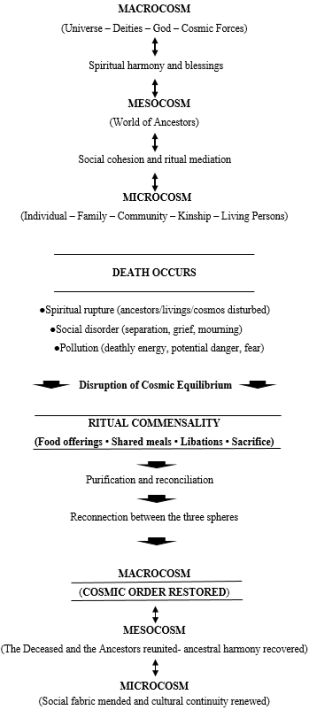
Figure 1. Diagram illustrating the role of ritual commensality in the cosmic order.
Through this ultimate funerary ritual, the microcosm, mesocosmos, and macrocosm are reunited in sublime harmony. With cosmic forces now in balance, life can continue for the bereaved family, which has crossed a significant threshold. The Creator, through the ancestors and especially the newly deceased, can manifest his benevolence and kindness toward the family. This calls to mind the Mexican Day of the Dead food rituals - including
ofrendas laden with
pan de muerto and favorite meals of the deceased — which has shaped recent literature on living dead food relationships. During that day, families invite spirits to partake during annual festivals. Altars are erected to honor the ancestors. The belief that deceased ancestors join the living at shared tables of offerings and meals, reinforce their worldview of life, death, and cyclical balance.
| [75] | Carmichael, E., & Sayer, C. The Skeleton at the Feast: The Day of the Dead in Mexico. Austin: University of Texas Press, Revised edition, 2010. |
| [76] | Navarro, L. Mexico's Day of the Dead: A Celebration of Life. New York: Skyhorse Publishing, 2025. |
[75, 76]
. As a result, the shared meal becomes a symbolic language that establishes the sacred union beyond the grave
| [77] | Bray, T. L. Ritual Commensality between Human and Non-Human Persons: Investigating Native Ontologies in the Late Pre-Columbian Andean World. Berlin: Edition Topoi, 2015. |
[77]
. The ritual enfolds the deceased into communal feasting, symbolically sustaining cosmic and familial continuity
| [78] | Wu, E. S. Food, Death, and Ritual. In Cann, C. K. (Ed.), Dying to Eat: Cross-Cultural Perspectives on Food, Death, and the Afterlife. Lexington: University Press of Kentucky, 2018. |
[78]
. It also attests to and seals the spiritual journey of the deceased to their eternal destination. Below is a diagram illustrating the role of ritual commensality in the cosmic order.





 Share This Article
 Twitter
 Linked In
 Facebook
 Copy
Copy Download