Abstract
For the first time, a theoretically based combination of colour and shape of traffic light signals is proposed. As a result of this combination, a new effective traffic light model (Dalton Traffic Light) is created. The purpose of the Dalton Traffic Light is to ensure equal and indivisible safety and new conveniences for all road users; to radically improve road safety and the quality of life of people with color vision deficiency (CVD, color blindness) and other visual impairments. A person receives information mainly visually, therefore; despite the active introduction of digital intelligent technologies, traffic lights, like road signs, is the most important means of visualising the rules for organising and ordering traffic flow. The traditional traffic light does not provide identical control signals universally to all road users. A significant portion of conventional traffic light users are discriminatorily limited in the quality (unambiguity) of the control signals. Identical round traffic light signals cannot be combined to create a universal combined traffic light section. Compared with the existing traditional design, the Dalton traffic light has the following social, information, economic and aesthetic advantages: the most important benefit from a social perspective is the rehabilitation of a large group of people as equal road users (Restrictions on issuing driver's licenses may be lifted too). “Arrow” (apex) of the yellow intermediate triangular signal indicates in advance which signal (green or red) will be activated next. This clear additional information improves decision-making accuracy and contributes to improved road safety. Reduction of material, energy, transport and service costs for the manufacturing and operation of universal combined traffic light sections (one-section and two-section) compared to conventional traffic lights. Compact Dalton Traffic Lights (one-section and two-section) help reduce visual pollution of the street and road network. There are important anti-conservative aspects of the device implementation: the Dalton Traffic Light (vertical or horizontal) does not require changes to the colour, position or signal sequence of existing traditional traffic lights. The functions of the additional green arrows and red, yellow and green arrows of the standard traffic light remain unchanged. For the Dalton Traffic Light, the current rules and technical regulations (operating mode: steps, phases and control cycles; duration of the control phase; operating conditions: installation rules, elements of the supporting structure, reliability of fastening, etc.) are applied, which are observed during the operation of a conventional traffic light.
Keywords
Traffic Light, Color Blindness, Road Safety, Road Users, Dalton Traffic Light, Colorblind People, Color Vision Deficiency, CVD
1. Introduction
1.1. Background Information
A person receives information mainly visually, therefore; despite the active introduction of digital intelligent technologies
| [1] | M. R. Z. Chowdhury, A. Seum, M. R. Talukder and F. S. Hossain. (2024). “Traffic Light Detection for Autonomous Vehicles in Diverse Environments Through Transfer Learning”. 27th International Conference on Computer and Information Technology (ICCIT), Cox's Bazar, Bangladesh, 2024, pp. 3548-3553, https://doi.org/10.1109/ICCIT64611.2024.11022006 |
| [2] | Ma Wen, Burra Venkata Durga Kumar. An Analysis on Scheduling of Traffic Light at Urban Traffic Intersection Using Fuzzy Control Algorithm. International Journal of Transportation Engineering and Technology. 2021, 7(3), 85-91.
https://doi.org/10.11648/j.ijtet.20210703.14 |
[1, 2]
, traffic lights, like road signs, are the most important means of visualising the rules for organising and ordering traffic flow.
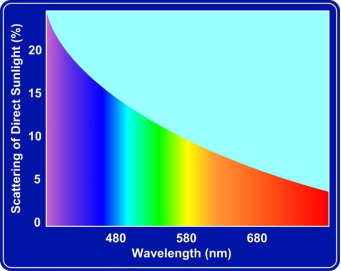
A typical traffic light (vertical or horizontal) has three circular signals – two main signals (red and green) and one intermediate signal (yellow, amber). Red means “stop”, green means “go ahead” and yellow means “caution”. It can be argued that the colours of traffic lights were initially chosen reasonably, in accordance with Rayleigh’s scattering law (
Figure 1)
.
Figure 1. Rayleigh scattering. The greater proportion of blue light scattered by the atmosphere relative to red light.
However, a traditional traffic light does not provide identical control signals universally for all road users.
A significant portion of conventional traffic light users are discriminatorily limited in the quality (unambiguity) of the control signals. Identical round traffic light signals cannot be combined to create a universal combined traffic light section.
1.2. The Conventional Traffic Lights Disadvantages
Conventional traffic lights have the following disadvantages:
1) A large group of road users with color blindness
and visual impairments have difficulty accurately recognising traditional traffic light signals, as all signals are identically round. This problem is especially acute in conditions of low visibility.
2) Identical round traffic light signals cannot be combined to create a universal combined traffic light section. For example, during the day, colorblind people can tell which signal is which because there is a standard position assigned: top – bottom or right – left
. This becomes problematic if the compact combined models of traffic lights are used.
3) The concept of harmony of form and colour
| [6] | Itten, J. (1961). The Art of Color: Subjective experience and objective recognition as paths to art. Federal Republic of Germany: Otto Maier Verlag Ravensburg. 120-121. |
[6]
suggests that red and yellow colours are incompatible with a circle. Green corresponds to a spherical shape. Blue, which has a high degree of atmospheric dispersion (
Figure 1), matches a circular shape.
1.3. Objective
The classic traffic light with round signals has been around for over a century. Throughout this time, there have been problems accurately identifying traffic light signals for color-blind road users. The task of “implementing” an option for such a large group of road users proved non-trivial.
The urgency of addressing the functional shortcomings of traditional traffic lights is demonstrated by the active work of scientists and engineers in this area. A wide variety of options are being proposed, from freely changing the signal shape to a common monitor displaying signals, arrows, etc.
| [7] | Patterson, R. Gordon. Illuminated traffic signal for color blind persons. U. S. Patent 4,839,647. June 13, 1989. |
| [8] | Kulichenko, A. Single-section LED traffic light. RF Patent 2468444. May 05, 2011. |
| [9] | Shadabi, F. Dispositif d’affichage pour feu de signalisation (Traffic signal has housing containing LEDs of different colours to show stop, warning and direction arrows in addition to speed limits). FR Patent 2 875 632. September 23, 2004. |
[7-9]
.
Recently, complex information navigation systems for detecting traffic lights have also been tested using architectures from YOLO (You Only Look Once)
| [10] | Yinyuan Ma, Fathan Arifah, Qonita Afifah, Liko Bun, Kangfu Zhang, Minan Tang. Traffic Light Recognition Assistant for Color Vision Deficiency Using YOLO with Multilingual Audio Feedback, Sensors. 2026, 26(4), 1093.
https://doi.org/10.3390/s26041093 |
| [11] | Julio Saucedo-Soto, Viridiana Hernandez-Herrera, Moises Marquez-Olivera, Octavio Sanchez-Garcia, Antonio-Gustavo Juarez-Gracia. Detection of Traffic Lights and Status (Red, Yellow and Green) in Images with Different Environmental Conditions Using Architectures from Yolov8 to Yolov12, Vehicles 2026, 8(4), 90.
https://doi.org/10.3390/vehicles8040090 |
[10, 11]
. Experimenters note that the traffic light signal recognition coefficient is below 1.0 (100%). In fact, even with the use of such complex IT systems, traffic light signal identification is not guaranteed.
Proposed innovations generally fail to meet the requirements of traffic light conciseness – simplicity, clarity, brevity and precision of control signals. These qualities are especially important in heavy and dynamic traffic conditions, as well as in poor visibility.
Furthermore, despite significant technological advances in the production of new materials and a variety of light sources, the proposed technical solutions for modernisation of conventional traffic lights are generally expensive and appear functionally unconvincing.
The purpose of this article is for the first time, theoretically based combination of colour and shape of traffic light signals is proposed. As a result of this combination, of a new effective traffic light model (Dalton Traffic Light) is created.
Purpose of the Dalton Traffic Light is to ensure equal and indivisible safety and new conveniences for all road users; to radically improve road safety and the quality of life of people with color vision deficiency (CVD, color blindness) and other visual impairments. (In 1794, John Dalton first conducted research and described the vision defect he himself suffered from – color blindness, later named daltonism in his honor).
2. Method, Colour and Shape
2.1. Art Theorists About Colour and Form
The perception of an object depends largely on its shape and colour. Human visual perception of an object in which colour and shape are harmoniously combined is most effective
| [12] | Itten, J. (1975). Design and Form: The Basic Course at the Bauhaus and Later (2nd ed.). London, England: Thames & Hudson. 75. |
[12]
. “Coordination of given colors with corresponding shapes involves a parallelism. Where colors and shapes agree in their expression, their effects are additive”
.
Art theorists Wassily Kandinsky and Johannes Itten studied and explored the question of the combination of form and colour.
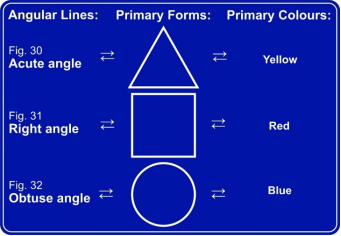
Wassily Kandinsky created a “diagrammatic indication of the line-plane-colour relationships”
and showed that red corresponds to the right angle and the square shape while yellow corresponds to the sharp angle and the triangular shape (
Figure 2).
Figure 2. Wassily Kandinsky. The “diagrammatic indication of the line-plane-colour relationships”.
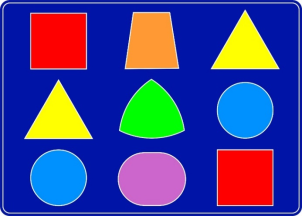
Johannes Itten: “The square corresponds to red, the colour of matter. The weight and opacity of red agree with the static and grave shape of the square. The triangle owes its nature to three intersecting diagonals. Its acute angles produce an effect of pugnacity and aggression. The triangle assimilates all shapes of diagonal character, such as the rhombus, trapezoid, zig-zag, and their derivatives. It is symbol of thought, and among colours its weightless character is matched by lucid yellow” (
Figure 3). “To summarize, the square is resting matter; the radiating triangle is thought, and the circle is spirit in eternal motion”
.
Figure 3. Johannes Itten. Association of colours with corresponding shapes.
2.2. Combining Colour and Shape in a Traffic Light Signal
Combining colour and shape in a traffic light signal can enhance visual and psycho-emotional recognition. Such a signal can be seen from a greater distance, allowing more time to make the best decision, which in turn improves road safety for all road users.
3. Results, Dalton Traffic Light
3.1. Creating a New Effective Traffic Light Model
For the first time, a theoretically based combination of colour and shape of traffic light signals is proposed. As a result of this combination, a new effective traffic light model (Dalton Traffic Light) is created.
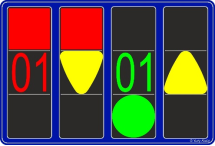
The Dalton Traffic Light, while maintaining the position and colour of a standard traffic light, has a square red signal, a triangular yellow signal, and a standard round green signal (
Figure 4). “Arrow” (apex) of the yellow intermediate triangular signal indicates in advance which signal (green or red) will be activated next.
Figure 4. Dalton Traffic Light. A three-section system with a timer and light sequence.
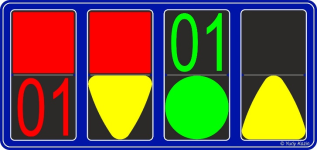
The three-section design of the Dalton Traffic Light can be converted (with the same functionality) into identical models – two-section (
Figure 5) and one-section (
Figure 6) models, which are more economical and help reduce visual pollution of the street and road network.
Figure 5. Dalton Traffic Light. A two-section system with a timer and light sequence.

The horizontal traffic light sequence is similar to that shown in
Figure 4 and
Figure 5.
Figure 6. Dalton Traffic Light. A monosection system and light sequence.

Figures 4, 5, and 6 illustrate the operating steps of the proposed traffic light. The operating modes (steps, phases, and control cycles) and operating conditions (installation rules, design elements, fastening reliability, etc.) for the three-section Dalton Traffic Light can be established in accordance with existing standards and technical regulations applicable to conventional traffic lights. It is crucial to accurately and precisely calculate the control phase time, which is the combination of the main step and the following intermediate step. This is particularly important when regulating conflicting traffic and pedestrian flows. For compact traffic lights, the operating modes and operating conditions can be modified based on experience with the three-section Dalton model and without compromising control safety.
Additional green arrows, and red, amber, and green arrows for the Dalton Traffic Light remain the same as for the conventional traffic light, and the shape of the arrows can be practically stylised in combination with the new image of the Dalton Traffic Light. For example, a yellow triangular signal has an arrow-shaped outline and is, in fact, the arrow with an increased illuminated area.
Various options for visualising arrows are possible. The Convention on Road Signs and Signals prescribes: “Black arrows on a red, amber or green background may be used”
.
The rationale for choosing different Dalton Traffic Light signal silhouettes can be further expanded by the following consideration. Road signs, like traffic lights, are a means of visually embodying traffic regulations. These signs also, for the most part and depending on their purpose, differ in their overall outline – triangle, circle, square (
Figure 7).
Figure 7. Contours of warning and regulatory (prohibitory or restrictive, mandatory, special regulation) road signs.

3.2. Superiority of the Dalton Traffic Light Compared to the Usual Traffic Light
Superiority of the Dalton Traffic Light compared to the usual traffic light:
1) Public Significance
Traffic light signals, which have their own shape for each colour, will be clearly identified by color-blind and visually impaired people.
Restrictions on issuing driver's licenses may be lifted.
Eliminates the need for colour vision testing for potential drivers. Eliminating this testing also saves resources (tens of millions of tests per year).
Compact Dalton Traffic Lights (one-section and two-section) help reduce visual pollution of the street and road network.
But the most important benefit from a social perspective is the rehabilitation of a large group of people as equal road users.
2) Additional Visual Information Content. Road Safety
“Arrow” (apex) of the yellow intermediate triangular signal indicates in advance which signal (green or red) will be activated next. This clear additional information improves decision-making accuracy and contributes to improved road safety.
3) Cost Reduction
Reduction of material, energy, transport and service costs for the manufacturing and operation of universal combined traffic light sections (one-section and two-section) compared to conventional traffic lights.
For example, the material consumption of a two-section or single-section model (excluding the lighting unit) is reduced by 1.5 and 3 times, respectively; the wind load is reduced on compact models, which allows for the lightening of structural elements (supports, posts, consoles, fastening cables, foundations).
4) The Aesthetics of the Urban Environment
Compact Dalton Traffic Lights (one-section and two-section) help reduce visual pollution
| [16] | Mihyawi, R. S. Z., Kamičaitytė, J., Darwish, S., Qaid, A. (2026). Alleviating Visual Pollution in Urban and Business Environment: A Transdisciplinary Approach. In: El Khoury, R. (eds) Strategic Decision-Making in Dynamic Business Environments. Studies in Systems, Decision and Control, vol 642. Springer, Cham.
https://doi.org/10.1007/978-3-032-07220-7_89 |
[16]
of the street and road network.
4. Conclusions and Recommendations
4.1. Conclusions
For the first time, a theoretically based combination of colour and shape of traffic light signals is proposed. As a result of this combination, of a new effective traffic light model (Dalton Traffic Light) is created.
The purpose of the Dalton Traffic Light is to ensure equal and indivisible safety and new conveniences for all road users; to radically improve road safety and the quality of life of people with color vision deficiency (CVD, color blindness) and other visual impairments.
Compared with the existing traditional design, the Dalton Traffic Light has the following advantages: social, information, economic and aesthetic, which, due to the originality and expressiveness of control signals, ensures an equal and higher level of safety for all road users.
4.2. Recommendations
The serial production of the Dalton Traffic Light is possible in any proposed configuration – The author is in contact with specific manufacturers.
A phased implementation of the Dalton Traffic Light is possible. The first phase will involve the traditional three-section model (
Figure 4). Subsequently, the universal single-section and two-section Dalton Traffic Light models can be implemented (
Figures 5 and 6).
Important anti-conservative aspects of the device implementation:
1) The Dalton Traffic Light is logically justified and relevant for all road users, and is convenient for people with color blindness and visual impairments.
2) The Dalton Traffic Light does not require changes to the colour, position or signal sequence of existing traditional “round” traffic lights.
3) The functions of the additional green arrows and red, yellow, and green arrows of the standard traffic light remain unchanged, but their design can be stylised in combination with the new configuration.
4) For the Dalton Traffic Light, the current rules and technical regulations (operating mode: steps, phases and control cycles; duration of the control phase; operating conditions: installation rules, elements of the supporting structure, reliability of fastening, etc.) are applied, which are observed during the operation of a conventional traffic light.
5) The above factors apply equally to horizontal traffic lights.
4.3. Restrictions
Conditionally, the bureaucratic limitation of popularisation of the Dalton Traffic Light for countries that have ratified the UNECE (United Nations Economic Commission for Europe) Convention on Road Signs and Signals (2006) is provided by the provisions of Chapter III. Article 23, which specifies the shape of the light signals of conventional traffic lights. For countries that have not adopted the Convention (e.g. Australia, China, USA…), there are no such restrictions on the distribution of traffic lights in the new format.
Abbreviations
CVD | Color Vision Deficiency |
UNECE | United Nations Economic Commission for Europe |
YOLO | You Only Look Once |
Author Contributions
Yuriy Kozin: Conceptualization, Data curation, Formal Analysis, Investigation, Methodology, Project administration, Resources, Supervision, Validation, Visualization, Writing – original draft, Writing – review & editing
Conflicts of Interest
The author declares no conflicts of interest.
References
| [1] |
M. R. Z. Chowdhury, A. Seum, M. R. Talukder and F. S. Hossain. (2024). “Traffic Light Detection for Autonomous Vehicles in Diverse Environments Through Transfer Learning”. 27th International Conference on Computer and Information Technology (ICCIT), Cox's Bazar, Bangladesh, 2024, pp. 3548-3553,
https://doi.org/10.1109/ICCIT64611.2024.11022006
|
| [2] |
Ma Wen, Burra Venkata Durga Kumar. An Analysis on Scheduling of Traffic Light at Urban Traffic Intersection Using Fuzzy Control Algorithm. International Journal of Transportation Engineering and Technology. 2021, 7(3), 85-91.
https://doi.org/10.11648/j.ijtet.20210703.14
|
| [3] |
Explaining Science Blog. Why is the Sky Blue? Available from:
https://explainingscience.org/2015/09/30/why-is-the-sky-blue/
(accessed 23 July 2026).
|
| [4] |
Almustanyir, A. A Global Perspective of Color Vision Deficiency: Awareness, Diagnosis, and Lived Experiences. Healthcare 2025, 13(16), 2031.
https://doi.org/10.3390/healthcare13162031
|
| [5] |
Oliveira, I. P., Souza, R., Junior, F., Sales L. & Ferraz F. (2015, June). A Vision of Traffic Lights for Color-Blind People. Paper presented at the Fourth International Conference on Smart Systems, Devices and Technologies (SMART 2015). Brussels, Belgium. URL:
https://www.researchgate.net/publication/311832580_A_Vision_of_Traffic_Lights_for_Color-Blind_People
|
| [6] |
Itten, J. (1961). The Art of Color: Subjective experience and objective recognition as paths to art. Federal Republic of Germany: Otto Maier Verlag Ravensburg. 120-121.
|
| [7] |
Patterson, R. Gordon. Illuminated traffic signal for color blind persons. U. S. Patent 4,839,647. June 13, 1989.
|
| [8] |
Kulichenko, A. Single-section LED traffic light. RF Patent 2468444. May 05, 2011.
|
| [9] |
Shadabi, F. Dispositif d’affichage pour feu de signalisation (Traffic signal has housing containing LEDs of different colours to show stop, warning and direction arrows in addition to speed limits). FR Patent 2 875 632. September 23, 2004.
|
| [10] |
Yinyuan Ma, Fathan Arifah, Qonita Afifah, Liko Bun, Kangfu Zhang, Minan Tang. Traffic Light Recognition Assistant for Color Vision Deficiency Using YOLO with Multilingual Audio Feedback, Sensors. 2026, 26(4), 1093.
https://doi.org/10.3390/s26041093
|
| [11] |
Julio Saucedo-Soto, Viridiana Hernandez-Herrera, Moises Marquez-Olivera, Octavio Sanchez-Garcia, Antonio-Gustavo Juarez-Gracia. Detection of Traffic Lights and Status (Red, Yellow and Green) in Images with Different Environmental Conditions Using Architectures from Yolov8 to Yolov12, Vehicles 2026, 8(4), 90.
https://doi.org/10.3390/vehicles8040090
|
| [12] |
Itten, J. (1975). Design and Form: The Basic Course at the Bauhaus and Later (2nd ed.). London, England: Thames & Hudson. 75.
|
| [13] |
Itten, J. (1970). The Elements of Color. New York, USA: Van Nostrand Reinhold Company. (Original work published 1961). 75-76. URL:
https://monoskop.org/images/4/46/Itten_Johannes_The_Elements_of_Color.pdf
|
| [14] |
Kandinsky, W. (1947). Point and Line to Plane: Contribution to the Analysis of the Pictorial Elements. New York City, USA: Published by Solomon R. Guggenheim Foundation for the Museum of Non-Objective Painting. (Original work published 1926). 74-75. URL:
https://www.holybooks.com/wp-content/uploads/Point-and-Line-to-Plane-by-Kandinsky.pdf
|
| [15] |
UNECE. (2006). The Convention on Road Signs and Signals. Geneva, Switzerland: The United Nations Economic Commission for Europe. 16. URL:
http://www.unece.org/fileadmin/DAM/trans/conventn/Conv_road_signs_2006v_EN.pdf
|
| [16] |
Mihyawi, R. S. Z., Kamičaitytė, J., Darwish, S., Qaid, A. (2026). Alleviating Visual Pollution in Urban and Business Environment: A Transdisciplinary Approach. In: El Khoury, R. (eds) Strategic Decision-Making in Dynamic Business Environments. Studies in Systems, Decision and Control, vol 642. Springer, Cham.
https://doi.org/10.1007/978-3-032-07220-7_89
|
Cite This Article
-
APA Style
Kozin, Y. (2026). Dalton Traffic Light: Equal and Indivisible Safety for All Road Users. International Journal of Transportation Engineering and Technology, 12(3), 119-124. https://doi.org/10.11648/j.ijtet.20261203.13
Copy
|
Download
ACS Style
Kozin, Y. Dalton Traffic Light: Equal and Indivisible Safety for All Road Users. Int. J. Transp. Eng. Technol. 2026, 12(3), 119-124. doi: 10.11648/j.ijtet.20261203.13
Copy
|
Download
AMA Style
Kozin Y. Dalton Traffic Light: Equal and Indivisible Safety for All Road Users. Int J Transp Eng Technol. 2026;12(3):119-124. doi: 10.11648/j.ijtet.20261203.13
Copy
|
Download
-
@article{10.11648/j.ijtet.20261203.13,
author = {Yuriy Kozin},
title = {Dalton Traffic Light: Equal and Indivisible Safety for All Road Users},
journal = {International Journal of Transportation Engineering and Technology},
volume = {12},
number = {3},
pages = {119-124},
doi = {10.11648/j.ijtet.20261203.13},
url = {https://doi.org/10.11648/j.ijtet.20261203.13},
eprint = {https://article.sciencepublishinggroup.com/pdf/10.11648.j.ijtet.20261203.13},
abstract = {For the first time, a theoretically based combination of colour and shape of traffic light signals is proposed. As a result of this combination, a new effective traffic light model (Dalton Traffic Light) is created. The purpose of the Dalton Traffic Light is to ensure equal and indivisible safety and new conveniences for all road users; to radically improve road safety and the quality of life of people with color vision deficiency (CVD, color blindness) and other visual impairments. A person receives information mainly visually, therefore; despite the active introduction of digital intelligent technologies, traffic lights, like road signs, is the most important means of visualising the rules for organising and ordering traffic flow. The traditional traffic light does not provide identical control signals universally to all road users. A significant portion of conventional traffic light users are discriminatorily limited in the quality (unambiguity) of the control signals. Identical round traffic light signals cannot be combined to create a universal combined traffic light section. Compared with the existing traditional design, the Dalton traffic light has the following social, information, economic and aesthetic advantages: the most important benefit from a social perspective is the rehabilitation of a large group of people as equal road users (Restrictions on issuing driver's licenses may be lifted too). “Arrow” (apex) of the yellow intermediate triangular signal indicates in advance which signal (green or red) will be activated next. This clear additional information improves decision-making accuracy and contributes to improved road safety. Reduction of material, energy, transport and service costs for the manufacturing and operation of universal combined traffic light sections (one-section and two-section) compared to conventional traffic lights. Compact Dalton Traffic Lights (one-section and two-section) help reduce visual pollution of the street and road network. There are important anti-conservative aspects of the device implementation: the Dalton Traffic Light (vertical or horizontal) does not require changes to the colour, position or signal sequence of existing traditional traffic lights. The functions of the additional green arrows and red, yellow and green arrows of the standard traffic light remain unchanged. For the Dalton Traffic Light, the current rules and technical regulations (operating mode: steps, phases and control cycles; duration of the control phase; operating conditions: installation rules, elements of the supporting structure, reliability of fastening, etc.) are applied, which are observed during the operation of a conventional traffic light.},
year = {2026}
}
Copy
|
Download
-
TY - JOUR
T1 - Dalton Traffic Light: Equal and Indivisible Safety for All Road Users
AU - Yuriy Kozin
Y1 - 2026/09/18
PY - 2026
N1 - https://doi.org/10.11648/j.ijtet.20261203.13
DO - 10.11648/j.ijtet.20261203.13
T2 - International Journal of Transportation Engineering and Technology
JF - International Journal of Transportation Engineering and Technology
JO - International Journal of Transportation Engineering and Technology
SP - 119
EP - 124
PB - Science Publishing Group
SN - 2575-1751
UR - https://doi.org/10.11648/j.ijtet.20261203.13
AB - For the first time, a theoretically based combination of colour and shape of traffic light signals is proposed. As a result of this combination, a new effective traffic light model (Dalton Traffic Light) is created. The purpose of the Dalton Traffic Light is to ensure equal and indivisible safety and new conveniences for all road users; to radically improve road safety and the quality of life of people with color vision deficiency (CVD, color blindness) and other visual impairments. A person receives information mainly visually, therefore; despite the active introduction of digital intelligent technologies, traffic lights, like road signs, is the most important means of visualising the rules for organising and ordering traffic flow. The traditional traffic light does not provide identical control signals universally to all road users. A significant portion of conventional traffic light users are discriminatorily limited in the quality (unambiguity) of the control signals. Identical round traffic light signals cannot be combined to create a universal combined traffic light section. Compared with the existing traditional design, the Dalton traffic light has the following social, information, economic and aesthetic advantages: the most important benefit from a social perspective is the rehabilitation of a large group of people as equal road users (Restrictions on issuing driver's licenses may be lifted too). “Arrow” (apex) of the yellow intermediate triangular signal indicates in advance which signal (green or red) will be activated next. This clear additional information improves decision-making accuracy and contributes to improved road safety. Reduction of material, energy, transport and service costs for the manufacturing and operation of universal combined traffic light sections (one-section and two-section) compared to conventional traffic lights. Compact Dalton Traffic Lights (one-section and two-section) help reduce visual pollution of the street and road network. There are important anti-conservative aspects of the device implementation: the Dalton Traffic Light (vertical or horizontal) does not require changes to the colour, position or signal sequence of existing traditional traffic lights. The functions of the additional green arrows and red, yellow and green arrows of the standard traffic light remain unchanged. For the Dalton Traffic Light, the current rules and technical regulations (operating mode: steps, phases and control cycles; duration of the control phase; operating conditions: installation rules, elements of the supporting structure, reliability of fastening, etc.) are applied, which are observed during the operation of a conventional traffic light.
VL - 12
IS - 3
ER -
Copy
|
Download