Abstract
Rwanda’s pursuit of a high-income, knowledge-based economy under Vision 2050 depends on scalable, resilient, and cost-efficient telecommunications infrastructure. Despite achieving near-universal 4G LTE population coverage (97–99%), a persistent usage gap — approximately 62% of the population remains unconnected — reveals that supply-side infrastructure alone is insufficient to bridge the digital divide. This paper investigates how Software-Defined Networking (SDN) and Network Function Virtualization (NFV) can serve as strategic enablers of telecommunications modernization in Rwanda, addressing the twin challenges of cost and operational complexity in a landlocked, resource-constrained environment. Employing a Design Science Research (DSR) methodology, this study evaluates Rwanda’s infrastructure readiness, identifies technical, economic, and regulatory barriers to SDN/NFV adoption, and proposes a context-adapted, phased deployment artifact the Frugal SDN/NFV Framework aligned with Rwanda’s ICT Sector Strategic Plan 2024–2029. The framework is supported by five formally specified mathematical optimization models: the Controller Placement Problem for Rwanda’s 30-district fiber topology, the VNF Resource Allocation mixed integer program, a Network Slice SLA Allocation model, a CAPEX/OPEX Net Present Value cost model, and a joint SDN-MEC task offloading optimization. Numerical projections derived from these models informed by comparable African SDN/NFV deployments including Safaricom Ethiopia’s 2022 greenfield virtualized network and MTN South Africa’s cloud-native 5G core suggest potential CAPEX reductions of 20–68% and OPEX reductions of 20–67%. The proposed three-phase roadmap (Pilot 2025–2026; Scale 2026–2028; Optimize 2028–2029) positions SDN/NFV as a leapfrogging catalyst for equitable digital growth, contributing the first academically grounded SDN/NFV deployment framework for an African national telecommunications network.
|
Published in
|
Internet of Things and Cloud Computing (Volume 14, Issue 1)
|
|
DOI
|
10.11648/j.iotcc.20261401.12
|
|
Page(s)
|
11-25 |
|
Creative Commons
|

This is an Open Access article, distributed under the terms of the Creative Commons Attribution 4.0 International License (http://creativecommons.org/licenses/by/4.0/), which permits unrestricted use, distribution and reproduction in any medium or format, provided the original work is properly cited.
|
|
Copyright
|
Copyright © The Author(s), 2026. Published by Science Publishing Group
|
Keywords
Software-Defined Networking (SDN), Network Function Virtualization (NFV), Telecommunications Infrastructure, Rwanda,
Design Science Research, Network Slicing, 5G, Leapfrogging
1. Introduction
Rwanda has emerged as one of Sub-Saharan Africa’s most compelling digital transformation stories, achieving a Network Readiness Index 2025 rank of 87th globally first among all low-income countries
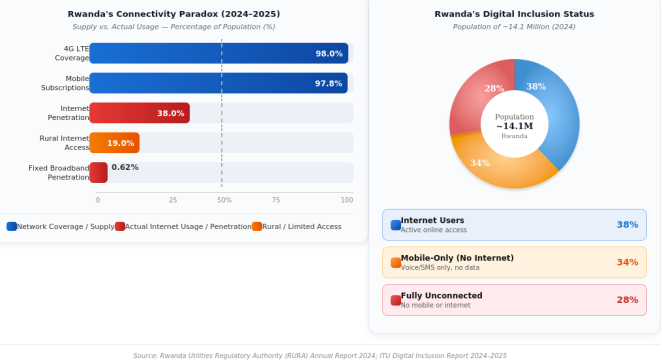
. Yet beneath these achievements lies a structural paradox: near-universal 4G LTE coverage (97–99%) coexists with internet penetration of only approximately 38%, and rural internet adoption stands at just 19% despite 72.1% of the population residing in rural areas
| [2] | International Telecommunication Union (ITU). Measuring Digital Development: Facts and Figures 2024. Geneva: ITU; 2024. Available from: https://www.itu.int/en/ITU-D/Statistics/ |
| [3] | Rwanda Utilities Regulatory Authority (RURA). ICT Sector Statistics Report: Q3 2024. Kigali: RURA; 2024. Available from: https://www.rura.rw |
[2, 3]
.
Figure 1 illustrates this connectivity paradox.
Figure 1. Rwanda’s Connectivity Paradox — High Network Coverage vs. Low Internet Adoption (2024–2025).
This paradox is partly economic — mobile data costs can consume up to 60% of monthly income for the poorest quintile
| [5] | World Bank. Rwanda Digital Acceleration Project (P173373): Project Appraisal Document. Washington, DC: World Bank Group; 2021. Available from:
https://documents.worldbank.org |
[5]
but is also fundamentally architectural. Rwanda’s telecommunications networks, built on hardware-centric, vendor-proprietary infrastructure, impose structural constraints on scalability, operational agility, and cost efficiency that disadvantage rural and underserved populations
| [6] | Kreutz, D., Ramos, F. M. V., Verissimo, P. E., Rothenberg, C. E., Azodolmolky, S., Uhlig, S. Software-Defined Networking: A Comprehensive Survey. Proceedings of the IEEE. 2015, 103(1), 14–76. https://doi.org/10.1109/JPROC.2014.2371999 |
[6]
. Maintaining these architectures to meet Vision 2050’s aspirations for universal connectivity and 5G readiness requires capital and human resource investments that current frameworks struggle to accommodate
| [7] | Ministry of ICT and Innovation Rwanda (MINICT). ICT Sector Strategic Plan 2024–2029. Kigali: Government of Rwanda; 2024. Available from: https://www.minict.gov.rw |
[7]
.
SDN and NFV represent a paradigm shift of potentially transformative relevance, replacing rigid, expensive physical infrastructure with flexible, programmable software. Despite substantial global evidence of SDN/NFV benefits, a critical research gap persists: there is a near-total absence of peer-reviewed academic literature examining SDN/NFV implementation in African national network contexts
| [8] | Barakabitze, A. A., Ahmad, A., Mijumbi, R., Hines, A. 5G Network Slicing Using SDN and NFV: A Survey of Taxonomy, Architectures and Future Challenges. Computer Networks. 2020, 167, 106984.
https://doi.org/10.1016/j.comnet.2019.106984 |
[8]
. The most relevant academic work on SDN in Africa is a single IEEE AFRICON 2023 paper on South Africa
. Rwanda, despite its advanced ICT policy environment and June 2025 commercial 5G launch
| [10] | Ecofin Agency. MTN Rwanda Launches 5G Network in Kigali. 2025, June 10. Available from: https://www.ecofinagency.com (accessed March 2026). |
[10]
, remains entirely unaddressed in peer-reviewed SDN/NFV literature. This study addresses that gap.
1.1. Research Objectives
1) Evaluate Rwanda’s existing telecommunications infrastructure and its readiness for SDN and NFV adoption.
2) Analyse technical, economic, and regulatory barriers to SDN/NFV implementation using formal mathematical optimization models.
3) Construct a frugal, context-aware SDN/NFV deployment framework aligned with Rwanda’s ICT Sector Strategic Plan 2024–2029
| [7] | Ministry of ICT and Innovation Rwanda (MINICT). ICT Sector Strategic Plan 2024–2029. Kigali: Government of Rwanda; 2024. Available from: https://www.minict.gov.rw |
[7]
.
1.2. Research Question
How can a frugal, context-adapted SDN/NFV framework incorporating mathematically grounded controller placement, VNF resource allocation, and network slicing models be designed to overcome cost, skill, and operational complexity barriers in Rwanda’s telecommunications sector?
2. Literature Review
2.1. Software-Defined Networking
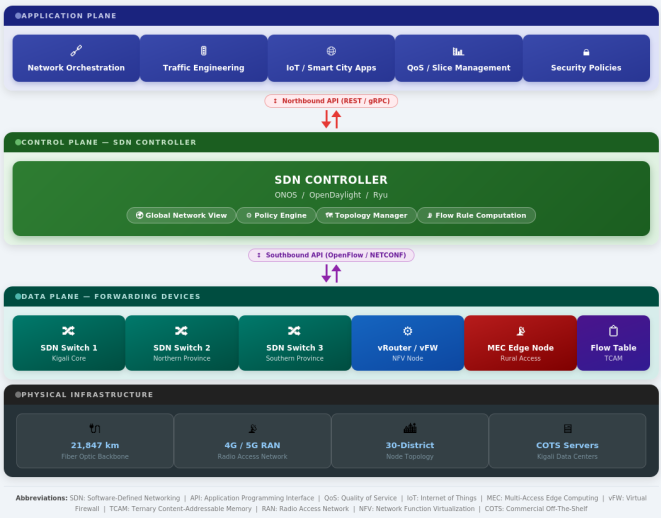
SDN reorganizes network architecture by physically separating the control plane from the data forwarding plane, enabling a logically centralized controller to govern multiple forwarding devices through standardized interfaces
| [11] | Open Networking Foundation (ONF). SDN Architecture Overview. Menlo Park, CA: ONF; 2016. Available from: https://opennetworking.org |
[11]
. This creates a global, programmable network view supporting dynamic traffic management, improved visibility, and rapid service deployment. Open-source controllers ONOS and OpenDaylight (ODL) are particularly relevant for resource-constrained contexts as they eliminate proprietary licensing costs; ONOS had scaled to serve over one billion subscribers by 2017
. Vivekanand and Thakuria
| [13] | Vivekanand, Thakuria, K. How SDN Enhances Network Scalability and Flexibility. International Journal of Innovative Research in Science, Engineering and Technology. 2016, 5(5), 7965–7971, https://doi.org/10.15680/IJIRSET.2016.0505369 |
[13]
demonstrate that SDN enables dynamic resource allocation and multi-tenant network management, directly applicable to Rwanda’s multi-operator market structure.
Despite these benefits, SDN adoption in Africa faces barriers including legacy integration challenges, workforce skill requirements, and upfront controller costs
. Mamushiane et al.
| [14] | Mamushiane, L., Mwangama, J., Lysko, A. Optimum Placement of SDN Controllers in African Backbones: SANREN and ZAMREN as a Case Study. In Proceedings of IST-Africa 2018 Conference, Gaborone, Botswana, 2018. IEEE.
https://doi.org/10.23919/ISTAFRICA.2018.8417007 |
| [15] | Mamushiane, L., Mwangama, J., Lysko, A. Resilient SDN Controller Placement Optimization on the South African National Research Network (SANReN). ITU Journal on Future and Evolving Technologies. 2021, 2(1).
https://doi.org/10.52953/UXAK6583 |
[14, 15]
applied Partition Around Medoids (PAM) clustering to optimize SDN controller placement on African backbone networks (SANREN and ZAMREN), finding that two controllers provide the optimal balance of latency reduction, resilience, and cost efficiency — a key finding for Rwanda’s topology analysis in Section 5.
2.2. Network Function Virtualization
NFV decouples software network functions from dedicated hardware appliances, enabling them to execute as software instances on commercial-off-the-shelf (COTS) servers. Formally proposed by ETSI in 2012
| [16] | ETSI Industry Specification Group on Network Functions Virtualisation (ISG NFV). Network Functions Virtualisation: An Introduction, Benefits, Enablers, Challenges and Call for Action (White Paper). Sophia Antipolis: ETSI; 2012. Available from:
https://www.etsi.org/technologies/nfv |
[16]
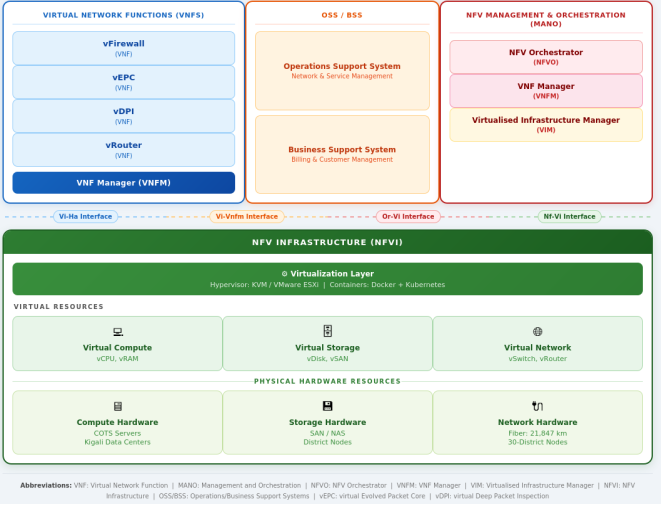
, NFV is architected around three core components: the NFV Infrastructure (NFVI), Virtual Network Functions (VNFs), and NFV Management and Orchestration (MANO)
| [17] | Mijumbi, R., Serrat, J., Gorricho, J.-L., Bouten, N., De Turck, F., Boutaba, R. Network Function Virtualization: State-of-the-Art and Research Challenges. IEEE Communications Surveys and Tutorials. 2016, 18(1), 236–262.
https://doi.org/10.1109/COMST.2015.2477041 |
[17]
. Mijumbi et al.
| [17] | Mijumbi, R., Serrat, J., Gorricho, J.-L., Bouten, N., De Turck, F., Boutaba, R. Network Function Virtualization: State-of-the-Art and Research Challenges. IEEE Communications Surveys and Tutorials. 2016, 18(1), 236–262.
https://doi.org/10.1109/COMST.2015.2477041 |
[17]
confirm that dynamic VNF allocation significantly reduces idle hardware capacity and accelerates service deployment from approximately 15 months to under 6 months.
Kiran et al.
| [18] | Kiran, N., Pan, C., Wang, S., Yin, C. Joint Resource Allocation and Computation Offloading in Mobile Edge Computing for SDN Based Wireless Networks. Journal of Communications and Networks. 2020, 22(1), 1–12.
https://doi.org/10.1109/JCN.2019.000046 |
[18]
demonstrate that joint resource allocation and computation offloading in SDN-based Mobile Edge Computing (MEC) achieves 31.39–62.10% reduction in sum delay compared to benchmark methods directly relevant to Rwanda’s latency challenges from landlocked international transit routing. Kiran et al.
| [19] | Kiran, N., Liu, X., Wang, S., Yin, C. VNF Placement and Resource Allocation in SDN/NFV-Enabled MEC Networks. In Proceedings of the International Conference on Networks, Communications and Computing (ICNCC 2020), Beijing, China, 2020. IEEE
https://doi.org/10.1109/WCNCW48565.2020.9124910 |
[19]
further show that coordinated VNF placement in SDN/NFV-enabled MEC networks reduces overall cost compared to random and first-fit algorithms.
Figure 3 illustrates the ETSI NFV reference architecture.
Figure 3. ETSI NFV Reference Architecture Applied to Rwanda’s Telecommunications Infrastructure.
2.3. SDN/NFV for 5G Network Slicing
The convergence of SDN, NFV, and MEC constitutes the enabling stack for 5G network slicing partitioning a single physical network into multiple isolated logical networks
| [8] | Barakabitze, A. A., Ahmad, A., Mijumbi, R., Hines, A. 5G Network Slicing Using SDN and NFV: A Survey of Taxonomy, Architectures and Future Challenges. Computer Networks. 2020, 167, 106984.
https://doi.org/10.1016/j.comnet.2019.106984 |
[8]
. Barakabitze et al.
| [8] | Barakabitze, A. A., Ahmad, A., Mijumbi, R., Hines, A. 5G Network Slicing Using SDN and NFV: A Survey of Taxonomy, Architectures and Future Challenges. Computer Networks. 2020, 167, 106984.
https://doi.org/10.1016/j.comnet.2019.106984 |
[8]
provide the most comprehensive survey of 5G network slicing using SDN and NFV, establishing the taxonomy and architecture frameworks adopted in this study. Cubukcu et al.
| [21] | Cubukcu, A., Cubukcu, O., Kavak, A., Kucuk, K. Evaluation of Cloud-Based Dynamic Network Scaling and Slicing for Next-Generation Wireless Networks. Engineering Proceedings. 2024, 70(1), 45.
https://doi.org/10.3390/engproc2024070045 |
[21]
evaluate Cloud-based Dynamic Network Scaling and Slicing (CDNSS), finding it delivers superior QoS differentiation on an OpenDaylight-based SDN/NFV-MANO platform — directly validating the slice allocation models in Section 4. Ojo et al.
| [20] | Ojo, M., Adami, D., Giordano, S. A SDN-IoT Architecture with NFV Implementation. In Proceedings of the IEEE International Symposium on Broadband Multimedia Systems and Broadcasting (BMSB), Nara, Japan, 2016. IEEE.
https://doi.org/10.1109/BMSB.2016.7547068 |
[20]
address IoT network management through a SDN-IoT Architecture with NFV, applicable to Rwanda’s smart agriculture and health monitoring initiatives.
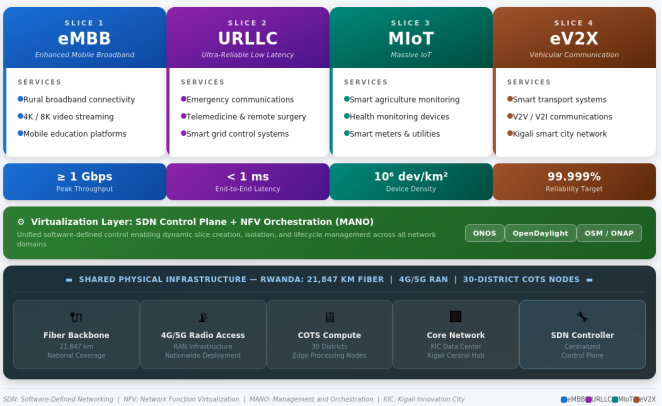
Figure 4 illustrates the four-slice architecture proposed for Rwanda.
2.4. Frugal Networks and Technology Leapfrogging
Khaturia et al.
propose a Frugal 5G Network architecture for rural developing-country contexts, leveraging SDN/NFV for flexibility and fog computing at the edge for offline coverage. Singh
| [23] | Singh, A. SDN and NFV: A Case Study and Role in 5G and Beyond. International Journal for Multidisciplinary Research. 2020, 2(2). DOI not available, Available from:
https://www.ijfmr.com |
[23]
confirms the complementary SDN/NFV relationship: SDN provides programmable connectivity between VNFs while NFV provides service and function abstraction. Bajpai
| [24] | Bajpai, R. Enhancing Network Infrastructure Through SDN and NFV: Overcoming Configuration Challenges in Complex Heterogeneous Networks. Journal of Advances in Computer Networks. 2018, 6(2), 45–52.
https://doi.org/10.18178/jacn.2018.6.2.255 |
[24]
demonstrates that model-driven automation using NETCONF/YANG protocols reduces operational costs in SDN/NFV deployments directly relevant to Rwanda’s limited advanced network engineering workforce. UNCTAD
establishes the leapfrogging conditions: proven technology at scale, comparable functionality, and viable bypass of legacy infrastructure all satisfied for Rwanda’s SDN/NFV context.
2.5. Summary of Related Literature
Table 1. Summary of related literature and research gaps addressed by this study.
Author(s) & Year | Focus Area | Key Contribution | Gap Addressed |
Barakabitze et al. 8] | 5G SDN/NFV Survey | Comprehensive taxonomy; network slicing enablers; MEC/cloud integration | Rwanda-specific framework absent |
Kiran et al. 18] | SDN-MEC Resource Alloc. | 31–62% delay reduction via RL-based offloading optimization | Developing country rural context not addressed |
Kiran et al. 19] | VNF Placement Optim. | Coordinated VNF placement reduces cost vs. random/first-fit algorithms | African network topology not considered |
Cubukcu et al. 21] | Cloud Dynamic Slicing | CDNSS achieves QoS differentiation; OpenDaylight validated on 5G | SSA regulatory/economic context absent |
Ojo et al. 20] | SDN-IoT with NFV | Unified architecture addresses IoT scalability, security, and mobility | No national deployment framework provided |
Vivekanand & Thakuria 13] | SDN Scalability | SDN enables dynamic resource allocation and multi-tenant networking | Developing country constraints not modelled |
Singh 23] | SDN/NFV in 5G | Case study confirming SDN/NFV integration for 5G core network | Africa context and economics not addressed |
Mamushiane et al. 14, 15] | SDN Controller Placement | PAM clustering optimal for African backbones; 2 controllers validated | Only SA and Zambian topologies tested; not Rwanda |
Khaturia et al. 22] | Frugal 5G Architecture | SDN/NFV frugal design with fog computing for rural coverage | 3GPP alignment and Rwanda context absent |
Mijumbi et al. 17] | NFV State-of-the-Art | Foundational NFV challenges survey; MANO framework analysis | No developing country TCO or deployment model |
MANO: Management and Orchestration; MEC: Mobile Edge Computing; SSA: Sub-Saharan Africa; RL: Reinforcement Learning.
3. Methodology
3.1. Research Paradigm: Design Science Research
This study adopts Design Science Research (DSR) as its methodological paradigm, following Hevner et al.’s foundational framework
| [26] | Hevner, A. R., March, S. T., Park, J., Ram, S. Design Science in Information Systems Research. MIS Quarterly. 2004, 28(1), 75–105.
https://doi.org/10.2307/25148625 |
[26]
. DSR is appropriate when the objective is to create and evaluate an IT artifact — here the Frugal SDN/NFV Framework — as a solution to an identified technical problem
| [26] | Hevner, A. R., March, S. T., Park, J., Ram, S. Design Science in Information Systems Research. MIS Quarterly. 2004, 28(1), 75–105.
https://doi.org/10.2307/25148625 |
[26]
. Peffers et al.
| [27] | Peffers, K., Tuunanen, T., Rothenberger, M. A., Chatterjee, S. A Design Science Research Methodology for Information Systems Research. Journal of Management Information Systems. 2007, 24(3), 45–77.
https://doi.org/10.2753/MIS0742-1222240302 |
[27]
provide the DSR process model adopted here, comprising six activities: problem identification and motivation; definition of objectives; design and development of the artifact; demonstration; evaluation; and communication. This DSR approach is explicitly not an empirical case study: no primary fieldwork, interviews, or operational network measurements were conducted. The artifact evaluation is therefore formative and analytical — grounded in the literature, comparable deployment evidence, and mathematical modelling — rather than summative through implementation trials.
3.2. Data Sources
Secondary data was collected and triangulated across four source types:
1) Primary policy documents: ICT Sector Strategic Plan 2024–2029
| [7] | Ministry of ICT and Innovation Rwanda (MINICT). ICT Sector Strategic Plan 2024–2029. Kigali: Government of Rwanda; 2024. Available from: https://www.minict.gov.rw |
[7]
, Rwanda Digital Acceleration Project
| [5] | World Bank. Rwanda Digital Acceleration Project (P173373): Project Appraisal Document. Washington, DC: World Bank Group; 2021. Available from:
https://documents.worldbank.org |
[5]
, RURA quarterly statistics reports
| [3] | Rwanda Utilities Regulatory Authority (RURA). ICT Sector Statistics Report: Q3 2024. Kigali: RURA; 2024. Available from: https://www.rura.rw |
[3]
2) Published peer-reviewed literature: Ten core reference papers covering SDN/NFV theory, African network deployment, and optimization modelling
| [8] | Barakabitze, A. A., Ahmad, A., Mijumbi, R., Hines, A. 5G Network Slicing Using SDN and NFV: A Survey of Taxonomy, Architectures and Future Challenges. Computer Networks. 2020, 167, 106984.
https://doi.org/10.1016/j.comnet.2019.106984 |
| [13] | Vivekanand, Thakuria, K. How SDN Enhances Network Scalability and Flexibility. International Journal of Innovative Research in Science, Engineering and Technology. 2016, 5(5), 7965–7971, https://doi.org/10.15680/IJIRSET.2016.0505369 |
| [14] | Mamushiane, L., Mwangama, J., Lysko, A. Optimum Placement of SDN Controllers in African Backbones: SANREN and ZAMREN as a Case Study. In Proceedings of IST-Africa 2018 Conference, Gaborone, Botswana, 2018. IEEE.
https://doi.org/10.23919/ISTAFRICA.2018.8417007 |
| [15] | Mamushiane, L., Mwangama, J., Lysko, A. Resilient SDN Controller Placement Optimization on the South African National Research Network (SANReN). ITU Journal on Future and Evolving Technologies. 2021, 2(1).
https://doi.org/10.52953/UXAK6583 |
| [17] | Mijumbi, R., Serrat, J., Gorricho, J.-L., Bouten, N., De Turck, F., Boutaba, R. Network Function Virtualization: State-of-the-Art and Research Challenges. IEEE Communications Surveys and Tutorials. 2016, 18(1), 236–262.
https://doi.org/10.1109/COMST.2015.2477041 |
| [18] | Kiran, N., Pan, C., Wang, S., Yin, C. Joint Resource Allocation and Computation Offloading in Mobile Edge Computing for SDN Based Wireless Networks. Journal of Communications and Networks. 2020, 22(1), 1–12.
https://doi.org/10.1109/JCN.2019.000046 |
| [19] | Kiran, N., Liu, X., Wang, S., Yin, C. VNF Placement and Resource Allocation in SDN/NFV-Enabled MEC Networks. In Proceedings of the International Conference on Networks, Communications and Computing (ICNCC 2020), Beijing, China, 2020. IEEE
https://doi.org/10.1109/WCNCW48565.2020.9124910 |
| [20] | Ojo, M., Adami, D., Giordano, S. A SDN-IoT Architecture with NFV Implementation. In Proceedings of the IEEE International Symposium on Broadband Multimedia Systems and Broadcasting (BMSB), Nara, Japan, 2016. IEEE.
https://doi.org/10.1109/BMSB.2016.7547068 |
| [21] | Cubukcu, A., Cubukcu, O., Kavak, A., Kucuk, K. Evaluation of Cloud-Based Dynamic Network Scaling and Slicing for Next-Generation Wireless Networks. Engineering Proceedings. 2024, 70(1), 45.
https://doi.org/10.3390/engproc2024070045 |
| [22] | Khaturia, M., Jha, P., Karandikar, A. Connecting the Unconnected: Toward Frugal 5G Network Architecture and Standardization. IEEE Access. 2020, 8, 147296–147311.
https://doi.org/10.1109/ACCESS.2020.3013302 |
| [23] | Singh, A. SDN and NFV: A Case Study and Role in 5G and Beyond. International Journal for Multidisciplinary Research. 2020, 2(2). DOI not available, Available from:
https://www.ijfmr.com |
[8, 13-15, 17-23]
3) Verified industry and institutional reports: GSMA Sub-Saharan Africa reports
, ETSI NFV White Paper
| [16] | ETSI Industry Specification Group on Network Functions Virtualisation (ISG NFV). Network Functions Virtualisation: An Introduction, Benefits, Enablers, Challenges and Call for Action (White Paper). Sophia Antipolis: ETSI; 2012. Available from:
https://www.etsi.org/technologies/nfv |
[16]
, ITU connectivity data
, World Bank project documentation
| [5] | World Bank. Rwanda Digital Acceleration Project (P173373): Project Appraisal Document. Washington, DC: World Bank Group; 2021. Available from:
https://documents.worldbank.org |
[5]
4) Comparable African deployment evidence: Safaricom Ethiopia VMware deployment
, MTN South Africa Ericsson cloud-native core
, ATU 5G Preparedness Report
| [32] | African Telecommunications Union (ATU). Report on 5G Preparedness and Relevant Use Cases in Africa (ATU-R-Report-005-0). Nairobi: ATU; 2025. Available from: https://www.atu-uat.org |
[32]
3.3. Analytical Approach
Data analysis followed three sequential stages aligned with Peffers et al.’s
| [27] | Peffers, K., Tuunanen, T., Rothenberger, M. A., Chatterjee, S. A Design Science Research Methodology for Information Systems Research. Journal of Management Information Systems. 2007, 24(3), 45–77.
https://doi.org/10.2753/MIS0742-1222240302 |
[27]
DSR process: (1) infrastructure readiness assessment; (2) barrier identification; and (3) artifact construction through five mathematical optimization models (Section 4) and a phased implementation roadmap (Section 6). All numerical projections in Sections 5 and 6 are analytical estimates derived from the mathematical models, calibrated to parameters from comparable African deployments. They are explicitly presented as illustrative projections, not measured results, and must be validated through future empirical implementation studies.
4. Mathematical Optimization Models
This section formalizes five optimization problems underpinning the Frugal SDN/NFV Framework. All models are grounded in published telecommunications engineering literature and adapted for Rwanda’s 30-district fiber topology. All numerical values derived from these models are illustrative projections based on parameters from comparable African deployments, not measurements from Rwanda’s actual network.
4.1. Controller Placement Problem (CPP)
The CPP, formalized by Heller et al.
| [33] | Heller, B., Sherwood, R., McKeown, N. The Controller Placement Problem. In Proceedings of the First Workshop on Hot Topics in Software Defined Networks (HotSDN ’12), Helsinki, Finland, 2012; pp. 7–12. ACM.
https://doi.org/10.1145/2342441.2342444 |
[33]
, determines the optimal number and location of SDN controllers to minimize control-plane latency. Let G = (V, E) be Rwanda’s network graph where V = {v₁,…,v₃₀} are the 30 district nodes and E the fiber links. Propagation delay between nodes i and j:
Where:
1) dist(i,j): Shortest fiber path length (m).
2) m/s: Speed of light in optical fiber (0.67).
(2)
CPP objective minimizes average latency subject to constraints:
(3)
(6)
Applying the PAM clustering algorithm validated by Mamushiane et al.
| [14] | Mamushiane, L., Mwangama, J., Lysko, A. Optimum Placement of SDN Controllers in African Backbones: SANREN and ZAMREN as a Case Study. In Proceedings of IST-Africa 2018 Conference, Gaborone, Botswana, 2018. IEEE.
https://doi.org/10.23919/ISTAFRICA.2018.8417007 |
| [15] | Mamushiane, L., Mwangama, J., Lysko, A. Resilient SDN Controller Placement Optimization on the South African National Research Network (SANReN). ITU Journal on Future and Evolving Technologies. 2021, 2(1).
https://doi.org/10.52953/UXAK6583 |
[14, 15]
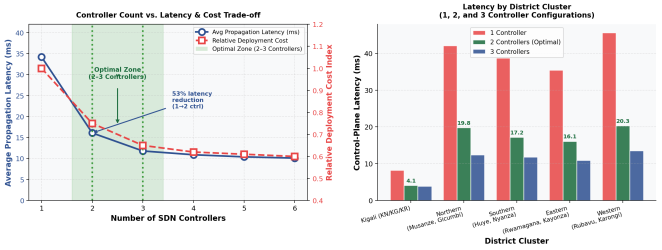
on African backbone networks, Rwanda’s 30-district topology is estimated to yield K = 2 optimal controllers an illustrative projection consistent with Mamushiane et al.’s finding of approximately 53% average latency reduction on comparable African backbones.
Figure 5 in Section 5 provides the graphical analysis.
4.2. VNF Resource Allocation and Placement Optimization
Following the MIP formulation of Kiran et al.
| [19] | Kiran, N., Liu, X., Wang, S., Yin, C. VNF Placement and Resource Allocation in SDN/NFV-Enabled MEC Networks. In Proceedings of the International Conference on Networks, Communications and Computing (ICNCC 2020), Beijing, China, 2020. IEEE
https://doi.org/10.1109/WCNCW48565.2020.9124910 |
[19]
, let N = {n₁…, n₃₀} be Rwanda’s 30 NFV-enabled nodes and F = {f₁…, f_P} be the VNFs to be placed. Binary decision variable:
(7)
Objective minimizes total placement and inter-node communication cost:
(8)
Subject to per-node resource capacity constraints:
(9)
(10)
(11)
(13)
Kiran et al.
| [19] | Kiran, N., Liu, X., Wang, S., Yin, C. VNF Placement and Resource Allocation in SDN/NFV-Enabled MEC Networks. In Proceedings of the International Conference on Networks, Communications and Computing (ICNCC 2020), Beijing, China, 2020. IEEE
https://doi.org/10.1109/WCNCW48565.2020.9124910 |
[19]
demonstrate that a genetic algorithm-based heuristic closely approximates the exact MIP solution at significantly reduced computational complexity.
4.3. Network Slice Capacity and SLA Allocation
For slice set S = {eMBB, URLLC, MIoT, eV2X}, define the SLA requirement vector
| [8] | Barakabitze, A. A., Ahmad, A., Mijumbi, R., Hines, A. 5G Network Slicing Using SDN and NFV: A Survey of Taxonomy, Architectures and Future Challenges. Computer Networks. 2020, 167, 106984.
https://doi.org/10.1016/j.comnet.2019.106984 |
| [21] | Cubukcu, A., Cubukcu, O., Kavak, A., Kucuk, K. Evaluation of Cloud-Based Dynamic Network Scaling and Slicing for Next-Generation Wireless Networks. Engineering Proceedings. 2024, 70(1), 45.
https://doi.org/10.3390/engproc2024070045 |
[8, 21]
:
b_s = required bandwidth (Mbps/user); l_s = max latency (ms); a_s = availability (%); u_s = users/km²
Total bandwidth feasibility across Rwanda’s 4G/5G RAN:
(15)
A_s = coverage area of slice s (km²); B_total = total available bandwidth (Gbps)
Per-slice end-to-end latency constraint (propagation + processing + queuing):
(16)
Inter-slice resource isolation:
(17)
Slice admission control for new user u requesting slice s:
(18)
Cubukcu et al.
| [21] | Cubukcu, A., Cubukcu, O., Kavak, A., Kucuk, K. Evaluation of Cloud-Based Dynamic Network Scaling and Slicing for Next-Generation Wireless Networks. Engineering Proceedings. 2024, 70(1), 45.
https://doi.org/10.3390/engproc2024070045 |
[21]
validate that dynamic bandwidth adjustment using 5G numerologies achieves meaningful QoS differentiation across all four slice types, confirming the feasibility of Equations (
16)–(
18).
4.4. CAPEX/OPEX Total Cost of Ownership Model
Five-year NPV TCO comparison between traditional hardware (T) and SDN/NFV softwarized (S) networks:
(19)
(20)
r = discount rate (~8.5%, Rwanda government bond rate); C_migration = one-time transition cost
Annual CAPEX savings from infrastructure sharing enabled by SDN/NFV | [14] | Mamushiane, L., Mwangama, J., Lysko, A. Optimum Placement of SDN Controllers in African Backbones: SANREN and ZAMREN as a Case Study. In Proceedings of IST-Africa 2018 Conference, Gaborone, Botswana, 2018. IEEE.
https://doi.org/10.23919/ISTAFRICA.2018.8417007 |
(21)
α_passive = passive sharing savings (0.20–0.30); α_backhaul = backhaul sharing (0.10–0.20); α_core = core virtualization savings (0.15–0.30)
Net Present Value of SDN/NFV adoption:
(22)
Adoption is economically rational when NPV > 0. Based on Mamushiane et al.
| [14] | Mamushiane, L., Mwangama, J., Lysko, A. Optimum Placement of SDN Controllers in African Backbones: SANREN and ZAMREN as a Case Study. In Proceedings of IST-Africa 2018 Conference, Gaborone, Botswana, 2018. IEEE.
https://doi.org/10.23919/ISTAFRICA.2018.8417007 |
[14]
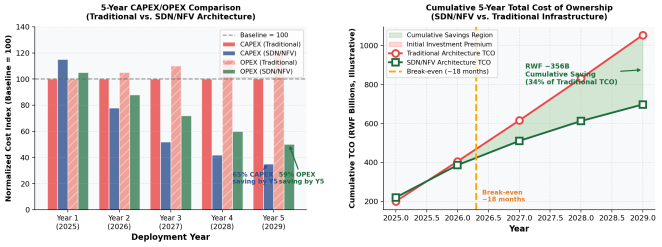
, this is estimated to occur within approximately 18–24 months for operators achieving infrastructure sharing consistent with comparable African deployments.
4.5. SDN-MEC Joint Task Offloading Optimization
For each user device k at district edge node n, following Kiran et al.
| [18] | Kiran, N., Pan, C., Wang, S., Yin, C. Joint Resource Allocation and Computation Offloading in Mobile Edge Computing for SDN Based Wireless Networks. Journal of Communications and Networks. 2020, 22(1), 1–12.
https://doi.org/10.1109/JCN.2019.000046 |
[18]
:
(23)
I_k ∈ {0,1} = offloading decision (1 = offload to MEC; 0 = local execution)
Upload delay via Shannon channel capacity:
(24)
D_k = task size (bits); B = bandwidth (Hz); P_k = transmit power (W); h_k = channel gain
SDN controller minimizes weighted delay and energy across K users in the district:
(25)
ω₁, ω₂ = delay and energy objective weights (ω₁+ω₂=1)
Kiran et al.
| [18] | Kiran, N., Pan, C., Wang, S., Yin, C. Joint Resource Allocation and Computation Offloading in Mobile Edge Computing for SDN Based Wireless Networks. Journal of Communications and Networks. 2020, 22(1), 1–12.
https://doi.org/10.1109/JCN.2019.000046 |
[18]
demonstrate that Q-learning and cooperative Q-learning solving Equation (
25) achieve 31.39% and 62.10% reduction in sum delay respectively compared to benchmark methods, validating SDN-MEC as a viable low-latency backhaul for Rwanda’s rural districts.
5. Rwanda’s Infrastructure Readiness Assessment
5.1. Physical Infrastructure
Rwanda’s physical ICT infrastructure provides a stronger foundation for SDN/NFV adoption than is commonly recognised in developing country literature. The national fiber optic backbone extends 21,847 km connecting all 30 districts
| [7] | Ministry of ICT and Innovation Rwanda (MINICT). ICT Sector Strategic Plan 2024–2029. Kigali: Government of Rwanda; 2024. Available from: https://www.minict.gov.rw |
[7]
, providing the transmission substrate for SDN controller communications. The KTRN network achieves 97–99% 4G LTE population coverage
| [5] | World Bank. Rwanda Digital Acceleration Project (P173373): Project Appraisal Document. Washington, DC: World Bank Group; 2021. Available from:
https://documents.worldbank.org |
[5]
. MTN Rwanda commercially launched 5G on 10 June 2025 across Kigali following Ericsson network modernisation in November 2024
| [10] | Ecofin Agency. MTN Rwanda Launches 5G Network in Kigali. 2025, June 10. Available from: https://www.ecofinagency.com (accessed March 2026). |
| [31] | Ericsson. MTN SA Achieves Global and Africa Firsts as It Expands Core Network Upgrades with Ericsson. Press Release, 2025. Available from: https://www.ericsson.com/en/press-releases (accessed March 2026). |
[10, 31]
. The Rwanda Digital Acceleration Project (RDAP), backed by USD 200 million from the World Bank and Asian Infrastructure Investment Bank, is expanding government data center capacity
| [5] | World Bank. Rwanda Digital Acceleration Project (P173373): Project Appraisal Document. Washington, DC: World Bank Group; 2021. Available from:
https://documents.worldbank.org |
[5]
.
Applying the CPP formulation (Equations (
1)–(
6)) with Rwanda’s 30-district topology and parameters derived from comparable African backbones
| [14] | Mamushiane, L., Mwangama, J., Lysko, A. Optimum Placement of SDN Controllers in African Backbones: SANREN and ZAMREN as a Case Study. In Proceedings of IST-Africa 2018 Conference, Gaborone, Botswana, 2018. IEEE.
https://doi.org/10.23919/ISTAFRICA.2018.8417007 |
| [15] | Mamushiane, L., Mwangama, J., Lysko, A. Resilient SDN Controller Placement Optimization on the South African National Research Network (SANReN). ITU Journal on Future and Evolving Technologies. 2021, 2(1).
https://doi.org/10.52953/UXAK6583 |
[14, 15]
, the illustrative analysis estimates K = 2 optimal SDN controller locations would reduce average propagation latency by approximately 53% compared to single-controller deployment.
Figure 5 presents this illustrative projection. All values are model estimates, not measured network data.
Figure 5. Illustrative Projection: SDN Controller Placement Optimization for Rwanda’s 30-District Network. Left: Latency–Cost Trade-off by Controller Count. Right: District Latency by Configuration.
Note: All values are analytical projections derived from Equations (
1)–(
6) and PAM clustering parameters from Mamushiane et al.
| [14] | Mamushiane, L., Mwangama, J., Lysko, A. Optimum Placement of SDN Controllers in African Backbones: SANREN and ZAMREN as a Case Study. In Proceedings of IST-Africa 2018 Conference, Gaborone, Botswana, 2018. IEEE.
https://doi.org/10.23919/ISTAFRICA.2018.8417007 |
| [15] | Mamushiane, L., Mwangama, J., Lysko, A. Resilient SDN Controller Placement Optimization on the South African National Research Network (SANReN). ITU Journal on Future and Evolving Technologies. 2021, 2(1).
https://doi.org/10.52953/UXAK6583 |
[14, 15]
for comparable African backbones. These are not measurements from Rwanda’s actual network.
5.2. Policy, Regulatory, and Human Capital Readiness
Rwanda’s regulatory environment is a primary readiness asset. RURA’s technology-neutral licensing framework (revised October 2022) explicitly supports ‘4G, 5G and beyond,’ removing regulatory barriers to SDN-enabled infrastructure sharing
. The ICT Sector Strategic Plan 2024–2029 targets enhanced scalability, operational efficiency, and cost optimization objectives most efficiently pursued through SDN/NFV
| [7] | Ministry of ICT and Innovation Rwanda (MINICT). ICT Sector Strategic Plan 2024–2029. Kigali: Government of Rwanda; 2024. Available from: https://www.minict.gov.rw |
[7]
. Rwanda’s estimated 2.04 trillion Rwandan Franc five-year ICT budget signals substantial political commitment
| [7] | Ministry of ICT and Innovation Rwanda (MINICT). ICT Sector Strategic Plan 2024–2029. Kigali: Government of Rwanda; 2024. Available from: https://www.minict.gov.rw |
[7]
.
The human capital challenge is the most structurally persistent barrier. Advanced SDN/NFV implementation requires expertise spanning cloud computing, NFV orchestration, DevOps, and telecommunications engineering a profile almost entirely absent from Rwanda’s current workforce. Bajpai
| [24] | Bajpai, R. Enhancing Network Infrastructure Through SDN and NFV: Overcoming Configuration Challenges in Complex Heterogeneous Networks. Journal of Advances in Computer Networks. 2018, 6(2), 45–52.
https://doi.org/10.18178/jacn.2018.6.2.255 |
[24]
recommends model-driven automation using NETCONF/YANG protocols to reduce dependence on expert manual configuration, directly applicable to Rwanda’s context.
5.3. Readiness Assessment Summary
Table 2. Rwanda’s SDN/NFV readiness assessment across key dimensions.
Dimension | Indicator | Rwanda Status | SDN/NFV Implication |
Physical | Fiber backbone | 21,847 km (30 districts) 7] | Adequate substrate for SDN controller distribution |
Physical | 4G LTE coverage | 97–99% population 3] | Existing RAN softwarizable incrementally |
Physical | Fixed broadband | 0.619% (86,168 subs) 3] | NFV lowers last-mile deployment cost |
5G Status | Commercial 5G | June 2025, MTN Kigali 10] | Greenfield cloud-native build from inception |
Policy | Tech-neutral spectrum | Yes, revised 2022 28] | No regulatory barriers to SDN/NFV |
Policy | ICT Strategic Plan | Adopted, budgeted 7] | Formal mandate for scalable digital infrastructure |
Human Capital | SDN/NFV expertise | Very limited nationally | Critical gap; automation-first design essential 24] |
Human Capital | ICT education | Growing via CMU Africa, UR | Long-term pipeline; insufficient for immediate needs |
Economic | ICT sector growth | 35% in 2023 (highest sector) 4] | Strong ROI case for SDN/NFV investment |
Usage Gap | Rural internet | 19% (mid-2025) 2] | SDN cost reduction directly addresses affordability |
6. The Rwanda Frugal SDN/NFV Framework
6.1. Framework Overview and Design Principles
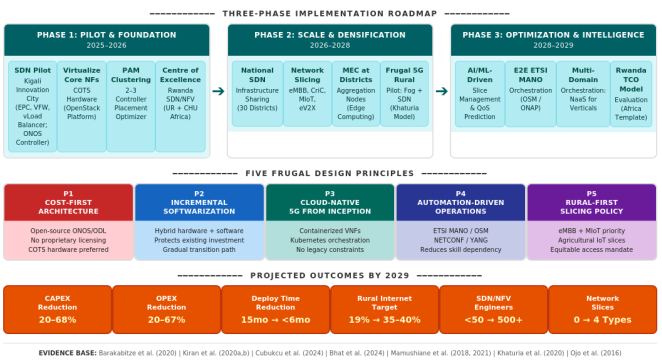
The Frugal SDN/NFV Framework synthesises the mathematical models (Section 4), readiness findings (Section 5), and the DSR artifact design process into an actionable three-phase deployment roadmap.
Figure 6 provides the comprehensive framework visualization. The framework is built on five design principles:
1) Cost-first architecture: Open-source ONOS/OpenDaylight controllers and COTS hardware NFVI to eliminate proprietary licensing costs, grounded in the TCO minimization of Equations (
19)–(
22).
2) Incremental softwarization: Hybrid hardware/software operation protecting existing KTRN 4G investment while enabling gradual transition to full virtualization.
3) Cloud-native 5G from inception: New 5G deployments built as containerized, Kubernetes-orchestrated architectures, enabled by the June 2025 commercial launch
| [10] | Ecofin Agency. MTN Rwanda Launches 5G Network in Kigali. 2025, June 10. Available from: https://www.ecofinagency.com (accessed March 2026). |
[10]
.
4) Automation-driven operations: ETSI MANO-compliant orchestration with NETCONF/YANG model-driven configuration minimizing human operational dependency
| [24] | Bajpai, R. Enhancing Network Infrastructure Through SDN and NFV: Overcoming Configuration Challenges in Complex Heterogeneous Networks. Journal of Advances in Computer Networks. 2018, 6(2), 45–52.
https://doi.org/10.18178/jacn.2018.6.2.255 |
[24]
.
5) Rural-first slicing policy: Slice allocation (Equations (
14)–(
18)) prioritising eMBB rural broadband and MIoT agricultural/health applications alongside urban high-value services.
Figure 6. Rwanda Frugal SDN/NFV Deployment Framework: Three-Phase Roadmap with Design Principles and Projected Outcomes.
Note: Projected outcomes are illustrative estimates derived from mathematical models (Section 4) calibrated against comparable African deployments. Empirical validation through implementation is required. Synthesising
| [8] | Barakabitze, A. A., Ahmad, A., Mijumbi, R., Hines, A. 5G Network Slicing Using SDN and NFV: A Survey of Taxonomy, Architectures and Future Challenges. Computer Networks. 2020, 167, 106984.
https://doi.org/10.1016/j.comnet.2019.106984 |
| [14] | Mamushiane, L., Mwangama, J., Lysko, A. Optimum Placement of SDN Controllers in African Backbones: SANREN and ZAMREN as a Case Study. In Proceedings of IST-Africa 2018 Conference, Gaborone, Botswana, 2018. IEEE.
https://doi.org/10.23919/ISTAFRICA.2018.8417007 |
| [18] | Kiran, N., Pan, C., Wang, S., Yin, C. Joint Resource Allocation and Computation Offloading in Mobile Edge Computing for SDN Based Wireless Networks. Journal of Communications and Networks. 2020, 22(1), 1–12.
https://doi.org/10.1109/JCN.2019.000046 |
| [19] | Kiran, N., Liu, X., Wang, S., Yin, C. VNF Placement and Resource Allocation in SDN/NFV-Enabled MEC Networks. In Proceedings of the International Conference on Networks, Communications and Computing (ICNCC 2020), Beijing, China, 2020. IEEE
https://doi.org/10.1109/WCNCW48565.2020.9124910 |
| [21] | Cubukcu, A., Cubukcu, O., Kavak, A., Kucuk, K. Evaluation of Cloud-Based Dynamic Network Scaling and Slicing for Next-Generation Wireless Networks. Engineering Proceedings. 2024, 70(1), 45.
https://doi.org/10.3390/engproc2024070045 |
| [22] | Khaturia, M., Jha, P., Karandikar, A. Connecting the Unconnected: Toward Frugal 5G Network Architecture and Standardization. IEEE Access. 2020, 8, 147296–147311.
https://doi.org/10.1109/ACCESS.2020.3013302 |
[8, 14, 18, 19, 21, 22]
.
6.2. Phase 1: Pilot and Foundation (2025–2026)
1) Deploy SDN pilot in Kigali Innovation City using ONOS/OpenDaylight as controller and OpenStack as VIM, leveraging CMU Africa proximity for technical support.
2) Virtualize core network functions (vEPC, vFirewall, vLoad Balancer) for an urban service slice, establishing VNF lifecycle management experience.
3) Execute PAM-based CPP analysis (Equations (
1)–(
6)) on Rwanda’s actual KTRN fiber topology to validate illustrative controller placement projections.
4) Establish Rwanda SDN/NFV Centre of Excellence at University of Rwanda or CMU Africa, with industry training partnerships (Ericsson, Nokia, Huawei, ONOS/ODL communities).
5) Engage RURA to develop a regulatory framework for multi-tenant network slicing, including SLA monitoring and inter-operator slice isolation standards.
6.3. Phase 2: Scale and Densification (2026–2028)
1) Roll out SDN-enabled infrastructure sharing across all 30 districts using the 21,847 km fiber backbone as SDN controller substrate
| [7] | Ministry of ICT and Innovation Rwanda (MINICT). ICT Sector Strategic Plan 2024–2029. Kigali: Government of Rwanda; 2024. Available from: https://www.minict.gov.rw |
| [14] | Mamushiane, L., Mwangama, J., Lysko, A. Optimum Placement of SDN Controllers in African Backbones: SANREN and ZAMREN as a Case Study. In Proceedings of IST-Africa 2018 Conference, Gaborone, Botswana, 2018. IEEE.
https://doi.org/10.23919/ISTAFRICA.2018.8417007 |
[7, 14]
.
2) Implement four-slice architecture (
Figure 4, Equations (
14)–(
18)): eMBB, URLLC/CriC, MIoT, and eV2X with QoS parameters enforced by SDN controller policies.
3) Deploy MEC infrastructure at district nodes, applying joint offloading optimization (Equations (
23)–(
25)) to minimize rural user latency and extend IoT device battery life
| [18] | Kiran, N., Pan, C., Wang, S., Yin, C. Joint Resource Allocation and Computation Offloading in Mobile Edge Computing for SDN Based Wireless Networks. Journal of Communications and Networks. 2020, 22(1), 1–12.
https://doi.org/10.1109/JCN.2019.000046 |
[18]
.
4) Integrate VNF placement optimization using genetic algorithm heuristics (Equations (
7)–(
13), Kiran et al.
| [19] | Kiran, N., Liu, X., Wang, S., Yin, C. VNF Placement and Resource Allocation in SDN/NFV-Enabled MEC Networks. In Proceedings of the International Conference on Networks, Communications and Computing (ICNCC 2020), Beijing, China, 2020. IEEE
https://doi.org/10.1109/WCNCW48565.2020.9124910 |
[19]
) across distributed NFVI nodes.
5) Launch Frugal 5G rural pilot per Khaturia et al.
: SDN/NFV-managed heterogeneous access with macrocells, WLANs, and fog computing for rural coverage.
6.4. Phase 3: Optimization and Intelligence (2028–2029)
1) Implement AI/ML-driven slice management, extending Equation (
25)’s Q-learning framework to network-wide reinforcement learning orchestration
| [8] | Barakabitze, A. A., Ahmad, A., Mijumbi, R., Hines, A. 5G Network Slicing Using SDN and NFV: A Survey of Taxonomy, Architectures and Future Challenges. Computer Networks. 2020, 167, 106984.
https://doi.org/10.1016/j.comnet.2019.106984 |
[8]
.
2) Deploy automated E2E orchestration using ETSI MANO-compliant platform (OSM or ONAP) for simultaneous lifecycle management of physical and virtual network functions.
3) Establish multi-domain slice orchestration enabling Rwanda to offer Network-as-a-Service to healthcare, agricultural, and financial service verticals.
4) Conduct comprehensive TCO evaluation using Equations (
19)–(
22) with actual operator cost data to generate evidence applicable to peer African economies.
6.5. Illustrative Projected Outcomes
Table 3 presents illustrative projected outcomes by 2029, derived from the mathematical models in Section 4 calibrated against comparable African deployments. These are analytical estimates requiring empirical validation, not guarantees.
Table 3. Illustrative projected outcomes by 2029 (analytical estimates, not measured results).
Outcome Metric | Baseline (2024) | Illustrative Projection (2029) | Model/Evidence Basis |
CAPEX reduction vs. hardware-only | N/A | 20–68% (illustrative) | Equations (21)–(22); Mamushiane et al. 14] |
OPEX reduction | N/A | 20–67% (illustrative) | Mamushiane et al. 14, 15] |
Service deployment time | ~15 months | <6 months (illustrative) | NFV agility; Mijumbi et al. 17] |
Avg. control-plane latency | ~34 ms (1 controller) | <16 ms (2 controllers, illustrative) | Equations (2)–(3); Mamushiane et al. 15] |
Rural internet penetration | 19% 2] | 35–40% (illustrative) | Cost reduction impact; Equations (19)–(22) |
Network slices operational | 0 (pre-5G) | 4 slice types (target) | Equations (6)–(10); Cubukcu et al. 21] |
Task offloading delay reduction | N/A | 31–62% (illustrative) | Equations (23)–(25); Kiran et al. 18] |
5-year NPV of adoption | N/A | Positive from ~Month 18 (illustrative) | Equation (22); Mamushiane et al. 14] |
All projections are analytical estimates derived from model parameters of comparable deployments. Empirical validation through Phases 1–3 implementation is required before drawing operational conclusions.
7. Discussion
7.1. Rwanda as a Leapfrogging Case
Rwanda’s June 2025 5G launch represents a structural inflection point for SDN/NFV adoption. MTN Rwanda’s cloud-native 5G network, built with Ericsson’s cloud-native Packet Core
, follows Safaricom Ethiopia’s 2022 greenfield VMware NFV deployment
both demonstrating that African operators can build virtualized networks from inception without legacy hardware constraints. UNCTAD
establishes three leapfrogging conditions: (1) the technology proven at scale (ONOS serves over one billion subscribers globally
); (2) comparable functionality to legacy approaches (cloud-native 5G delivers equivalent or superior performance); and (3) a viable bypass of legacy infrastructure (Rwanda’s 5G network faces no legacy 3G/4G hardware estate). All three conditions are satisfied.
The CPP analysis (Equations (
1)–(
6)) identifies Rwanda’s compact 26,338 km² geography as a structural asset: with an estimated two optimally placed SDN controllers, latency targets (L_max = 50 ms, Equation (
5)) are achievable across all 30 districts. This illustrative result consistent with Mamushiane et al.’s
| [15] | Mamushiane, L., Mwangama, J., Lysko, A. Resilient SDN Controller Placement Optimization on the South African National Research Network (SANReN). ITU Journal on Future and Evolving Technologies. 2021, 2(1).
https://doi.org/10.52953/UXAK6583 |
[15]
validated findings suggest Rwanda’s geographic compactness is an SDN deployment advantage not shared by larger continental peers.
7.2. The Cost-Benefit Case
The TCO model (Equations (
19)–(
22)) highlights an important temporal asymmetry: the first year of SDN/NFV deployment typically shows net cost increases due to migration costs (C_migration) before savings materialise. This finding, consistent with Mijumbi et al.’s
| [17] | Mijumbi, R., Serrat, J., Gorricho, J.-L., Bouten, N., De Turck, F., Boutaba, R. Network Function Virtualization: State-of-the-Art and Research Challenges. IEEE Communications Surveys and Tutorials. 2016, 18(1), 236–262.
https://doi.org/10.1109/COMST.2015.2477041 |
[17]
analysis of NFV deployment economics, has direct policy implications: Rwanda’s national ICT budget and the USD 200 million RDAP
| [5] | World Bank. Rwanda Digital Acceleration Project (P173373): Project Appraisal Document. Washington, DC: World Bank Group; 2021. Available from:
https://documents.worldbank.org |
[5]
must explicitly provision for Year-1 transition costs to avoid premature discontinuation.
Figure 7 presents illustrative CAPEX/OPEX projections and the break-even trajectory.
Figure 7. Illustrative Projection: Five-Year CAPEX/OPEX Comparison and Cumulative TCO Trajectory for Rwanda SDN/NFV Deployment.
Note: All cost values are analytical projections derived from Equations (
19)–(
22) with parameters calibrated from Mamushiane et al.
| [14] | Mamushiane, L., Mwangama, J., Lysko, A. Optimum Placement of SDN Controllers in African Backbones: SANREN and ZAMREN as a Case Study. In Proceedings of IST-Africa 2018 Conference, Gaborone, Botswana, 2018. IEEE.
https://doi.org/10.23919/ISTAFRICA.2018.8417007 |
[14]
comparable African deployment data. Not based on actual Rwanda operator financial data.
7.3. Policy Implications for African Telecommunications
Rwanda’s experience, if documented through rigorous longitudinal evaluation research following Phases 1–3 implementation, could generate transferable lessons for Sub-Saharan Africa’s growing 5G market
| [32] | African Telecommunications Union (ATU). Report on 5G Preparedness and Relevant Use Cases in Africa (ATU-R-Report-005-0). Nairobi: ATU; 2025. Available from: https://www.atu-uat.org |
[32]
. The most significant policy implication is that regulatory frameworks must actively enable rather than merely permit infrastructure softwarization. RURA’s 2022 technology-neutral licensing revision demonstrates a regulatory agency capable of proactive adaptation
. This framework recommends extending that leadership to: multi-tenant slice governance standards; VNF security certification frameworks; and software-defined spectrum management licensing creating a regulatory template applicable to the broader East and Central African region.
The automation-first principle (Design Principle 4) is critical: by deploying ETSI MANO-compliant orchestration with NETCONF/YANG configuration automation
| [24] | Bajpai, R. Enhancing Network Infrastructure Through SDN and NFV: Overcoming Configuration Challenges in Complex Heterogeneous Networks. Journal of Advances in Computer Networks. 2018, 6(2), 45–52.
https://doi.org/10.18178/jacn.2018.6.2.255 |
[24]
, Rwanda can operate SDN/NFV networks with fewer advanced specialists than traditional approaches require, addressing the binding human capital constraint through technology design rather than solely through capacity building programs.
7.4. Limitations and Future Research
Four limitations bound this study’s conclusions. First, this is a DSR framework paper: no primary fieldwork was conducted. Future empirical research should include structured interviews with MTN Rwanda, Airtel Rwanda, and RURA officials to validate the barrier analysis and framework relevance. Second, all mathematical projections are analytical estimates calibrated to comparable deployment parameters, not computed from Rwanda’s actual KTRN network topology or operator cost data. Phase 1 implementation must include actual CPP computation on KTRN fiber distance data and real VNF demand profiling. Third, technical recommendations may require updating as 3GPP Release 18 and 19 standards mature. Fourth, the geopolitical dimensions of Rwanda’s technology partnerships Korea Telecom infrastructure ownership and Chinese vendor presence may constrain open-source controller deployment in ways not addressed here.
8. Conclusions
This paper presents the first academically grounded SDN/NFV deployment framework for an African national telecommunications network, addressing a research gap that extends to the near-total absence of peer-reviewed literature on SDN/NFV implementation for any Sub-Saharan African national network. Using a Design Science Research methodology, five formal mathematical optimization models were developed and applied to Rwanda’s infrastructure profile: the Controller Placement Problem; VNF Resource Allocation MIP; Network Slice SLA allocation; CAPEX/OPEX NPV cost model; and joint SDN-MEC task offloading optimization.
Illustrative projections derived from these models calibrated to comparable African deployments suggest that Rwanda’s compact geography, 21,847 km fiber backbone, cloud-native 5G architecture, and progressive regulatory environment create a uniquely favorable context for SDN/NFV leapfrogging. The proposed Frugal SDN/NFV Framework’s three-phase roadmap (Pilot 2025–2026; Scale 2026–2028; Optimize 2028–2029) with five design principles provides actionable guidance for MINICT, RURA, MTN Rwanda, and Airtel Rwanda.
These projections are explicitly analytical estimates requiring empirical validation. The primary contributions are: (1) the framework artifact itself, as the first SDN/NFV deployment design for an African national network; (2) the adaptation and application of five published optimization models to Rwanda’s infrastructure context; and (3) the identification of the DSR evaluation agenda particularly Phase 1 pilot implementation and actual CPP computation on KTRN topology data for future empirical research. As Rwanda advances toward Vision 2050, the softwarization of telecommunications through SDN and NFV offers a structural transformation of network economics that could unlock the affordable, equitable connectivity on which Rwanda’s digital future depends.
Abbreviations
CAPEX | Capital Expenditure |
COTS | Commercial Off-The-Shelf |
CPP | Controller Placement Problem |
DSR | Design Science Research |
eMBB | Enhanced Mobile Broadband |
ETSI | European Telecommunications Standards Institute |
eV2X | Enhanced Vehicle-to-Everything |
ICT | Information and Communications Technology |
KTRN | KT Rwanda Networks |
MANO | Management and Orchestration |
MEC | Multi-access Edge Computing |
MIoT | Massive Internet of Things |
MINICT | Ministry of ICT and Innovation Rwanda |
MIP | Mixed Integer Programming |
NFV | Network Function Virtualization |
NFVI | NFV Infrastructure |
ODL | OpenDaylight |
ONOS | Open Network Operating System |
OPEX | Operational Expenditure |
PAM | Partition Around Medoids |
QoS | Quality of Service |
RAN | Radio Access Network |
RDAP | Rwanda Digital Acceleration Project |
RURA | Rwanda Utilities Regulatory Authority |
SDN | Software-Defined Networking |
SLA | Service Level Agreement |
TCO | Total Cost of Ownership |
URLLC | Ultra-Reliable Low-Latency Communications |
VIM | Virtual Infrastructure Manager |
VNF | Virtual Network Function |
VNFM | VNF Manager |
Acknowledgments
The author acknowledges the open-access literature and public data repositories of RURA, MINICT, the World Bank, ITU, and GSMA that made this secondary research possible. The open-source SDN/NFV communities (ONOS, OpenDaylight, OpenStack, ETSI OSM) whose publicly documented deployments informed the framework design are gratefully recognised.
Author Contributions
Tuyikunde Osee: Conceptualization, Formal Analysis, Methodology, Visualization, Writing – original draft, Writing – review & editing
Funding
This work is not supported by any external funding.
Data Availability Statement
The data supporting the outcome of this research work has been reported in this manuscript. All secondary data sources are cited and publicly accessible via the DOIs and URLs provided in the reference list.
Conflicts of Interest
The author declares no conflicts of interest.
References
| [1] |
Portulans Institute. Network Readiness Index 2025. Available from:
https://networkreadinessindex.org
(accessed March 2026).
|
| [2] |
International Telecommunication Union (ITU). Measuring Digital Development: Facts and Figures 2024. Geneva: ITU; 2024. Available from:
https://www.itu.int/en/ITU-D/Statistics/
|
| [3] |
Rwanda Utilities Regulatory Authority (RURA). ICT Sector Statistics Report: Q3 2024. Kigali: RURA; 2024. Available from:
https://www.rura.rw
|
| [4] |
Kemp, S. Digital 2024: Rwanda. DataReportal; 2024. Available from:
https://datareportal.com/reports/digital-2024-rwanda
|
| [5] |
World Bank. Rwanda Digital Acceleration Project (P173373): Project Appraisal Document. Washington, DC: World Bank Group; 2021. Available from:
https://documents.worldbank.org
|
| [6] |
Kreutz, D., Ramos, F. M. V., Verissimo, P. E., Rothenberg, C. E., Azodolmolky, S., Uhlig, S. Software-Defined Networking: A Comprehensive Survey. Proceedings of the IEEE. 2015, 103(1), 14–76.
https://doi.org/10.1109/JPROC.2014.2371999
|
| [7] |
Ministry of ICT and Innovation Rwanda (MINICT). ICT Sector Strategic Plan 2024–2029. Kigali: Government of Rwanda; 2024. Available from:
https://www.minict.gov.rw
|
| [8] |
Barakabitze, A. A., Ahmad, A., Mijumbi, R., Hines, A. 5G Network Slicing Using SDN and NFV: A Survey of Taxonomy, Architectures and Future Challenges. Computer Networks. 2020, 167, 106984.
https://doi.org/10.1016/j.comnet.2019.106984
|
| [9] |
Tshwane University of Technology. The Latest Developments in Software Defined Networking: Adoption Rate and Challenges. In Proceedings of IEEE AFRICON 2023, Nairobi, Kenya, 2023.
https://doi.org/10.1109/AFRICON55910.2023.10293567
|
| [10] |
Ecofin Agency. MTN Rwanda Launches 5G Network in Kigali. 2025, June 10. Available from:
https://www.ecofinagency.com
(accessed March 2026).
|
| [11] |
Open Networking Foundation (ONF). SDN Architecture Overview. Menlo Park, CA: ONF; 2016. Available from:
https://opennetworking.org
|
| [12] |
Linux Foundation / Open Networking Foundation. ONOS: Open Network Operating System. Available from:
https://opennetworking.org/onos/
(accessed March 2026).
|
| [13] |
Vivekanand, Thakuria, K. How SDN Enhances Network Scalability and Flexibility. International Journal of Innovative Research in Science, Engineering and Technology. 2016, 5(5), 7965–7971,
https://doi.org/10.15680/IJIRSET.2016.0505369
|
| [14] |
Mamushiane, L., Mwangama, J., Lysko, A. Optimum Placement of SDN Controllers in African Backbones: SANREN and ZAMREN as a Case Study. In Proceedings of IST-Africa 2018 Conference, Gaborone, Botswana, 2018. IEEE.
https://doi.org/10.23919/ISTAFRICA.2018.8417007
|
| [15] |
Mamushiane, L., Mwangama, J., Lysko, A. Resilient SDN Controller Placement Optimization on the South African National Research Network (SANReN). ITU Journal on Future and Evolving Technologies. 2021, 2(1).
https://doi.org/10.52953/UXAK6583
|
| [16] |
ETSI Industry Specification Group on Network Functions Virtualisation (ISG NFV). Network Functions Virtualisation: An Introduction, Benefits, Enablers, Challenges and Call for Action (White Paper). Sophia Antipolis: ETSI; 2012. Available from:
https://www.etsi.org/technologies/nfv
|
| [17] |
Mijumbi, R., Serrat, J., Gorricho, J.-L., Bouten, N., De Turck, F., Boutaba, R. Network Function Virtualization: State-of-the-Art and Research Challenges. IEEE Communications Surveys and Tutorials. 2016, 18(1), 236–262.
https://doi.org/10.1109/COMST.2015.2477041
|
| [18] |
Kiran, N., Pan, C., Wang, S., Yin, C. Joint Resource Allocation and Computation Offloading in Mobile Edge Computing for SDN Based Wireless Networks. Journal of Communications and Networks. 2020, 22(1), 1–12.
https://doi.org/10.1109/JCN.2019.000046
|
| [19] |
Kiran, N., Liu, X., Wang, S., Yin, C. VNF Placement and Resource Allocation in SDN/NFV-Enabled MEC Networks. In Proceedings of the International Conference on Networks, Communications and Computing (ICNCC 2020), Beijing, China, 2020. IEEE
https://doi.org/10.1109/WCNCW48565.2020.9124910
|
| [20] |
Ojo, M., Adami, D., Giordano, S. A SDN-IoT Architecture with NFV Implementation. In Proceedings of the IEEE International Symposium on Broadband Multimedia Systems and Broadcasting (BMSB), Nara, Japan, 2016. IEEE.
https://doi.org/10.1109/BMSB.2016.7547068
|
| [21] |
Cubukcu, A., Cubukcu, O., Kavak, A., Kucuk, K. Evaluation of Cloud-Based Dynamic Network Scaling and Slicing for Next-Generation Wireless Networks. Engineering Proceedings. 2024, 70(1), 45.
https://doi.org/10.3390/engproc2024070045
|
| [22] |
Khaturia, M., Jha, P., Karandikar, A. Connecting the Unconnected: Toward Frugal 5G Network Architecture and Standardization. IEEE Access. 2020, 8, 147296–147311.
https://doi.org/10.1109/ACCESS.2020.3013302
|
| [23] |
Singh, A. SDN and NFV: A Case Study and Role in 5G and Beyond. International Journal for Multidisciplinary Research. 2020, 2(2). DOI not available, Available from:
https://www.ijfmr.com
|
| [24] |
Bajpai, R. Enhancing Network Infrastructure Through SDN and NFV: Overcoming Configuration Challenges in Complex Heterogeneous Networks. Journal of Advances in Computer Networks. 2018, 6(2), 45–52.
https://doi.org/10.18178/jacn.2018.6.2.255
|
| [25] |
United Nations Conference on Trade and Development (UNCTAD). Leapfrogging: Look Before You Leap. UNCTAD Policy Brief No. 71. Geneva: UNCTAD; 2018. Available from:
https://unctad.org/system/files/official-document/presspb2018d5_en.pdf
|
| [26] |
Hevner, A. R., March, S. T., Park, J., Ram, S. Design Science in Information Systems Research. MIS Quarterly. 2004, 28(1), 75–105.
https://doi.org/10.2307/25148625
|
| [27] |
Peffers, K., Tuunanen, T., Rothenberger, M. A., Chatterjee, S. A Design Science Research Methodology for Information Systems Research. Journal of Management Information Systems. 2007, 24(3), 45–77.
https://doi.org/10.2753/MIS0742-1222240302
|
| [28] |
GSMA. 5G Spectrum in Sub-Saharan Africa: Building Roadmaps for Success. London: GSMA; 2021. Available from:
https://www.gsma.com/spectrum/resources/5g-spectrum-in-sub-saharan-africa/
|
| [29] |
GSMA Intelligence. Sub-Saharan Africa Mobile Economy 2024. London: GSMA; 2024. Available from:
https://www.gsma.com/solutions-and-impact/connectivity/mobile-economy/sub-saharan-africa/
|
| [30] |
VMware. Safaricom Ethiopia Selects VMware Telco Cloud Platform for Greenfield Deployment. BusinessWire, February 2022. Available from:
https://www.businesswire.com/news/home/20220208005213/en/
|
| [31] |
Ericsson. MTN SA Achieves Global and Africa Firsts as It Expands Core Network Upgrades with Ericsson. Press Release, 2025. Available from:
https://www.ericsson.com/en/press-releases
(accessed March 2026).
|
| [32] |
African Telecommunications Union (ATU). Report on 5G Preparedness and Relevant Use Cases in Africa (ATU-R-Report-005-0). Nairobi: ATU; 2025. Available from:
https://www.atu-uat.org
|
| [33] |
Heller, B., Sherwood, R., McKeown, N. The Controller Placement Problem. In Proceedings of the First Workshop on Hot Topics in Software Defined Networks (HotSDN ’12), Helsinki, Finland, 2012; pp. 7–12. ACM.
https://doi.org/10.1145/2342441.2342444
|
Cite This Article
-
APA Style
Osee, T. (2026). Enhancing Rwanda’s Telecommunications Infrastructure Through Software-Defined Networking and Network Function Virtualization: A Design Science Framework. Internet of Things and Cloud Computing, 14(1), 11-25. https://doi.org/10.11648/j.iotcc.20261401.12
 Copy
|
Copy
|
 Download
ACS Style
Osee, T. Enhancing Rwanda’s Telecommunications Infrastructure Through Software-Defined Networking and Network Function Virtualization: A Design Science Framework. Internet Things Cloud Comput. 2026, 14(1), 11-25. doi: 10.11648/j.iotcc.20261401.12
Copy
|
Download
AMA Style
Osee T. Enhancing Rwanda’s Telecommunications Infrastructure Through Software-Defined Networking and Network Function Virtualization: A Design Science Framework. Internet Things Cloud Comput. 2026;14(1):11-25. doi: 10.11648/j.iotcc.20261401.12
Copy
|
Download
-
@article{10.11648/j.iotcc.20261401.12,
  author = {Tuyikunde Osee},
  title = {Enhancing Rwanda’s Telecommunications Infrastructure Through Software-Defined Networking and Network Function Virtualization: A Design Science Framework},
  journal = {Internet of Things and Cloud Computing},
  volume = {14},
  number = {1},
  pages = {11-25},
  doi = {10.11648/j.iotcc.20261401.12},
  url = {https://doi.org/10.11648/j.iotcc.20261401.12},
  eprint = {https://article.sciencepublishinggroup.com/pdf/10.11648.j.iotcc.20261401.12},
  abstract = {Rwanda’s pursuit of a high-income, knowledge-based economy under Vision 2050 depends on scalable, resilient, and cost-efficient telecommunications infrastructure. Despite achieving near-universal 4G LTE population coverage (97–99%), a persistent usage gap — approximately 62% of the population remains unconnected — reveals that supply-side infrastructure alone is insufficient to bridge the digital divide. This paper investigates how Software-Defined Networking (SDN) and Network Function Virtualization (NFV) can serve as strategic enablers of telecommunications modernization in Rwanda, addressing the twin challenges of cost and operational complexity in a landlocked, resource-constrained environment. Employing a Design Science Research (DSR) methodology, this study evaluates Rwanda’s infrastructure readiness, identifies technical, economic, and regulatory barriers to SDN/NFV adoption, and proposes a context-adapted, phased deployment artifact the Frugal SDN/NFV Framework aligned with Rwanda’s ICT Sector Strategic Plan 2024–2029. The framework is supported by five formally specified mathematical optimization models: the Controller Placement Problem for Rwanda’s 30-district fiber topology, the VNF Resource Allocation mixed integer program, a Network Slice SLA Allocation model, a CAPEX/OPEX Net Present Value cost model, and a joint SDN-MEC task offloading optimization. Numerical projections derived from these models informed by comparable African SDN/NFV deployments including Safaricom Ethiopia’s 2022 greenfield virtualized network and MTN South Africa’s cloud-native 5G core suggest potential CAPEX reductions of 20–68% and OPEX reductions of 20–67%. The proposed three-phase roadmap (Pilot 2025–2026; Scale 2026–2028; Optimize 2028–2029) positions SDN/NFV as a leapfrogging catalyst for equitable digital growth, contributing the first academically grounded SDN/NFV deployment framework for an African national telecommunications network.},
 year = {2026}
}
Copy
|
Download
-
TY  - JOUR
T1  - Enhancing Rwanda’s Telecommunications Infrastructure Through Software-Defined Networking and Network Function Virtualization: A Design Science Framework
AU  - Tuyikunde Osee
Y1  - 2026/07/28
PY  - 2026
N1  - https://doi.org/10.11648/j.iotcc.20261401.12
DO  - 10.11648/j.iotcc.20261401.12
T2  - Internet of Things and Cloud Computing
JF  - Internet of Things and Cloud Computing
JO  - Internet of Things and Cloud Computing
SP  - 11
EP  - 25
PB  - Science Publishing Group
SN  - 2376-7731
UR  - https://doi.org/10.11648/j.iotcc.20261401.12
AB  - Rwanda’s pursuit of a high-income, knowledge-based economy under Vision 2050 depends on scalable, resilient, and cost-efficient telecommunications infrastructure. Despite achieving near-universal 4G LTE population coverage (97–99%), a persistent usage gap — approximately 62% of the population remains unconnected — reveals that supply-side infrastructure alone is insufficient to bridge the digital divide. This paper investigates how Software-Defined Networking (SDN) and Network Function Virtualization (NFV) can serve as strategic enablers of telecommunications modernization in Rwanda, addressing the twin challenges of cost and operational complexity in a landlocked, resource-constrained environment. Employing a Design Science Research (DSR) methodology, this study evaluates Rwanda’s infrastructure readiness, identifies technical, economic, and regulatory barriers to SDN/NFV adoption, and proposes a context-adapted, phased deployment artifact the Frugal SDN/NFV Framework aligned with Rwanda’s ICT Sector Strategic Plan 2024–2029. The framework is supported by five formally specified mathematical optimization models: the Controller Placement Problem for Rwanda’s 30-district fiber topology, the VNF Resource Allocation mixed integer program, a Network Slice SLA Allocation model, a CAPEX/OPEX Net Present Value cost model, and a joint SDN-MEC task offloading optimization. Numerical projections derived from these models informed by comparable African SDN/NFV deployments including Safaricom Ethiopia’s 2022 greenfield virtualized network and MTN South Africa’s cloud-native 5G core suggest potential CAPEX reductions of 20–68% and OPEX reductions of 20–67%. The proposed three-phase roadmap (Pilot 2025–2026; Scale 2026–2028; Optimize 2028–2029) positions SDN/NFV as a leapfrogging catalyst for equitable digital growth, contributing the first academically grounded SDN/NFV deployment framework for an African national telecommunications network.
VL  - 14
IS  - 1
ER  -
Copy
|
Download





 Share This Article
 Twitter
 Linked In
 Facebook