
Cancer growth depends on both the physiological process of angiogenesis, supported by binding of the vascular endothelial growth factor (VEGF) to endothelial cells of blood vessels, and on the interaction of angiogenic growth factors with receptors on endothelial cells, which promote angiogenesis through signaling pathways. The purpose of this in-silico study was to compare the binding of the small molecule inhibitor quininib (QNB) to the VEGFR2 receptor with the binding of the standard anti-cancer drug axitinib using AutoDock 4.2 to predict and assess docking scores; and to categorize each compound's pharmacokinetic properties using the Swiss ADME (Absorption, Distribution, Metabolism, and Excretion) online tool. The results presented here demonstrate that quininib is capable of binding to the areas of the VEGFR2 receptor corresponding to the following amino acids: LEU889, VAL898, VAL899, LEU1019, ASP1028, and ILE1044. These binding interactions involve primarily hydrophobic interactions, together with a hydrogen bond with ASP1046 and a docking score of -4.72 kcal/mol. In addition, it was found that QNB possesses a high level of gastrointestinal (GI) absorption and the ability to cross the Blood–Brain Barrier (BBB), as well as that it conforms to Lipinski's rule of five for oral administration. We can therefore conclude that quininib has the potential to inhibit angiogenesis, which could thereby suppress the growth of cancer cells by binding to VEGFR2; and that even though its inhibition of VEGFR2 is lower than that of axitinib, there is potential for QNB to be developed as an orally administered agent following appropriate formulation and subsequent validation by further in-vitro and in-vivo studies.
| Published in | Journal of Cancer Treatment and Research (Volume 14, Issue 1) |
| DOI | 10.11648/j.jctr.20261401.11 |
| Page(s) | 1-8 |
| Creative Commons |
This is an Open Access article, distributed under the terms of the Creative Commons Attribution 4.0 International License (http://creativecommons.org/licenses/by/4.0/), which permits unrestricted use, distribution and reproduction in any medium or format, provided the original work is properly cited. |
| Copyright |
Copyright © The Author(s), 2026. Published by Science Publishing Group |
Molecular Docking, Quininib, VEGFR2, In-Silico
N | Residue | AA | Distance (Å) | QNB Atom | VEGFR2 Atom |
|---|---|---|---|---|---|
1 | 889A | LEU | 3.28 | 2945 | 722 |
2 | 898A | VAL | 2.89 | 2942 | 810 |
3 | 899A | VAL | 2.92 | 2945 | 819 |
4 | 1019A | LEU | 3.11 | 2941 | 1436 |
5 | 1028A | ASP | 3.48 | 2931 | 1534 |
6 | 1044A | ILE | 3.73 | 2941 | 1692 |
8 | 1046A | ASP | 3.00 | 2929 | 1707 |
N | Lipinski Rule of Five | QNB | Violate |
|---|---|---|---|
1 | Molecular mass less than 500 Dalton Molecular weight ≤ 500 | 275.29 | No |
2 | High lipophilicity (expressed as log P less than 5) MLOGP ≤ 5 | 3.04 | No |
3 | Less than 10 hydrogen bond acceptors N or O ≤ 10 | 2 | No |
4 | Less than 5 hydrogen bond donors NH or OH ≤ 5 | 1 | No |
5 | Molar refractivity should be between 40- 130. | 79.14 | No |
Molecular Properties of QNB | |||
1 | TPSA (Topological Polar Surface Area) | 33.12 Ų | |
2 | Solubility class | Moderately soluble | |
3 | Synthetic accessibility (from 1 very easy to 10 very difficult) | 2.25 | |
ADME analysis of QNB | |||
1 | GI absorption | High | |
2 | BBB permeant | Yes | |
3 | P-gp substrate | No | |
4 | CYP1A2 inhibitor | Yes | |
5 | CYP2C19 inhibitor | Yes | |
6 | CYP2C9 inhibitor | No | |
7 | CYP2D6 inhibitor | Yes | |
8 | CYP3A4 inhibitor | No | |
9 | Log Kp (skin permeation) | -4.87 cm/s | |
ADME | Absorption, Distribution, Metabolism, and Excretion |
BBB | Blood–Brain Barrier |
EGF | Epidermal Growth Factor |
FGF | Fibroblast Growth Factor |
GA | Genetic Algorithm |
GI | Gastrointestinal |
MAPK | Mitogen-Activated Protein Kinase |
PDB | Protein Data Bank |
PI3K | Phosphoinositide 3-Kinase |
P-gp | P-glycoprotein |
PIGF | Placental Growth Factor |
PLIP | Protein–Ligand Interaction Profiler |
QNB | Quininib |
RCSB PDB | Research Collaboratory for Structural Bioinformatics Protein Data Bank |
SDF | Structure Data File |
SPARC | Secreted Protein Acidic and Rich in Cysteine |
TPSA | Topological Polar Surface Area |
VEGF | Vascular Endothelial Growth Factor |
| [1] | Jafari M, Shahryar S, Mohebbi S, Ahmadi A, Nazari R, Reshad A, et al. DNA nanostructures as promising anticancer agents: a review. Cancer Treatment and Research Communications. 2025, (45), 101029. |
| [2] | Modi SJ, Kulkarni VM. Vascular Endothelial Growth Factor Receptor (VEGFR-2) / KDR Inhibitors : Medicinal Chemistry Perspective. Medecine Drug in Discovery. 2019, (2), 100009. |
| [3] | Cords L, Engler S, Haberecker M, Moch H, R JH, Souza N De, et al. Cancer-associated fibroblast phenotypes are associated with patient outcome in non-small cell lung cancer ll Cancer-associated fibroblast phenotypes are associated with patient outcome in non-small cell lung cancer. Cancer Cell. 2024, 11, 42(3), 396–412. |
| [4] | Lin Q xin, Song W wen, Xie W xia, Deng Y ting, Gong Y na, Liu Y ru, et al. Sequential treatment of anti-PD-L1 therapy prior to anti-VEGFR2 therapy contributes to more significant clinical benefits in non-small cell lung cancer. Neoplasia. 2025, (59), 101077. |
| [5] | Zheng X, Liu X, Wang Z, Li R, Zhao Q. Selenium – Chondroitin Sulfate Nanoparticles Inhibit Angiogenesis by Regulating the VEGFR2-Mediated PI3K / Akt Pathway. Mar Drugs. 2025, 2, 23(1), 22. |
| [6] | Asthana S, Agarwal T, Singothu S, Samal A, Banerjee I, Pal K, et al. Molecular Docking and Interactions of Pueraria Tuberosa with Vascular Endothelial Growth Factor Receptors. Indian Journal of Pharmsceutical Sciences. 2015, 77(4), 439-45. |
| [7] | Shaw P, Kumar S, Dwivedi D, Bhattacharya R, Mukherjee P, Rao G. VEGF signaling : Role in angiogenesis and beyond. Biochimica et Biophysica Acta (BBA) - Reviews on Cancer. 2024, 1879(2), 189079. |
| [8] | Malekan M, Haass NK, Rahmatpour G, Gholizadeh N, Ali M, Kazeminejad A. VEGF / VEGFR axis and its signaling in melanoma : Current knowledge toward therapeutic targeting agents and future perspectives. Life Sciences. 2024, (345), 122563. |
| [9] | Nayarisseri A, Abdalla M, Joshi I, Yadav M, Bhrdwaj A, Chopra I, et al. Potential inhibitors of VEGFR1, VEGFR2, and VEGFR3 developed through Deep Learning for the treatment of Cervical Cancer. Scietific Reports. 2024, 10, 14 (1), 13251. |
| [10] | Fatima A, Khan MU, Ibrahim S, Khurram I. Multiscale computational evaluation of Vitex trifolia phytochemicals as VEGFR2 inhibitors for targeted breast cancer therapy. Pols One. 2025, 10, 20(6), e0325255. |
| [11] | Patel N, Patel M, Patel A, Patel S, Sakariya D, Parmar A. Investigating the role of natural flavonoids in VEGFR inhibition : Molecular modelling and biological activity in A549 lung cancer cells. Journal of Molecular Structure. 2025, 1322(P2), 140392. |
| [12] | Hu W, Cai W, Wu Y, Ren C, Yu D, Li T. Topical Application of Cell-Penetrating Peptide Modified Anti-VEGF Drug Alleviated Choroidal Neovascularization in Mice Topical Application of Cell-Penetrating Peptide Modified Anti-VEGF Drug Alleviated Choroidal Neovascularization in Mice. International Journal of Nnaomedicine. 2024, 3(19), 35-51. |
| [13] | Feng W, Zhou L, He J, Wang Y, Cai J, Jiang T, et al. Association of VEGFR2 polymorphisms with clinical outcomes of anti-angiogenesis therapy in cancer patients: A systematic review and meta-analysis. European Journal of Pharmacology. 2025, (990), 177299. |
| [14] | Rahman M, Shahin K, Reza S, Hossain H, Mumtahin S, Siam M, et al. Prediction of angiogenesis suppression by myricetin from Aeginetia indica via inhibiting VEGFR2 signaling pathway using computer-aided analysis. Heliyon 2025, 11(2): e41749. |
| [15] | Mahon AN, Slater K, Brien JO, Alvarez Y. Discovery and Development of the Quininib Series of Ocular Drugs. Journal of Ocular Pharmacology and Therapeutics. 2022 38(1), 33-42. |
| [16] | Fouad MA, Osman AA, Abdelhamid NM, Rashad MW, Nabawy AY. Discovery of dual kinase inhibitors targeting VEGFR2 and FAK : structure ‑ based pharmacophore modeling, virtual screening, and molecular docking studies. BMC Chem. 2024, 12, 18(1), 29. |
| [17] | Lutfiya AS, Priya S, Manzoor MAP, Hemalatha S. Molecular docking and interactions between vascular endothelial growth factor (VEGF) receptors and phytochemicals : An in - silico study. Biocatalysis and Agricultural Biotechnology. 2019; (22), 101424. |
| [18] | Hassan RA, Emam SH, Hwang D, Kim G do, Hassanin SO, Khalil MG, et al. Design, synthesis and evaluation of anticancer activity of new pyrazoline derivatives by down-regulation of VEGF : Molecular docking and apoptosis inducing activity. Bioorganic Chemistry. 2022; (118), 105487. |
| [19] | Abdullaziz MA, Abdel-mohsen HT, El AM, Ragab FAF, Ali MM, Abu-bakr SM, et al. Design, synthesis, molecular docking and cytotoxic evaluation of novel 2-furybenzimidazoles as VEGFR-2 inhibitors. European Journal of Medicinal Chemistry. 2017, 18, (136), 315-329. |
| [20] | Abusaif MS, Ragab A, Fayed EA, Ammar YA, Gowifel AMH, Osama S, et al. Exploring a novel thiazole derivatives hybrid with fluorinated-indenoquinoxaline as dual inhibitors targeting VEGFR2 / AKT and apoptosis inducers against hepatocellular carcinoma with docking simulation. Bioorganic Chemistry. 2025, (154), 108023. |
| [21] | Ghany A, Helby A El, Karmalawy AA Al, Sakr H, Adl K El, Eissa IH. Design, synthesis, molecular docking, and anticancer activity of benzoxazole derivatives as VEGFR - 2 inhibitors. Arch Pharm (Weinheim). 2019, 352(10), e1900113. |
| [22] | Hamza S, Tayab A, Uzairu A, Bello A, Tukur M, Tijjani M, et al. Molecular docking studies of some benzoxazole and benzothiazole derivatives as VEGFR-2 target inhibitors : In silico design, MD simulation, pharmacokinetics and DFT studies. Intellegent Pharmacy. 2024, (2), 232–50. |
| [23] | Chandrasekaran V, Ambati J, Ambati BK, Will E. Molecular docking and analysis of interactions between vascular endothelial growth factor (VEGF) and SPARC protein. Journal of Molecular Graphics and Modelling. 2007, (26), 775–82. |
| [24] | Mohsen HTA, Ibrahim MA, Nageeb AM, Kerdawy AM El. Receptor ‑ based pharmacophore modeling, molecular docking, synthesis and biological evaluation of novel VEGFR‑2, FGFR‑1, and BRAF multi‑kinase inhibitors. BMC Chem. 2024, 1–27. |
| [25] | Sangande F, Julianti E, Tjahjono DH. Ligand-Based Pharmacophore Modeling, Molecular Docking, and Molecular Dynamic Studies of Dual Tyrosine Kinase Inhibitor of EGFR. International Journal of Molecular Sciences. 2020, 21(20), 7779. |
APA Style
Jafari, M., Zahedi, K., Haidari, A. R., Wahid, M. F., Azimi, O. (2026). In-silico Study on Pharmacokinetic Properties and VEGFR-2 Binding of Quininib Through Molecular Docking. Journal of Cancer Treatment and Research, 14(1), 1-8. https://doi.org/10.11648/j.jctr.20261401.11
ACS Style
Jafari, M.; Zahedi, K.; Haidari, A. R.; Wahid, M. F.; Azimi, O. In-silico Study on Pharmacokinetic Properties and VEGFR-2 Binding of Quininib Through Molecular Docking. J. Cancer Treat. Res. 2026, 14(1), 1-8. doi: 10.11648/j.jctr.20261401.11
@article{10.11648/j.jctr.20261401.11,
  author = {Murtaza Jafari and Kamalluddin Zahedi and Ahmad Reshad Haidari and Mohammad Firdous Wahid and Omar Azimi},
  title = {In-silico Study on Pharmacokinetic Properties and VEGFR-2 Binding of Quininib Through Molecular Docking},
  journal = {Journal of Cancer Treatment and Research},
  volume = {14},
  number = {1},
  pages = {1-8},
  doi = {10.11648/j.jctr.20261401.11},
  url = {https://doi.org/10.11648/j.jctr.20261401.11},
  eprint = {https://article.sciencepublishinggroup.com/pdf/10.11648.j.jctr.20261401.11},
  abstract = {Cancer growth depends on both the physiological process of angiogenesis, supported by binding of the vascular endothelial growth factor (VEGF) to endothelial cells of blood vessels, and on the interaction of angiogenic growth factors with receptors on endothelial cells, which promote angiogenesis through signaling pathways. The purpose of this in-silico study was to compare the binding of the small molecule inhibitor quininib (QNB) to the VEGFR2 receptor with the binding of the standard anti-cancer drug axitinib using AutoDock 4.2 to predict and assess docking scores; and to categorize each compound's pharmacokinetic properties using the Swiss ADME (Absorption, Distribution, Metabolism, and Excretion) online tool. The results presented here demonstrate that quininib is capable of binding to the areas of the VEGFR2 receptor corresponding to the following amino acids: LEU889, VAL898, VAL899, LEU1019, ASP1028, and ILE1044. These binding interactions involve primarily hydrophobic interactions, together with a hydrogen bond with ASP1046 and a docking score of -4.72 kcal/mol. In addition, it was found that QNB possesses a high level of gastrointestinal (GI) absorption and the ability to cross the Blood–Brain Barrier (BBB), as well as that it conforms to Lipinski's rule of five for oral administration. We can therefore conclude that quininib has the potential to inhibit angiogenesis, which could thereby suppress the growth of cancer cells by binding to VEGFR2; and that even though its inhibition of VEGFR2 is lower than that of axitinib, there is potential for QNB to be developed as an orally administered agent following appropriate formulation and subsequent validation by further in-vitro and in-vivo studies.},
 year = {2026}
}
TY  - JOUR
T1  - In-silico Study on Pharmacokinetic Properties and VEGFR-2 Binding of Quininib Through Molecular Docking
AU  - Murtaza Jafari
AU  - Kamalluddin Zahedi
AU  - Ahmad Reshad Haidari
AU  - Mohammad Firdous Wahid
AU  - Omar Azimi
Y1  - 2026/01/29
PY  - 2026
N1  - https://doi.org/10.11648/j.jctr.20261401.11
DO  - 10.11648/j.jctr.20261401.11
T2  - Journal of Cancer Treatment and Research
JF  - Journal of Cancer Treatment and Research
JO  - Journal of Cancer Treatment and Research
SP  - 1
EP  - 8
PB  - Science Publishing Group
SN  - 2376-7790
UR  - https://doi.org/10.11648/j.jctr.20261401.11
AB  - Cancer growth depends on both the physiological process of angiogenesis, supported by binding of the vascular endothelial growth factor (VEGF) to endothelial cells of blood vessels, and on the interaction of angiogenic growth factors with receptors on endothelial cells, which promote angiogenesis through signaling pathways. The purpose of this in-silico study was to compare the binding of the small molecule inhibitor quininib (QNB) to the VEGFR2 receptor with the binding of the standard anti-cancer drug axitinib using AutoDock 4.2 to predict and assess docking scores; and to categorize each compound's pharmacokinetic properties using the Swiss ADME (Absorption, Distribution, Metabolism, and Excretion) online tool. The results presented here demonstrate that quininib is capable of binding to the areas of the VEGFR2 receptor corresponding to the following amino acids: LEU889, VAL898, VAL899, LEU1019, ASP1028, and ILE1044. These binding interactions involve primarily hydrophobic interactions, together with a hydrogen bond with ASP1046 and a docking score of -4.72 kcal/mol. In addition, it was found that QNB possesses a high level of gastrointestinal (GI) absorption and the ability to cross the Blood–Brain Barrier (BBB), as well as that it conforms to Lipinski's rule of five for oral administration. We can therefore conclude that quininib has the potential to inhibit angiogenesis, which could thereby suppress the growth of cancer cells by binding to VEGFR2; and that even though its inhibition of VEGFR2 is lower than that of axitinib, there is potential for QNB to be developed as an orally administered agent following appropriate formulation and subsequent validation by further in-vitro and in-vivo studies.
VL  - 14
IS  - 1
ER  -
Department of Pharmaceutics & Pharmacology, Cheragh Medical University, Kabul, Afghanistan
Biography: Murtaza Jafari is a member of the Department of Pharmaceutics & Pharmacology at Cheragh Medical University, Kabul, Afghanistan. He holds a Doctor of Pharmacy (Pharm D) degree and a Master’s (MSc) in Cellular and Molecular Biology. His research interests include nanotechnology and bioinformatics.
Department of Chemistry & Biochemistry, Khatam-Al-Nabeien University, Kabul, Afghanistan
Biography: Kamalluddin Zahedi holds a Master’s (MSc) degree in Analytical Chemistry and is a member of the Department of Chemistry & Biochemistry at Khatam-Al-Nabeien University, Kabul. His research focuses on bioinformatics and nanotechnology.
Department of Pharmaceutics & Pharmacology, Cheragh Medical University, Kabul, Afghanistan
Biography: Ahmad Reshad Haidari is a Doctor of Pharmacy (Pharm D) and head of the Department of Pharmaceutics & Pharmacology at Cheragh Medical University. His research areas include pharmacology, bioinformatics, and nanotechnology.
Department of Pharmaceutics & Pharmacology, Cheragh Medical University, Kabul, Afghanistan
Biography: Mohammad Firdous Wahid is a Doctor of Pharmacy (Pharm D) and a Master’s (MSc) in Clinical Pharmacy, and a faculty member in the Department of Pharmaceutics & Pharmacology at Cheragh Medical University. His research interests cover pharmaceutical and biomedical sciences.
Department of Pharmaceutics & Pharmacology, Cheragh Medical University, Kabul, Afghanistan
Biography: Omar Azimi holds a Master’s (MSc) degree in Medical Laboratory Technology and is a member of the Department of Pharmaceutics & Pharmacology at Cheragh Medical University, Kabul. His research interests include medical and biomedical investigations.
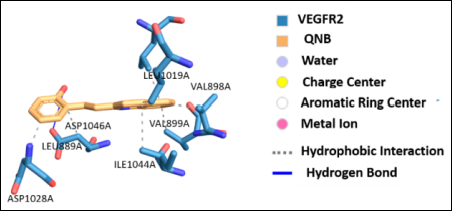
Figure 1. Interaction of VEGFR2 with QNB using the Protein–Ligand Interaction Profiler (PLIP). QNB by forming interactions with LEU889, VAL898, VAL899, LEU1019, ASP1028, ILE1044, and ASP1046 of VEGFR2 and one hydrogen bond with ASP1046, can inhibited VEGFR2 activity. QNB: quininib, VEGFR2: vascular endothelial growth factor receptor 2.
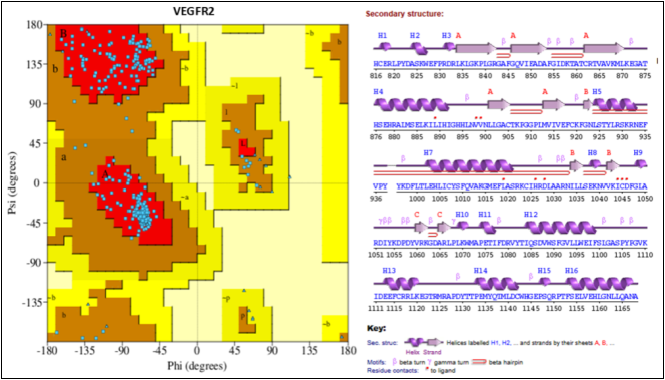
Figure 2. Ramachandran plot and secondary structure of VEGFR2 using the PDBsum. It represents the spatial angles of the peptide chain in VEGFR2, indicating that the spatial states (conformations) are suitable for the bonds between atoms in the backbone. VEGFR2: vascular endothelial growth factor receptor 2.
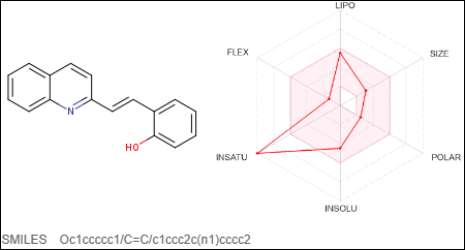
Figure 3. Bioavailability radar chart from the SwissADME online tool of QNB. This chart shows that the QNB has suitable pharmacokinetic properties and can be formulated as an oral drug. QNB: quininib.

Information



 Share This Article
 Twitter
 Linked In
 Facebook
 Copy
Copy Download