2. Political Ideological Spectrum and Political Party Formation
The ideological spectrum is a way to understand different political beliefs, usually shown as a line from left to right. It also includes ideas like progressive versus conservative. This spectrum helps explain how political parties are formed, how they compete, and how they stay in power. In 1967, Lipset and Rokkan explained that political parties often grow out of deep social divisions, called ‘cleavages’ such as, differences between rich and poor, religious and secular groups, or people from the center versus the outskirts of a country
| [31] | Lipset, S. M., & Rokkan, S. (1967). Cleavage Structures, Party Systems and Voter Alignments: An Introduction. In S. M. Lipset & S. Rokkan (Eds.), Party Systems and Voter Alignments: Cross-National Perspectives. New York: Free Press. |
[31]
. These divisions helped shape the left-right divide: left-wing parties, like socialists, supported equality for the working class, while right-wing parties, like conservatives, focused on tradition and religion. Centrist parties tried to find a middle ground between these two sides.
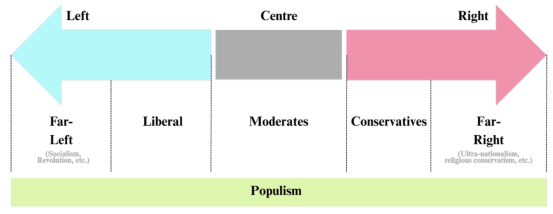
On the other hand, populism cannot be neatly placed on the traditional left-right-center spectrum because it is more a political style than a fixed ideology which is centered on appealing directly to ‘the people’ against ‘the elite’
| [28] | Lewandowski, A. & Polakowski, M. (2018). Elites vs. the People: Populism in the Political Thought of Law and Justice. State University of Applied Sciences in Płock. Faculty of Humanities and Social Science. Vol. XXV, 2., Section K., pp. 145-163. https://doi.org/10.17951/k.2018.25.2.145-163 |
[28]
. Left-wing populism emphasizes economic equality and social welfare and criticizes corporate elites, while right-wing populism focuses on nationalism, religious identity, and anti-immigration policies which portrays elites as betraying the true people. Some populist movements claim to be centrist or above traditional politics by adopting pragmatic agendas. Essentially, populism can appear anywhere on the spectrum (
Figure 1), and its exact position depends on the policies and values it promotes rather than on the populist style itself.
Figure 1. Political ideological spectrum.
Moving into the 1990s, Kitschelt (1995) argued that in post-industrial societies, old cleavages became less important, and new ones emerged. People began to care more about social liberties, the environment, and cultural issues. This led to the creation of new parties like green parties (supporting environmental causes) and populist parties (challenging elites and institutions). This showed that the ideological spectrum was not fixed but could evolve with social and economic changes
| [27] | Kitschelt, H. (1995). Formation of Party Cleavages in Post-Communist Democracies’, Party Politics, p. pp. 447-472. |
[27]
. Dalton and Wattenberg noted that even though the left-right divide still existed, parties often became more pragmatic, adapting to what voters wanted rather than sticking strictly to ideology
. This made party positions blur over time. Mudde added that radical right-wing parties, which mix nationalism and anti-elite ideas, were becoming more popular
. These parties did not always fit neatly into traditional ideologies.
The link between ideology and party formation has been brought under consideration by Hanson (2010). In any stable democracy, parties cannot entirely abandon ideological commitments because these positions give meaning to party labels and credibility to electoral promises. Without this, campaigns risk becoming hollow performances in which elites take positions they never intend to defend, eroding voter trust and participation. While political expediency can lead parties to modify or soften positions, Hanson argues that there are always practical limits to ideological flexibility if parties wish to remain legitimate actors in competitive politics
| [21] | Hanson, Stephen E. (2010). “Ideology and Party Formation.” In Post-Imperial Democracies: Ideology and Party Formation in Third Republic France, Weimar Germany, and Post-Soviet Russia, Cambridge Studies in Comparative Politics, Cambridge: Cambridge University Press. chapter, pp. 57-84. |
[21]
.
Research like Norris’s Global Party Survey shows that similar types of parties, such as, social democratic or Christian democratic parties exist in many countries and share common values
. However, some parties care more about winning than about sticking to clear beliefs. This difference between acting on interests (what helps them win) and acting on principles (what they truly believe) was first noted by Tocqueville in 1835
.
Joshi’s (2023) ‘one-dimension, multiple domains’ approach refines this understanding by proposing that the left-right divide is not only about equality but about the diffusion or concentration of power across economic, foreign, and social policy domains
| [26] | Joshi, Devin K. (2021). “A New Conceptualization of the Political Left and Right: One Dimension, Multiple Domains.” Canadian Journal of Political Science 54(3): pp. 534-54.
https://doi.org/10.1017/S0008423921000408. |
[26]
. In this view, the left seeks to de-concentrate power and broaden inclusion, while the right favours concentrated authority and hierarchical control though these tendencies can vary by domain. This multi-domain lens is particularly useful for analysing Bangladesh, where parties may be left-leaning in economic policy but right-leaning in cultural or religious issues, or vice versa.
Ostrowski (2023) further expands the framework by highlighting that the political spectrum is not a binary but a three-pole structure, left, centre, and right, each with its own logic and values
. The centre, in particular, is not merely a midpoint but a distinct ideological position characterized by reformism, institutionalism, and incremental change. His ‘ideological morphology’ approach helps explain how ideas evolve, labels shift meaning over time, and new political movements emerge by recombining ideological elements in innovative ways.
Table 1 illustrates how the ideological spectrum in Bangladesh can be understood across various social domains, with distinct tendencies on the left, Centre, and right, and the overarching influence of populism. Politically, the left is characterized by mass mobilisation, secular nationalism, and transformative visions, the centre by coalition-building and reformist approaches, and the right by religious nationalism and the restoration of traditional identities, while populism cuts across all sides through anti-elite rhetoric, appeals to ‘the people,’ and emotionally charged mass campaigns. Economically, the left focuses on state-led development and redistribution, the centre on balanced public-private partnerships, and the right on market liberalisation, with populists promising subsidies, job creation, and blaming rivals for economic hardship. Legally, the left emphasises constitutional secularism and rights-based reforms, the centre gradual legal change, and the right Sharia-influenced legalism and rollback of secular provisions, while populists frame reforms as moral victories for ordinary citizens.
In the
Table 2, we can see three more domains to analyze the political spectrum in Bangladesh. In religious matters, the left promotes secularism and cultural inclusivity, the centre religious tolerance with pragmatic accommodation, and the right political religion and conservative alliances, while populists invoke faith-based unity and frame opponents as enemies of tradition. Culturally, the left supports progressive arts, national heritage, and gender equality, the centre blends tradition with modern influence, and the right focuses on cultural revivalism and resistance to external influences, with populists mobilising through cultural icons, war heroes, and religious symbols. In education, the left pushes for inclusive curricula and scientific advancement, the centre balances general and religious instruction, and the right prioritises religious-based learning and moral instruction, while populists promise free education and portray reforms as restoring “true” national values.
Table 1. Examples of Left, Centre, Right and Populists Concepts in Bangladesh Politics and Society.
Domain | Left | Centre | Right | Populism |
Political | Liberation War legacy, mass mobilization, secular nationalism, pro-democracy movements, utopia. | Coalition-building, electoral compromise, reformist agendas. | Religious nationalism, restoration of ‘Bangladeshi’ nationalism. | Anti-elite rhetoric, voice of the people campaigns, emotional appeals in mass rallies. |
Economic | State-led development, redistribution, public sector dominance. | Public-private partnerships, balanced liberalization. | Market liberalization | Promises of subsidies, job creation pledges, blaming rivals for economic hardship. |
Legal | Constitutional secularism, human rights legislation, judicial reforms for equality. | Rule of law, incremental legal reforms. | Sharia-influenced legalism, rollback of secular constitutional provisions. | Framing law reforms as moral victories for ordinary citizens. |
Table 2. Examples of Left, Centre, Right and Populists Concepts in Bangladesh Politics and Society.
Domain | Left | Centre | Right | Populism |
Religious | Secularism and cultural inclusivity. | Religious tolerance with pragmatic accommodation. | Political Islam, protection of majority Muslim identity, alliance with conservative clerics. | Invoking faith-based unity, framing opponents as enemies of religion or tradition. |
Cultural | Progressive arts, promotion of Bengali nationalism, gender equality in public life. | Preservation of traditions while allowing modern influence. | Cultural revivalism, Islamic heritage promotion, resistance to Western influence. | Using cultural icons, war heroes, or religious symbols to mobilize support. |
Educational | Curriculum reform for inclusivity, science and technology promotion. | National standardization with balance in general and religious curriculum. | Emphasis on madrasa education, rote learning, moral-religious inclusion in general education. | Free education pledges, framing reforms as restoring true national values. |
3. Formation of Political Parties in Bangladesh: Regime Centric or Uprising Driven
The political history of Bangladesh shows that party formation has often been shaped by either regime-centric engineering or popular uprising. In many cases, ruling regimes have actively created or sponsored political parties to consolidate power, co-opt opposition, or fragment emerging challenges. The roots of the Awami League’s (the oldest political party of Bangladesh) eventual formation can be traced back to 1906, when the All-India Muslim League was founded in Dhaka
| [14] | Chander, S. (1987). Congress-Raj Conflict and the Rise of the Muslim League in the Ministry Period, 1937-39. Modern Asian Studies, 21(2), pp. 303-328.
http://www.jstor.org/stable/312649 |
[14]
. This party emerged to represent the political interests of Muslims with direct support from British rule to confront National Congress as a part of their ‘divide and rule’ policy. When the partition of India came in 1947, East Bengal became East Pakistan under the new dominion of Pakistan
| [33] | Masum, Sk. Golam & Haque, Sk. Sahafur (2015). Ideology of Rightist, Leftist and Rightist-Communalist Parties in India. International Journal of Innovative Research and Development, vol. 4, issue. 3, p. 206-2010. |
[33]
. The Muslim League took control of the central government, dominated by leaders from West Pakistan. However, in these early years, the regime also faced the challenge of growing discontent in the East. Instead of allowing opposition to consolidate into one unified, radical movement, the West Pakistani ruling elite tolerated and, in some cases, encouraged the creation of smaller, more controllable opposition groups. This political strategy of ‘managed pluralism’ was aimed at channeling Bengali dissatisfaction into factions that would not threaten the overall dominance of the central government.
The Awami League’s origins in 1949 must be seen in this context. It began as the East Pakistan Awami Muslim League, formed at a meeting at the Rose Garden in Dhaka. Emerging in the political context of post-partition Pakistan, it initially sought to represent the interests of Bengalis in East Pakistan who felt politically, economically, and culturally marginalised by the West Pakistani ruling elite. The party played a central role in championing the Bengali language movement, opposing discriminatory policies, and advocating for regional autonomy
| [25] | Jahan, Rounaq (2019). Political Parties in Bangladesh: Challenges of Democratization. Prothoma Prokashoni. |
[25]
. Over time, it evolved from a religion-based party to a secular nationalist organisation, dropping ‘Muslim’ from its name in 1955 to embrace a broader, more inclusive political identity. Its leadership under figures like Huseyn Shaheed Suhrawardy and later Sheikh Mujibur Rahman shaped it into a powerful mass movement that eventually led the struggle for Bangladesh’s independence in 1971.
However, the birth of the Awami League can be seen as partly regime-supported. The party’s formation was facilitated by political undercurrents within Pakistan that sought to create controlled opposition to the dominant Muslim League. After the decline of the Muslim League’s credibility due to governance failures and unpopular policies, the ruling establishment in Karachi tacitly allowed alternative political groupings in East Pakistan as a way to manage dissent rather than completely suppress it. Many of the founding leaders of the Awami League, such as Maulana Abdul Hamid Khan Bhashani and Shamsul Huq, were initially part of the Muslim League but broke away with encouragement from certain political actors who saw benefit in splintering the Bengali nationalist movement into more manageable factions. In its earliest years, this indirect regime tolerance provided the Awami League with space to organise publicly, hold rallies, and mobilise without facing the level of suppression that would come later when its demands became more radical.
In addition, the Bangladesh Nationalist Party (BNP), for instance, was founded in 1978 under the leadership of then-President Ziaur Rahman. Although Zia sought to portray the BNP as a broad-based nationalist platform, its creation was directly tied to the consolidation of his military-backed regime. The party brought together politicians from diverse backgrounds, including Islamic parties, and anti-liberation war forces, with the aim of legitimising Zia’s rule through electoral politics. Similarly, the Jatiya Party emerged in the 1980s as the political arm of military ruler Hussain Muhammad Ershad. Like the BNP before it, the Jatiya Party was a regime instrument designed to civilianize military authority and to create a loyal political base.
Other example can include the National Citizen Party (NCP) which was launched on 28 February 2025, is an example of an uprising-centric and regime supported political party in Bangladesh, born directly out of the student-led July 2024 movement. Emerging from the ‘Students Against Discrimination’ network and the Jatiya Nagorik Committee, the NCP frames itself as the political embodiment of the uprising’s democratic and anti-authoritarian aspirations by rejecting the influence of old power structures.
Overall, the pattern indicates that political parties in Bangladesh typically emerge either with direct or indirect backing from ruling regimes or because of popular uprisings which often serves strategic purposes. Parties formed under regime support benefit from rapid organizational growth and access to state resources, but they struggle to maintain status quo once their founding regime loses power. This raises the question: how can these parties survive without regime support? The answer lies in building a strong and enduring ideological foundation which we can understand by analyzing historical narratives of political parties and their ideologies.
3.1. 1971 Liberation War and the Ideology Politics in Bangladesh
The 1971 Liberation War of Bangladesh was a major turning point in the country’s history which leads to independence from Pakistan
. The war was driven by long-standing issues like economic inequality, language discrimination, and political exclusion. While it was a nationalist movement, it was also deeply influenced by leftist ideas such as socialism and secularism. Many leftist groups actively took leadership in the fight for freedom, and the way the war was presented both within the country and internationally reflected these values
. Support from countries aligned with socialist ideals further showed the global impact of left leaning politics on the Bengali cause.
The 1971 war has its roots in the 1947 partition of British India, which created Pakistan as a divided state with East and West wings separated by thousands of kilometers and deep differences in language, culture, and economic priorities. East Pakistan, where most people spoke Bengali, was consistently marginalized by the West Pakistani ruling elite, who held most of the political power and controlled national resources. According to Jahan (1972), economic inequality grew as the West received most of the industrial investment, while the East’s main export, jute, was heavily exploited. By the 1960s, East Pakistan generated more than 60% of the country’s export income but got less than 30% of its development budget
| [24] | Jahan, Rounaq (1972). Pakistan: Failure in National Integration. New York: Columbia University Press. |
[24]
. This economic unfairness, along with the 1948 decision to make Urdu the only national language, sparked protests and resistance in the East. The 1952 Language Movement, as described by Badruddin Umar (1974), became a key moment in the growing demand for cultural and political rights
| [55] | Umar, Badruddin (1974). Puba Banglar Bhasha Andolon Ebong Totkalin Rajniti (1st part). Mawla Brothers Ltd. |
[55]
.
Political exclusion made the situation even worse. The Awami League (AL), originally formed in 1949 as the Awami Muslim League, became the main voice for the Bengali people and called for greater autonomy through its Six-Point Program in 1966. This program called for a federal system, fair economic treatment, and local control over resources, ideas that reflected leftist opposition to centralized and exploitative systems. In the 1970 general election, the AL won a huge majority in East Pakistan, but the ruling military junta refused to hand over power which eventually created a major crisis
| [3] | Bajpai, K. (2014). The Making of Bangladesh [Review of 1971: A Global History of the Creation of Bangladesh, by S. Raghavan]. Economic and Political Weekly, 49(13), pp. 26-30. https://www.jstor.org/stable/24479354 |
[3]
. The breaking point came on March 25, 1971, when the Pakistan Army launched Operation Searchlight, a violent crackdown targeting Bengali intellectuals, students, and political leaders. This brutal attack triggered the full-scale Liberation War.
Left leaning ideology played a strong role in shaping the 1971 Liberation War. It influenced both its message and how people were mobilized. Under Sheikh Mujibur Rahman’s leadership, the Awami League presented the war as a struggle against injustice and inequality, which aligned with socialist values even though the party also appealed to broader nationalist sentiments. The AL’s early move away from a Muslim-centered identity to a more inclusive, secular position by 1953 showed its rejection of Pakistan’s religious-based politics. It is also an approach supported by leftist groups
. The Six-Point Program emphasized economic fairness and regional control which reflected socialist demands for redistribution and justice. These ideas attracted support from peasants, workers, and ordinary people who believed that independence could bring about social and economic equality.
Leftist parties, such as the Communist Party of Bangladesh (CPB) and various Maoist splinter factions, further strengthened the left-wing influence during the 1971 Liberation War. These parties saw the war as a chance to overthrow the existing system, drawing inspiration from anti-colonial struggles in countries like Vietnam and Algeria. Although the CPB initially had differences with the Awami League, it eventually joined the Mukti Bahini and helped form guerrilla units that combined class struggle with the goal of national liberation
. Influential leaders like Maulana Bhashani, known for his strong socialist views, rallied rural communities by promoting the idea of a ‘people’s war,’ blending Marxist ideas with Bengali nationalism
. Together, moderate leaders from the AL and more radical leftists created the image of a united left-leaning movement leading the fight for Bangladesh’s independence.
The global Cold war context added to the left-wing nature of the 1971 Liberation War. Pakistan was closely aligned with the United States, which provided weapons later used in the brutal military crackdown making the Bengali struggle appear as an anti-imperialist fight
| [11] | Butt, I. Z., Zennat & Malik, A. (2024). The Role of Right-Wing Political Parties in Politics of Pakistan: An Exploratory Study. Annals of Human and Social Sciences, Vol. 5, No. 4, p. 265.
http://doi.org/10.35484/ahss.2024(5-IV)26 |
[11]
. On the other hand, the Soviet Union supported the Bengali cause, both diplomatically and militarily, especially by backing India’s intervention in December 1971, which played a major role in ending the war
| [36] | Murshid, N. (2011). India’s Role in Bangladesh’s War of Independence: Humanitarianism or Self-interest? Economic and Political Weekly, 46(52), pp. 53-60.
http://www.jstor.org/stable/41719989 |
[36]
. This rivalry between the superpowers made Bangladesh’s independence look like a win for the socialist bloc. Leftist thinkers like Badruddin Umar (1974) described the war as a rejection of both capitalist exploitation and religious extremism
| [55] | Umar, Badruddin (1974). Puba Banglar Bhasha Andolon Ebong Totkalin Rajniti (1st part). Mawla Brothers Ltd. |
[55]
. This narrative was further supported by the secular nature of the resistance, which excluded religious militias from official participation.
By December 16, 1971, when Pakistan officially surrendered to the joint forces of the Mukti Bahini and Indian military, the outcome of the war seemed to confirm the rise of left-wing influence
| [56] | Umar, Badruddin (2006). The Emergence of Bangladesh: Vol. 2: Rise of Bengali Nationalism (1958-1971). Oxford University Press. |
[56]
. Bangladesh’s independence broke down the oppressive and exploitative systems imposed by Pakistan by aligning with socialist ideals of economic fairness and social justice. The Awami League took charge of building a new nation based on principles of secularism and equality. The cultural memory of the war expressed through revolutionary songs, poems, and literature celebrated a forward-looking Bengali identity, free from both colonial domination and feudal traditions. This can be described as a symbolic victory for leftist politics. With independence, Bangladesh appeared to embrace secularism and social justice
.
3.2. Emergence of Bangladesh Nationalist Party (BNP) to Fill the Right-wing Vacuum
The independence of Bangladesh in 1971 created a favorable environment for left-wing politics. In the early years after independence, left-leaning parties, including the Awami League (AL) and Jatiya Samajtantrik Dal (JSD), held strong political control, pushing right-wing voices to the margins in a climate where secular ideas were dominant. However, the assassination of Sheikh Mujibur Rahman in 1975 marked a turning point, disrupting the political order and allowing new ideologies to rise. In this context, Major General Ziaur Rahman took power and founded the Bangladesh Nationalist Party (BNP) in 1978, aiming to establish a right-wing alternative to the AL
. He positioned the BNP as a party rooted in Bangladeshi nationalism, economic liberalism, and Islamic values. This essay explores how the BNP filled the right-wing gap in post-independence Bangladesh and how it evolved under Ziaur Rahman to become one of the country’s major political forces.
The AL’s early policies like nationalizing major industries and banning religion-based political parties strengthened the secular and socialist dominance. Alongside the AL, other leftist parties such as the Communist Party of Bangladesh (CPB) and the Jatiya Samajtantrik Dal (JSD) pushed for more radical changes, even though they had limited success in elections. In contrast, right-wing politics was largely absent in the early years of independent Bangladesh. The strong anti-Pakistan sentiment following the war discredited Islamist and conservative groups, especially Jamaat-e-Islami, which had supported the Pakistani military during the conflict. As a result, religious and pro-market ideologies were pushed to the margins, and there was no organized right-wing force in the political landscape
. This left-leaning dominance was further solidified in 1975 when Sheikh Mujibur Rahman introduced BAKSAL, a one-party socialist system under the Bangladesh Krishak Sramik Awami League
| [2] | Ahamed, E. (2004). The Military and Democracy in Bangladesh. In R. J. May & V. Selochan (Eds.), The Military and Democracy in Asia and the Pacific. ANU Press., pp. 101-118. http://www.jstor.org/stable/j.ctt2jbj1g.12 |
[2]
.
The assassination of Sheikh Mujibur Rahman on August 15, 1975, by a group of army officers marked a turning point in Bangladesh’s politics which brought an abrupt end to the Awami League’s dominance and the left-wing vision
. The coup was fueled by growing dissatisfaction with economic stagnation, corruption, and the increasingly authoritarian nature of Mujib’s rule. In the aftermath, Bangladesh entered a period of political instability with multiple military takeovers, eventually leading to Major General Ziaur Rahman’s rise to power by November 1975. Zia, a respected war hero, presented himself as a stabilizing leader during a time of chaos. However, with the fall of the AL and suppression of leftist groups under military rule, the political landscape was left ideologically fragmented. No organized right-wing force had yet emerged which created a vacuum that Zia skillfully used to reshape the country’s political direction and lay the groundwork for right-wing politics in Bangladesh.
On September 1, 1978, Ziaur Rahman founded the Bangladesh Nationalist Party (BNP) to fill the political and ideological gap left by the fall of the Awami League (AL) and to challenge its leftist legacy. In contrast to the AL’s Bengali nationalism, which focused on language and culture, Zia introduced ‘Bangladeshi nationalism’, a more state-centered ideology that emphasized territorial unity and Islamic values
. This marked a clear turn to the right, aiming to reconnect with conservative and religious groups that had been pushed aside since independence. Drawing on his military background, Zia adopted a practical approach that combined strong national identity with market-oriented economic reforms, responding to the failures of Mujib’s socialist model, including the inefficiencies of state-run industries. His 1977 constitutional amendment replacing ‘secularism’ with ‘absolute trust and faith in Almighty Allah’ was a bold step away from the AL’s secular-left ideals and helped legitimize a new, right-leaning political force in Bangladesh
.
The BNP started civilianization process with a clear strategy to build a broad support base by attracting unhappy former Awami League members, military leaders, and conservative voters from rural areas. Ziaur Rahman also brought Islamist groups like Jamaat-e-Islami back into politics by lifting their ban and forming alliances to strengthen the right-wing coalition though they were marginalized since independence as they were not supporting the liberation war against Pakistan. His 19-point program, introduced in 1977, focused on self-reliance, privatization, and developing rural areas, which stood in contrast to the AL’s focus on state control and appealed especially to a growing middle class (Tayeb, 1978). By moving the country back to civilian rule and winning the 1979 elections, Zia firmly established the BNP as a strong political party which became the main opponent to the AL and the leading voice of right-wing politics in Bangladesh.
The BNP’s lasting strength as the main right-wing party came from its ability to adapt and build strong institutions. After Ziaur Rahman was assassinated in 1981, his widow Khaleda Zia took over the party leadership in 1984, continuing his political vision while managing Bangladesh’s unstable political environment. The BNP used widespread dissatisfaction with the Awami League to grow its support, especially during the military rule of H. M. Ershad from 1982 to 1990. During this time, the BNP worked with the AL in pro-democracy movements but kept its own clear right-wing identity. When the BNP won the 1991 election with Khaleda Zia as prime minister, it firmly established itself as a major political force and helped create a two-party system in Bangladesh where right-wing politics had a permanent place.
The BNP kept its right-wing support strong by combining nationalism with Islamic ideas, which helped it connect with conservative voters while clearly setting itself apart from the Awami League’s secular approach
| [46] | Rahman, T. (2019). Party System Institutionalization and Pernicious Polarization in Bangladesh. The Annals of the American Academy of Political and Social Science, 681, pp. 173-192. https://www.jstor.org/stable/26966205 |
[46]
. Its coalition with Jamaat-e-Islami giving the party a clear and consistent ideology. It can be argued that BNP’s lasting success comes from how well it filled the political gap after 1975, providing a united right-wing option amid a divided left and a weakened Awami League. By the late 1990s, the BNP had firmly established itself as the main leader of Bangladesh’s right-wing politics and kept this position for many years after.
3.3. Ershad’s Regime and Messy Political Ideology
Following the assassination of President Ziaur Rahman on May 30, 1981, Bangladesh entered a phase of political instability which facilitated a bloodless coup taken by General Hussain Muhammad Ershad on March 24, 1982
. During this time, the Bangladesh Nationalist Party (BNP) started to lead the right-wing ideological spectrum in politics under Ziaur Rahman. Ershad followed a similar strategy to legitimate his rule. Ershad formed the Jatiya Party (JP) in 1986, hoping to build a political force separate from the Awami League’s (AL) secular-left ideology and the BNP’s right-wing nationalism. However, the JP lacked a clear and consistent ideology unlike AL and BNP. Its political identity was confusing and poorly defined, and instead of building strong grassroots support, it relied heavily on the power of the military. At one point of his power, he also tried to lead the right-wing politics, but he was not enough successful to do this. This lack of ideological clarity and overdependence on military backing weakened the party, making it difficult for the JP to survive in the long run, especially after Ershad’s fall from power in 1990.
Ziaur Rahman’s assassination left the BNP in disarray, though his widow Khaleda Zia would later bring the party back to life. In the meantime, Vice President Abdus Sattar briefly became president but was soon overthrown by General Hussain Muhammad Ershad in a military coup, as Bangladesh faced economic hardship and political instability
. Ershad suspended the Constitution, imposed martial law, and ruled as a military dictator until 1986, when he sought legitimacy by forming the Jatiya Party (JP) and transitioning to civilian rule. The JP was meant to serve as a political platform for Ershad’s continued authority and to challenge the two major forces of the time: the Awami League’s secular-leftist traditions and the BNP’s nationalist-conservative stance
. However, Ershad struggled to carve out a distinct ideological space, as the political spectrum was already deeply polarized, leaving little room for the JP to develop a unique and sustainable identity.
The Jatiya Party’s formation under Ershad was obsessed more by a desire for political legitimacy than by a clear ideological vision. While Ershad attempted to follow Ziaur Rahman’s model of turning military rule into civilian leadership, the JP could not do it properly. Instead, the party borrowed selectively from various sources retaining Zia’s ‘Bangladeshi nationalism’ and using Islamic rhetoric, such as the 1988 constitutional amendment making ‘Islam’ the state religion. In addition, Ershad promoted rural development and economic modernization in ways that resembled the Awami League’s state-led approach. However, he did not fully adopt socialism as well. This mix of nationalism, Islamism, and development goals created a jumbled ideological platform that struggled to connect with a public used to clearer political identities.
The Jatiya Party’s ideological confusion arose from Ershad’s effort to attract all political factions without clearly aligning with any one ideology. The JP functioned as a ‘centrist catch-all party,’ mixing right-wing Islamic imagery with left-leaning social welfare rhetoric but lacking real commitment to either. Ershad’s 18-point program, introduced in 1982, emphasized decentralization and agricultural development, echoing Zia’s earlier 19-point agenda
. However, it steered clear of the BNP’s focus on free-market reforms and the AL’s secular, egalitarian ideals. His regime’s push for Islamization, such as lifting bans on parties like Jamaat-e-Islami resembled BNP strategies but was widely seen as politically opportunistic rather than grounded in belief, ultimately alienating both secular voters and religious conservatives.
Ershad’s Jatiya Party struggled with ideological clarity largely because it relied on patronage rather than principles. This clientelist strategy turned the party into a vehicle for holding onto power rather than promoting any coherent political ideology. Ershad’s frequent policy shifts alternating between support for privatization and state-led development added to the confusion and made the JP’s position hard to define, especially when compared to the AL’s consistent left-leaning position or the BNP’s firm nationalism. Unlike Ziaur Rahman, who secured the BNP with a unifying right-wing narrative and war-hero legacy, Ershad failed to offer a compelling ideological foundation to position the JP.
However, the Jatiya Party (JP) under Ershad managed to hold onto power for a time by using controlled election mechanisms. Ershad organized elections in 1986 and 1988, which he won through widespread vote-rigging and amid boycotts by the AL and BNP
| [45] | Rahman, S. (1990). Bangladesh in 1989: Internationalization of Political and Economic Issues. Asian Survey, 30(2), pp. 150-157. https://doi.org/10.2307/2644893 |
[45]
. These electoral victories gave his regime a facade of legitimacy, even though the process was widely discredited. The JP grew by attracting opportunists and defectors from other parties, but this only reinforced its image as a party driven by power, not principles. While Ershad’s personal charm and promises of order appealed to a population, this support was largely superficial and depended more on his tight control than on any real ideological connection with the people.
Ershad’s regime collapsed in December 1990 following massive pro-democracy protests led by the students and political parties which marked the end of Ershad’s nine-year authoritarian rule. The movement was fueled by economic hardship and widespread demands for democratic governance, non-cooperation by the civil bureaucratic elite and it unified opposition forces against Ershad’s authoritarianism. The JP, lacking an ideologically committed base, failed to defend his regime meaningfully. In the 1991 election, the JP managed to win only 35 seats, compared to the BNP’s 140 and the AL’s 88 (Hossain, 2009). Its post-1990 survival strategy relied on forming opportunistic alliances with either the AL or BNP.
3.4. Democratic Journey and Formation of Different Political Parties Since 1990s
The fall of General Hussain Muhammad Ershad’s military rule in December 1990 was a major turning point for Bangladesh which brought back democracy, civilian government, and multiparty elections
. The mass protests led by the students, Bangladesh Nationalist Party (BNP) and the Awami League (AL) helped remove Ershad and created a more competitive political environment. Since then, many smaller political parties have tried to challenge the dominance of the BNP and AL, but most have failed because they lacked clear ideas or strong beliefs to attract voters. In contrast, the BNP and AL have stayed powerful because they have clear and distinct ideologies that connect with large groups of people
. The caretaker government system helped make elections fairer and more trustworthy until it was removed in 2011
.
The democratic system established in the 1990s encouraged more political parties to form, as many tried to take advantage of people’s frustration with the strong hold of the Awami League (AL) and Bangladesh Nationalist Party (BNP). However, the political scene was sharply divided between the AL’s left-leaning secularism and the BNP’s right-leaning nationalism which left little space for new parties to create their own identity.
For example, the Bangladesh Islami Front (BIF), formed in the early 1990s to represent Islamist views, could not stand out because it was very similar to Jamaat-e-Islami, a more established religious party allied with the BNP. Another example is the Liberal Democratic Party (LDP), created in 2006 by former BNP leader Oli Ahmad, which aimed to offer a middle-ground option combining liberal and nationalist ideas. However, it’s unclear position, not fully secular like the AL nor fully conservative like the BNP made it hard to attract many voters, and it won only a few seats.
The Gano Forum, started in 1993 by Kamal Hossain, who was once a key member of the Awami League (AL), aimed to promote progressive and democratic ideas but did not have a clear enough ideology to stand out from the AL’s secularism. Similarly, Bikalpa Dhara Bangladesh (BDB), founded in 2004 by A. Q. M. Badruddoza Rahman, a former BNP leader, tried to offer a ‘third way’ or ‘Plan-B’ between parties but struggled because it’s unclear mix of practical politics and nationalism resembled the BNP without its clear conservative identity.
The failure of smaller political parties in Bangladesh is mainly due to their unclear ideologies and inability to connect with a politically divided population. The dominance of the AL and BNP is also rooted in structural advantages. Both parties maintain strong loyalty through extensive patronage networks, control of state resources when in power, and powerful narratives connected to Bangladesh’s founding history. Smaller parties, lacking this deep historical connection and broad organizational reach, struggle to compete in Bangladesh’s winner-takes-all political system. Even during setbacks like military interventions in 2007-2008, the AL and BNP were able to recover because their clear ideological identities kept them relevant and influential
.
3.5. A Clear Ideological Clash: Shahbagh and Shapla Chattar Movement
The Shahbagh and Shapla Chattar movements of 2013 show a deep ideological divide in Bangladesh which reflects the country’s long-standing split between left-wing secularism and right-wing religious nationalism. These two major movements happened within a short time of each other and clearly represented two sides of the ideological spectrum
| [41] | Parvez, S. (2021). Understanding the Shahbag and Hefajat Movements in Bangladesh: A Critical Discourse Analysis. Journal of Asian and African Studies, 57(4), pp. 841-855.
https://doi.org/10.1177/00219096211038657 |
[41]
. The Shahbagh movement, led mostly by young people, called for justice for the war crimes committed in 1971
. It brought together secular and left-leaning groups and was supported by the ruling Awami League (AL), which has roots in leftist politics. In response, the Shapla Chattar movement was organized by Hefazat-e-Islam, a conservative Islamist group. It gathered right-wing religious forces and had the support from the Bangladesh Nationalist Party (BNP). These two movements introduced clear ideological clashes into the political arena.
The Shahbagh movement began on February 5, 2013, sparked by public outrage over what many saw as a too-lenient sentence for Abdul Quader Mollah, a Jamaat-e-Islami leader convicted of committing war crimes during the 1971 Liberation War
. The protest took place in Shahbagh Square in Dhaka and was led mainly by students and bloggers. They demanded the death penalty for Mollah and called for banning Jamaat which eventually shows a strong secular and left-leaning position. The movement clearly supported the ideals of the Awami League’s liberation war legacy and stood firmly against religious extremism. This clear stance attracted large support from progressive urban youth, intellectuals, and leftist groups. Slogans like ‘Joy Bangla’ echoed the AL’s history of secularism and helped reinforce its leftist image.
The Awami League (AL) quickly supported the Shahbagh movement and connected it to its own political goals. Prime Minister Sheikh Hasina’s government even changed the law to allow for harsher punishments in war crimes cases, satisfying protesters and strengthening unity among leftist and secular groups
. Shahbagh was successful because it had a very clear message. It stood strongly against Islamist politics and firmly supported secularism.
In response to the Shahbagh movement, the Shapla Chattar protest broke out on May 5, 2013, led by Hefazat-e-Islam, a group made up mostly of madrasa-based Islamic scholars and students
. Held at Dhaka’s Shapla Chattar, the protest was a reaction to the secular demands of Shahbagh. Hefazat released a 13-point list of demands, which included introducing blasphemy laws, state punishment of the atheist-secular bloggers and enforcing gender segregation, ideas that reflected a strong right-wing, religious agenda. The BNP and Jamaat-e-Islami quietly supported this movement. Tens of thousands of people joined the protest, showing a strong conservative reaction against the rising influence of secularism. Protesters chanted slogans and held banners calling for Islamic rule and values which made the ideological divide even more visible.
However, security forces violently broke up the protest on May 6. At the same time, this crackdown showed just how powerful and effective a focused right-wing movement could be in mobilizing people. The AL used Shahbagh to strengthen its leftist supporters, presenting itself as the protector of the 1971 liberation’s secular values, while the right wing’s for Shapla Chattar helped it connect with religious voters and reinforce its right-wing image.
6. Correlation Analysis: Ideological Clarity and Political Party Formation
The political scene in Bangladesh has long been shaped by a clear divide between the left-wing and the right-wing politics which influences how people view politics and vote. After the July Uprising of 2024, which removed the AL from power, there has been growing interest, especially among students in forming a new political party and in February 2025, they formally announced the establishment of National Citizen Party (NCP). Besides, there are other at least 143 parties which have interest to launch them as a strong political party. This study analyzes survey data (n=94) to examine how having a clear ideology affects public support for new left- and right-leaning parties, their ability to unite different groups, and the importance of ideological leadership.
The survey included eight questions that measured how familiar respondents were with the ideologies of the Awami League (AL) and Bangladesh Nationalist Party (BNP), how important they believed ideological clarity was, their views on the lack of strong ideological leadership, and their support for new political parties on the left or right spectrum. Participants responded using a 5-point Likert scale. To analyze the data, Pearson correlation coefficients (r) were calculated to examine relationships between variables, with statistical significance determined at p < 0.05 where indicated. However, these patterns should be viewed as tentative signals rather than firm conclusions. Because the survey relied on a small, convenience-based sample, the relationships observed here may not reflect the views of the broader population. Future research with larger and more representative samples will be necessary to test whether these associations hold more widely and to draw any reliable, generalizable conclusions.
6.1. Familiarity with AL and BNP Ideologies
This variable (r = 1.000 with itself) has a strong positive connection with the importance of ideological clarity (r = 0.661), meaning that people who know more about the AL’s left-leaning views and the BNP’s nationalist ideas also tend to believe that a political party should have a clear and consistent ideology. This matches Bangladesh’s political history, where the AL’s identity was shaped by the 1971 Liberation War and the BNP became a strong right-wing party under Ziaur Rahman in 1978, creating clear and lasting political ideas.
6.2. Importance of Ideological Clarity
Ideological clarity has a meaningful positive link with support for new left-wing (r = 0.218, p < 0.05) and right-wing (r = 0.227, p < 0.05) parties, showing that having a clear set of ideas is important for gaining public support. This pattern is similar to what happened during the 2013 Shahbagh movement, where the Awami League’s clear secular position helped unite left-wing groups against war criminals. On the other hand, the Jatiya Party’s unclear and confused stance led to its decline after 1990.
6.3. Perception of Ideological Leadership Deficit
This variable has a very weak connection with how familiar people are with existing parties (r = 0.056) and how important they think clear ideas are (r = 0.279). However, it has strong positive connections with support for new left-wing (r = 0.495) and right-wing (r = 0.656) parties, as well as how effective people think these new parties would be (left: r = 0.572; right: r = 0.815). This means that people who are unhappy with current political leaders are more open to new parties, especially right-wing ones.
6.4. Support for New Left Leaning Party
The chance that people will support new left leaning parties has a moderate connection with how clear their ideas are (r = 0.218, p < 0.05) and a strong connection with how much people feel current leaders are failing (r = 0.495). This means that if the AL becomes weaker, there is a good chance for left-wing groups to come back stronger. The strong link with how well a new party can bring leftist groups together (r = 0.890) is similar to what happened in 2013 during the Shahbagh movement, when the AL united different left-wing groups clearly and effectively.
6.5. Support for New Right Leaning Party
This means there is a clear connection between support for new right leaning parties and how clear their ideas are (r = 0.227, p < 0.05), along with a strong link to people feeling that current leaders are not doing well (r = 0.656). This suggests that after 2024, more people might be open to right-wing alternatives, especially as the BNP moves away from its alliance with Jamaat-e-Islam.
6.6. Effectiveness of New Right Leaning Party
This shows a very strong connection to people feeling there is a leadership gap on the right (r = 0.815) and a strong link to support for new right leaning parties (r = 0.704). This suggests that many see a big opportunity for new right-wing groups to grow. The BNP’s success after 1975 under Ziaur Rahman shows how having a clear right-wing identity can bring different groups together and gain wide support.
6.7. Success Dependent on Ideological Spectrum
This belief has a strong connection with the importance of ideological clarity (r = 0.542), meaning many people think that clearly defining a party’s place on the political spectrum is key to its success. In other words, it is very clear that for a new political party to form and survive, it must have a well-defined ideological position.
6.8. Ideological Clarity Drives Support
The significant correlations between ideological clarity and support for new parties on the left (r = 0.218) and right (r = 0.227), both statistically significant (p < 0.05), highlight how important clear ideology is for gaining public backing. For example, the Awami League’s clear secular stance during the 2013 Shahbagh movement united leftist groups and helped it maintain power for 16 years, while the BNP’s strong nationalist position after 1978 successfully filled the right-wing gap.
Table 3. Correlation Matrix of Public Attitudes Toward Political Ideologies, Party Support, and Perceived Leadership*.
| Familiarity with AL-BNP Ideologies | Importance of Ideological Clarity | Perceived Ideological Leadership Deficit | Support for New Left-Wing Party | Effectiveness of New Left-Wing Unity | Support for New Right-Wing Party | Effectiveness of New Right-Wing Unity | Belief in Ideological Spectrum Capture |
Familiarity with AL-BNP Ideologies | 1.000 | 0.661 | 0.056 | 0.356 | 0.275 | 0.359 | -0.056 | 0.354 |
Importance of Ideological Clarity | 0.661 | 1.000 | 0.279 | 0.218 | 0.123 | 0.227 | 0.195 | 0.542 |
Perceived Ideological Leadership Deficit | 0.056 | 0.279 | 1.000 | 0.495 | 0.572 | 0.656 | 0.815 | 0.199 |
Support for New Left-Wing Party | 0.356 | 0.218 | 0.495 | 1.000 | 0.890 | 0.598 | 0.584 | 0.017 |
Effectiveness of New Left-Wing Unity | 0.275 | 0.123 | 0.572 | 0.890 | 1.000 | 0.708 | 0.701 | -0.074 |
Support for New Right-Wing Party | 0.359 | 0.227 | 0.656 | 0.598 | 0.708 | 1.000 | 0.704 | -0.202 |
Effectiveness of New Right-Wing Unity | -0.056 | 0.195 | 0.815 | 0.584 | 0.701 | 0.704 | 1.000 | -0.127 |
Belief in Ideological Spectrum Capture | 0.354 | 0.542 | 0.199 | 0.017 | -0.074 | -0.202 | -0.127 | 1.000 |
8. Conclusion
Countries around the world are often divided into left-right wing or liberal-conservative politics, which represent different beliefs about how society, politics and economics should be organized
| [12] | Caprara, G. V., & Vecchione, M. (2018). On the Left and Right Ideological Divide: Historical Accounts and Contemporary Perspectives. Political Psychology, 39, p. pp. 49-83.
https://www.jstor.org/stable/48756032 |
[12]
. The emergence of political parties in Bangladesh, especially after the July Uprising of 2024, is deeply connected to the country’s historical and ideological journey, as shown throughout this study. Historically, the formation of political parties in Bangladesh can be considered as regime-centric approach or uprising-driven movements. The Awami League in its early years, the BNP under Ziaur Rahman, and the Jatiya Party under Hussain Muhammad Ershad, the National Citizen Party (NCP) were either facilitated or directly created to consolidate authority, co-opt opposition, or fragment emerging challenges.
Since the 1971 Liberation War, which solidified the Awami League’s (AL) left-wing dominance, and the formation of the Bangladesh Nationalist Party (BNP) in 1978 to fill the right-wing gap, Bangladesh’s politics have remained ideologically divided. This left-right or liberal-conservative divide has continuously shaped political developments. The decline of Ershad’s Jatiya Party (JP) in the 1980s and the failure of other smaller parties after 1990s due to their lack of clear ideological positions was also an evident in support of this argument. The ideological clarity displayed during the 2013 Shahbagh movement (led by the AL’s secular front) and the Islamist-BNP religious alliance in the Shapla Chattar protests further demonstrated how political legitimacy is tied to strong ideological identity. In the wake of the AL’s fall in 2024, political entities now face an open field, but history reinforces a central lesson, to survive and succeed, a party must define, claim, and lead a clear ideological spectrum.
The correlation analysis from the survey (n=94) provides empirical backing to the historical patterns discussed earlier which sheds light on public opinion in the aftermath of the 2024 uprising. The results clearly show that ideological clarity plays a crucial role in generating support for political parties. This reflects how the AL and BNP historically maintained public trust through clear ideological stances. However, the data also signals a present-day shift in public sentiment more in favor of right-wing alternatives. Support for right-leaning parties shows stronger correlations (r=0.656 for support and r=0.704 for perceived effectiveness in uniting factions) than for the left (r=0.495 and r=0.572, respectively). This tilt likely stems from the BNP’s recent strategic move to distance itself from Jamaat-e-Islami and the public fallout from the AL’s fall, which together have left a noticeable gap on the right, similar to what Ziaur Rahman capitalized on in 1978. On the other hand, while the left shows strong internal coherence (support-unity correlation at r=0.890), it struggles with fragmentation and the burden of distancing itself from the AL. Though the results provide initial evidence of these relationships, but their interpretation remains provisional. Subsequent studies with larger and more representative samples are essential to confirm and build on these observations.
In the wake of the 2024 July uprising, many groups including the students who led the movement wanted to establish political forces in Bangladesh. They could reinvigorate the left by uniting fragmented groups around a clear agenda of secularism and social justice, similar to how the AL mobilized support during the Shahbagh movement, especially by using strong media presence to influence public discourse. Alternatively, the parties could carve out space on the right by channeling nationalist and religious sentiments. However, past examples like the decline of the ideologically incoherent political parties in the 1990s serve as cautionary tales about the dangers of ambiguity. The moderate correlation between belief in spectrum capture and the importance of ideological clarity (r=0.542) suggests that while ideology is crucial, other factors such as organizational capability and historical legitimacy traits long embodied by the AL and BNP are also essential. For the newly formed parties, this means it must move beyond its roots in student activism and build a broader, credible platform if it hopes to endure.
In addition, situating political parties along the traditional left-right spectrum has become increasingly challenging in the contemporary Bangladesh. Many emerging parties exhibit unclear or fluid ideologies and often relies on populist strategies rather than coherent ideological frameworks. Moreover, there is a noticeable trend of ideological reversal with some extreme leftist political personnel shifting toward extreme rightist positions and vice versa. As a result, political parties are continuously redefining their ideological stances. This fluidity not only makes it harder to understand Bangladesh’s political landscape but also offers a good opportunity for future research to study how and why parties or person change from left to right or from right to left.
In conclusion, the formation of political parties in Bangladesh has followed two prevailing trends: emergence with direct or indirect support from ruling regimes, and formation in response to popular uprisings. It becomes clear that the ideological spectrum is both a strategic opportunity and a critical challenge for any political formation in post-2024 Bangladesh. For any party to succeed, it must decisively position itself, either left or right while uniting factions under that banner and responding to the electorate’s urgent demands for justice, accountability, and systemic reform in a post-uprising political order. However, this opportunity will only matter if a party boldly claims a clear ideological position and presents a strong, future-oriented vision for the country. In the immediate aftermath of the July Uprising, this presents a unique opportunity for the political parties to (re)define the political ‘Left’ and ‘Right’ in Bangladesh which will enable them to give a clear vision to the citizen and their partymen.





 Share This Article
 Twitter
 Linked In
 Facebook
 Copy
Copy Download