Research Article | | Peer-Reviewed

Stimulation of Technetium Activity in Human Body Organs After Injection Using MIRD and ICRP Models

Received: 18 June 2026     Accepted: 3 July 2026     Published: 28 July 2026
Views:       Downloads:
Abstract

Internal dosimetry deals with the measurement of the radiation dose absorbed internally by an organ after the administration of isotopes for diagnosis and treatment. The purpose of this research was to evaluate bladder-urine transfer coefficient impact on the bladder technetium activity in the MIRD bio kinetic model and propose a simplified biokinetic model using the ICRP 134 model. The residence time in the bladder and kidneys was determined using scans of five volunteer patients at three different time points (1 h, 2 h, and 3 h post-injection). To quantify activity in the kidneys and bladder, the conjugate-view method was applied to the imaging data. In the present study technetium activity has been calculated in human organs using the MIRD et ICRP bio-kinetic models. The theoretical results were obtained by simulation on the MatLab software of the matrix equations obtained from different equations of the quantity of technetium in the different organs used in the bio-kinetic models. The study showed that it is important to take into account the transfer coefficient between the bladder and urine to reduce the fraction of technetium in the bladder. The ICRP model and the proposed simplified model predict technetium fractions better than the MIRD model three hours after injection. The study also showed that the ICRP model and the proposed simplified model are in agreement in predicting the technetium fraction in the bladder and kidneys.

Published in Nuclear Science (Volume 10, Issue 3)
DOI 10.11648/j.ns.20261003.11
Page(s) 44-54
Creative Commons

This is an Open Access article, distributed under the terms of the Creative Commons Attribution 4.0 International License (http://creativecommons.org/licenses/by/4.0/), which permits unrestricted use, distribution and reproduction in any medium or format, provided the original work is properly cited.

Copyright

Copyright © The Author(s), 2026. Published by Science Publishing Group

Keywords

Activity, Bio-kinetic Model, Bladder, Kidneys, Technetium, MIRD, ICRP

1. Introduction
Nuclear medicine is the medical specialty using small amounts of radioisotopes as tracers to diagnose disease, or larger amounts for therapy. These tracers are usually attached to chemical compounds that are attracted to special organs such as bones or tissues, like iodine to the thyroid gland. After being administered to the body, these tracers emit characteristic radiations. Special electronic instruments, such as scintillation or a gamma camera, which display these emissions into images, can detect these emissions. The images yield information about the anatomy or the functional state of the body organ being imaged. The nuclear medicine physician interprets the image to determine the extent and/or severity of a given disease . In nuclear medicine applications, scintigraphic studies have been applied to different organs such as liver, spleen, heart, kidneys, bone, lung, thyroid, lymph glands etc. Although the absorbed dose levels by critical organs during the scintigraphic application are lower than the therapeutic dose levels, their evaluation may be also considered important . Nuclear medicine continues to employ radionuclides such as Tc-99m, F-18, In-111, I-123, I-131, Tl-201 etc in diagnostic procedures. Such procedures are used to scan bone, cardiovascular system, thyroid and to scan liver, spleen and lung .
The most widely utilized radiopharmaceutical for skeletal imaging is technetium methylene diphosphonate (Tc-99m MDP) because of its improved image quality and lower exposure of radiation to patients. The low-energy high-yield photons of Tc-99m make it more compatible with conventional and modern-day scintigraphic systems .
A bone scan or bone scintigraphy is a nuclear scanning procedure to find certain abnormalities in bone. It is primarily used to help diagnose a number of conditions relating to bones, including cancer of the bone or cancers that have spread (metastasized) to the bone, locating some sources of bone inflammation (e.g., bone pain such as lower back pain due to a fracture), the diagnosis of fractures that may not be visible in traditional X‑ray images, and the detection of damage to bones due to certain infections and other problems .
In nuclear medicine applications, the amount of administered activity is such that the absorbed dose to both imaged and non-imaged tissues are typically very low and thus stochastic risks of cancer induction are greatly outweighed by the diagnostic benefit of the imaging procedure . The role of internal dosimetry in diagnostic nuclear medicine is thus to provide the basis for stochastic risk quantification. Once this risk is quantified, it may be used to optimize the amount of administered activity in order to maximize image quality while minimizing patient risk. This optimization process is of particular importance for paediatric patients owing to their enhanced organ radiosensitivities and years over which any stochastic effects may become manifest. This optimization should be considered, and always evaluated for any imaging procedure .
Dosimetry of diagnostic radiopharmaceuticals is therefore primarily concerned with the dosimetry of a total population or group . The absorbed dose from internally distributed radioactivity used in diagnostic procedures is usually only calculated using models based on reference individuals and not specific patients .
The time-activity curve was stimulated with the computer program MatLab using biokinetic model published in MIRD Report 13. The model was used to determine the activities in the kidneys and bladder, which were compared to the experimental data. The experimental results show that less than 1% of the administered activity remained in the kidneys and bladder three (3) hours after the injection of Tc-99m MDP. On the other hand, the theoretical results based on the MIRD 13 model show that 1.5% of the administered activity remained in the kidneys and more than 29% remained in the bladder . In a study carried out in Sudan, Mohammedelmoez et al., shows that 1.05% of the administered activity remained in the kidneys and 1.76% in the bladder after three hours . Both studies showed that the theoretical value of activity in the bladder is much higher than that obtained in theoretical studies. This difference is due to the fact that in the theoretical model of MIRD, the urinary aspect of the patient is not taken into account. Hence the need to define a model taking into account the patient's urinary appearance and comparing the results with other models.
The primary objective of this study is to determine the impact of a bladder-urine transfer coefficient on the MIRD model and propose a simplified technetium-99m biokinetic model using the ICRP 134 model.
The Specific objectives of this research work are:
1) To stimulate the time-activity curve for blood, bone, kidney and urinary bladder using a modified MIRD model;
2) To determine the fraction of technetium in the bladder three hours after injection for different values of transfer coefficient from bladder to urine;
3) To compare the theoretical activities of Tc-99m in the kidneys and bladder three hours after injection with the practical results;
4) To stimulate the time-activity curve of technetium for different organs using ICRP and simplified models;
5) To compare the activity fraction in the bladder and kidneys using the MIRD, ICRP and simplified models.
2. Materials et Method
2.1. Determination of Activity in the Compartment
The activity q (mCi) in each human organ at time t (hour) after intake of Tc-99 is calculated using the following equation:
dqi(t)dt=İtDiFi+J=1Jinλj,iqj-(λR+J=1Jinλi,j)qi(1)
Where İt is the radionuclide intake rate (Bq/day) at time t by inhalation, Di is the fraction of the inhaled activity deposited in compartment i, λj,iis the transfer coefficient from compartment j to compartment i, λi,j is the transfer coefficient from compartment i to compartment j, λR is the radioactive decay constant, and n is the number of compartments used in the model .
In case on injection of Tc-99m in the Blood, the activity q (mCi) in each human organ at time t (hour) after injection is calculated using the following equation:
dqi(t)dt=İt+J=1Jinλj,iqj-(λR+J=1Jinλi,j)qi(2)
2.2. Biokinetic Model
2.2.1. Modified Biokinetic Model for Technetium from MIRD Report 13
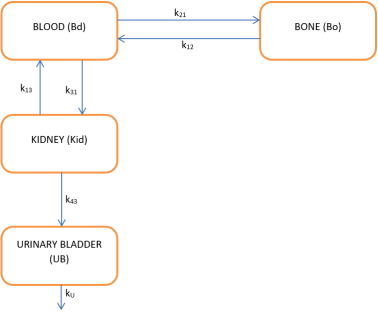
To study the variation in the activity of technetium in the bladder, a biokinetic model was proposed based on the MIRD model published in report 13. In this proposed model, the coefficient of transfer from the kidneys to the blood and that of the bladder to urine are taken into account. Figure 1 shows the modified MIRD model. This model will be used on MathLab software to simulate the variation in activity in the bladder as a function of the transfer coefficient three hours after injection.
Figure 1. Model used for dose estimates of bone imaging agents (MIRD report No 13).
The simulation of the amounts of Tc-99m activity in Blood, Bone, Kidney and Urinary Bladder was done by these equations:
dqBddt=-kr+k21+k31qBd+k12qBo+k13qKid(3)
dqBodt=-kr+k12qBo+k21qBd(4)
dqKiddt=-kr+k13+k43qKid+k31qBd(5)
dqUBdt=-kr+kUqUB+k43qKid(6)
Equations (3), (4), (5) and (6) are used to write a matrix equation given in (7). This matrix equation is used to write a MatLab code which will make it possible to determine the activities at different times and to plot the variation curves of the activities as a function of the transfer coefficient.
dqBddtdqBodtdqKddtdqUBdt=-kr+k21+k31k12k130k21-kr+k1200k310-kr+k13+k43000k43-kr+kU*qBdqBoqKdqUB(7)
k12, k21, k13, k31, kU and k43 are the transfer rate constants and kR is the physical decay constant of the Tc-99m radionuclide.
The Table 1 shows the values of k12, k21, k13, k31 and k43 given in the MIRD report 13 , in ICRP publication 134 and kR=0.115h-1.
Table 1. Transfer rate constants.

Radiopharmaceutical

k12

k21

k31

k43

k13

Tc-99m MDP

0.063±0.010

0.295±0.025

0.305±0.012

3.25±0.37

0.00144583

2.2.2. Biokinetic Model for Technetium from ICRP 134
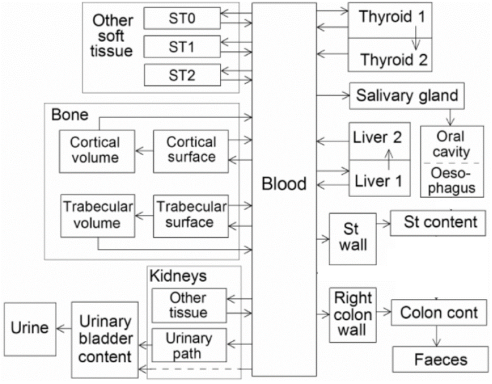
The biokinetic model (Figure 2) published in ICRP publication 134 was used to simulate with MATLAB the transfer of the amounts of Tc-99 in human organs .
Figure 2. Biokinetic model for systemic technetium. ST, soft tissue; St, stomach; SI, small intestine; cont, contents (ICRP publication 134).
The transfer coefficient values in the systemic model for technetium are given in the Table 2 .
Table 2. Transfer coefficient for technetium.

From

To

Transfer Coefficient (h-1)

Blood (Bd)

Thyroid 1

k21=0.292

Blood

STO

k121=2.995

Blood

ST1

k131=0.125

Blood

ST2

k141=0.0075

Blood

Urinary bladder content

k211=0.0708

Blood

Salivary glands

k41=0.1083

Blood

Stomach wall

k81=0.17917

Blood

Kidneys 1

k201=0.02917

Blood

Kidneys 2

k191=0.001667

Blood

Liver 1

k71=0.1875

Blood

Right colon wall

k101=0.14167

Blood

Trabecular bone surface

k171=0.014583

Blood

Cortical bone surface

k151=0.014583

Thyroid 1 (Th)

Blood

k12=4.16667

Thyroid 1

Thyroid 2

k32=0.041667

Thyroid 2

Blood

k13=0.041667

STO

Blood

k112=2.08333

ST1

Blood

k113=0.01925

ST2

Blood

k114=0.00144583

Salivary glands (SG)

Oral cavity (OC)

k54=2.083333

Stomach wall (SW)

Stomach content (SC)

k98=2.083333

Kidneys 1 (Kid)

Urinary bladder content (UB)

k2120=0.3466667

Kidneys 2

Blood

k119=0.00144583

Liver 1 (Li)

Blood

k17=0.343083

Liver 1

Liver 2

k67=0.0034667

Liver 2

Blood

k16=0.00144583

Right colon wall (CW)

Right colon content (CC)

k1110=0.0579167

Trabecular bone surface (TBS)

Blood

k117=0.01904167

Trabecular bone surface

Trabecular bone volume

k1817=0.0001925

Cortical bone surface (CBS)

Blood

k115=0.01904167

Cortical bone surface

Cortical bone volume

k1615=0.0001925

Trabecular bone volume (TBV)

Blood

k118=2.054167E-05

Cortical bone volume (CBV)

Blood

k116=3.42083E-06

The simulation of the amounts of technetium activity in Blood, Thyroid, Oral cavity, Liver, Stomach, Colon, Other soft tissue, Bone, Kidney and Urinary Bladder was done by these equations:
dqBddt=-kr+k21+k41+k71+k81+k101+k121+k131+k141+k151+k171+k191+k201+k211qBd+k12qTh1+
k13qTh2+k16qLi2+k17qLi1+k112qST0+k113qST1+k114qST2+k115qCS+k116qCV+k117qTS+k118qTV+k119qKid2(8)
dqTh1dt=-kr+k12+k32qTh1+k21qBd(9)
dqTh2dt=-kr+k13qTh2+k32qTh1(10)
dqSGdt=-kr+k54qSG+k41qBd(11)
dqOCdt=-krqOC+k54qSG(12)
dqLi2dt=-kr+k16qLi2+k67qLi1(13)
dqLi1dt=-kr+k67+k17qLi1+k71qBd(14)
dqSWdt=-kr+k98qSW+k81qBd(15)
dqSCdt=-krqSC+k98qSW(16)
dqRCWdt=-kr+k1110qRCW+k101qBd(17)
dqCCdt=-krqCC+k1110qRCW(18)
dqST0dt=-kr+k112qST0+k121qBd(19)
dqST1dt=-kr+k113qST1+k131qBd(20)
dqST2dt=-kr+k114qST2+k141qBd(21)
dqCSdt=-kr+k115+k1615qCS+k151qBd(22)
dqCVdt=-kr+k116qCV+k1615qCS(23)
dqTSdt=-kr+k117+k1817qTS+k171qBd(24)
dqTVdt=-kr+k118qTV+k1817qTS(25)
dqKid2dt=-kr+k119qKid2+k191qBd(26)
dqKid1dt=-kr+k2120qKid1+k201qBd(27)
dqUBdt=-krqUB+k2120qKid+k211qBd(28)
Equations (9) to (28) give the differential equation in activities in each organ, and they will be used to write a matrix equation. The matrix equation obtained will be used to write a MatLab code which will make it possible to determine the activities at different times and to plot the curves of variation of activities as a function of time in the blood, the thyroid, the oral cavity, the liver, stomach, colon, other soft tissues, bones, kidneys and bladder.
2.2.3. Simplified Biokinetic Model for Technetium from ICRP 134
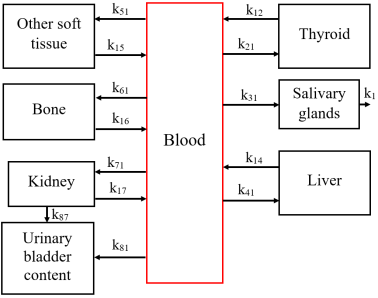
The simplified biokinetic model (Figure 3) was propose using the model published in ICRP publication 134. This simplified model was used to simulate with MATLAB the transfer of the amounts of Tc-99 in human organs.
Figure 3. Simplified biokinetic model for systemic technetium using ICRP publication 134.
The transfer coefficients used in this modified model are calculated from the transfer coefficients given in ICRP publication 134.
The transfer coefficient values in simplified model for technetium are given in the Table 3.
Table 3. Transfer coefficient in the simplified model for technetium.

From

To

Transfer Coefficient (h-1)

Blood

Thyroid

k21

0.2917

Blood

Salivary glands

k31

0.1083

Blood

Liver

k41

0.1875

Blood

Other Soft tissue

k51

3.1275

Blood

Bone

k61

0.0292

Blood

Kidneys

k71

0.0308

Blood

Urinary bladder content

k81

0.0708

Thyroid

Blood

k12

4.2083

Liver

Blood

k14

0.3445

Other Soft tissue

Blood

k15

2.1040

Bone

Blood

k16

0.0381

Kidneys

Blood

k17

1.45E-03

Kidneys

Urinary bladder content

k87

0.3467

Salivary glands

-

k1

2.0833

The simulation of the amounts of technetium activity in Blood, Thyroid, Oral cavity, Liver, Stomach, Colon, Other soft tissue, Bone, Kidney and Urinary Bladder was done by these equations:
dqBddt=-kr+k21+k31+k41+k51+k61+k71+k81qBd+k12qTh+k14qLi+k15qST+k16qBo+k17qKid(29)
dqThdt=-kr+k12qTh+k21qBd(30)
dqSGdt=-kr+k1qSG+k31qBd(31)
dqLidt=-kr+k14qLi+k41qBd(32)
dqSTdt=-kr+k15qST+k51qBd(33)
dqBodt=-kr+k16qBo+k61qBd(34)
dqKiddt=-kr+k17+k87qKid+k71qBd(35)
dqUBdt=-krqUB+k87qKid+k81qBd(36)
Equations (29) to (36) are the differential equations of the different activities in the different organs. These equations are used to write a matrix equation. This matrix equation is used to write a MatLab code which will make it possible to determine the activities at different times and to plot the curves of variation of activities as a function of time in the blood, bones, kidneys and bladder.
3. Results and Discussion
3.1. Variation of the Fraction of Activity in Unary Bladder After Three Hours
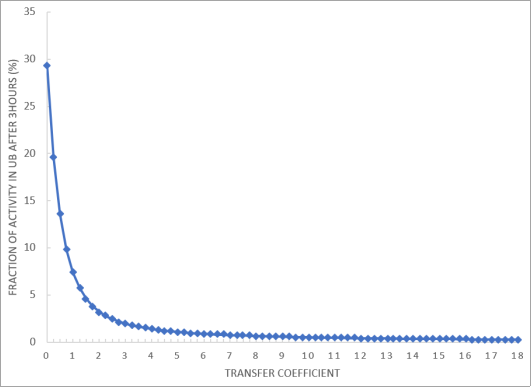
Figure 4 shows the variation in the fraction of technetium activity in the bladder as a function of the transfer coefficient from the bladder to the urine. In the MIRD model, the transfer of urine outside the patient is not taken into account, which gives a fraction of Tc-99 activity of approximately 30% in the bladder, but in practice this fraction is less than 1% according to Bambara et al. and less than 2% according to Mohammedelmoez et al. .
Figure 4. Variation of Tc-99m activity fraction in the bladder after 3 hours.
Figure 4 shows that the fraction of technetium activity in the bladder decreases exponentially with the transfer coefficient. The fraction of technetium activity in the bladder becomes less than 2% when the transfer coefficient reaches 3h-1. The fraction of technetium activity in the bladder becomes less than 1% when the transfer coefficient reaches 5.5 h-1. Therefore, the transfer coefficient from the bladder to urine must be greater than 3h-1 to have an activity fraction in bladder less than 2%. Taking into account the transfer coefficient in the MIRD model makes it possible to reduce the fraction of activity in the bladder.
3.2. Time-activity Curve for ICRP 134 Model
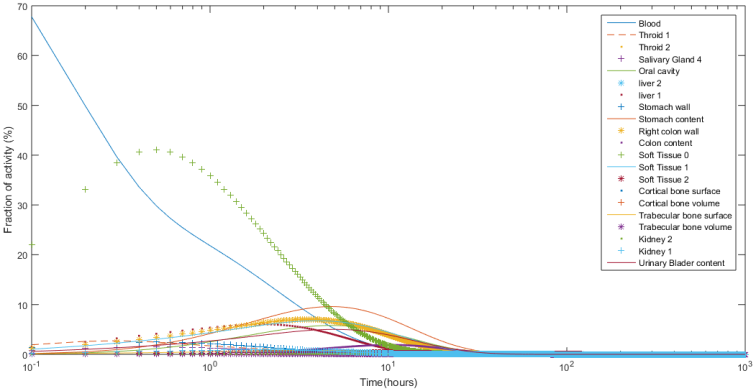
Figure 5 shows the evolution of the fraction of technetium activity in the different organs of the body using the ICRP 134 model. These curves are obtained from a simulation of the matrix equation obtained from equations (9) to (28) on MatLab software. In the model, technetium was injected intravenously into the bloodstream. The model predicts that the fraction of technetium in the blood decreases over time and that the initial fraction is 67.8%. In the model, the fraction of technetium in the blood is less than 22% after one hour, less than 11% after three hours, less than 4% after six hours and less than 0.2% after twenty-four hours. So the ICRP 134 model predicts a very low fraction of technetium in the blood after twenty-four hours.
The fraction of technetium in soft tissue zero (ST0) increases between 0 and 0.5 hours to reach a maximum of approximately 41% and decreases after 0.5 hours. The model predicts that technetium fractions in other organs are below 10% at all times. The fraction of technetium in the bladder increases between 0 and 5 hours to reach its maximum fraction which is 5%, after 5 hours it decreases to less than 1% after 24 hours. After 3 hours, the fraction in the bladder is 4.58%. The ICRP 134 model makes it possible to predict the activity of technetium in most human organs as a function of time after injection into the blood, so it can be used to perform internal dosimetry in nuclear medicine.
Figure 5. Time activity curve for Tc-99m for human organs for ICRP 134 model.
3.3. Comparison of Fraction of Tc-99 After Three Hours
Table 4 gives the fractions of technetium in the bladder and kidneys three hours after injection into the blood predicted by the models and measured in the experimental studies.
Table 4. Fraction of technetium in bladder and kidneys after three hours.

Model

ICRP

Simplified from ICRP

MIRD

Experimentally estimated radionuclide activity

Ghana

Sudan

Bladder

4.58

5.92

29.31

0.72

1.76

Kidneys

0.96

1.26

1.5

0.22

1.05

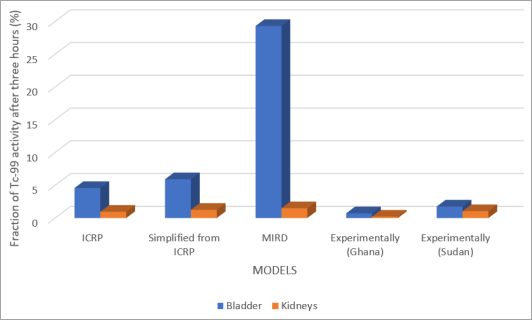
The ICRP 134 model predicts that the fraction of technetium after three hours in the bladder and kidneys are 4.58% and 0.96% respectively, while that of MIRD predicts 29.31% in the bladder and 1.26% in the kidneys. The simplified model of ICRP 134 predicts that the fraction of technetium after three hours in the bladder and kidneys are 5.92% and 1.26% respectively. Experimental studies evaluating the activity, three hours after injection carried out in Ghana and Sudan showed that the fraction of technetium in the bladder was 0.72% and 1.76% respectively . The fraction of technetium in kidneys in Ghana and Sudan was 0.22% and 1.05% respectively.
Figure 6 presents the histogram of technetium fractions in the bladder and kidneys three hours injection into the blood, for bio kinetic models and experimental studies.
Figure 6. Histogram of technetium fractions in the bladder and kidneys.
In the kidneys, the different models predict technetium fractions very close to the experimental value obtained in Sudan. The simplified model predicts a fraction that is closer to the experimental value than that of MIRD, which allows us to say that this model can be used for the prediction of activity after three hours in the bladders. The three models predict activity fractions higher than that obtained experimentally in the study carried out in Accra.
In the bladder, the predictions after three hours of the three models are higher than the values obtained experimentally in the studies carry out in Ghana and Sudan. The MIRD model predicts a fairly large fraction in the bladder after three hours, and it can be considered as a maximum prediction of activity, because it does not take into account the patient's urinary appearance. The prediction of the ICRP 134 model can be considered as a minimum prediction of activity because it takes into account the exchanges between the blood and most organs, and the organs between it. The study shows that the prediction after three hours of the simplified model is very close to that of ICRP 134, so this model can be used for the prediction of activity after three hours of injection of technetium into the blood.
3.4. Comparison of Bladder Activity Curve for the Model
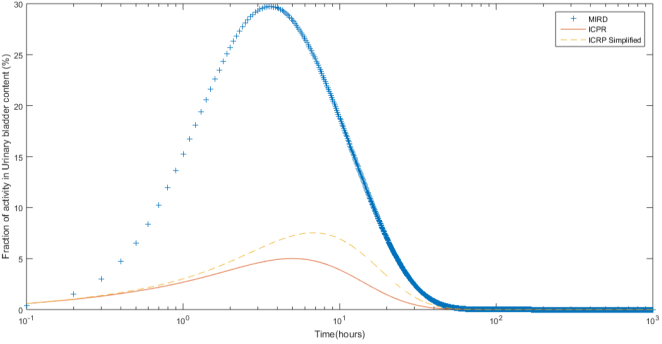
Figure 7 presents the variation of the technetium activity fraction in the bladder as a function of time for the three models studied.
The three curves have the same bell-shaped shape. In the MIRD model, the activity fraction increases to reach a maximum of approximately 29.7% after 3.6 hours. In the ICRP model, the maximum of the technetium fraction is around 5% after 5 hours. The simplified model predicts a maximum fraction of around 7.5% after 6.8 hours. The results show that the IRCP models and the simplified model have approximately the same prediction between 0 to 1h after injection. After 48 hours, the three models predict technetium fractions lower than 0.35%. The ICRP model and the simplified model predict fractions of technetium in the bladder which are lower than 8% throughout the entire time while that of MIRD presents fractions of up to 29.7%. The simplified model is closer to the ICRP model than that of MIRD, therefore can be used to quantify the activity of technetium in the bladder.
Figure 7. Variation of technetium fraction in the bladder from the models.
3.5. Comparison of Kidneys Activity Curve for the Model
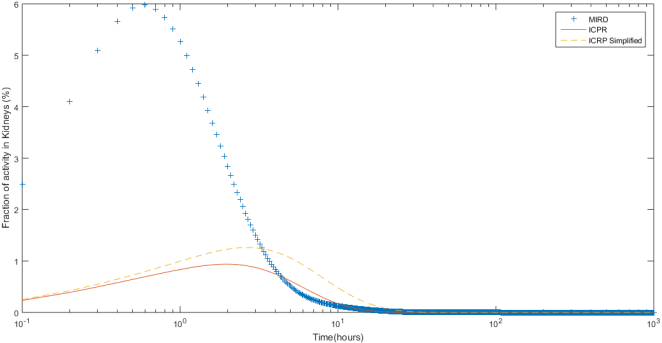
The variations of the technetium activity fraction in the kidneys as a function of time for the three models studied are presented in Figure 8. The variations of the technetium fraction in the kidneys for the ICRP and simplified models have the same and the fractions are less than 1.3% whatever the time after injection. The simplified model has a slightly better prediction than the ICRP model, but the fractions remain lower than those of the MIRD model.
Figure 8. Variation of technetium fraction in the kidneys from the models.
4. Conclusion
This study aimed to determine variations in technetium activity in different human organs and to propose a simplified model. This study shows that adding a bladder urine transfer coefficient in the MIRD model will reduce high activity in the bladder. This study also revealed that technetium fractions in the bladder decrease exponentially as a function of the bladder-to-urine transfer factor in the MIRD model. Most human organs had activity fractions lower than 10% of the injected activity except blood and soft tissue. The three models predict the activity fractions three hours after injection are higher than those obtained in the studies experimental. The simplified ICRP 134 model can be used to predict activities in the bladder and kidneys.
Abbreviations

IAEA

International Atomic Energy Agency

ICRP

International Commission on Radiological Protection

MIRD

Medical Internal Radiation Dose

Tc

Technetium

Acknowledgments
We gratefully acknowledge the financial support of International Center for Theoretical Physics.
Author Contributions
Bambara Telado Luc: Conceptualization, Methodology, Software, Investigation, Writing – original draft
Kabore Karim: Software, Investigation, Writing – review & editing
Derra Moumouni: Writing – review & editing
Francois Zougmore: Writing – review & editing
Conflicts of Interest
The authors declare that they have no conflict of interest related to the publication of this article.
References
[1] Nadia Helal, April 2012. “Patient organs dose calculations in nuclear medicine”. IJRRAS 11 (1), April 2012.
[2] Sahebnasagh, November 15, 2012 ‘Determination and Comparison of Absorbed dose of Ovaries and Uterus in Heart Scan from TC-99m, by Three Methods: TLD Measurement, MCNP Simulation and MIRD Calculation and Estimation of its Risks’. Research Journal of Applied Sciences, Engineering and Technology 4(22): 4572-4575, 2012.
[3] Ebele Yigbedeck Yolande Huguette, 2001. «Quantitative analysis of bone scintigrams at the Korle-Bu Teaching Hospital », School of Nuclear and Allied Sciences, Master Thesis, July 2012, 73pages.
[4] Daryoush Shahbazi-Gahrouei, Mohsen Cheki, Masoud Moslehi, (2012). Estimation of Organ Absorbed Doses in Patients from 99mTc-diphosphonate Using the Data of MIRDose Software, J Med Signals Sens. 2012 Oct-Dec; 2(4): 231–234.
[5] W Bolch, F Fahey, August 2013. “The management of imaging procedure dose 2: Nuclear Medicine”.
[6] INTERNATIONAL ATOMIC ENERGY AGENCY (IAEA), Report of a Consultancy Meeting held 26-28 September 2011 at the IAEA Headquarters in Vienna.
[7] Kevin James Hickson (BAppSc) (2011). Internal radionuclide dosimetry of model and patient based voxelised phantoms using the GATE toolkit. School of Applied Sciences College of Science, Engineering and Health, RMIT University Melbourne Australia, Master of Applied Science (Medical and Health Physics), August 2011, 179 pages.
[8] Luc T. Bambara, Augustine K. Kyere, Francis Hasford, “Estimation of kidney and bladder radionuclide activity for patients undergoing bone scan”, Journal of Radiation Research and Applied Sciences. 2015, page 317-322.
[9] Mohammedelmoez E. A. Mokhtar, Nadia O Elatta, Wadah Ali, Amgad Kh O Nasr, 2022. Measurement of organs dose during bone scan in Sudan. Humanities & Natural Sciences Journal, HNSJ, 2022, 3(10);
[10] Hrycushko Brian Andrew, 2008. An investigation into the use of biokinetic models when assessing intakes of Plutonium, A Thesis, MASTER OF SCIENCE, Texas A&M University.
[11] Weber David A., P. Todd Makler, Jr., Evelyn E. Watson, Jack L. Coffey, Stephen R. Thomas, and Jack London. MIRD DOSE ESTIMATE REPORT NO 13, “Radiation Absorbed Dose from Technetium-99m-Labeled Bone Imaging Agents”. J Nucl Med 30: 1117-1122, 1989.
[12] ICRP, 2016. Occupational intakes of radionuclides: Part 2. ICRP Publication 134. Ann. ICRP 45(3/4), 1–352.
Cite This Article
  • APA Style

    Luc, B. T., Karim, K., Moumouni, D., Zougmore, F. (2026). Stimulation of Technetium Activity in Human Body Organs After Injection Using MIRD and ICRP Models. Nuclear Science, 10(3), 44-54. https://doi.org/10.11648/j.ns.20261003.11

    Copy | Download

    ACS Style

    Luc, B. T.; Karim, K.; Moumouni, D.; Zougmore, F. Stimulation of Technetium Activity in Human Body Organs After Injection Using MIRD and ICRP Models. Nucl. Sci. 2026, 10(3), 44-54. doi: 10.11648/j.ns.20261003.11

    Copy | Download

    AMA Style

    Luc BT, Karim K, Moumouni D, Zougmore F. Stimulation of Technetium Activity in Human Body Organs After Injection Using MIRD and ICRP Models. Nucl Sci. 2026;10(3):44-54. doi: 10.11648/j.ns.20261003.11

    Copy | Download

  • @article{10.11648/j.ns.20261003.11,
      author = {Bambara Telado Luc and Kabore Karim and Derra Moumouni and Francois Zougmore},
      title = {Stimulation of Technetium Activity in Human Body Organs After Injection Using MIRD and ICRP Models},
      journal = {Nuclear Science},
      volume = {10},
      number = {3},
      pages = {44-54},
      doi = {10.11648/j.ns.20261003.11},
      url = {https://doi.org/10.11648/j.ns.20261003.11},
      eprint = {https://article.sciencepublishinggroup.com/pdf/10.11648.j.ns.20261003.11},
      abstract = {Internal dosimetry deals with the measurement of the radiation dose absorbed internally by an organ after the administration of isotopes for diagnosis and treatment. The purpose of this research was to evaluate bladder-urine transfer coefficient impact on the bladder technetium activity in the MIRD bio kinetic model and propose a simplified biokinetic model using the ICRP 134 model. The residence time in the bladder and kidneys was determined using scans of five volunteer patients at three different time points (1 h, 2 h, and 3 h post-injection). To quantify activity in the kidneys and bladder, the conjugate-view method was applied to the imaging data. In the present study technetium activity has been calculated in human organs using the MIRD et ICRP bio-kinetic models. The theoretical results were obtained by simulation on the MatLab software of the matrix equations obtained from different equations of the quantity of technetium in the different organs used in the bio-kinetic models. The study showed that it is important to take into account the transfer coefficient between the bladder and urine to reduce the fraction of technetium in the bladder. The ICRP model and the proposed simplified model predict technetium fractions better than the MIRD model three hours after injection. The study also showed that the ICRP model and the proposed simplified model are in agreement in predicting the technetium fraction in the bladder and kidneys.},
     year = {2026}
    }
    

    Copy | Download

  • TY  - JOUR
    T1  - Stimulation of Technetium Activity in Human Body Organs After Injection Using MIRD and ICRP Models
    AU  - Bambara Telado Luc
    AU  - Kabore Karim
    AU  - Derra Moumouni
    AU  - Francois Zougmore
    Y1  - 2026/07/28
    PY  - 2026
    N1  - https://doi.org/10.11648/j.ns.20261003.11
    DO  - 10.11648/j.ns.20261003.11
    T2  - Nuclear Science
    JF  - Nuclear Science
    JO  - Nuclear Science
    SP  - 44
    EP  - 54
    PB  - Science Publishing Group
    SN  - 2640-4346
    UR  - https://doi.org/10.11648/j.ns.20261003.11
    AB  - Internal dosimetry deals with the measurement of the radiation dose absorbed internally by an organ after the administration of isotopes for diagnosis and treatment. The purpose of this research was to evaluate bladder-urine transfer coefficient impact on the bladder technetium activity in the MIRD bio kinetic model and propose a simplified biokinetic model using the ICRP 134 model. The residence time in the bladder and kidneys was determined using scans of five volunteer patients at three different time points (1 h, 2 h, and 3 h post-injection). To quantify activity in the kidneys and bladder, the conjugate-view method was applied to the imaging data. In the present study technetium activity has been calculated in human organs using the MIRD et ICRP bio-kinetic models. The theoretical results were obtained by simulation on the MatLab software of the matrix equations obtained from different equations of the quantity of technetium in the different organs used in the bio-kinetic models. The study showed that it is important to take into account the transfer coefficient between the bladder and urine to reduce the fraction of technetium in the bladder. The ICRP model and the proposed simplified model predict technetium fractions better than the MIRD model three hours after injection. The study also showed that the ICRP model and the proposed simplified model are in agreement in predicting the technetium fraction in the bladder and kidneys.
    VL  - 10
    IS  - 3
    ER  - 

    Copy | Download

Author Information
  • Institute of Sciences and Technology, Higher Teachers School, Koudougou, Burkina Faso

  • Training and Research Unit for Science and Technology, Digital Sciences, Virtual University of Burkina Faso, Ouagadougou, Burkina Faso

  • Physics Department, University Norbert Zongo, Koudougou, Burkina Faso

  • Laboratory of Materials and Environment, University Joseph Ki-Zerbo, Ouagadougou, Burkina Faso
  • Abstract
  • Keywords
  • Document Sections

    1. 1. Introduction
    2. 2. Materials et Method
    3. 3. Results and Discussion
    4. 4. Conclusion
    Show Full Outline
  • Abbreviations
  • Acknowledgments
  • Author Contributions
  • Conflicts of Interest
  • References
  • Cite This Article
  • Author Information