
Photosynthesis, litter decomposition, and root exudation are key processes contributing to organic carbon sequestration in ecosystems. Soil organic carbon (SOC) is a heterogeneous mixture of organic components, including microbial biomass, plant and animal residues, simple sugars, complex organic compounds, and carbohydrates. Globally, soils contain an estimated 1,550 Pg of organic carbon. However, historical land conversion for agriculture has caused substantial carbon losses, with approximately 78 Pg lost mainly through erosion and mineralization. In Ethiopia, SOC loss is similarly attributed to soil erosion and land use change, with estimates ranging from 15 to 1,000 kg ha-1 yr-1. SOC sequestration occurs through various mechanisms, including carbon inputs from plant litter, crop residues, and rhizodeposition. The stabilization of SOC plays a vital role in the long-term storage and protection of carbon in soils. Physical protection involves strong chemical bonding between SOC and the soil’s mineral matrix and the physical inaccessibility of SOC to decomposers. Biological protection involves the encapsulation of SOC within soil aggregates and hydrophobic domains of soil organic matter. Overall, SOC storage is influenced by complex interactions among soil, plant systems, and management practices. Effective soil management strategies can significantly enhance SOC sequestration in croplands.
| Published in | Science Discovery Chemistry (Volume 1, Issue 1) |
| DOI | 10.11648/j.sdc.20260101.12 |
| Page(s) | 9-19 |
| Creative Commons |
This is an Open Access article, distributed under the terms of the Creative Commons Attribution 4.0 International License (http://creativecommons.org/licenses/by/4.0/), which permits unrestricted use, distribution and reproduction in any medium or format, provided the original work is properly cited. |
| Copyright |
Copyright © The Author(s), 2026. Published by Science Publishing Group |
SOC Dynamics, Carbon Storage, SOM
Soil Site | order | pH (H2O) Vegetation | Texture | OC (g kg−1) | |||
|---|---|---|---|---|---|---|---|
Forested | Cultivated | Forested | Cultivated | ||||
Awassa | Andisol | High land savanna | LS | 5.28 | 5.45 | 40.3 | 16.6 |
Ghinchi | Vertisol | Savanna | C | 5.74 | 5.98 | 32.8 | 20 |
Holeta | Vertisol | Savanna | C | 5.58 | 4.88 | 36.1 | 16 |
Jimma | Alfisol | Rain forest | C | 6.15 | 4.94 | 47.3 | 20.2 |
Sirinka | Vertisol | Guinea savanna | C | 6.02 | 6.75 | 27.2 | 7.7 |
Soil Order (US Taxonomy) | SOC (Pg) (1015g) | SOC (t/ha) |
|---|---|---|
Alfisols | 127 | 7.0 |
Andisols | 78 | 31 |
Aridosols | 110 | 4.0 |
Entisols | 148 | 10 |
Histosols | 357 | 205 |
Inceptsols | 352 | 16 |
Mollisols | 72 | 13 |
Oxisols | 119 | 10 |
Spodosols | 71 | 15 |
Ultisols | 105 | 9.0 |
Vertisols | 19 | 6.0 |
AMP | Agricultural Management Practices |
DOC | Dissolved Organic Carbon |
MBC | Microbial Biomass Carbon |
MRT | Mean Residence Time |
POC | Particulate Organic Carbon |
TOC | Total Organic Carbon |
FYM | Farmyard Manure |
MAC | Mineral-Associated Organic Carbon |
MAT | Mean Annual Temperatur |
MRT | Mean Residence Time |
PG | Penta Gram |
POM | Particulate Organic Matter |
SOC | Soil Organic Carbon |
SOM | Soil Organic Matter |
| [1] | Dignac, M. F., et al., Increasing soil carbon storage: mechanisms, effects of agricultural practices and proxies. A review: Soil C storage: mechanisms, practices and proxies. Agronomy for sustainable development, 2017. 37(2): p. 14. |
| [2] | Sheikh, M. A., A. Tiwari, and S. Sharma, Carbon sequestration potential of various litter components in temperate coniferous forests of Kashmir Himalaya India. Archives of Agriculture and Environmental Science, 2017. 2(3): p. 162–166. |
| [3] | Verma, S. and A. Verma, Plant Root Exudate Analysis: Recent Advances and Applications. Phytomicrobiome Interactions and Sustainable Agriculture, 2021: p. 1–14. |
| [4] | Liu, X., et al., Effects of agricultural management on soil organic matter and carbon transformation-a review. Plant, Soil and Environment, 2006. 52(12): p. 531–543. |
| [5] | Silver, W., R. Ostertag, and A. Lugo, The Potential for Carbon Sequestration Through Reforestation of Abandoned Tropical Agricultural and Pasture Lands. Restoration Ecology, 2000. 8: p. 394–407. |
| [6] | Lal, R., Digging deeper: A holistic perspective of factors affecting soil organic carbon sequestration in agroecosystems. Global change biology, 2018. 24(8): p. 3285–3301. |
| [7] | Zhang, Z. and D. Huisingh, Carbon dioxide storage schemes: technology, assessment and deployment. Journal of cleaner production, 2017. 142: p. 1055–1064. |
| [8] | Nivethadevi, P., C. Swaminathan, and P. Kannan, Chapter-4 soil organic matter decomposition-roles, factors and mechanisms. Latest Trends in, 2021: p. 61. |
| [9] | Bhattacharyya, R., et al., Carbon management in irrigated arable lands of India. Indian Journal of Fertilisers, 2023. 19(5): p. 460–483. |
| [10] | Jakhar, R. R., et al., Potential and importance of carbon sequestrations in agricultural soils. International Journal of Current Microbiology and Applied Sciences, 2017. 6(2): p. 1776–1788. |
| [11] | Demessie, A., B. Singh, and R. Lal, Soil carbon sequestration: Ethiopia. Encyclopedia of Soil Science. 2016, Taylor and Francis. |
| [12] | Batjes, N. H., Management options for reducing CO2-concentrations in the atmosphere by increasing carbon sequestration in the soil. 1999: International Soil Reference and Information Centre Wageningen. |
| [13] | Jayaraman, S., et al., Soil carbon sequestration through conservation tillage and residue management, in Conservation Agriculture: A Sustainable Approach for Soil Health and Food Security: Conservation Agriculture for Sustainable Agriculture. 2021, Springer. p. 299–319. |
| [14] | Girmay, G., et al., Carbon stocks in Ethiopian soils in relation to land use and soil management. Land Degradation & Development, 2008. 19(4): p. 351–367. |
| [15] | Wubaye, G. B., et al., Trends in rainfall and temperature extremes in Ethiopia: station and agro-ecological zone levels of analysis. Atmosphere, 2023. 14(3): p. 483. |
| [16] | Lemma, B., et al., Soil carbon sequestration under different exotic tree species in the southwestern highlands of Ethiopia. Geoderma, 2006. 136(3-4): p. 886–898. |
| [17] | Abebe, M., Nature and management of Ethiopian soils. Alemaya University of Agriculture, Ethiopia, 1998. 272. |
| [18] | Zeleke, G., A review on soil carbon sequestration in Ethiopia to mitigate land degradation and climate change. Journal of Environment and Earth Science, 2013. |
| [19] | de Moraes Sá, J. C., et al., Soil carbon fractions and biological activity based indices can be used to study the impact of land management and ecological successions. Ecological Indicators, 2018. 84: p. 96–105. |
| [20] | Thangavel, R., et al., Soil organic carbon dynamics: Impact of land use changes and management practices: A review. Advances in Agronomy, 2019. 156: p. 1–107. |
| [21] | Bisutti, I., I. Hilke, and M. Raessler, Determination of total organic carbon–an overview of current methods. TrAC Trends in Analytical Chemistry, 2004. 23(10-11): p. 716–726. |
| [22] | Woolf, D. and J. Lehmann, Microbial models with minimal mineral protection can explain long-term soil organic carbon persistence. Scientific reports, 2019. 9(1): p. 6522. |
| [23] | Das, S., et al., Soil microbial biomass carbon stock and its relation with climatic and other environmental factors in forest ecosystems: A review. Acta Ecologica Sinica, 2023. 43(6): p. 933–945. |
| [24] | Kӧgel-Knabner, I., M. Wiesmeier, and S. Mayer, Mechanisms of soil organic carbon sequestration and implications for management. 2023. |
| [25] | Watanabe, K. and T. Kuwae, How organic carbon derived from multiple sources contributes to carbon sequestration processes in a shallow coastal system? Global change biology, 2015. 21(7): p. 2612–2623. |
| [26] | Dynarski, K. A., D. A. Bossio, and K. M. Scow, Dynamic stability of soil carbon: reassessing the “permanence” of soil carbon sequestration. Frontiers in Environmental Science, 2020. 8: p. 514701. |
| [27] | Tiefenbacher, A., et al., Optimizing carbon sequestration in croplands: A synthesis. Agronomy, 2021. 11(5): p. 882. |
| [28] | Lal, R., Soil carbon sequestration impacts on global climate change and food security. science, 2004. 304(5677): p. 1623–1627. |
| [29] | Borana, H., et al., Grass based cropping system source or sink for carbon sequestration to mitigate changing climate: A review. The Pharma Innovation Journal, 2023. 12: p. 582–590. |
| [30] | Poeplau, C., Soil organic carbon in the ‘Anthropocene’–Human Pressure on an important natural resource via agricultural management and climate change. 2021, Habilitationsschrift, Hildesheim, Universität Hildesheim, 2018. |
| [31] | Freibauer, A., et al., Carbon sequestration in the agricultural soils of Europe. Geoderma, 2004. 122(1): p. 1–23. |
| [32] | Goh, K. M., Carbon sequestration and stabilization in soils: Implications for soil productivity and climate change. Soil Science and Plant Nutrition, 2004. 50(4): p. 467–476. |
| [33] | Doetterl, S., et al., Soil redistribution and weathering controlling the fate of geochemical and physical carbon stabilization mechanisms in soils of an eroding landscape. Biogeosciences, 2015. 12(5): p. 1357–1371. |
| [34] | Schweizer, S. A., et al., The role of clay content and mineral surface area for soil organic carbon storage in an arable toposequence. Biogeochemistry, 2021. 156(3): p. 401–420. |
| [35] | Takahashi, T. and R. A. Dahlgren, Nature, properties and function of aluminum–humus complexes in volcanic soils. Geoderma, 2016. 263: p. 110–121. |
| [36] | Anindita, S., P. Finke, and S. Sleutel, Tropical Andosol organic carbon quality and degradability in relation to soil geochemistry as affected by land use. Soil, 2023. 9(2): p. 443–459. |
| [37] | Matus, F., et al., Soil carbon storage and stabilisation in andic soils: A review. Catena, 2014. 120: p. 102–110. |
| [38] | Nguyen, B. T., et al., Temperature sensitivity of black carbon decomposition and oxidation. Environmental science & technology, 2010. 44(9): p. 3324–3331. |
| [39] | Moukanni, N., et al., Optimizing carbon sequestration through cover cropping in Mediterranean agroecosystems: Synthesis of mechanisms and implications for management. Frontiers in Agronomy, 2022. 4: p. 844166. |
| [40] | Fujisaki, K., et al., Semantics about soil organic carbon storage: DATA4C+, a comprehensive thesaurus and classification of management practices in agriculture and forestry. Soil, 2023. 9(1): p. 89–100. |
| [41] | Brown, T. and D. Huggins, Soil carbon sequestration in the dryland cropping region of the Pacific Northwest. Journal of Soil and Water Conservation, 2012. 67(5): p. 406–415. |
| [42] | Angers, D. A. and N. S. Eriksen-Hamel, Full-inversion tillage and organic carbon distribution in soil profiles: A meta-analysis. Soil Science Society of America Journal, 2008. 72(5): p. 1370–1374. |
| [43] | Mohammadi, K., et al., Soil management, microorganisms and organic matter interactions: A review. African Journal of Biotechnology, 2011. 10(86): p. 19840. |
| [44] | Awasthi, S. K., et al., RETRACTED: Changes in global trends in food waste composting: Research challenges and opportunities. Bioresource technology, 2020. 299: p. 122555. |
| [45] | Fischer, D. and B. Glaser, Synergisms between compost and biochar for sustainable soil amelioration, in Management of organic waste. 2012, IntechOpen. |
| [46] | Chaparro, J. M., et al., Manipulating the soil microbiome to increase soil health and plant fertility. Biology and Fertility of Soils, 2012. 48(5): p. 489–499. |
| [47] | Erhart, E. and W. Hartl, Compost use in organic farming, in Genetic engineering, biofertilisation, soil quality and organic farming. 2010, Springer. p. 311–345. |
| [48] | Elkhlifi, Z., et al., Potential role of biochar on capturing soil nutrients, carbon sequestration and managing environmental challenges: a review. Sustainability, 2023. 15(3): p. 2527. |
| [49] | Joseph, S., et al., How biochar works, and when it doesn't: A review of mechanisms controlling soil and plant responses to biochar. Gcb Bioenergy, 2021. 13(11): p. 1731–1764. |
| [50] | Adekiya, A. O., et al., Enhancing organic carbon content in tropical soils: Strategies for sustainable agriculture and climate change mitigation. The Open Agriculture Journal, 2023. 17(1). |
| [51] | Han, L., et al., Biochar’s stability and effect on the content, composition and turnover of soil organic carbon. Geoderma, 2020. 364: p. 114184. |
| [52] | Diatta, A. A., et al., Effects of biochar on soil fertility and crop productivity in arid regions: a review. Arabian Journal of Geosciences, 2020. 13(14): p. 595. |
| [53] | Guillaume, T., et al., Long-term soil organic carbon dynamics in temperate cropland-grassland systems. Agriculture, ecosystems & environment, 2021. 305: p. 107184. |
| [54] | Lawal, U. Y., IMPACTS OF SOIL CARBON SEQUESTRATION ON CLIMATE CHANGE MITIGATION AND AGRICULTURE. |
| [55] | Dheri, G., R. Lal, and N. I. Moonilall, Soil carbon stocks and water stable aggregates under annual and perennial biofuel crops in central Ohio. Agriculture, Ecosystems & Environment, 2022. 324: p. 107715. |
| [56] | Trost, B., et al., Irrigation, soil organic carbon and N2O emissions. A review. Agronomy for Sustainable Development, 2013. 33(4): p. 733–749. |
| [57] | Pareja-Sánchez, E., et al., Soil organic carbon sequestration when converting a rainfed cropping system to irrigated corn under different tillage systems and N fertilizer rates. Soil Science Society of America Journal, 2020. 84(4): p. 1219–1232. |
| [58] | Virto, I., et al., Carbon input differences as the main factor explaining the variability in soil organic C storage in no-tilled compared to inversion tilled agrosystems. Biogeochemistry, 2012. 108(1): p. 17–26. |
| [59] | Ontl, T. and L. A. Schulte, Soil carbon storage. Nat. Educ. Knowl., 2012. 3. |
| [60] | Blanco-Canqui, H., et al., Soil organic carbon: The value to soil properties. Journal of Soil and Water Conservation, 2013. 68(5): p. 129A–134A. |
| [61] | Zhang, Y., et al., Effect of long-term organic amendment application on the vertical distribution of nutrients in a vertisol. Agronomy, 2022. 12(5): p. 1162. |
| [62] | Sharififar, A., et al., Lateral and vertical variations of soil organic and inorganic carbon content in Aridisols and Entisols of a rangeland. Eurasian Soil Science, 2019. 52(9): p. 1051–1062. |
| [63] | Eswaran, H., E. Van Den Berg, and P. Reich, Organic carbon in soils of the world. Soil science society of America journal, 1993. 57(1): p. 192–194. |
| [64] | Herawati, A., et al., Application of soil amendments as a strategy for water holding capacity in sandy soils. IOP Conference Series: Earth and Environmental Science, 2021. 724: p. 012014. |
| [65] | Sharma, S., et al., Impact of Chemically Diverse Organic Residue Amendment on Soil Enzymatic Activities in a Sandy Loam Soil. Agronomy, 2023. 13: p. 1719. |
| [66] | Tavakkoli, E., et al., The effect of cation–anion interactions on soil pH and solubility of organic carbon. European Journal of Soil Science, 2015. 66(6): p. 1054–1062. |
| [67] | Han, L., et al., Some concepts of soil organic carbon characteristics and mineral interaction from a review of literature. Soil Biology and Biochemistry, 2016. 94: p. 107–121. |
| [68] | Sparks, D., B. Singh, and M. Siebecker, Chemistry of Soil Organic Matter. 2024. p. 105–167. |
| [69] | Malik, A. A., et al., Land use driven change in soil pH affects microbial carbon cycling processes. Nature communications, 2018. 9(1): p. 3591. |
| [70] | Chen, S., et al., Plant diversity enhances productivity and soil carbon storage. Proceedings of the National Academy of Sciences, 2018. 115(16): p. 4027–4032. |
| [71] | Tanveer, S., Soil carbon sequestration through agronomic management practices. CO2 sequestration, 2019. |
| [72] | Gulde, S., et al., Soil carbon saturation controls labile and stable carbon pool dynamics. Soil Science Society of America Journal, 2008. 72(3): p. 605–612. |
| [73] | Johnston, A., et al., Changes in soil organic matter over 70 years in continuous arable and ley–arable rotations on a sandy loam soil in E ngland. European journal of soil science, 2017. 68(3): p. 305–316. |
| [74] | Don, A., J. Schumacher, and A. Freibauer, Impact of tropical land-use change on soil organic carbon stocks–a meta-analysis. Global Change Biology, 2011. 17(4): p. 1658–1670. |
| [75] | Smith, P., Land use change and soil organic carbon dynamics. Nutrient Cycling in Agroecosystems, 2008. 81(2): p. 169–178. |
| [76] | Ngatia, L., et al., Land use change affects soil organic carbon: An indicator of soil health. Intech Open, 2021. 2021(January 2021): p. 1–15. |
APA Style
Gebre, T. T., Jorge, A. (2026). Mechanisms and Processes of Soil Organic Carbon Sequestration in Ethiopia: A Review. Science Discovery Chemistry, 1(1), 9-19. https://doi.org/10.11648/j.sdc.20260101.12
ACS Style
Gebre, T. T.; Jorge, A. Mechanisms and Processes of Soil Organic Carbon Sequestration in Ethiopia: A Review. Sci. Discov. Chem. 2026, 1(1), 9-19. doi: 10.11648/j.sdc.20260101.12
AMA Style
Gebre TT, Jorge A. Mechanisms and Processes of Soil Organic Carbon Sequestration in Ethiopia: A Review. Sci Discov Chem. 2026;1(1):9-19. doi: 10.11648/j.sdc.20260101.12
@article{10.11648/j.sdc.20260101.12,
  author = {Tesfaye Tadesse Gebre and Amanuel Jorge},
  title = {Mechanisms and Processes of Soil Organic Carbon Sequestration in Ethiopia: A Review},
  journal = {Science Discovery Chemistry},
  volume = {1},
  number = {1},
  pages = {9-19},
  doi = {10.11648/j.sdc.20260101.12},
  url = {https://doi.org/10.11648/j.sdc.20260101.12},
  eprint = {https://article.sciencepublishinggroup.com/pdf/10.11648.j.sdc.20260101.12},
  abstract = {Photosynthesis, litter decomposition, and root exudation are key processes contributing to organic carbon sequestration in ecosystems. Soil organic carbon (SOC) is a heterogeneous mixture of organic components, including microbial biomass, plant and animal residues, simple sugars, complex organic compounds, and carbohydrates. Globally, soils contain an estimated 1,550 Pg of organic carbon. However, historical land conversion for agriculture has caused substantial carbon losses, with approximately 78 Pg lost mainly through erosion and mineralization. In Ethiopia, SOC loss is similarly attributed to soil erosion and land use change, with estimates ranging from 15 to 1,000 kg ha-1 yr-1. SOC sequestration occurs through various mechanisms, including carbon inputs from plant litter, crop residues, and rhizodeposition. The stabilization of SOC plays a vital role in the long-term storage and protection of carbon in soils. Physical protection involves strong chemical bonding between SOC and the soil’s mineral matrix and the physical inaccessibility of SOC to decomposers. Biological protection involves the encapsulation of SOC within soil aggregates and hydrophobic domains of soil organic matter. Overall, SOC storage is influenced by complex interactions among soil, plant systems, and management practices. Effective soil management strategies can significantly enhance SOC sequestration in croplands.},
 year = {2026}
}
TY  - JOUR
T1  - Mechanisms and Processes of Soil Organic Carbon Sequestration in Ethiopia: A Review
AU  - Tesfaye Tadesse Gebre
AU  - Amanuel Jorge
Y1  - 2026/03/12
PY  - 2026
N1  - https://doi.org/10.11648/j.sdc.20260101.12
DO  - 10.11648/j.sdc.20260101.12
T2  - Science Discovery Chemistry
JF  - Science Discovery Chemistry
JO  - Science Discovery Chemistry
SP  - 9
EP  - 19
PB  - Science Publishing Group
UR  - https://doi.org/10.11648/j.sdc.20260101.12
AB  - Photosynthesis, litter decomposition, and root exudation are key processes contributing to organic carbon sequestration in ecosystems. Soil organic carbon (SOC) is a heterogeneous mixture of organic components, including microbial biomass, plant and animal residues, simple sugars, complex organic compounds, and carbohydrates. Globally, soils contain an estimated 1,550 Pg of organic carbon. However, historical land conversion for agriculture has caused substantial carbon losses, with approximately 78 Pg lost mainly through erosion and mineralization. In Ethiopia, SOC loss is similarly attributed to soil erosion and land use change, with estimates ranging from 15 to 1,000 kg ha-1 yr-1. SOC sequestration occurs through various mechanisms, including carbon inputs from plant litter, crop residues, and rhizodeposition. The stabilization of SOC plays a vital role in the long-term storage and protection of carbon in soils. Physical protection involves strong chemical bonding between SOC and the soil’s mineral matrix and the physical inaccessibility of SOC to decomposers. Biological protection involves the encapsulation of SOC within soil aggregates and hydrophobic domains of soil organic matter. Overall, SOC storage is influenced by complex interactions among soil, plant systems, and management practices. Effective soil management strategies can significantly enhance SOC sequestration in croplands.
VL  - 1
IS  - 1
ER  -
Department of Chemistry, Bonga University, Bonga, Ethiopia
Department of Chemistry, Bonga University, Bonga, Ethiopia
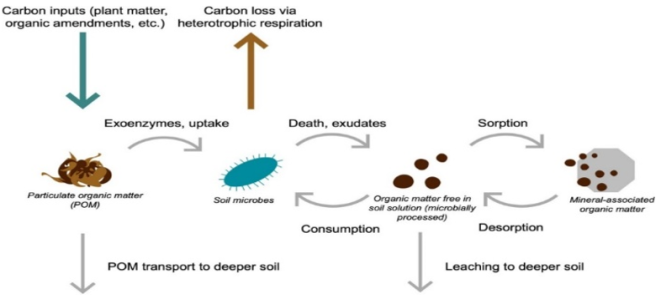
Figure 1. Conceptual illustration of soil carbon (C) flows. Carbon is mostly taken up by plants (green arrow) and expelled from the soil by heterotrophic respiration (brown arrow). Particulate organic matter (POM) comes from plant carbon inputs and can move deeper into the soil or be broken down by microbes into biomass. Mineral-associated organic matter (MAOM) forms when microbially processed carbon binds to minerals, which can then leach deeper or be reabsorbed by microbes, gradually transferring both POM and MAOM to deeper soil layers. Source [26].
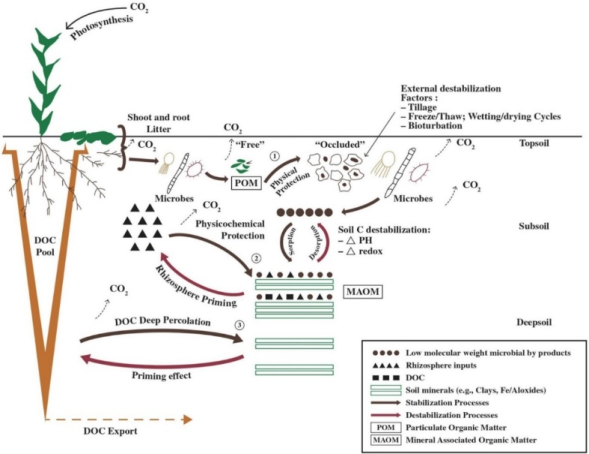
Figure 2. Summary of the main mechanisms of soil organic carbon stabilization Source: [39].

Information



 Share This Article
 Twitter
 Linked In
 Facebook
 Copy
Copy Download