Research Article | | Peer-Reviewed

Removal of Cadmium (II) Metal Ions from Aqueous Solutions Using Modified Kennan’s Sugarcane Bagasse Activated Carbon with Natural Zeolite

Received: 22 June 2025     Accepted: 2 February 2026     Published: 20 April 2026
Views:       Downloads:
Abstract

This study investigates a comparative assessment of two adsorbents, prepared activated carbon from Kennan's Sugarcane Bagasse, AC (KSCB)KOH and AC (KSCB)H3PO4 combined with natural zeolite samples for cadmium(II) ions removal. Maximum Cd(II)removal was observed at pH (6.0 – 8.0) when using KOH and H3PO4 respectively. The Langmuir and Freundlich isotherm models were applied to the adsorption data. The coefficients for determination of the two models were high with Langmuir model providing the best description for the experimental adsorption data. The fitting of the adsorption data into Freundlich model shows that the mode of adsorption of the metal ions by both adsorbents follows physisorption. Investigations into the maximum adsorption capacity showed that Cd(II) has an excellent adsorption on both adsorbents. Maximum adsorption capacities for Cd(II) metal ions corresponding to monolayer coverage, obtained from the Langmuir plots, were (714.29) mg/g and (270.27) mg/g onto the AC (KSCB)KOH and AC (KSCB)H3PO4 combined with natural zeolite respectively. The Langmuir adsorption coefficient, KL which is related to the affinity of the adsorbents were (150.00) and (34.33) for adsorption of Cd(II) ions onto AC (KSCB)KOH AC and (KSCB)H3PO4 combined with natural zeolite respectively, following the initial order. The carbonized AC (KSCB)KOH Combined with natural zeolite based - adsorbent was generally found to have an increased adsorption capacity for the metal ions than AC (KSCB)H3PO4 Combined with Natural Zeolite.

Published in Science Discovery Chemistry (Volume 1, Issue 1)
DOI 10.11648/j.sdc.20260101.16
Page(s) 52-62
Creative Commons

This is an Open Access article, distributed under the terms of the Creative Commons Attribution 4.0 International License (http://creativecommons.org/licenses/by/4.0/), which permits unrestricted use, distribution and reproduction in any medium or format, provided the original work is properly cited.

Copyright

Copyright © The Author(s), 2026. Published by Science Publishing Group

Keywords

Activated Carbon, Cadmium (II), Chemical Activation, Kennan's Sugarcane Baggase (KSB), Water Distribution System (WDS)

1. Introduction
The importance of Drinking water to human life should not impose a significant risk to humans . Although some heavy metals are essential for human health, an excess percentage of them may have negative effects . The natural process and anthropogenic activities are the main sources of released heavy metals into the environment. The surface waters; ground water and sea water are always polluted by heavy metals . Metals leaching from water distribution system (WDS) may contaminate drinking water. Seawater desalination processes may remove some heavy metals, but desalinated drinking water might contain various metals, this is possibly due to treatment and stabilization, blending with treated groundwater and leaching of metals from pipes of the WDS . Major concern heavy metals in drinking water and their negative effects on human health are Cd, Hg, As, Pb, Cr, Cu, and Ni, this is mainly due to their presence at relative high concentrations . Tanning and leather industries, catalyst and pigments, fungicides, ceramics, crafts, glass, photography, electroplating industry, corrosion control application, and manufacturing industries, are the main sources for Cadmium releasing . The most applicable methods for unfavorable metal ions removal from polluted water are adsorption, ion-exchange, precipitation , membrane separation , electro coagulation , nanoparticles , dialysis/ electrodialysis . The preferred well method among all of these is adsorption process this is because of its convenience, easy operation and simplicity of design . Further, adsorption has gained a lot of credibility because of its excellent performance, cost effectiveness and environmental eco- friendly nature, . Furthermore, this process can remove different types of pollutants and thus have wider applicability in water pollution control. Adsorption is a process that occurs when a gas or liquid solute accumulates on the surface of a solid or a liquid (adsorbent), forming a film of molecules or atoms; on the adsorbate .
The objective of this study was to prepare a micro porous activated carbon from Sugar Cane Bagasse, (SCB) by chemical activation using KOH and H3PO4, then combined with commercial natural zeolite in different ratios to obtain a new product for an efficient removal of Cadmium metal ions from aqueous solutions at optimum conditions and to determine different process parameters effect such as pH, adsorbent dose, initial metals ions concentrations and contact time on the removal efficiency of AC(KSCB) H3PO4 and AC(KSCB) KOH. This study also deals to investigate the porous characteristics of the products obtained and to determined the optimum sample for the metal ions recovery from its aqueous solutions.
2. Martial and Methods
Cd(II) aqueous solutions were prepared by dissolving respective amount of the metal nitric salts, Cd(NO3)2.4H2O (Fluka, Germany), in distilled water. The initial total metal ion concentration used in the adsorption equilibrium experiments was in the range between 10 mg/l and 150 mg/l.
Kennan's Sugarcane Bagasse, (KSCB) collected from Kennan's Sugar Company in White Nile State –Sudan, was used as a precursor for preparation of activated carbon and denoted as AC(KSCB). Prior to use, sample was washed smoothly numerous times with hot distilled water until the washing water was clean to get rid of most contaminations present on the surface and then dried at 105°C for one week. The natural zeolite (clinoptilolite) was supplied from (Fluka, Germany). According to the data from the supplier, it consists mainly of clinoptilolite (more than 80%), heulandite, and mordenite, with quartz, sanidine, and biotite present in trace quantities. Analytical grade chemical reagents, (Merck, Germany) or (Fluka, Germany), were used throughout this work without additional purification.
2.1. Preparation of Activated Carbon
After complete drying, the prepared activated carbon AC(KSCB) was crushed and grinded in a ball mill. Grinded sample was sieved to obtain homogeneous particles of uniform <90-125µm). Two 100g AC(KSCB) samples were impregnated with KOH and H3PO4 for 72 h each in a ratio of 1: 1.5 at 50°C to achieve well saturation of the chemical into their interior. After saturation, the samples were dried for 72 hrs. at 105°C. The solid residues were cooled to room temperature, then thoroughly washed with double distilled water followed by 0.10 M Hydrochloric Acid (HCl) or 0.10 M Sodium Hydroxide (NaOH) to remove or eliminate the chemical residual, until the rinsed water pH values were neutral. The adsorbents prepared were denoted as AC(KSCB) H3PO4 and AC(KSCB) KOH throughout the work, and shown in Figure 1.
2.2. Combination of Activated Carbon with Natural Zeolite
A series of natural zeolite (clinoptilolite) and activated carbon adsorbents were initially screened for the removal of cadmium ions from its aqueous media. Adsorbent screening was performed in ratio according to Table 1.
Table 1: Natural Zeolite and activated carbon adsorbents ratio for the removal of cadmium ions from aqueous media.
Table 1. Natural Zeolite and activated carbon adsorbents ratio for the removal of cadmium ions from aqueous media.

Sample no.

AC (KSCB) (H3PO4) + Natural Zeolite in (g)

AC (KSCB) (KOH) + Natural Zeolite in (g)

AC (KSCB) (H3PO4)

Zeolite

AC (KSCB) (KOH)

Zeolite

1

0.1

0.9

0.9

0.1

2

0.2

0.8

0.8

0.2

3

0.3

0.7

0.7

03

4

0.4

0.6

0.6

0.4

5

0.5

0.5

0.5

0.5

6

0.6

0.4

0.4

0.6

7

0.7

0.3

0.3

0.7

8

0.8

0.2

0.2

0.8

9

0.9

0.1

0.1

0.9

2.3. Evaluation of Activated Carbon
The samples of Kennan's Sugarcane Bagasse, (KSCB), Activated Carbon With KOH and H3PO4 modified with natural zeolite were evaluated five ways:
2.3.1. Energy Dispersive X-ray Spectroscopy (EDX)
Energy dispersive X-ray spectroscopy (EDX) analysis was carried out using (Perkin-Elmer 2400 Series) analyzer. The elemental compositions data of the two ACs, AC(KSCB) H3PO4 and AC(KSCB) KOH for (carbon, hydrogen, nitrogen, sulfur and oxygen (CHNS-O) and other constituents, (Mg, Si, P, K, Ca, Al, and Fe), were determined.
2.3.2. Fourier Transform Infrared Spectroscopy
Transform Infrared (FTIR) spectroscopy (Shimadzu, Japan) was used to estimate the surface functional groups for the prepared AC(KSCB) H3PO4 and AC(KSCB) KOH samples and recorded within 400 – 4000 cm-1 range. The KBr pellet was used to record he sample’s transmission spectra. Approximately 1.5 – 3.0% of each sample was mixed with dry grinded KBr. Then hydraulically pressed. The transparent in appearance and homogeneous pellets were dried at 100°C for 24 hrs., and then inserted, for the analysis, into the IR sample holder .
2.3.3. Scanning Electron Microscopy (SEM)
AC(KSCB) H3PO4 and AC(KSCB) KOH samples were performed using The (JSM-6380LA) scanning electron microscope. The instrument was operated, at 55°C inclination and 5kV/SE, using accelerating voltage machine. Prior to analysis, samples were coated in a sputter shell unit, using Edwards Vacuum Components Ltd., Sussex, England, so as to reduce charging and improve the secondary electron signals for imaging. The micrographs were recorded via photographic techniques.
2.3.4. Process Parameters Effect
Batch experiments for adsorption of Cd(II) metal ions on AC(KSCB)KOH and AC(KSCB)H3PO4 each modified with Natural Zeolite, at 25 ± 0.5°C., were conducted using Cd(II) metal ions aqueous solutions. A 1000 mg/L stock solution was prepared by dissolving appropriate weight of dissolving respective amount of its metallic nitric salt. To obtain different concentrations, the stock Cd (II) metal ions solution was diluted as required. For each run, a definite amount of AC(KSCB)KOH and AC(KSCB)H3PO4 each modified with natural zeolite was added to 25 ml Cd(II) solution taken in 100 ml Erlenmeyer flasks.
(i). pH Effect
An electronic pH - Meter (3510) was used to study the pH effect on metal adsorption, which was monitored over a pH range of 2 to 10. In this work, 25 ml separate solutions, 50 mg/L Cd(II) metal ion, was transferred into100 ml conical flasks, vigorously stirrer well for 60 mints. with 0.25g AC(KSCB)KOH or AC(KSCB)H3PO4 each modified with Natural Zeolite, at 25 ± 0.5°C. The filtered mixture was analyzed for residual metal ion concentration via Atomic Absorption Spectrophotometer (AAS). The equilibrium concentration (Ce) of Cd(II) and removal percentage were determined at the different pH.
(ii). Contact Time Effect
To investigate contact time effect on Cd(II) metal ions removal percentage from its aqueous solutions, experiments were carried out using 75 mg/L initial concentration and 0.25g AC(KSCB)KOH or AC(KSCB)H3PO4 each modified with Natural Zeolite dose at different contact times, 15-180 minutes. The filtered mixtures were well centrifuged. The filtrate of the metal ions residue was spectrophotometrically analyzed, using (AAS) . The equilibrium concentration (Ce) of Cd(II) and removal percentage were determined at different contact time.
(iii). Adsorbent Dosage Effect
Optimization of adsorbent dosage was carried out experimentally using different weights, 0.05 - 1.50g, of AC(KSCB)KOH and AC(KSCB)H3PO4 each modified with natural zeolite. 75 ml of desired concentration of metal ion in 250 ml conical flask at the optimum pH for Cd(II) metal ion solutions. Aliquots concentration was analyzed to determine the extent of Cd(II) metal ions adsorption at equilibrium .
(iv). Initial Concentration Effect
25 ml metal ions solutions with different initial concentrations between (10.0 – 150.0 mg/L) Cd(II) were contacted with optimized adsorbent dosage at the optimum pH. The mixtures were shaken well for the desired time at 25 ± 0.5°C. The mixtures were filtered, centrifuged and the concentrations of the metal ions adsorbed were determined .
2.3.5. Equilibrium Adsorption Studies
Cd(II) metal ions adsorption isotherms on AC(KSCB)KOH and AC(KSCB)H3PO4 each modified with natural zeolite, 25 ± 0.5°C., were investigated by varying initial concentration (10.0 –150.0 mg/L) Cd(II), at optimized pH, contact time, adsorbent dose, temperature, which were established after optimization of working parameters. To examine the equilibrium data obtained, Langmuir and Freundlich Isotherms models were used. The equilibrium metal ion adsorptive amounts (mg/g) in each batch modes were calculated using the following expressions :
qe= (V/w) (CO- Ce)(1)
% Removal = 100 (CO- Ce)/CO(2)
Where qe is the amount of Cd(II) removed per unit weight of AC(KSCB)KOH or AC(KSCB)H3PO4 sample, each modified with Natural Zeolite in (mg/g), Co and Ce are the initial and equilibrium concentrations of Cd(II) respectively in (mg/L), V is the treated volume of the solution in (L) and w is the mass dose of AC(KSCB)KOH or AC(KSCB)H3PO4 which modified with Natural Zeolite, in (g) .
3. Results and Discussion
3.1. Energy Dispersive X-ray Spectroscopy (EDX)
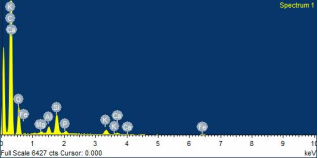
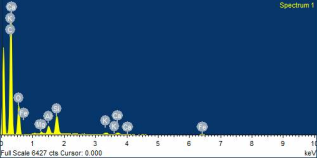
The elemental composition of the adsorbents samples, AC(KSCB)KOH and AC(KSCB)H3PO4, were determined. Energy dispersive X-ray spectroscopy (EDX) data of the two ACs were presented. The ACs samples contain C, Ca, O, Fe, Mg, Al, and Si. The presence of the elements P and K, which are in corporate by chemical activation with, is due to H3PO4 and KOH activators respectively. The high adsorption efficiency of AC(KSCB)KOH and AC(KSCB)H3PO4 for Cd(II) metal ions solutions can also be confirmed by observing the EDX profiles results shown in Figure 2.
Figure 1. Sample No. (7) the best optimum one, when using KOH activator (0.85g. KSCB + 0.15g. Natural Zeolite).
Figure 2. Sample No. (4) the best optimum one, when using H3PO4 activator (0.40g. KSCB + 0.60g. Natural Zeolite).
3.2. Fourier Transform Infrared Spectroscopy (FTIR) Analysis
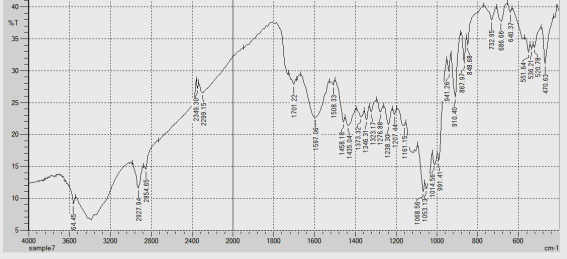
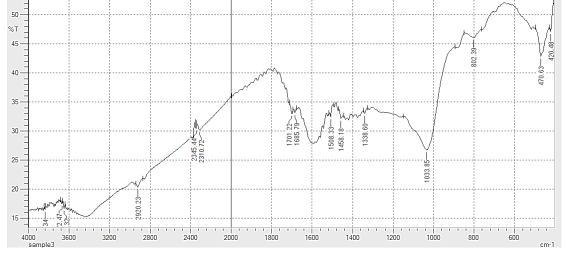
The FT-IR spectra of the two adsorbents, prepared activated carbon AC (KSCB)KOH and AC(KSCB)H3PO4 Combined with Natural Zeolite, were performed in order to explore their surface characteristics Figure 1. The spectra display a number of absorption peaks, indicating the possible functional groups present on these biosorbents, that may be responsible for the removal of Cd(II) metal ions from solution. The peak positions were observed at 3564.45, 1435.12, 1597.06, 1207.44, 1161.15 cm-1 for AC (KSCB)KOH and 3442.13, 1458.18, 1338.60, 1093.67, 1033.85, 802.39 and 1685.79 cm-1 for AC (KSCB)H3PO4. The bands at 3564.45 and 3442.13 cm-1 are due to N-H stretch (mainly primary and secondary amines) present on the adsorbents. The band observed at 1458.18, 1597.06 cm-1 are assigned to C=C bond (from alkenes), the bands at 1068.56 and 1161.15 cm-1 are assigned to C-O stretch (alcohols, ethers, acids, esters), 11701.62 and 1685.79 cm-1 corresponds to N-H bend of amines and amides, 1033.85 cm-1 is due to C–H bend of CH2=CH2- from vinyl groups. These peaks which correspond to different functional groups are possible sites for adsorption of Cd(II) metal ions by AC(KSCB)KOH or AC(KSCB)H3PO4 adsorbents. The peak intensities indicate that especially the OH groups, carboxylic acids or esters, the C-O stretch of either alcohols ethers, the N–H stretch of the primary or secondary amines, N– H bend of the amine or amides and the C=C stretch of the alkenes may play a major role in the adsorption of Cd(II) ions from the aqueous solutions. These functional groups contain either - electron which is electron - rich or lone pairs on nitrogen or oxygen, with which they can coordinate with the metal ions leading to their adsorption. Comparing Figures 1 & 2, one can conclude that, some of these peaks are either absent or new ones detected. This may be due to surface variation resulting from the combination of the AC (KSCB)H3PO4 with natural zeolite.
Figure 3. FTIR spectrum of AC (KSCB)KOH combined with Natural Zeolite.
Figure 4. FTIR spectrum of AC (KSCB)H3PO4 combined with Natural Zeolite.
3.3. Scanning Electron Microscopy (SEM)
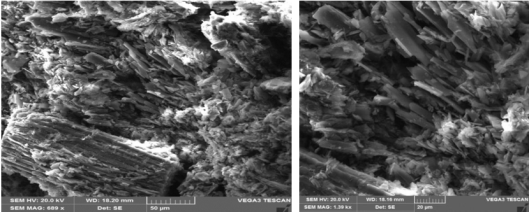
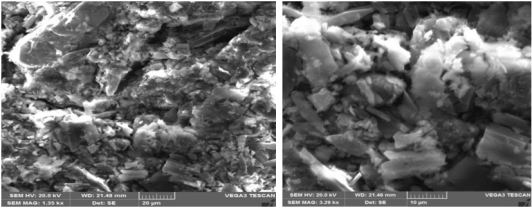
Scanning electron microscopy images of the modified activated carbons with natural zeolite when using KOH and H3PO4 as activators are shown in Figures 3 & 4. The SEM scans show that the optimum prepared samples of the modified activated carbons {Samples No. 7, the best optimum one when using KOH activator (0.85g KSCB + 0.15g Zeolite)} and {Sample No. 4, the best optimum one when using H3PO4 activator (0.40g KSCB + 0.60g Zeolite)} has a more developed porous structure than the other prepared ones when using other different fractions from KSCB/ KOH modified with zeolite and KSCB/ H3PO4 modified with zeolite. The scans further show that, the treatment enhanced the porous structure of the modified activated carbon leading to the development of channels, pores and great increase in the surface area. The enhancement in surface area, in the case of the treated modified samples, is likely due to the interaction of zeolite and ashes, and also due to the basic and acidic nature of the KOH and H3PO4 activators respectively. Nevertheless, the scans showed that, zeolite has deposited on the surface of the treated activated carbon samples. On the other hand, the increase in the surface area of the treated KSCB activated carbons is likely due to the opening of the structure of the biomass due to the acidic and basic digestion in the KOH and H3PO4 solution. The deposition of the zeolite is observed to be more thoroughly distributed through the ridges, channels and pores of the treated KSCB activated carbons.
Figure 5. Sample No. (7) the best optimum one when, using KOH activator (0.85g. KSCB + 0.15g. Natural Zeolite).
Figure 6. Sample No. 4 the best optimum one when using H3PO4 activator (0.40g. KSCB + 0.60g. Natural Zeolite).
3.4. Process Parameters Effect
3.4.1. pH Effect
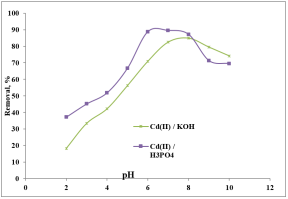
The adsorption of Cd(II) metal ion from its aqueous solutions on adsorbent is significantly influences by solution pH, which has been introduced as one of the effective factors in process parameters . Kennan’s sugarcane bagasse AC (KSCB)KOH/ H3PO4 prepared by chemical activators(KOH and H3PO4) Combined with Natural Zeolite were engaged for Cd(II) removal at different pH values (2–10). The preliminary experiments at definite experimental conditions (initial Cd(II) concentration 75.0 mg/L, adsorbent dose 0.25 g/100ml, contact time 60 min, and temperature 25 ± 0.50°C) were performed. The removal of the metal ions was affected by changes in pH as shown in Figure 6. It is proved from the figure that adsorption percentage was higher at pH(6 and 8). On the other hand, the highest average removals of Cd(II) observed at pH(6 and 8), was 88.49% and 83.72% when using H3PO4 and KOH activators respectively. Generally, metal ions are more soluble at lower pH values and this enhances their adsorption. Removal of metal ions at higher pH values could be attributed to their hydroxides formed, which results in precipitates, this is consistent with the observation. The results obtained are in close agreement with previously reported investigations .
Figure 7. Effect of pH on Cd(II) removal by AC (KSCB) Activated Carbon with KOH/ H3PO4 Combined with Zeolite (CO = 75mg/ L, Dose = 0.25 g /ml, Contact Time = 60 min., T = 25 ± 0.50°C).
3.4.2. Adsorbent Dose Effect
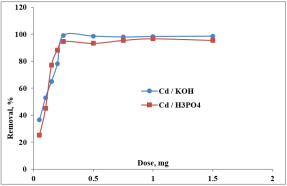
The adsorbent dose, of AC(KSCB)KOH or AC(KSCB)H3PO4 modified with natural zeolite, as effective factor on removal percentage of Cd(II) was studied. The results were illustrated in Figure 7. Different series of adsorbent doses, (50 –1500 mg) were considered and other process parameters were maintained constant, pH (6&8), using a concentration of 75 mg/L, contact time – 60 min, at 25°C ± 0.50). A significant increase in removal efficiency with increasing adsorbent dose up to a maximum of 0.25g/ml was found. The results showed that the corresponding optimal removal percentage were 99.10% and 94.60% when using KOH and H3PO4 activators respectively. In contract, the obtained results showed that any further addition over the above mentioned weight, (˃ 0.25 g), will not make any enhancement in the efficiency of adsorption, where exactly negligible increase of removal efficiency over the identifiable specific adsorbent amount. The initial increase in removal of Cd(II) ions from their aqueous solutions with increasing adsorbent mass suggesting that it can be explained by the increase in the number of exchangeable sites on AC(KSCB)KOH or AC(KSCB)H3PO4 modified with natural zeolite for Cd(II) metal ion removal, after which equilibrations was attained .
Figure 8. Effect ofadsorbent dose on Cd(II) removal by AC (KSCB) Activated Carbon with KOH/ H3PO4 Combined with Zeolite (CO=75mg/L, pH = {6 & 8}, Contact Time = 60 min., T = 25 ± 0.50°C).
3.4.3. Contact Time Effect
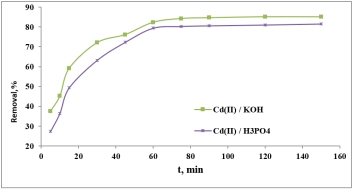
The effect of contact time on the removal of Cd(II) using AC (KSCB) KOH and H3PO4 combined with zeoliteis were shown in Figure 8. The adsorption capacity of metal ions increased by a nearly even dynamic trend with increasing time, reached equilibrium after approximately 60 mints; the adsorption capacity sequence was consistent with the result obtained in initial concentration tests. A constant adsorption is indicative of equilibration due to saturation of adsorption sites. Rapid removal of Cd(II) ions during the initial stages was due to the large initial concentration gradient between its concentration in solution and the number of available unoccupied sites on surface of AC(KSCB)KOH or AC(KSCB)H3PO4 modified with natural zeolite. The removal of Cd(II) was 79.41% at (pH=6), and 82.36% at (pH=8) each at 60 mints. as contact time, when using KOH and H3PO4 activators respectively.
Figure 9. Effect of Contact Time on Cd(II) removal by AC (KSCB) Activated Carbon with KOH/ H3PO4 Combined with Zeolite,(CO = 75 mg/L, pH={6 & 8}, Dose = 0.25g/ml, T = 25 ± 0.50°C).
3.4.4. Initial Concentration Effect
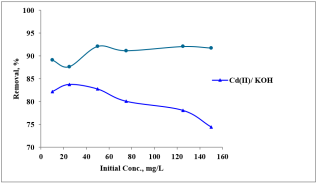
The initial concentration of Cd(II) is an essential effective parameter since it changes over abroad extent in effluents applications. Different initial concentrations were used to carry out batch adsorption experiments. The variation of removal percentage for these different initial concentrations, using AC(KSCB) activated carbon with KOH or H3PO4 each combined with natural zeolite were shown in Figure 9. The figure shows an excellent performance for Cd(II) metal ions initial concentrations, at equilibrium state and the most favorable initial concentration, (75.0 mg/L) under the experimental conditions. It is also clearly as well as observed, that the removal percentage of Cd(II) when using KOH and H3PO4 as activators were sufficiently high, (80.08%, 91.17%) respectively and no significant additional increase as the concentration increases.
Figure 10. Effect of Initial concentration on Cd(II) removal by AC (KSCB) Activated Carbon with KOH/ H3PO4 Combined with Zeolite, pH = {6 & 8}Dose = 0.25g/ml, Contact Time = 60 min., T = 25± 0.50°C).
3.5. Adsorption Isotherm
The adsorption capacity of any adsorbent is conceder an effective specific function of concentration. The shape of an isotherm provides information about the adsorption affinity of molecules and stability of the interactions between adsorbent and adsorbate . The equilibrium adsorption isotherms were described by plotting solute concentration in the solid phase (qe) against liquid phase concentration (Ce). Langmuir and Freundlich adsorption isotherms were applied to the experimental data to investigate the adsorption behavior of Cd(II) metal ions on prepared AC (KSCB) Activated Carbon with KOH and H3PO4 each modified with Natural Zeolite, at different conditions of process parameters.
3.5.1. Langmuir Isotherm
The Langmuir isotherm is applicable to homogeneous sorption where the sorption of each sorbet molecule on to the surface has equal sorption activation energy and is represented as follows .
Ce/qe=1/qmKL+ Ce/qm(3)
Where qm (mg/g) is the maximum adsorption capacity of the adsorbent, KL (L/mg) is the affinity parameter or Langmuir isotherm constants related to adsorption capacity (mg g−1), which can be correlated with the variation of the suitable area and porosity of the adsorbent which implies that large surface area and pore volume will result in higher adsorption capacity.
Dividing equation (3) by Ce one can obtain:
1/qe= 1 /qm+ 1/ qmKLCe(4)
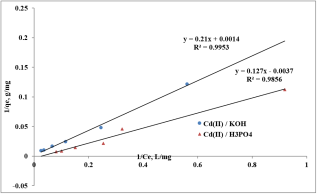
The analyzed adsorption data, according to Langmuir isotherm linear form (equation 4), was described by plotting of 1/qe versus 1/Ce. The obtained linear plots shows that, the adsorption obeys to the Langmuir isotherm model, Figure 10. The constant values were calculated from the slope (1/qmKL) and intercept (1/qm) and reported in Table 2. According to R2 values, (0.9953 and 0.9856) for Cd(II) removal when using KOH and H3PO4 activators respectively, the Langmuir equation well fitted the experimental adsorption data for Cd(II) removal using AC(KSCB) Activated Carbon with KOH/ H3PO4 combined with Natural Zeolite, thereby representing a monolayer adsorption in each case.
Figure 11. Langmuir isotherms of AC (KSCB) Activated Carbon with KOH/ H3PO4 Combined with Zeolite for Cd(II) removal 25 ± 0.50°C.
To investigate in details the Langmuir isotherm, a dimensionless parameter, Namely, separation factor RL, , defined by equation (4):
RL= 1/ (1+KLCO)(5)
Where CO is the initial metal ion concentration. The RL values for the prepared adsorbent, AC (KSCB) with KOH and H3PO4 combined with Natural Zeolite, were between 0.005 and 0.012 which were in the range of: 0 < RL< 1; hence the prepared adsorbent sample show satisfactory adsorption of Cd(II) metal ions under the specified conditions . In addition, RL was closed to zero at high CO values, thereby suggesting that the prepared adsorbent sample undergo irreversible metal ion adsorption process at high initial metal ion concentration.
The maximum adsorption capacity of the prepared adsorbent samples were compared with those of various conventional adsorbent are tabulated in Table 1. Although the adsorption conditions differed among them, the prepared adsorbent sample had a level of adsorption capacity similar to that of conventional adsorbents, thereby suggesting that the prepared adsorbent samples can be used for the removal of Cd(II) metal ions. The reasonably high regression coefficients which confirm a well fitting to the Langmuir equation are summarized in Table 2.
Table 2. Comparison of heavy metal removal capacities(mg/g) by different adsorbents. Comparison of heavy metal removal capacities(mg/g) by different adsorbents. Comparison of heavy metal removal capacities(mg/g) by different adsorbents.

Adsorbent

Cd(II)

Sources

Unmodified rice husk and modified rice husk

8.82

26]

11.03

African white star apple shell

10.59

27]

Sphagnum moss peat

-

28]

Maple sawdust

-

29]

Activated carbon Sigma C-3014

1.51

30]

AC (KSCB)KOH combined with natural zeolite

714.29

This Study

AC (KSCB)H3PO4 combined with natural zeolite

270.27

3.5.2. Freundlich Isotherm
Freundlich empirical model can be applied to non-ideal sorption on heterogeneous surfaces as well as multilayer sorption and is expresses by the following equation .
qe=KFCe1/n(6)
Where n and KF are investigative constants of the intensity of the sorption and the relative sorption capacity of the sorbent. Equation (4) can be linearized in the form of Equation (5) and the constants can be determined :
lnqe= ln KF+ 1/n lnCe(7)
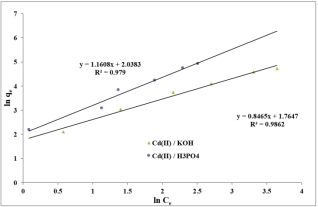
Where qe is the extent of Cd(II) adsorbed per unit mass of AC(KSCB)KOH or AC(KSCB)H3PO4 modified with natural zeolite in (mg/g) and Ce is the equilibrium concentration of Cd(II) in (mg/L). Figure 11 show the fit of data to Freundlich isotherm indicates the surface heterogeneity of AC(KSCB)KOH and AC(KSCB)H3PO4 each modified with natural zeolite. 1/n is the heterogeneity factor and it is a feature measure of the deviation from linearity of Cd(II) adsorption. The n value indicates the degree of non-linearity between solution concentration and adsorption as follows: if the value of n = 1, the adsorption is linear; n < 1, the adsorption process is chemical; if n > 1, the adsorption is a favorable physical process. The correlation coefficients, R = 0.9931 and 0.9894, obtained from the Freundlich model when using KOH and H3PO4 as activators respectively, were comparable to that obtained from Langmuir model. This result indicates that the experimental data fit to the Freundlich model, and n >1 when KOH activator was used. The values of Freundlich constants with the correlation coefficients are presented in Table 2.
Figure 12. Freundlich isotherms of AC (KSCB) Activated Carbon with KOH/ H3PO4 Combined with Zeolite for Cd(II) removal at 25 ± 0.50°C.
As a result from these isotherms one can show that, the equilibrium adsorption amount of AC(KSCB) Activated Carbon with KOH and H3PO4 combined with Natural Zeolite for Cd(II) removal with different initial concentrations, and according to the fitting curves and correlation coefficients(R2), Langmuir model was more suitable to describe the adsorption of Cd(II) onto the prepared adsorbent sample, indicating that the surface of AC(KSCB) Activated Carbon with KOH and H3PO4 combined with Natural Zeolite were homogeneous and the adsorption was monolayer, where it adsorption capacity (qm) for Cd(II) was 714.29 mg/g when using KOH activator, while it was 270.27 mg/g when using H3PO4, the obtained results are tabulated in Table 2.
4. Conclusion
The findings in this study revealed that Modified Kennan's Sugarcane Baggase Activated Carbon With Natural Zeolite can be effectively be employed as an eco-friendly adsorbent for the removal of Cd(II) ions form aqueous solutions. It will also provide an ideal technology to utilize and convert this adsorbent into valuable product which can be commercialized for the removal of contaminants from aqueous phase. The data from the batch adsorption studies provided essential information in terms of optimum pH, contact time, adsorbent dose and Cadmium(II) initial concentration.
Conflicts of Interest
The authors declare no conflicts of interest.
References
[1] WHO (World Health Organization) (2011) Guidelines for drinking-water quality. Fourth edn. World Health Organi-zation, Geneva.
[2] USEPA (US Environmental Protection Agency) (2015) Reg-ulated drinking water contaminants. Online database.
[3] Bryan GW, Langston WJ (1992) Bioavailability, accumula-tion and effects of heavy metals in sediments with special reference to United Kingdom estuaries: a review. Environ Pollut 76: 89-131.
[4] Alabdula’aly AI, Khan MA (2009) Heavy metals in cooler waters in Riyadh, Saudi Arabia. Environ Monit Assess 157: 23-28.
[5] ATSDR (Agency for Toxic Substances and Disease Registry) (2015) Toxicological Profiles, Toxic Substances Portal.
[6] Das, N., Vimala, R. and Kartika, P. (2007). Biosorption of Heavy metals: An overview. Indian Journal of Biotechnology 7, 159-169.
[7] P. C. Grevatt, Toxicological Review of Hexavalent Chromium. Support of Summary Information on the Integrated Risk Information System (IRIS), US Environmental Protection Agency, Washington DC, US 1998.
[8] M. H. Dehghani, M. Mohammadtaher, A. K. Bajpai, B. Heibati, I. Tyagi, M. Asif, S. Agarwal, V. K. Gupta, Removal of Noxious Cr (VI) Ions Using Single-walled Carbon Nanotubes and Multi-walled Carb Nanotubes, 279 (2015) (2015) 344-352.
[9] Z Asku, Application of biosorption for the removal of organic pollutants: a review, Process Biochemistry, 40, 2009, 997-10268.
[10] C. A. Kozlowski, W. Walkowiak, Removal of chromium (VI) from aqueous solutions by polymer inclusion membranes, Water Res. 36 (19) (2002) 4870-4876.
[11] F. Akbal, S. Camcı, Copper, chromium and nickel removal from metal plating wastewater by electro coagulation, Desalination 269 (1) (2011) 214-222.
[12] A. Assadi, M. H. Dehghani, N. Rastkari, S. Nasseri, A. H. Mahvi, Photo catalytic reduction of hexavalent chromium in aqueous solution with zinc oxide nanoparticles and hydrogen peroxide, Environ. Prot. Eng. 38 (4) (2012) 5-16.
[13] T. Mohammadi, et al., Modeling of metal ion removal from wastewater by electrodialysis, Sep. Purif. Technol. 41 (1) (2005) 73-82.
[14] Gupta, S. and Babua, B. V. (2006) Adsorption of Cr (VI) by a Low-Cost Adsorbent Prepared from Neem Leaves. Proceeding of National Conference on Environmental Conservation, Pilani, 175-180.
[15] Amboga, D. A., Onyari, J. M., Shiundu, P. M. and Gichuki, J. W. (2014) Equilibrium and Kinetics Studies for the Biosorption of Aqueous Cd (II) ions onto Eichhornia Crassipes Biomass. Journal of Applied Chemistry 7, (1); 29-3.
[16] Thakur, L. S. and Parmar, M. (2013) Adsorption of Heavy Metal (Cu2+, Ni2+ and Zn2+) from Synthetic Waste Water by Tea Waste Adsorbent. International Journal of Chemical and Physical Sciences 2 (6); 2319 - 6602. Tokimoto.
[17] ANIA, M. C. Purification of Industrial Effluents with Activated Carbon, Adsorption of Pollutants and Adsorbent RegenerationAustrias. 2003.
[18] V. K. Garg), MoirangthemAmita, Rakesh Kumar, Renuka Gupta (2004) Basic dye (methylene blue) removal from simulated wastewater by adsorption using Indian Rosewood sawdust: a timber industry waste, Dyes and Pigments 63 (2004) 243-250.
[19] Y. Onal, C. Akmil-Basar, DidemEren, CigdemSarıcı-O zdemir, TolgaDepci (2006). Adsorption kinetics of malachite green onto activated carbon prepared from Tunc¸bilek lignite, Journal of Hazardous Materials B128 (2006) 150-157.
[20] Ahmad pour, A., Do, D. The preparation of activated carbon from macadamia nut shell by chemical activation. Carbon, 35, 1997, 1723-1732.
[21] Youssef, A., Radwan, N., Abdel-Gawad, I., Singer, G. Texturalproperties of activated carbons from apricot stones. Colloids and Surfaces A, 252, 2005, 143-51.
[22] AI-Duri, B. Introduction to adsorption. In: Use of adsorbents for theremoval of Pollutants from Wastewaters. Boca Raton, McKay, G. (Ed.)., FL: CRC Press, 1996, 1-6.
[23] Xiao B, Sun XF, Sun RC, The chemical modification of lignins with succinic anhydride in aqueous systems, Polymer Degradation and Stability, 2001: 71; 223-231.
[24] Ho YS, McKay GA, Two-stage batch sorption optimized design for dye removal to minimize contact time, Transactions of I Chem. E Part B, 1998: 76; 332-340.
[25] Orlando US, Baes AU, Nishijima W, Okada M, A new procedure to produce lingo cellulosic anion exchangers from agricultural waste materials, Bioresource Technology, 2002: 83; 195-198.
[26] Acharya, J., Sahu, J. N., Sahoo, B. K., Mohanty, C. R., Meikap, B. C. Removal of chromium (VI) from wastewater by activated carbon developed from Tamarind wood activated with zinc chloride. Chemical Engineering Journal, 150 (1), 2009, 9.
[27] Arami-Niya, A., Daud, W. M. A. W., Mjalli, F. S. Comparative study of the textural characteristics of oil palm shell activated carbon produced by chemical and physical activation for methane adsorption. Chemical Engineering Research and Design, 89 (6), 2011, 657-664.
[28] Ariyadejwanich, P., Tanthapanichakoon, W., Nakagawa, K., Mukai, S. R., Tamon, H. Preparation and characterization of microporous activated carbon from waste tires. Carbon, 41, 2003, 157-164.
[29] Arriagada, R., Garcia, R., Molina-Sabio, M., Rodriguez-Reinoso, F. Effect of steam activation on the porosity and chemical nature of activated carbons from Eucalyptus globules and peach stones. Microporous Materials, 8 (3), 1997, 123-130.
[30] Aworn, A., Thiravetyan, P., Nakbanpote, W. Preparation and characteristics of agricultural waste activated carbon by physical activation having micro and mesopores. Journal of Analytical and Applied Pyrolysis, 82 (2), 2008, 279-285.
Cite This Article
  • APA Style

    Elhussien, M., Sulieman, S., Hassan, M., Hamid, G., Nimir, S. (2026). Removal of Cadmium (II) Metal Ions from Aqueous Solutions Using Modified Kennan’s Sugarcane Bagasse Activated Carbon with Natural Zeolite. Science Discovery Chemistry, 1(1), 52-62. https://doi.org/10.11648/j.sdc.20260101.16

    Copy | Download

    ACS Style

    Elhussien, M.; Sulieman, S.; Hassan, M.; Hamid, G.; Nimir, S. Removal of Cadmium (II) Metal Ions from Aqueous Solutions Using Modified Kennan’s Sugarcane Bagasse Activated Carbon with Natural Zeolite. Sci. Discov. Chem. 2026, 1(1), 52-62. doi: 10.11648/j.sdc.20260101.16

    Copy | Download

    AMA Style

    Elhussien M, Sulieman S, Hassan M, Hamid G, Nimir S. Removal of Cadmium (II) Metal Ions from Aqueous Solutions Using Modified Kennan’s Sugarcane Bagasse Activated Carbon with Natural Zeolite. Sci Discov Chem. 2026;1(1):52-62. doi: 10.11648/j.sdc.20260101.16

    Copy | Download

  • @article{10.11648/j.sdc.20260101.16,
      author = {Mutasim Elhussien and Safa Sulieman and Mawia Hassan and Gaafer Hamid and Sumia Nimir},
      title = {Removal of Cadmium (II) Metal Ions from Aqueous Solutions Using Modified Kennan’s Sugarcane Bagasse Activated Carbon with Natural Zeolite},
      journal = {Science Discovery Chemistry},
      volume = {1},
      number = {1},
      pages = {52-62},
      doi = {10.11648/j.sdc.20260101.16},
      url = {https://doi.org/10.11648/j.sdc.20260101.16},
      eprint = {https://article.sciencepublishinggroup.com/pdf/10.11648.j.sdc.20260101.16},
      abstract = {This study investigates a comparative assessment of two adsorbents, prepared activated carbon from Kennan's Sugarcane Bagasse, AC (KSCB)KOH and AC (KSCB)H3PO4 combined with natural zeolite samples for cadmium(II) ions removal. Maximum Cd(II)removal was observed at pH (6.0 – 8.0) when using KOH and H3PO4 respectively. The Langmuir and Freundlich isotherm models were applied to the adsorption data. The coefficients for determination of the two models were high with Langmuir model providing the best description for the experimental adsorption data. The fitting of the adsorption data into Freundlich model shows that the mode of adsorption of the metal ions by both adsorbents follows physisorption. Investigations into the maximum adsorption capacity showed that Cd(II) has an excellent adsorption on both adsorbents. Maximum adsorption capacities for Cd(II) metal ions corresponding to monolayer coverage, obtained from the Langmuir plots, were (714.29) mg/g and (270.27) mg/g onto the AC (KSCB)KOH and AC (KSCB)H3PO4 combined with natural zeolite respectively. The Langmuir adsorption coefficient, KL which is related to the affinity of the adsorbents were (150.00) and (34.33) for adsorption of Cd(II) ions onto AC (KSCB)KOH AC and (KSCB)H3PO4 combined with natural zeolite respectively, following the initial order. The carbonized AC (KSCB)KOH Combined with natural zeolite based - adsorbent was generally found to have an increased adsorption capacity for the metal ions than AC (KSCB)H3PO4 Combined with Natural Zeolite.},
     year = {2026}
    }
    

    Copy | Download

  • TY  - JOUR
    T1  - Removal of Cadmium (II) Metal Ions from Aqueous Solutions Using Modified Kennan’s Sugarcane Bagasse Activated Carbon with Natural Zeolite
    AU  - Mutasim Elhussien
    AU  - Safa Sulieman
    AU  - Mawia Hassan
    AU  - Gaafer Hamid
    AU  - Sumia Nimir
    Y1  - 2026/04/20
    PY  - 2026
    N1  - https://doi.org/10.11648/j.sdc.20260101.16
    DO  - 10.11648/j.sdc.20260101.16
    T2  - Science Discovery Chemistry
    JF  - Science Discovery Chemistry
    JO  - Science Discovery Chemistry
    SP  - 52
    EP  - 62
    PB  - Science Publishing Group
    UR  - https://doi.org/10.11648/j.sdc.20260101.16
    AB  - This study investigates a comparative assessment of two adsorbents, prepared activated carbon from Kennan's Sugarcane Bagasse, AC (KSCB)KOH and AC (KSCB)H3PO4 combined with natural zeolite samples for cadmium(II) ions removal. Maximum Cd(II)removal was observed at pH (6.0 – 8.0) when using KOH and H3PO4 respectively. The Langmuir and Freundlich isotherm models were applied to the adsorption data. The coefficients for determination of the two models were high with Langmuir model providing the best description for the experimental adsorption data. The fitting of the adsorption data into Freundlich model shows that the mode of adsorption of the metal ions by both adsorbents follows physisorption. Investigations into the maximum adsorption capacity showed that Cd(II) has an excellent adsorption on both adsorbents. Maximum adsorption capacities for Cd(II) metal ions corresponding to monolayer coverage, obtained from the Langmuir plots, were (714.29) mg/g and (270.27) mg/g onto the AC (KSCB)KOH and AC (KSCB)H3PO4 combined with natural zeolite respectively. The Langmuir adsorption coefficient, KL which is related to the affinity of the adsorbents were (150.00) and (34.33) for adsorption of Cd(II) ions onto AC (KSCB)KOH AC and (KSCB)H3PO4 combined with natural zeolite respectively, following the initial order. The carbonized AC (KSCB)KOH Combined with natural zeolite based - adsorbent was generally found to have an increased adsorption capacity for the metal ions than AC (KSCB)H3PO4 Combined with Natural Zeolite.
    VL  - 1
    IS  - 1
    ER  - 

    Copy | Download

Author Information
  • Department of Chemistry, Nile Valley University, Atbra, Sudan

  • Department of Chemistry, Nile Valley University, Atbra, Sudan

  • Department of Chemistry, University of Merowe, Merow, Sudan
  • Department of Chemistry, Nile Valley University, Atbra, Sudan

  • Department of Chemistry, Nile Valley University, Atbra, Sudan

  • Abstract
  • Keywords
  • Document Sections

    1. 1. Introduction
    2. 2. Martial and Methods
    3. 3. Results and Discussion
    4. 4. Conclusion
    Show Full Outline
  • Conflicts of Interest
  • References
  • Cite This Article
  • Author Information