Research Article | | Peer-Reviewed

Quantitative Phytochemical Analysis and Bioactivities of Hydroethanolic Extracts of Amorphophallus consimilis

Received: 8 December 2025     Accepted: 20 December 2025     Published: 31 December 2025
Views:       Downloads:
Abstract

This study is devoted to the determination of polyphenol, flavonoid and mineral contents and then to the evaluation of antioxidant and antibacterial activities of Amorphophallus consimilis extracts. The spectrophotometric method is used for the determination of polyphenol and flavonoid contents with standard solutions of gallic acid and quercetin respectively. The polyphenol content varies from 2.33 (stems) to 4.68 (tubers) µg EAG/g and that of flavonoids from 2.425 (tubers) to 9.373 (stems) µg EQ/g. The antioxidant activity is evaluated by the DPPH and ABTS+ method. The 50% Inhibitory Concentration (IC50) values obtained with both methods range from 0.17±0.011 (leaves) to 0.254±0.001 (tubers) mg/mL. Atomic absorption spectrophotometry (AAS) is used for the determination of mineral contents. Amorphophallus consimilis contains minerals with average contents of calcium (43 µg/g), iron (11 µg/g), zinc (0.28 µg/g) and copper (0.14 µg/g). The disk diffusion method is used for the evaluation of antibacterial activity. A total of five bacterial strains are used, these are: Escherichia coli ATCC25922, Enterococcus faecalis ATCC29213, Staphylococcus aureus ATCC29212, Pseudomonas (community strain), Candida albican ATCC24433 were used. The minimum inhibitory concentrations (MIC) range from 1.875 to 30 mg/mL, showing overall interesting bacterial activity of the extracts on the strains tested.

Published in Science Journal of Chemistry (Volume 13, Issue 6)
DOI 10.11648/j.sjc.20251306.14
Page(s) 194-201
Creative Commons

This is an Open Access article, distributed under the terms of the Creative Commons Attribution 4.0 International License (http://creativecommons.org/licenses/by/4.0/), which permits unrestricted use, distribution and reproduction in any medium or format, provided the original work is properly cited.

Copyright

Copyright © The Author(s), 2025. Published by Science Publishing Group

Keywords

Amorphophallus Consimilis, Polyphenols, Flavonoids, Minerals, Antioxidants, Antibacterial

1. Introduction
Humans have always lived in an environment full of plant potential. This proximity between humans and nature has led to a multitude of uses of flora by humans according to their needs. The diversity of flora and ancestral knowledge allow humans to feed themselves and cope with various possible ailments. The constant development of chemoresistance of modern drugs against pathogens has allowed the development of pharmacopoeia based on the knowledge of traditional medicine. Amorphophallus is a genus that is part of the Araceae family. Plants of this genus are distributed throughout the world and have been used in traditional medicine for a long time, particularly in Ayurvedic and Yunani medical rituals. They are also used in traditional Chinese medicine . They have pharmacological properties, such as analgesic , neuroprotective, hepatoprotective, anti-inflammatory , anticonvulsant, antibacterial, antioxidant, anticancer, antiobesity and immunomodulatory . They are used for acute rheumatism, tumors, lung swelling, asthma, sinusitis, dysentery, jaundice, lack of appetite, vomiting and abdominal pain . Amorphophallus consimilis is a wild, semi-shade plant. It often grows under large trees. The objective of this work is to determine some biological properties such as antioxidant and antibacterial activities and to evaluate the polyphenol, flavonoid and mineral content of the different parts of the plant.
2. Materials and Methods
2.1. Plant Materials
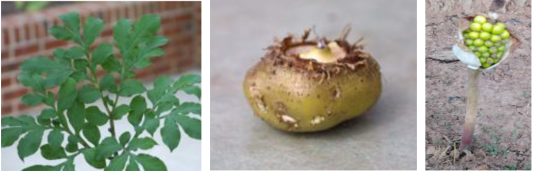
The choice of Amorphophallus consimilis is justified by an ethnobotanical survey coupled with a bibliographic study of plants listed among some traditional practitioners in Senegal. The harvest of the different organs (tubers, fruits, leaves and stems) of this plant was carried out in the commune of Dioulacolon, located in the south of Senegal, with the geographical coordinates 13°05' North and 14°49' West. The different parts of the plant were cut into small pieces then dried in the shade at 27°C and then crushed using an electric grinder.
Figure 1. Photograph of the parts of Amorphophallus consimilis studied. Photograph of the parts of Amorphophallus consimilis studied.
2.2. Polyphenol and Flavonoid Dosages
The content of total phenolic compounds is determined with the Folin-Ciocalteu reagent . Indeed, 40 µL of each extract are taken and made up to 200 µL with distilled water. A volume of 150 µL of Folin-Ciocalteu reagent, 600 µL of a 20% Na2CO3 solution and 2.32 mL of distilled water are added in addition. After 30 minutes of incubation in the dark, the absorbance is read at 760 nm from a Perkin-Elmer Lamda 365 UV/Visible spectrometer. The measurement is compared to a standard curve of gallic acid prepared from a 0.1 mg/mL stock solution. The concentrations are expressed in microgram gallic acid equivalent per gram (µg EAG/g).
Flavonoid content is measured by the method described by Dirar et al. . This method consists of adding 2.5 mL of a 2% AlCl3 ethanolic solution to 500 µL of each extract. The mixtures are incubated for 1 hour at room temperature and the absorbance is read at 425 nm. The flavonoid content is expressed in micrograms of quercetin equivalent per gram (µg EQ/g) by reference to the calibration curve plotted with a concentration range obtained from a 0.1 mg/mL quercetin stock solution.
From the equations of the calibration lines of the established standards of the form Y=ax+b, the concentration (x) of polyphenols or flavonoids is deduced for a given absorbance at a given wavelength and the content is calculated according to the following formula:
Total content (µg/g) =x*501*Fd
x: concentration found from absorbance and calibration line
Fd: dilution factor
50: volume
2.3. Dosage of Some Metals
A mass of 1g of each dried and ground sample (fruits, stems, tubers, seeds) is weighed and subjected to acid mineralization. This consists of a contact time of one hour between the sample and 10 mL of a mixture of 37% HCl (2 volumes) and 68% HNO3 (1 volume). Mineralization is carried out for 50 minutes in a microwave oven (25 to 170°C (10 min), 170°C (10 min), 170°C to 100°C (10 min), 100°C (10 min), 100°C to 80°C (5 min), 80°C (5 min). Thus, mineralization is carried out in triplets for each sample . The mineralized samples are then collected in a volumetric flask and the volume precisely adjusted to 50 mL with demineralized water and stored in the refrigerator at +4°C. A filtration step using a syringe equipped with a microfilter (0.45 µm diameter) is carried out before analysis with the ICP-OES spectrophotometer. The following elements are specifically targeted using the ICP-OES: Calcium (422.673 nm), Copper (327.395 nm), Iron (238.204 nm), Zinc (213.817 nm). The calibration was carried out using nine points (2 decades) of dilution of a stock solution containing the whole elements at different concentrations. The stock solution was obtained by diluting a certified individual element from a multi-element solution to 100 and 10,000 ppm.
Mineral contents are calculated using the formula below.
Mineral content (mg/100g) =C*50*100PE*1000xFD
C: Concentration of the element to be measured in mg/L read at the SAA
PE: Test sample in g.
FD: Dilution factor
2.4. Determination of Antioxidant Activity by the DPPH and ABTS+.Method
1) The antioxidant test was carried out according to the DPPH. method . A stock solution of 40 mg/mL is prepared by dissolving 80 mg of dry extract in 2 mL of methanol. Then a range of concentrations was prepared with a dilution factor of 1/2. For each of these different concentrations, 0.2 mL is taken and introduced into test tubes and mixed with 7.8 mL of the previously prepared purple ethanolic solution of DPPH•. The tubes are shaken manually for a few seconds and then incubated for 30 min away from light. The absorbance reading is carried out by a spectrophotometer at a wavelength of 517 nm, using ethanol as a blank. Ascorbic acid is used as a reference antioxidant. The DPPH solution. is obtained by dissolving 10 mg of DPPH• in 250 mL of ethanol with stirring for 30 minutes away from light.
2) The method used was that described by Sarr et al. . A quantity of 38.40 mg of ABTS+. [2,2'-azino-bis (3-ethylbenzothiazoline-6-sulphonic acid)] was previously dissolved in 10 mL of water before adding 6.75 mg of potassium persulfate. The mixture obtained was incubated away from light and at room temperature for 12 h before use. It was subsequently diluted with ethanol to obtain an absorbance of the order of 0.7 for a wavelength of 734 nm. The antioxidant activity was measured by adding 2 ml of an ethanolic solution of the tested extract to 2 ml of the ABTS+ solution. The extracts were tested at the following concentrations: 2.5; 10; 100 and 200 µg/mL. Ascorbic acid and quercetin, used as reference antioxidants, were tested at the same concentrations. Absorbance was measured using a UV-Visible molecular absorption spectrophotometer at 734 nm after 2 minutes of incubation in the dark, using ethanol as a blank. Three absorbance measurements were performed for each concentration tested (n=3).
The inhibitory powers are determined using the formula below:
Scanvenging activity %=Ac-AsAc*100
Ac: Control absorbance, As= Sample absorbance
2.5. Antibacterial Activities
2.5.1. Sample Sterility Test
This test is intended to check whether the extracts contain germs or not. To this end, 0.1 g of the extract must be added to 10 mL of thioglycolate broth, and the broth incubated at 37°C for 24 hours. After this time, inoculate the broth onto a Petri dish containing nutrient agar and another containing Sabouraud agar, and incubate the Petri dishes at 37°C . The substance is declared sterile if no colony is visible on the agar dish after 24, 48, and 72 hours of incubation at 37°C .
2.5.2. Bacterial Susceptibility Testing
The disc diffusion method was used to test the susceptibility of bacterial strains to different extracts . Bacteria were inoculated onto Muller-Hinton (MH) agar and Sabouraud agar for Candida albican. From a bacterial culture of 18 to 24 hours, inocula equivalent to the 0.5 Mac-Ferland standard (106 bacteria per mL) were prepared. A drop of the culture dilution (inoculum) prepared with a few micrograms of bacteria in a biological fluid (sodium chloride) was placed on each Petri dish and spread by tight streaks with a sterile swab, over the entire MH agar and the Sabouraud agar for Candida albican. Sabouraud cups of 0.7 cm diameter were then placed on the upper layer of the agar medium, seeded with bacteria. The cups were impregnated with 100 µL of solution at a concentration of 30 mg/mL and the dishes were incubated in the incubator at 37°C for 24 hours. Throughout the incubation period (24 hours at 37°C), the strain studied competes with the inhibitory effect of the plant extract. A circular inhibition zone forms around the cup when the strain is sensitive to the extracts and an absence of inhibition zones if the strain is resistant . The extract is not effective if the diameter is less than 4.8 mm; effective if the diameter is between 4.8 and 9.6 mm and very effective if the diameter is greater than 9.6 mm.
2.5.3. Determination of Minimum Inhibitory Concentrations (MIC)
The MIC is the lowest concentration of antibiotic capable of causing complete inhibition of the growth of a given bacterium, appreciable by the naked eye, after a given incubation period. The MIC determination is carried out for extracts that have shown zones of inhibition against the microorganism by the disk diffusion method. Rectangular plates containing 96 wells are used, concentration ranges are prepared from a stock solution of concentration 30 mg/mL and a solution of biological fluid (sodium chloride). On each well, 20 µL of bacterial culture suspension is added. For each bacterial strain, a solution of dimethyl sulfoxide (DMSO) is used as a positive control, and as a negative control ceftriaxone (C-tri 10) is used. Each microplate is covered and incubated for 24 hours at 37°C. A clear color of the well indicates no growth and a cloudiness of the well indicates growth of bacteria. Each experiment is repeated three times.
3. Results and Discussions
3.1. Total Polyphenols and Flavonoids in Amorphophallus consimilis
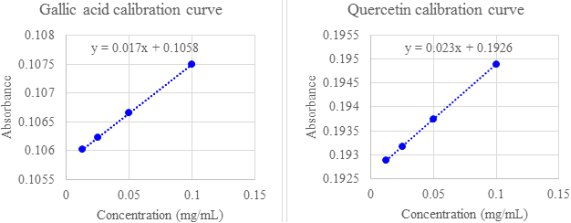
The contents of polyphenols and flavonoids were determined by the spectrometric method. Standard solutions of gallic acid for polyphenols and quercetin for flavonoids at concentrations ranging from 0.1 to 0.0125 mg/mL were prepared and their absorbances were measured. The curves representing the absorbances as a function of concentrations are shown in Figure 2. From the equation of the regression line and the absorbance of the extract, the evaluation of the concentration and content of polyphenols and flavonoids was carried out.
Figure 2. Calibration curves of gallic acid and quercitrin. Calibration curves of gallic acid and quercitrin.
The total polyphenol and flavonoid contents of the determined samples are reported in Table 1. The polyphenol contents of the samples vary between 2 and 5 µg EAG/g. The lowest polyphenol content is obtained with the stem extract (2.33±0.011 µg EAG/g). The tuber, fruit and leaf extracts give practically identical values respectively (4.68; 4.565; 4.625 µg EAG/g). The extracts of tubers, fruits and leaves are richer in polyphenols. The flavonoid content of the stem extract is higher (9.373±0.112 µg EQ/g) than that of tubers, fruits and leaves. It can also be noted that the flavonoid content in fruits is twice that in tubers.
Table 1. Polyphenol and flavonoid composition of extracts from parts of Amorphophallus consimilis. Polyphenol and flavonoid composition of extracts from parts of Amorphophallus consimilis. Polyphenol and flavonoid composition of extracts from parts of Amorphophallus consimilis.

Dosed compounds

Tubers

Stems

Fruits

Leaves

Polyphenol (µg EAG/g)

4,68±0,002

2,33±0,011

4,565±0,102

4,625±0,011

Flavonoid (µg EQ/g)

2,425±0,001

9,373±0,112

4,96±0,013

3,75±0,020

3.2. Distribution of Minerals in Different Parts of Amorphophallus Consimilis
The results obtained are recorded in Table 2 below. Minerals such as calcium, iron, zinc and copper are unevenly distributed in the different parts of Amorphophallus consimilis. The leaf extract contains the highest levels of calcium (54.67±0.001 µg/g) and zinc (0.44±0.001 µg/g). However, it has the lowest levels of iron (9.95±0.001 µg/g) and copper (0.08±0.0001 µg/g). The distribution of calcium and iron between the tubers, fruits and stems is almost identical with average values of 39 and 11 µg/g respectively. The zinc content of the leaves is double, or 0.44 µg/g, the zinc content of the other parts of the plant alone. Zinc is an essential trace mineral that acts as an antioxidant by neutralizing free radicals while iron is a pro-oxidant.
Table 2. Mineral content expressed in micrograms per gram of sample. Mineral content expressed in micrograms per gram of sample. Mineral content expressed in micrograms per gram of sample.

Samples

Element content (µg/g)

Ca

Fe

Zn

Cu

Leaves

54,67±0,001

9,95±0,001

0,44±0,001

0,08±0,0001

Tubers

39,39±0,012

12,35±0,011

0,26±0,041

0,21±0,012

Fruits

39,71±0,001

11,76±0,001

0,24±0,002

0,15±0,0001

Stems

38,63±0,013

10,98±0,002

0,18±0,001

0,11±0,0002

The copper content of the tuber extract is three times that of the leaves and double that of the fruits and stems. Therefore, the tubers are richer in copper (0.21 ± 0.012 µg/g). The mineral composition is established as follows: there is more calcium followed by iron, zinc and lastly comes copper. This trend is observed in all parts of the plant. The iron content of the different parts of the plant is higher than that of oat flakes (5.9 µg/g), cooked green beans (9.4 µg/g) and almost similar to that of tuna (12.1 µg/g) . The zinc contents are relatively low compared to that of cooked fish (5.5 µg/g) and cooked lentils (10.3 µg/g).
3.3. DPPH and ABTS Antioxidant Activities of Hydroethanolic Extracts of Amorphophallus consimilis
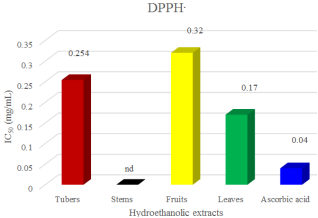
The absorbances measured as a function of the concentrations of the extracts made it possible to calculate the corresponding inhibitory percentages. The results obtained are represented in the diagrams in order to plot the regression lines and determine the minimum inhibitory concentrations at 50% of our different extracts. Ascorbic acid was used as a standard. If the correlation coefficient (R2) of the regression line is less than 0.9; the extract is discarded and considered inactive because it cannot inhibit 50% of the DPPH. radical or ABTS+., in other words, the highest value of the inhibitory power is less than 50%.
Figure 3. Diagram of 50% inhibitory concentrations (IC50) of extracts from different parts of the plant. Diagram of 50% inhibitory concentrations (IC50) of extracts from different parts of the plant.
The minimum inhibitory concentration of an extract provides information on its effectiveness; the lower it is, the more active the extract is considered. The antioxidant or anti-radical property of a sample is its capacity or ability to reduce a radical such as DPPH once in contact with it. The inhibitory concentrations obtained with DPPH for the different extracts vary between 0.17 and 0.32 mg/mL. The hydro-ethanolic extract of the stems does not present remarkable antioxidant activity. Among the extracts tested, the leaf extract has the lowest IC50 (0.17±0.011 mg/mL) followed by the tuber and fruit extract respectively (0.254±0.001 and 0.32±0.001 mg/mL).
Table 3. Inhibitory concentration at 50% (DPPH and ABTS+ method). Inhibitory concentration at 50% (DPPH and ABTS+ method). Inhibitory concentration at 50% (DPPH and ABTS+ method).

Inhibitory concentration at 50% (mg/mL)

Method

Hydro-ethanolic extract

Standard

Tubers

Stems

Fruits

Leaves

Ascorbic accid

DPPH.

0,254± 0,001

nd

0,32±0,001

0,17±0,011

0,04

ABTS+.

0,243±0,002

nd

0,274±0,013

0,194±0,012

0,042

nd: not determined
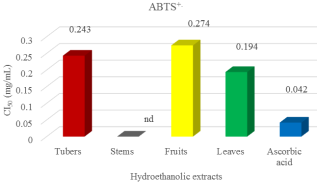
The values of the minimum inhibitory concentrations obtained for each sample are in the same order of magnitude. This fact gives reliability to our values.
Figure 4. Inhibitory concentration at 50% (IC50) diagram. Inhibitory concentration at 50% (IC50) diagram.
The lower IC50 of the leaf extract may be due to its higher zinc content, which plays an antioxidant role and therefore enhances the extract's anti-free radical capacity.
3.4. Antibacterial Activities
3.4.1. Extract Sterility
Since the environment is full of microbial strains, our extracts can be contaminated during handling processes. Sterility tests for our various extracts are carried out in petri dishes. This involves checking whether the extracts are infested with bacteria or not during processing.
Table 4. Results of sterility tests of extracts. Results of sterility tests of extracts. Results of sterility tests of extracts.

Hydro-ethanolic Extract

Amorphophallus Consimilus

Tubers

Stems

Fruits

Leaves

Results

-

-

-

-

-: absence of bacterial colony development
+: presence of bacterial colony development
These results show that no infection was noted after 24 hours of incubation of the dishes containing the culture of the extracts at 27°C.
3.4.2. Bacterial Sensitivity
Sensitivity is the effect of the extract on the growth of the corresponding bacteria. If the extract prevents or inhibits the growth of the bacteria, the bacteria is said to be sensitive to the extract; otherwise, the bacteria is not sensitive to the corresponding extract. The concentration of the extract used in this sensitivity test is 30 mg/mL.
Table 5. Diameters of sensitivity of bacteria to hydro-ethanolic extracts in millimeters (mm). Diameters of sensitivity of bacteria to hydro-ethanolic extracts in millimeters (mm). Diameters of sensitivity of bacteria to hydro-ethanolic extracts in millimeters (mm).

Bacteria

Hydro-ethanolic Extracts

Tubers

Stems

Fruits

Leaves

Escherichia Coli ATCC25922

16

na

11

13

Enterococcus faecalis ATCC 29213

12

na

9

10

Staphylococcus aureus ATCC 29212

11

na

8

11

Pseudomonas (communitystrain)

9

na

8

8

Candida Albican ATCC24433

11

na

na

na

na: not active
Only extracts with an inhibition diameter greater than 5 mm for an initial concentration of 30 mg/mL exhibit activity against the tested strain. The results show that the inhibition diameters vary between 8 and 16 mm. It is noted that all bacteria are sensitive to the hydro-ethanolic extract of the tubers with inhibition diameters varying between 9 and 16 mm. However, no sensitivity of the different strains to the stem extract is noted. The Candida albican ATCC24433 strain is only sensitive to the tuber extract with a diameter of 11 mm.
3.4.3. Minimum Inhibitory Concentration (MIC)
The MIC is the lowest concentration of antibiotic capable of causing complete inhibition of the growth of a given bacterium, appreciable by the naked eye, after a given incubation period. The MIC is determined in well microplates with extracts that have shown zones of inhibition against the strains tested by the disk diffusion method.
Table 6. Minimum inhibitory concentration MIC (mg/mL). Minimum inhibitory concentration MIC (mg/mL). Minimum inhibitory concentration MIC (mg/mL).

Bacteria

MIC (mg/mL)

Tubers

Fruits

Leaves

Escherichia Coli ATCC25922

1,875

15

3,75

Enterococcus faecalis ATCC 29213

3,75

30

7,5

Staphylococcus aureus ATCC 29212

7,5

30

15

Pseudomonas (communitystrain)

15

30

30

Candida Albican ATCC24433

7,5

nd

nd

nd: not determined
The minimum inhibitory concentrations of the extracts vary between 1.875 and 30 mg/mL. The MICs obtained with the E.Coli strain are lower, showing the efficacy of the extracts against the latter. Overall, the MICs obtained with the hydro-ethanolic extract of the fruits are higher than those obtained with the other organs of the plant. These results reflect the low antibacterial activity of the hydro-ethanolic extract of the leaves on the strains tested. The highest MICs are obtained with the community strain (pseudomonas) on the one hand and with the fruit extract on the other hand. This result is in correlation with the IC50 found previously and which are higher with the fruit extract. It should be noted that the higher the IC50, the less active the extract.
4. Conclusion
Amorphophallus consimilis exhibits very interesting antioxidant and antibacterial activities with relatively low inhibitory concentrations. It is relatively rich in minerals, particularly calcium and iron. Furthermore, there is an almost equal distribution of polyphenols, unlike flavonoids, within the plant. The highest MICs are obtained with the fruit extract. The results show that Amorphophallus consimilis could be a potential source of natural antioxidants that could be beneficial in the prevention of degenerative diseases linked to oxidative stress. It can also contribute to the nutritional management of populations with dietary imbalances. To our knowledge, this study is the first conducted on Amorphophallus consimilis.
Abbreviations

MIC

Minimum Inhibitory Concentration

IC50

Inhibitory Concentration at 50%

DPPH

2,2-Diphenyl-1-Picrylhydrazyl Radical

Conflicts of Interest
The authors declare no conflicts of interest.
References
[1] M. Chua, T. C. Baldwin, T. J. Hocking, et K. Chan, «Traditional uses and potential health benefits of Amorphophallus konjac K. Koch ex NE Br.», J. Ethnopharmacol., vol. 128, no 2, p. 268‑278, 2010,
[2] J. A. Shilpi, P. K. Ray, M. M. Sarder, et S. J. Uddin, «Analgesic activity of Amorphophallus campanulatus tuber», Fitoterapia, vol. 76, no 3‑4, p. 367‑369, 2005,
[3] S. K. Reddy, S. A. Kumar, V. D. Kumar, and S. Ganapaty, «Anti-inflammatory and analgesic activities of Amorphophallus bulbifer (Roxb) Kunth whole plant», Trop. J. Pharm. Res., vol. 11, no 6, p. 971‑976, 2012,
[4] F. Islam et al., «Genus Amorphophallus: A Comprehensive Overview on Phytochemistry, Ethnomedicinal Uses, and Pharmacological Activities», Plants, vol. 12, no 23, p. 3945, 2023,
[5] S. Raj et K. M. Gothandam, «Immunomodulatory activity of methanolic extract of Amorphophallus commutatus var. wayanadensis under normal and cyclophosphamide induced immunosuppressive conditions in mice models», Food Chem. Toxicol., vol. 81, p. 151‑159, 2015,
[6] Y. N. Dey, S. Ota, N. Srikanth, M. Jamal, et M. Wanjari, «A phytopharmacological review on an important medicinal plant-Amorphophallus paeoniifolius», AYU Int. Q. J. Res. Ayurveda, vol. 33, no 1, p. 27‑32, 2012,
[7] J. Swain, A. Jaiswal, et S. Kumar, «Medicinal values of Amorphophallus species», Indigenous Traditional Knowledge and Advancement in Medicinal Plants Research, 2022,
[8] Abdou Khadre Diouf et al., «Phytochemical screening: Determination of total polyphenol and flavonoid contents, antioxidant and antimicrobial activity of leaves and seeds of Abelmoschus esculentus L.», World J. Adv. Res. Rev., vol. 19, no 1, p. 394‑402, 2023,
[9] Mame Coumba Diop et al., «Optimization of extraction conditions by the dosage of polyphenols and determination of antioxidant activity: Case of Melothria maderaspatana organs, a plant used in traditional African medicine for the treatment of diabetes», Int. J. Frontline Res. Multidiscip. Stud., vol. 2, no 1, p. 001‑009, 2023,
[10] H. Tirera et al., «Study of the antioxydant activity and determination of the content of mineral elements in the leaves and flowers of Ziziphus mauritiana lam», Int. J. Pharm. Phys.-Chem. Nutr. Anal., vol. 1, no 1, p. 29‑33, 2021,
[11] I. Diallo et al., «Phytochemical screening; determination of total polyphenol and flavonoid contents, and antioxidant activity of different parts of Datura metel L.», IOSR Journal Of Pharmacy And Biological Sciences (IOSR-JPBS), p. 24‑31, 2022,
[12] I. Diallo, B. Mbow, E. O. FAYE, A. SENE, et M. FOFANA, «Phytochemical study, determination of the antioxidant and antimicrobial activities of the bark and root extracts of Bridelia micrantha, a plant widely used in traditional African medicine», IOSR Journal of Applied Chemistry (IOSR-JAC), p. 08‑14, 2022,
[13] S. O. Sarr et al., « Study of the antioxydant of extracts from the leaves of Vitex doniana (Verbenacea) », Int. J. Biol. Chem. Sci., vol. 9, no 3, p. 1263‑1269, 2015,
[14] Y. Vaghasiya, «Screening of some medicinal plants for antimicrobial properties-phytochemical and pharmacological studies of a selected medicinal plant», PhD Thesis, Saurashtra University, 2009. Accessed on: 12 may 2025.
[15] O. D. Badji et al., «Phytochemical screening and determination of antimicrobial activity of different extracts from the roots and leaves of Stylocheaton Hypogaeus, a plant used for the treatment of prostatitis in Senegal», Int. J. Biosci. IJB, 2025,
[16] A. D. Kone, B. Mbow, A. A. Gaye, S. F. Ndoye, et M. Gaye, «Ficus sycomorus L. extracts: Phytochemical screening, total polyphenols and flavonoids contents, antioxidant and antibacterial activity», Sci. J. Chem., vol. 10, no 4, p. 126‑132, 2022,
[17] What Is Iron: Role, Benefits, and Food Sources, Alvityl. Accessed on: 21 june 2025.
Cite This Article
  • APA Style

    Ibrahima, D., Harouna, T., Abdoulaye, D., Bedie, M., Biram, S. P., et al. (2025). Quantitative Phytochemical Analysis and Bioactivities of Hydroethanolic Extracts of Amorphophallus consimilis. Science Journal of Chemistry, 13(6), 194-201. https://doi.org/10.11648/j.sjc.20251306.14

    Copy | Download

    ACS Style

    Ibrahima, D.; Harouna, T.; Abdoulaye, D.; Bedie, M.; Biram, S. P., et al. Quantitative Phytochemical Analysis and Bioactivities of Hydroethanolic Extracts of Amorphophallus consimilis. Sci. J. Chem. 2025, 13(6), 194-201. doi: 10.11648/j.sjc.20251306.14

    Copy | Download

    AMA Style

    Ibrahima D, Harouna T, Abdoulaye D, Bedie M, Biram SP, et al. Quantitative Phytochemical Analysis and Bioactivities of Hydroethanolic Extracts of Amorphophallus consimilis. Sci J Chem. 2025;13(6):194-201. doi: 10.11648/j.sjc.20251306.14

    Copy | Download

  • @article{10.11648/j.sjc.20251306.14,
      author = {Diallo Ibrahima and Tirera Harouna and Diop Abdoulaye and Mbow Bedie and Sy Papa Biram and Diop Seydina and Faye Elhadji Ousmane and Fofana Mouhamadou and Sarr Serigne Omar and Sene Aboubacary},
      title = {Quantitative Phytochemical Analysis and Bioactivities of Hydroethanolic Extracts of Amorphophallus consimilis},
      journal = {Science Journal of Chemistry},
      volume = {13},
      number = {6},
      pages = {194-201},
      doi = {10.11648/j.sjc.20251306.14},
      url = {https://doi.org/10.11648/j.sjc.20251306.14},
      eprint = {https://article.sciencepublishinggroup.com/pdf/10.11648.j.sjc.20251306.14},
      abstract = {This study is devoted to the determination of polyphenol, flavonoid and mineral contents and then to the evaluation of antioxidant and antibacterial activities of Amorphophallus consimilis extracts. The spectrophotometric method is used for the determination of polyphenol and flavonoid contents with standard solutions of gallic acid and quercetin respectively. The polyphenol content varies from 2.33 (stems) to 4.68 (tubers) µg EAG/g and that of flavonoids from 2.425 (tubers) to 9.373 (stems) µg EQ/g. The antioxidant activity is evaluated by the DPPH• and ABTS+ method. The 50% Inhibitory Concentration (IC50) values obtained with both methods range from 0.17±0.011 (leaves) to 0.254±0.001 (tubers) mg/mL. Atomic absorption spectrophotometry (AAS) is used for the determination of mineral contents. Amorphophallus consimilis contains minerals with average contents of calcium (43 µg/g), iron (11 µg/g), zinc (0.28 µg/g) and copper (0.14 µg/g). The disk diffusion method is used for the evaluation of antibacterial activity. A total of five bacterial strains are used, these are: Escherichia coli ATCC25922, Enterococcus faecalis ATCC29213, Staphylococcus aureus ATCC29212, Pseudomonas (community strain), Candida albican ATCC24433 were used. The minimum inhibitory concentrations (MIC) range from 1.875 to 30 mg/mL, showing overall interesting bacterial activity of the extracts on the strains tested.},
     year = {2025}
    }
    

    Copy | Download

  • TY  - JOUR
    T1  - Quantitative Phytochemical Analysis and Bioactivities of Hydroethanolic Extracts of Amorphophallus consimilis
    AU  - Diallo Ibrahima
    AU  - Tirera Harouna
    AU  - Diop Abdoulaye
    AU  - Mbow Bedie
    AU  - Sy Papa Biram
    AU  - Diop Seydina
    AU  - Faye Elhadji Ousmane
    AU  - Fofana Mouhamadou
    AU  - Sarr Serigne Omar
    AU  - Sene Aboubacary
    Y1  - 2025/12/31
    PY  - 2025
    N1  - https://doi.org/10.11648/j.sjc.20251306.14
    DO  - 10.11648/j.sjc.20251306.14
    T2  - Science Journal of Chemistry
    JF  - Science Journal of Chemistry
    JO  - Science Journal of Chemistry
    SP  - 194
    EP  - 201
    PB  - Science Publishing Group
    SN  - 2330-099X
    UR  - https://doi.org/10.11648/j.sjc.20251306.14
    AB  - This study is devoted to the determination of polyphenol, flavonoid and mineral contents and then to the evaluation of antioxidant and antibacterial activities of Amorphophallus consimilis extracts. The spectrophotometric method is used for the determination of polyphenol and flavonoid contents with standard solutions of gallic acid and quercetin respectively. The polyphenol content varies from 2.33 (stems) to 4.68 (tubers) µg EAG/g and that of flavonoids from 2.425 (tubers) to 9.373 (stems) µg EQ/g. The antioxidant activity is evaluated by the DPPH• and ABTS+ method. The 50% Inhibitory Concentration (IC50) values obtained with both methods range from 0.17±0.011 (leaves) to 0.254±0.001 (tubers) mg/mL. Atomic absorption spectrophotometry (AAS) is used for the determination of mineral contents. Amorphophallus consimilis contains minerals with average contents of calcium (43 µg/g), iron (11 µg/g), zinc (0.28 µg/g) and copper (0.14 µg/g). The disk diffusion method is used for the evaluation of antibacterial activity. A total of five bacterial strains are used, these are: Escherichia coli ATCC25922, Enterococcus faecalis ATCC29213, Staphylococcus aureus ATCC29212, Pseudomonas (community strain), Candida albican ATCC24433 were used. The minimum inhibitory concentrations (MIC) range from 1.875 to 30 mg/mL, showing overall interesting bacterial activity of the extracts on the strains tested.
    VL  - 13
    IS  - 6
    ER  - 

    Copy | Download

Author Information
  • Departement of Chemistry, Cheikh Anta Diop University of Dakar (UCAD), Dakar, Senegal

  • Faculty of Medicine, Pharmacy and Dentistry, Cheikh Anta Diop University (UCAD), Dakar, Senegal

  • MicoCSBsystm Biotechnology Research and Expertise Unit, Dakar, Senegal

  • Departement of Chemistry, Cheikh Anta Diop University of Dakar (UCAD), Dakar, Senegal

  • Departement of Chemistry, Cheikh Anta Diop University of Dakar (UCAD), Dakar, Senegal

  • Fundamental Institute of Black Africa (IFAN), Cheikh Anta Diop University of Dakar (UCAD), Dakar, Senegal

  • Faculty of Medicine, Pharmacy and Dentistry, Cheikh Anta Diop University (UCAD), Dakar, Senegal

  • Departement of Chemistry, Cheikh Anta Diop University of Dakar (UCAD), Dakar, Senegal

  • Faculty of Medicine, Pharmacy and Dentistry, Cheikh Anta Diop University (UCAD), Dakar, Senegal

  • Departement of Chemistry, Cheikh Anta Diop University of Dakar (UCAD), Dakar, Senegal

  • Abstract
  • Keywords
  • Document Sections

    1. 1. Introduction
    2. 2. Materials and Methods
    3. 3. Results and Discussions
    4. 4. Conclusion
    Show Full Outline
  • Abbreviations
  • Conflicts of Interest
  • References
  • Cite This Article
  • Author Information
  • Table 1

    Table 1. Polyphenol and flavonoid composition of extracts from parts of Amorphophallus consimilis. Polyphenol and flavonoid composition of extracts from parts of Amorphophallus consimilis.

  • Table 2

    Table 2. Mineral content expressed in micrograms per gram of sample. Mineral content expressed in micrograms per gram of sample.

  • Table 3

    Table 3. Inhibitory concentration at 50% (DPPH and ABTS+ method). Inhibitory concentration at 50% (DPPH and ABTS+ method).

  • Table 4

    Table 4. Results of sterility tests of extracts. Results of sterility tests of extracts.

  • Table 5

    Table 5. Diameters of sensitivity of bacteria to hydro-ethanolic extracts in millimeters (mm). Diameters of sensitivity of bacteria to hydro-ethanolic extracts in millimeters (mm).

  • Table 6

    Table 6. Minimum inhibitory concentration MIC (mg/mL). Minimum inhibitory concentration MIC (mg/mL).