
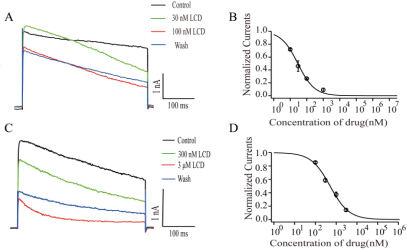
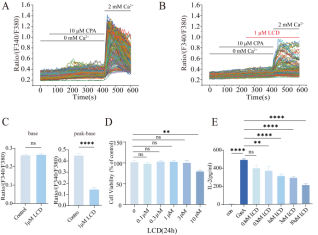
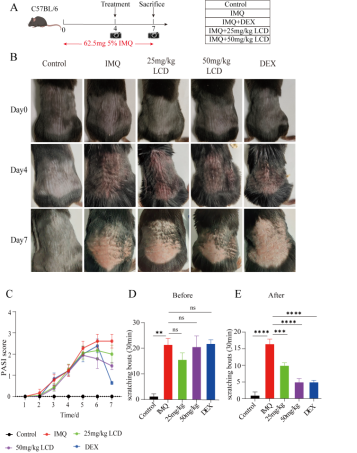
Objective: To investigate the blocking effect of licochalcone D on the voltage-gated potassium channel Kv1.3 and its potential therapeutic efficacy in psoriasiform skin inflammation, thereby providing experimental evidence for its use as an immunomodulatory candidate drug. Methods: The inhibitory effects of licochalcone D on exogenous and endogenous Kv1.3 currents were recorded by whole-cell patch-clamp. Ca2+ influx in Jurkat T cells was monitored with Fura-2 AM imaging. A ConA-induced T-cell activation model was established to quantify IL-2 secretion. An imiquimod-induced psoriasis-like mouse model was then established for in-vivo pharmacodynamic evaluation of licochalcone D. Results: Licochalcone D concentration-dependently inhibited Kv1.3 currents, with IC50 values of 28.77 ± 3.40 nM in HEK293T cells and 497.72 ± 87.30 nM in Jurkat T cells. Ca2+ imaging revealed that it suppressed Ca2+ influx in T cells. Animal studies demonstrated that licochalcone D markedly improved psoriasiform lesions (erythema, scaling, thickening), reduced PASI scores and itching, alleviated epidermal hyperplasia and inflammatory infiltration, and down-regulated IL-6, IL-17, and IL-23 expression. Conclusion: Licochalcone D exerts immunomodulatory effects by blocking Kv1.3 channels, thereby alleviating psoriasiform skin inflammatory responses. This provides an experimental foundation and theoretical support for its potential as a targeted immunotherapy drug.
| Published in | Science Discovery (Volume 13, Issue 6) |
| DOI | 10.11648/j.sd.20251306.17 |
| Page(s) | 143-148 |
| Creative Commons |
This is an Open Access article, distributed under the terms of the Creative Commons Attribution 4.0 International License (http://creativecommons.org/licenses/by/4.0/), which permits unrestricted use, distribution and reproduction in any medium or format, provided the original work is properly cited. |
| Copyright |
Copyright © The Author(s), 2025. Published by Science Publishing Group |
Licochalcone D, Kv1.3 Channel, Psoriasis, T Cells, Immunomodulation
| [1] | Lowes MA, Suárez-Fariñas M, Krueger JG. Immunology of psoriasis. Annu Rev Immunol. 2014;32:227-55. |
| [2] | Campanati A, Marani A, Martina E, et al. Psoriasis as an Immune-Mediated and Inflammatory Systemic Disease: From Pathophysiology to Novel Therapeutic Approaches. Biomedicines. 2021 Oct 21; 9(11): 1511. |
| [3] | Di Cesare A, Di Meglio P, Nestle FO. The IL-23/Th17 axis in the immunopathogenesis of psoriasis. J Invest Dermatol. 2009 Jun;129(6):1339-50. |
| [4] | Zhang B, Roesner LM, Traidl S, et al. Single-cell profiles reveal distinctive immune response in atopic dermatitis in contrast to psoriasis. Allergy. 2023 Feb;78(2):439-453. |
| [5] | Sharma A, Upadhyay DK, Gupta GD, et al. IL-23/Th17 Axis: A Potential Therapeutic Target of Psoriasis. Curr Drug Res Rev. 2022; 14(1): 24-36. |
| [6] | Tarcha EJ, Olsen CM, Probst P, et al. Safety and pharmacodynamics of dalazatide, a Kv1.3 channel inhibitor, in the treatment of plaque psoriasis: A randomized phase 1b trial. PLoS One. 2017 Jul 19; 12(7): e0180762. |
| [7] | Yang R, Yuan BC, Ma YS, et al. The anti-inflammatory activity of licorice, a widely used Chinese herb. Pharm Biol. 2017 Dec; 55(1): 5-18. |
| [8] | Sun J, Zhang Q, Yang G, et al. The licorice flavonoid isoliquiritigenin attenuates Mycobacterium tuberculosis-induced inflammation through Notch1/NF-κB and MAPK signaling pathways. J Ethnopharmacol. 2022 Aug 10; 294: 115368. |
| [9] | Jiang M, Zhao S, Yang S, et al. An "essential herbal medicine"-licorice: A review of phytochemicals and its effects in combination preparations. J Ethnopharmacol. 2020 Mar 1; 249: 112439. |
| [10] | Phan HTL, Kim HJ, Jo S, et al. Anti-Inflammatory Effect of Licochalcone A via Regulation of ORAI1 and K+ Channels in T-Lymphocytes. Int J Mol Sci. 2021 Oct 7;22(19):10847. doi: |
| [11] | Zhao Q, Zhang X, Long S, et al. Licochalcone Mediates the Pain Relief by Targeting the Voltage-Gated Sodium Channel. Mol Pharmacol. 2023 Oct; 104(4): 133-143. |
| [12] | Immler R, Nadolni W, Bertsch A, et al. The voltage-gated potassium channel KV1.3 regulates neutrophil recruitment during inflammation. Cardiovasc Res. 2022 Mar 25; 118(5): 1289-1302. |
| [13] | Capera J, Jainarayanan A, Navarro-Pérez M, et al. Dynamics and spatial organization of Kv1.3 at the immunological synapse of human CD4+ T cells. Biophys J. 2024 Aug 6; 123(15): 2271-2281. |
| [14] | Chen Y, Liu H, Yan Y, et al. Methotrexate and electrostimulation cooperate to alleviate the relapse of psoriasiform skin inflammation by suppressing memory T cells. Biochem Pharmacol. 2024 Jan;219:115979. |
| [15] | Serrano-Albarrás A, Cirera-Rocosa S, Sastre D, et al. Fighting rheumatoid arthritis: Kv1.3 as a therapeutic target. Biochem Pharmacol. 2019 Jul; 165: 214-220. |
| [16] | Gubič Š, Hendrickx LA, Toplak Ž, et al. Discovery of KV 1.3 ion channel inhibitors: Medicinal chemistry approaches and challenges. Med Res Rev. 2021 Jul; 41(4): 2423-2473. |
| [17] | Ross SH, Cantrell DA. Signaling and Function of Interleukin-2 in T Lymphocytes. Annu Rev Immunol. 2018 Apr 26; 36: 411-433. |
| [18] | Ye C, Brand D, Zheng SG. Targeting IL-2: an unexpected effect in treating immunological diseases. Signal Transduct Target Ther. 2018 Jan 19; 3: 2. |
| [19] | Guo J, Zhang H, Lin W, et al. Correction: Signaling pathways and targeted therapies for psoriasis. Signal Transduct Target Ther. 2024 Jan 22; 9(1): 25. |
| [20] | Liu T, Li S, Ying S, et al. The IL-23/IL-17 Pathway in Inflammatory Skin Diseases: From Bench to Bedside. Front Immunol. 2020 Nov 17; 11: 594735. |
| [21] | Rizzato G, Scalabrin E, Radaelli M, et al. A new exploration of licorice metabolome. Food Chem. 2017 Apr 15; 221: 959-968. |
APA Style
Long, H., Xiang, Q., Lan, Z., Bai, L., Yin, S. (2025). Licochalcone D Alleviates Psoriasiform Skin Inflammation by Inhibiting Kv1.3 Channels. Science Discovery, 13(6), 143-148. https://doi.org/10.11648/j.sd.20251306.17
ACS Style
Long, H.; Xiang, Q.; Lan, Z.; Bai, L.; Yin, S. Licochalcone D Alleviates Psoriasiform Skin Inflammation by Inhibiting Kv1.3 Channels. Sci. Discov. 2025, 13(6), 143-148. doi: 10.11648/j.sd.20251306.17
AMA Style
Long H, Xiang Q, Lan Z, Bai L, Yin S. Licochalcone D Alleviates Psoriasiform Skin Inflammation by Inhibiting Kv1.3 Channels. Sci Discov. 2025;13(6):143-148. doi: 10.11648/j.sd.20251306.17
@article{10.11648/j.sd.20251306.17,
  author = {Haiqing Long and Qiu Xiang and Zhuxuan Lan and Luxiang Bai and Shijin Yin},
  title = {Licochalcone D Alleviates Psoriasiform Skin Inflammation by Inhibiting Kv1.3 Channels
},
  journal = {Science Discovery},
  volume = {13},
  number = {6},
  pages = {143-148},
  doi = {10.11648/j.sd.20251306.17},
  url = {https://doi.org/10.11648/j.sd.20251306.17},
  eprint = {https://article.sciencepublishinggroup.com/pdf/10.11648.j.sd.20251306.17},
  abstract = {Objective: To investigate the blocking effect of licochalcone D on the voltage-gated potassium channel Kv1.3 and its potential therapeutic efficacy in psoriasiform skin inflammation, thereby providing experimental evidence for its use as an immunomodulatory candidate drug. Methods: The inhibitory effects of licochalcone D on exogenous and endogenous Kv1.3 currents were recorded by whole-cell patch-clamp. Ca2+ influx in Jurkat T cells was monitored with Fura-2 AM imaging. A ConA-induced T-cell activation model was established to quantify IL-2 secretion. An imiquimod-induced psoriasis-like mouse model was then established for in-vivo pharmacodynamic evaluation of licochalcone D. Results: Licochalcone D concentration-dependently inhibited Kv1.3 currents, with IC50 values of 28.77 ± 3.40 nM in HEK293T cells and 497.72 ± 87.30 nM in Jurkat T cells. Ca2+ imaging revealed that it suppressed Ca2+ influx in T cells. Animal studies demonstrated that licochalcone D markedly improved psoriasiform lesions (erythema, scaling, thickening), reduced PASI scores and itching, alleviated epidermal hyperplasia and inflammatory infiltration, and down-regulated IL-6, IL-17, and IL-23 expression. Conclusion: Licochalcone D exerts immunomodulatory effects by blocking Kv1.3 channels, thereby alleviating psoriasiform skin inflammatory responses. This provides an experimental foundation and theoretical support for its potential as a targeted immunotherapy drug.
},
 year = {2025}
}
TY  - JOUR
T1  - Licochalcone D Alleviates Psoriasiform Skin Inflammation by Inhibiting Kv1.3 Channels

AU  - Haiqing Long
AU  - Qiu Xiang
AU  - Zhuxuan Lan
AU  - Luxiang Bai
AU  - Shijin Yin
Y1  - 2025/12/24
PY  - 2025
N1  - https://doi.org/10.11648/j.sd.20251306.17
DO  - 10.11648/j.sd.20251306.17
T2  - Science Discovery
JF  - Science Discovery
JO  - Science Discovery
SP  - 143
EP  - 148
PB  - Science Publishing Group
SN  - 2331-0650
UR  - https://doi.org/10.11648/j.sd.20251306.17
AB  - Objective: To investigate the blocking effect of licochalcone D on the voltage-gated potassium channel Kv1.3 and its potential therapeutic efficacy in psoriasiform skin inflammation, thereby providing experimental evidence for its use as an immunomodulatory candidate drug. Methods: The inhibitory effects of licochalcone D on exogenous and endogenous Kv1.3 currents were recorded by whole-cell patch-clamp. Ca2+ influx in Jurkat T cells was monitored with Fura-2 AM imaging. A ConA-induced T-cell activation model was established to quantify IL-2 secretion. An imiquimod-induced psoriasis-like mouse model was then established for in-vivo pharmacodynamic evaluation of licochalcone D. Results: Licochalcone D concentration-dependently inhibited Kv1.3 currents, with IC50 values of 28.77 ± 3.40 nM in HEK293T cells and 497.72 ± 87.30 nM in Jurkat T cells. Ca2+ imaging revealed that it suppressed Ca2+ influx in T cells. Animal studies demonstrated that licochalcone D markedly improved psoriasiform lesions (erythema, scaling, thickening), reduced PASI scores and itching, alleviated epidermal hyperplasia and inflammatory infiltration, and down-regulated IL-6, IL-17, and IL-23 expression. Conclusion: Licochalcone D exerts immunomodulatory effects by blocking Kv1.3 channels, thereby alleviating psoriasiform skin inflammatory responses. This provides an experimental foundation and theoretical support for its potential as a targeted immunotherapy drug.

VL  - 13
IS  - 6
ER  -
Ethnomedicine Level 3 Laboratory, School of Pharmaceutical Sciences, South-Central Minzu University, Wuhan, China
Ethnomedicine Level 3 Laboratory, School of Pharmaceutical Sciences, South-Central Minzu University, Wuhan, China
Ethnomedicine Level 3 Laboratory, School of Pharmaceutical Sciences, South-Central Minzu University, Wuhan, China
Ethnomedicine Level 3 Laboratory, School of Pharmaceutical Sciences, South-Central Minzu University, Wuhan, China
Ethnomedicine Level 3 Laboratory, School of Pharmaceutical Sciences, South-Central Minzu University, Wuhan, China

Information


 Share This Article
 Twitter
 Linked In
 Facebook

 Copy
Copy Download