Research Article | | Peer-Reviewed

Evaluation of Different Brachiaria Cultivars for Forage Yield and Agronomic Performance in Sub-humid Climate of Ethiopia

Received: 23 February 2026     Accepted: 4 March 2026     Published: 16 March 2026
Views:       Downloads:
Abstract

A major reason for the inadequate quantity and quality of feed is the shortage of improved, adapted forages. The growing interest in livestock development, fueled by the rising demand for animal products, underscores the necessity for high-quality, productive forages to address the feed shortage. This study was conducted in 2023 and 2024 at the Bako, Boneya Boshe, and Gute sites to identify the most adaptable and high-yielding cultivars of Brachiaria. The treatment consists of four Brachiaria cultivars (Brachiaria brizantha (DZF-13379), Brachiaria humidicola (DZF-9222), Brachiaria mutica (var. DZF-483) and Brachiaria decumbens (DZF-10871) arranged in a randomized complete block design (RCBD) with three replications. This study showed that the Brachiaria cultivars*year*location interaction was significantly varied (P <.05) across all the sites for most of the measured parameters. The highest and the lowest plant heights were recorded for Brachiaria mutica (var. DZF-483) and Brachiaria humidicola (DZF-9222), respectively. The highest DMY was obtained from Brachiaria mutica (var. DZF-483), followed by Brachiaria decumbens (DZF-10871), Brachiaria brizantha (DZF-13379), and Brachiaria humidicola (DZF-9222). Even though there were some differences in some of the measured parameters, Brachiaria mutica (var. DZF-483) and Brachiaria decumbens (DZF-10871) are recommended based on their maximum forage DMY production and distinct growth habits. Thus, it is recommended to be demonstrated and familiarized with the farming community to utilize the potential of these cultivars.

Published in Science Discovery Plants (Volume 1, Issue 1)
DOI 10.11648/j.sdplants.20260101.15
Page(s) 42-49
Creative Commons

This is an Open Access article, distributed under the terms of the Creative Commons Attribution 4.0 International License (http://creativecommons.org/licenses/by/4.0/), which permits unrestricted use, distribution and reproduction in any medium or format, provided the original work is properly cited.

Copyright

Copyright © The Author(s), 2026. Published by Science Publishing Group

Keywords

Adaptability, Brachiaria Cultivars, Dry Matter Yield, Brachiaria mutica, Brachiaria decumbens

1. Introduction
Ethiopia's livestock sector has been a key component of the nation's economy and continues to hold promise for fostering economic growth. At the household level, livestock is a vital source of sustenance and income for smallholder farmers and pastoralists. Approximately 80% of Ethiopian farmers rely on animal power to plough their fields . Consequently, livestock plays a crucial role in ensuring food security, enhancing nutritional status, and driving economic growth within the country . Nonetheless, livestock productivity lags behind its rapidly increasing population due to various technical and management-related challenges. Notably, feed shortages, both in terms of quantity and quality, represent a significant technical obstacle that warrants urgent attention. Cultivated forages are insufficient to adequately nourish the large livestock population. In smallholder mixed crop-livestock systems, the widely used fodder Napier grass (Pennisetum purpureum) faces threats from diseases and also competes as a fuel source in certain regions . Meanwhile, Rhodes grass (Chloris gayana L.), a cultivated pasture variety, suffers from a limited genetic base and restricted ecological adaptability . Crop residues, which form the bulk of livestock feed during the dry season, are highly lignified . These residues generally possess insufficient crude protein levels—below the 7% minimum necessary for optimal animal production—and lack essential minerals and vitamins . In the country’s extensive livestock production systems, livestock primarily manage to survive on natural pastures, which are diminishing due to the expansion of cropland. These pastures are not only limited in area but also low in quality, with their productivity declining rapidly during the dry season.
A significant factor contributing to the insufficient quantity and quality of feed is the lack of improved, adapted forages. The rising interest in livestock development, driven by increased demand for animal products, has highlighted the need for productive, high-quality forages to alleviate the feed deficit . To address the existing feed shortage and enhance livestock productivity, it is essential to introduce and cultivate high-quality forages that exhibit high-yielding capabilities and adaptability to both biotic and abiotic environmental stresses. Interest in Brachiaria research was sparked by the remarkable performance of livestock production on Brachiaria pastures in South America . Grasses in the Brachiaria genus offer several advantages over other genera, including drought tolerance, resilience in low-fertility soils, and the ability to sequester carbon . Additionally, these grasses enhance nitrogen use efficiency through biological nitrification inhibition (BNI) and help mitigate greenhouse gas emissions .
The evaluation of the adaptability and utilization potential of Brachiaria grasses is crucial for ensuring a sustainable supply of feed resources in the study area. To date, the available Brachiaria cultivars have not been assessed at the Bako Agricultural Research Center (BARC). Consequently, the introduction and evaluation of Brachiaria grass cultivars becomes imperative to address the existing feed shortages in the study area. Hence, this study was designed to assess the adaptability and yield potential of different Brachiaria cultivars across Bako, Boneya Boshe, and Gute sub-sites.
2. Materials and Methods
2.1. Description of the Study Area
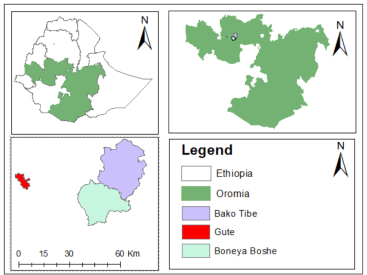
The study was conducted at three sites—Bako onstation, Boneya Boshe, and Gute sub-sites—in the Oromia regional state, western Ethiopia (see Figure 1). The specific sites included Bako (9°06' N, 37°09' E; elevation: 1,650 metres above sea level; mean annual rainfall: 2,285 mm), Boneya Boshe (9°54' N, 37°00' E; elevation: 1,645 metres; rainfall: 1,295 mm), and Gute (9°01' N, 36°40' E; elevation: 1,880 metres; rainfall: 1,586 mm). The soil at Bako is classified as Nitosol, with 2.5% organic carbon, 10 ppm available phosphorus, 0.22% total nitrogen, and a pH (H₂O) of 5.18. In contrast, Boneya Boshe has clay loam soil containing 1.86% organic carbon, 12 ppm available phosphorus, 0.16% total nitrogen, and a pH (H₂O) of 4.6. At Gute, the soil consists of 60% silt, 35% sand, and 5% clay, with 1.98% organic carbon, 6.2 ppm available phosphorus, 0.17% total nitrogen, and a pH (H₂O) of 4.43. The farming systems in the area primarily involve mixed crop-livestock systems, with key crops including maize (Zea mays), teff (Eragrostis tef), noug (Guizotia abyssinica), sorghum (Sorghum spp.), hot pepper (Capsicum annuum), and sugarcane (Saccharum officinarum). The dominant types of livestock are cattle, small ruminants, and poultry .
Figure 1. Map of the study area.
2.2. Experimental Materials
Cultivars of Brachiaria were collected from the Debre Zeit Agricultural Research Center for this study. The Cultivars were:
1) Brachiaria brizantha (DZF-13379)
2) Brachiaria humidicola (DZF-9222)
3) Brachiaria mutica (var. DZF-483)
4) Brachiaria decumbens (DZF-10871)
2.3. Treatments and Experimental Design
The experimental design is a randomized complete block design (RCBD) with three replications. The plot size was 2 m x 1.6 m, with a 1 m path between plots and 1.5 m between blocks. The roots of the grasses will be planted at 0.5 m and 0.15 m between rows and plants, respectively, on a well-prepared seedbed. Recommended fertilizer rates of 100 kg/ha DAP and UREA were applied. Recommended management practices (land preparation, hoeing, weeding, etc.) were applied during the experimental periods.
2.4. Biomass Yield Determination
At the 50% flowering stage, the herbage in the two middle rows was harvested, and the fresh biomass weight was taken using a field balance. The harvested herbage mass was manually chopped up into shorter lengths using a sickle, and the subsample weighing 200 g was dried in an oven at 65 o c for 72 hrs. or in the sun to determine herbage dry matter production.
DMY (tha)=10*TFW*(DWSs/(HA * FWSs))
Where: 10 = constant for conversion of yields in kg/m2 to ton/ ha;
TFW = total fresh weight from harvesting area (kg);
SSDW = sub-sample dry weight (g);
HA = harvest area (m2), and
SSFW = sub-sample fresh weight (g).
2.5. Statistical Analysis
Data were recorded and summarized using Microsoft Excel 2013 and analyzed with the general linear model (GLM) procedure of SAS 9.3. Significant differences among treatment means were separated and compared using the Least Significant Difference (LSD) test at a 5% significance level, or 95% confidence interval.
The model for data analysis was:
Yij=μ+Ti+Bj+eij
Where: Yij= measured response of treatment i in block j,
μ= grand mean of the experiment,
Ti = effect of treatment i,
Bj= effect of block j,
eij= random error effect of treatment i in block j.
3. Results and Discussion
3.1. ANOVA Result
The analysis of variance (ANOVA) findings for different Brachiaria cultivars tested in Bako, Boneya Boshe, and Gute are presented in Table 1. The findings revealed significant variation (P<.05) among the tested cultivars, locations, and years of the study for dry matter yield (DMY), plant height (PH), and leafiness (Leafi). The variations in yield and yield components, other than the plot cover of Brachiaria cultivars in this study, were strongly influenced by location. The variability among locations may be attributed to differences in rainfall and temperature, as well as the physicochemical characteristics of the soil . The tested Brachiaria cultivars exhibited varying growth traits and dry matter yields. The interaction effects of year, location, and cultivars also showed significant variation. This result aligns with the findings of Wekgari et al. .
Table 1. ANOVA result for dry matter yield and growth performance of Brachiaria cultivars at Bako in 2023 & 2024.

Source

d.f.

Mean squares

DMY

PH

PC

Leafi

Year

1

749.81***

636.06***

1.38ns

2.72*

Rep

2

3.86ns

0.13ns

4.05ns

1.79ns

Cltvr

3

428.10***

16665.20***

3.61***

1.79*

Loc

2

48.55***

98.04***

0.51ns

1.54*

Year*Loc*Cltvr

17

3.31***

192.69***

0.98**

1.35**

df=degree of freedom, DMY=dry matter yield, PH=plant height, PC=plot cover, Leafi= leafiness, Rep=replication, Cltvr=cultivar, Loc=location
3.2. Agronomic Performance of Different Brachiaria Cultivars at Different Locations
3.2.1. Dry Matter Yield
According to the current study, dry matter yield (DMY) and plant height at harvest of four distinct Brachiaria cultivars varied significantly (P <.01) (Table 2). Brachiaria Mutica produced the highest DMY among the tested cultivars, followed by Brachiaria decombens in every study location. On the other hand, the lowest DMY was obtained from Brachiaria humidicola in each location. With the highest DMY coming from the Gute sub-site, the ranges at Bako, Boneya Boshe, and Gute are 8.83 to 19.90 t ha-1, 8.58 to 18.24 t ha-1, and 10.74 to 20.55 t ha-1, respectively. The highest forage DMY production of this cultivar could be due to the highest plant height of the cultivar. Azeem et al. also concluded that plant height and biomass production are directly related, with higher plant height resulting in greater biomass yield. The findings of Mekonnen and Mekuriaw , Hunegnaw et al. , and Wekgari et al. , who found that the same Brachiaria cultivar produced the maximum forage dry matter yield at various locations, are consistent with this conclusion.
Table 2. Dry matter yield performances of four Brachiaria cultivars across locations in 2023 and 2024.

Cultivars

Location

Combined mean

Bako

BB

Gute

B. brizantha (DZF-13379)

8.83c

8.58c

11.60c

9.67c

B. humidicola (DZF-9222)

7.36d

8.67c

10.74c

8.92d

B. mutica (var. DZF-483)

19.90a

18.24a

20.55a

19.56a

B. decumbens (DZF-10871)

10.82b

10.79b

13.54b

11.72b

Mean

11.73

11.57

14.11

12.47

LSD(0.05)

0.8628

0.846

1.0755

0.5893

P value

<.0001

<.0001

<.0001

<.0001

Cv (%)

8.54

8.49

8.85

7.04

a, b, c, d means with different letters are significantly different. BB = Boneya Boshe, coefficient of variance, LSD = least significant difference.
3.2.2. Plant Height at Harvest
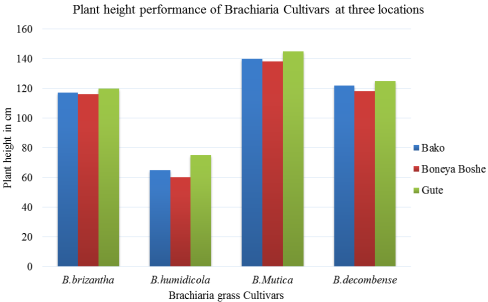
Plant height is one of the traits that are important for forage biomass production. The results of this study showed that there were substantial differences (P<.05) in plant height at harvest between four different Brachiaria cultivars (Figure 2). In every testing site, Brachiaria humidicola and Brachiaria mutica had the shortest (60 cm) and tallest plant heights (140 cm) at harvest, respectively. The highest plant height of Brachiaria mutica recorded in the current study agrees with the findings of Hunegnaw et al. . In all the study sites, the lowest plant height of Brachiaria humidicola was below the mean value of all the cultivars. This is reflected in the lowest dry matter yield of the cultivar among the others in all study locations. This is mainly due to the genetic potential difference among different Brachiaria cultivars used in this study. The plant height of Brachiaria mutica is lower than the height recorded for the same cultivar at the Haro Sabu Agricultural Research Center by Wekgari et al. , but higher than the value documented by Dereje et al. in the Debre Zeit Agricultural Research Center.
Figure 2. Plant height at the forage harvesting stage of four Brachiaria Cultivars across three locations.
3.2.3. Plot Cover
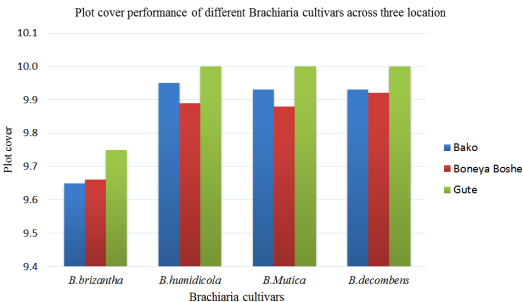
Plot cover in forage crops is a highly desirable characteristic, contributing to both forage biomass production from a specific plot of land and to soil and water conservation. The plot cover among various Brachiaria cultivars evaluated in this study demonstrated significant variations (Figure 3). Notably, B. humidicola, B. decombens and B. mutica exhibited comparably higher plot cover than B. brizantha. Across all study sites, B. mutica, B. humidicola, and B. decombens consistently showed the highest plot cover, followed by B. brizantha. Findings from this study revealed that plot cover values had a direct positive correlation with forage biomass production. This result is consistent with the finding of Chen et al. .
Figure 3. Plot cover of four Brachiaria Cultivars across three locations.
3.2.4. Vigour and Leafiness
The vigour and leafiness characteristics of four Brachiaria cultivars are presented in Table 3. At the Bako site, although numerical differences were observed among the cultivars, no significant variation in vigour and leafiness was recorded. This result is against the findings of Mekonnen and Mekuriaw .
Table 3. Agronomic performance of four Brachiaria cultivars across locations in 2023 & 2024.

Cultivar

Vigor

Leafiness

Bako

BB

Gute

Bako

BB

Gute

B. brizantha (DZF-13379)

8.33

8.50b

8.33b

8.50

9.00

8.33b

B. humidicola (DZF-9222)

9.17

8.17b

8.83b

9.33

9.33

9.00ab

B. mutica (var. DZF-483)

9.00

9.83a

9.67a

9.00

9.17

9.67a

B. decumbens (DZF-10871)

9.16

9.83a

9.83a

8.33

9.50

9.83a

Mean

8.92

9.08

9.17

8.79

9.25

9.21

LSD(0.05)

0.946

0.505

0.744

1.000

1.013

0.838

P value

0.234

0.0001

0.002

0.172

0.754

0.005

Cv (%)

8.7

4.6

6.7

9.3

9.0

7.5

a, b,=means with different letters are significantly different. BB=Boneya Boshe
In contrast, both Brachiaria mutica and Brachiaria decumbens exhibited noticeably higher vigour, followed by Brachiaria brizantha and Brachiaria humidicola. At the Boneya Boshe sub-site, leafiness among all cultivars was statistically similar. However, at the Gute sub-site, differences in leafiness were statistically significant, with Brachiaria mutica, Brachiaria decumbens, and Brachiaria humidicola exhibiting comparable levels of leafiness.
3.2.5. Effect of Year on Dry Matter Performance of Different Brachiaria Cultivars
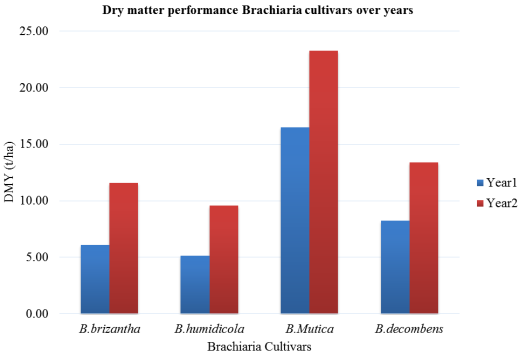
Figure 4. Forage Dry matter Performance of different Brachiaria Cultivars in year 1 and year 2.

In this study, a significant variation was noted between the first and second years of establishment of Brachiaria cultivars across all testing sites (Figure 4). The most substantial difference in dry matter yield (DMY) was observed in Brachiaria mutica (var. DZF-483), which exhibited a variation of 6.77 t ha-1, whereas Brachiaria humidicola (DZF-9222) demonstrated the smallest variation at 4.42 t ha-1.
Generally, the forage dry matter yield for all Brachiaria cultivars increased over the years and is comparable with the previous work of Garay et al. . This increase can likely be attributed to enhanced root development in these perennial grass cultivars, allowing them to more effectively utilize essential growth nutrients from the soil.
3.3. Morphological Characteristics of the Four Brachiaria Cultivars
The four Brachiria cultivars in the current study were found to have distinct patterns of growth (Table 4). Farmers and growers can take care of the agronomic practices that a crop requires by being aware of and identifying the growth characteristics of any crop. For example, Brachiaria mutica spreads quickly along the ground surface and requires enough land area to reach its maximum growth potential for forage production. However, the other cultivars spread less along the ground surface and grow erect upward. In addition to forage biomass production potential as a criterion, farmers may find this observation result useful in selecting cultivars based on their available plot of land.
Table 4. Growth habit of four Brachiaria cultivars used for the study.

Cultivars

Growth Habit

Brachiaria brizantha (DZF-13379)

Erect/prostrate with high seed-bearing potential

Brachiaria humidicola (DZF-9222)

Erect/prostrate with dense spongy ground cover with no seed-bearing potential

Brachiaria mutica (var.DZF-483)

Spreading/creeping by rhizomes along the ground with moderate seed-bearing potential

Brachiaria decumbens (DZF-10871)

Erect/prostrate with high seed-bearing potential

4. Conclusion
This study evaluated the growth and herbage dry matter yield of four Brachiaria cultivars across three sub-humid agro-ecological zones in western Oromia, Ethiopia. The combined analysis highlights the significance of taking into account locations and cultivar attributes when choosing forage grasses. Notably, Brachiaria mutica (var. DZF-483) is the leading cultivar, demonstrating superior dry matter yield and agronomic traits across all the testing sites and years, followed by Brachiaria decombens (DZF-10871). Consequently, demonstrating Brachiaria mutica (var. DZF-483) and Brachiaria decombens (DZF-10871) on farmers’ fields in the study areas due to their promising biomass production and adaptability is recommended. Furthermore, it is suggested to conduct additional research to analyze the nutritional value of the cultivars and the performance of animals when these grass cultivars are used as a basal diet supplemented with concentrates.
Acknowledgments
All team members of Bako Agricultural Research Center's animal feed resources and rangeland management team deserve special recognition for their invaluable contributions to the experimental field management during the study, as well as Oromia Agricultural Research Institute for funding this research project.
Abbreviations

ANOVA

Analysis of Variance

BARC

Bako Agricultural Research Center

BNI

Biological Nitrification Inhibition

DMY

Dry Matter Yield

GLM

The General Linear Model

LSD

Least Significant Difference

RCBD

Randomized Complete Block Design

SAS

Statistical Analysis Software

Author Contributions
Wakgari Keba: Conceptualization, Data curation, Formal Analysis, Funding acquisition, Investigation, Methodology, Project administration, Resources, Software, Supervision, Validation, Visualization, Writing – original draft, Writing – review & editing
Conflicts of Interest
The author declares no conflicts of interest.
References
[1] Gebregziabher, S., Mouazen, A. M., Van Brussel, H., Ramon, H., Nyssen, J., Verplancke, H., Behailu, M., Deckers, J. and De Baerdemaeker, J., 2006. Animal drawn tillage, the Ethiopian ard plough, maresha: a review. Soil and Tillage Research, 89(2), pp. 129-143.
[2] Shapiro, B. I., Gebru, G., Desta, S., Negassa, A., Nigussie, K., Aboset, G. and Mechal, H. 2015. Ethiopia livestock master plan. ILRI Project Report. Nairobi, Kenya: International Livestock Research Institute (ILRI).
[3] Somerville, C., Youngs, H., Taylor, C., Davis, S. C. and Long, S. P., 2010. Feedstocks for lignocellulosic biofuels. science, 329(5993), pp. 790-792.
[4] Djikeng, A., Rao, I. M., Njarui, D., Mutimura, M., Caradus, J., Ghimire, S. R., Johnson, L., Cardoso, J. A., Ahonsi, M. and Kelemu, S., 2014. Climate-smart Brachiaria grasses for improving livestock production in East Africa. Tropical Grasslands-Forrajes Tropicales, 2(1), pp. 38-39.
[5] Mureithi, J. G. and Djikeng, A., 2016. Overview of the climate smart Brachiaria grass programme. Climate Smart Brachiaria Grasses for Improving Livestock Production in East AfricaKenya Experience, p. 1.
[6] Kubkomawa, H., Olawuye, H. U., Krumah, L. J., Etuk, E. B. and Okoli, I. C., 2015. Nutrient requirements and feed resource availability for pastoral cattle in the tropical Africa: A review. Journal of Agricultural and Crop Research, 3(7), pp. 100-116.
[7] Akintan, O., Gebremedhin, K. G. and Uyeh, D. D., 2024. Animal feed formulation—connecting technologies to build a resilient and sustainable system. Animals, 14(10), p. 1497.
[8] Ghimire, S. R., Njarui, D. M., Mutimura, M., Cardoso, J. A., Johnson, L., Gichangi, E. M., Teasdale, S., Odokonyero, K., Caradus, J., Rao, I. M. and Djikeng, A., 2019. Climate-smart Brachiaria for improving livestock production in East Africa: Emerging opportunities.
[9] Tegegn, A., Kyalo, M., Mutai, C., Hanson, J., Asefa, G., Djikeng, A. and Ghimire, S., 2019. Genetic diversity and population structure of Brachiaria brizantha (A. Rich.) Stapf accessions from Ethiopia. African Journal of Range & Forage Science, 36(2), pp. 129-133.
[10] Fikadu, T., Bekuma, W., Tesfaye, W. and Furgasa, M., 2021. Adaptability Study of Brachiaria Grass Accessions for Forage Yield and Nutritive Value in Lowlands of East Oromia, Ethiopia. Ecology and Evolutionary Biology, 6(2), p. 42.
[11] Merera, C., Galmessa, U., Lemma, T., Kebede, M. and Dassalegn, J., 2004. Study on the utilization and management of draft animals in east and west Wellega zones. ESAP Proceedings, pp. 112-116.
[12] Mekonen, T., Tolera, A., Nurfeta, A., Bradford, B. and Mekasha, A., 2022. Location and plant spacing affect biomass yield and nutritional value of pigeon pea forage. Agronomy Journal, 114(1), pp. 228-247.
[13] Wekgari, Y., Gamachu, N. and Dereba, F., 2023. Adaptation Trial of Brachiaria Grass Varieties in West and Kellem Wollega Zones of Oromia, Ethiopia. J Plant Sci Curr Res 7: 026. of, 7, p. 2.
[14] Azeem, A., Mai, W. and Ali, R., 2024. Modeling plant height and biomass production of cluster bean and sesbania across diverse irrigation qualities in pakistan’s thar desert. Water, 16(1), p. 9.
[15] Mekonnen, W. and Mekuriaw, S., 2022. Evaluation of Brachiaria grass cultivars productivity and yield in different agro-ecological Zones of Amhara Region, Ethiopia. In Proceedings of the 14th annual regional conference on completed livestock research activities (Vol. 2).
[16] Hunegnaw, B., Mekuriaw, Y., Asmare, B. and Mekuriaw, S., 2022. Morphoagronomical and Nutritive Performance of Brachiaria Grasses Affected by Soil Type and Fertilizer Application Grown under Rainfed Condition in Ethiopia. Advances in Agriculture, 2022(1), p. 7373145.
[17] Dereje, F., Mengistu, A., Geleti, D., Diba, D. and Feyissa, F., 2024. Herbage Yield and Nutritive Value of Selected Grasses in Subhumid Agroecological Environments in Ethiopia. International Journal of Agronomy, 2024(1), p. 6170361.
[18] Chen, J., Gu, S., Shen, M., Tang, Y. and Matsushita, B., 2009. Estimating aboveground biomass of grassland having a high canopy cover: an exploratory analysis of in situ hyperspectral data. International Journal of Remote Sensing, 30(24), pp. 6497-6517.
[19] Garay, J. R., Cancino, S. J., Zarate Fortuna, P., Ibarra Hinojosa, M. A., Martinez Gonzalez, J. C., Gonzalez Davila, R. P. and Cienfuegos Rivas, E. G., 2017. Dry matter accumulation and crude protein concentration in Brachiaria spp. cultivars in the humid tropics of Ecuador. Tropical Grasslands-Forrajes Tropicales, 5(2), pp. 66-76.
Cite This Article
  • APA Style

    Keba, W. (2026). Evaluation of Different Brachiaria Cultivars for Forage Yield and Agronomic Performance in Sub-humid Climate of Ethiopia. Science Discovery Plants, 1(1), 42-49. https://doi.org/10.11648/j.sdplants.20260101.15

    Copy | Download

    ACS Style

    Keba, W. Evaluation of Different Brachiaria Cultivars for Forage Yield and Agronomic Performance in Sub-humid Climate of Ethiopia. Sci. Discov. Plants 2026, 1(1), 42-49. doi: 10.11648/j.sdplants.20260101.15

    Copy | Download

    AMA Style

    Keba W. Evaluation of Different Brachiaria Cultivars for Forage Yield and Agronomic Performance in Sub-humid Climate of Ethiopia. Sci Discov Plants. 2026;1(1):42-49. doi: 10.11648/j.sdplants.20260101.15

    Copy | Download

  • @article{10.11648/j.sdplants.20260101.15,
      author = {Wakgari Keba},
      title = {Evaluation of Different Brachiaria Cultivars for Forage Yield and Agronomic Performance in Sub-humid Climate of Ethiopia},
      journal = {Science Discovery Plants},
      volume = {1},
      number = {1},
      pages = {42-49},
      doi = {10.11648/j.sdplants.20260101.15},
      url = {https://doi.org/10.11648/j.sdplants.20260101.15},
      eprint = {https://article.sciencepublishinggroup.com/pdf/10.11648.j.sdplants.20260101.15},
      abstract = {A major reason for the inadequate quantity and quality of feed is the shortage of improved, adapted forages. The growing interest in livestock development, fueled by the rising demand for animal products, underscores the necessity for high-quality, productive forages to address the feed shortage. This study was conducted in 2023 and 2024 at the Bako, Boneya Boshe, and Gute sites to identify the most adaptable and high-yielding cultivars of Brachiaria. The treatment consists of four Brachiaria cultivars (Brachiaria brizantha (DZF-13379), Brachiaria humidicola (DZF-9222), Brachiaria mutica (var. DZF-483) and Brachiaria decumbens (DZF-10871) arranged in a randomized complete block design (RCBD) with three replications. This study showed that the Brachiaria cultivars*year*location interaction was significantly varied (P <.05) across all the sites for most of the measured parameters. The highest and the lowest plant heights were recorded for Brachiaria mutica (var. DZF-483) and Brachiaria humidicola (DZF-9222), respectively. The highest DMY was obtained from Brachiaria mutica (var. DZF-483), followed by Brachiaria decumbens (DZF-10871), Brachiaria brizantha (DZF-13379), and Brachiaria humidicola (DZF-9222). Even though there were some differences in some of the measured parameters, Brachiaria mutica (var. DZF-483) and Brachiaria decumbens (DZF-10871) are recommended based on their maximum forage DMY production and distinct growth habits. Thus, it is recommended to be demonstrated and familiarized with the farming community to utilize the potential of these cultivars.},
     year = {2026}
    }
    

    Copy | Download

  • TY  - JOUR
    T1  - Evaluation of Different Brachiaria Cultivars for Forage Yield and Agronomic Performance in Sub-humid Climate of Ethiopia
    AU  - Wakgari Keba
    Y1  - 2026/03/16
    PY  - 2026
    N1  - https://doi.org/10.11648/j.sdplants.20260101.15
    DO  - 10.11648/j.sdplants.20260101.15
    T2  - Science Discovery Plants
    JF  - Science Discovery Plants
    JO  - Science Discovery Plants
    SP  - 42
    EP  - 49
    PB  - Science Publishing Group
    UR  - https://doi.org/10.11648/j.sdplants.20260101.15
    AB  - A major reason for the inadequate quantity and quality of feed is the shortage of improved, adapted forages. The growing interest in livestock development, fueled by the rising demand for animal products, underscores the necessity for high-quality, productive forages to address the feed shortage. This study was conducted in 2023 and 2024 at the Bako, Boneya Boshe, and Gute sites to identify the most adaptable and high-yielding cultivars of Brachiaria. The treatment consists of four Brachiaria cultivars (Brachiaria brizantha (DZF-13379), Brachiaria humidicola (DZF-9222), Brachiaria mutica (var. DZF-483) and Brachiaria decumbens (DZF-10871) arranged in a randomized complete block design (RCBD) with three replications. This study showed that the Brachiaria cultivars*year*location interaction was significantly varied (P <.05) across all the sites for most of the measured parameters. The highest and the lowest plant heights were recorded for Brachiaria mutica (var. DZF-483) and Brachiaria humidicola (DZF-9222), respectively. The highest DMY was obtained from Brachiaria mutica (var. DZF-483), followed by Brachiaria decumbens (DZF-10871), Brachiaria brizantha (DZF-13379), and Brachiaria humidicola (DZF-9222). Even though there were some differences in some of the measured parameters, Brachiaria mutica (var. DZF-483) and Brachiaria decumbens (DZF-10871) are recommended based on their maximum forage DMY production and distinct growth habits. Thus, it is recommended to be demonstrated and familiarized with the farming community to utilize the potential of these cultivars.
    VL  - 1
    IS  - 1
    ER  - 

    Copy | Download

Author Information
  • Abstract
  • Keywords
  • Document Sections

    1. 1. Introduction
    2. 2. Materials and Methods
    3. 3. Results and Discussion
    4. 4. Conclusion
    Show Full Outline
  • Acknowledgments
  • Abbreviations
  • Author Contributions
  • Conflicts of Interest
  • References
  • Cite This Article
  • Author Information