
This study offers a detailed examination of vegetation health monitoring in the Tullo District of eastern Ethiopia, underscoring the critical role of spatially explicit data in land management within semi-arid environments. Employing a multi-index remote sensing framework with Landsat 9 imagery, the research evaluates vegetation health, stress, and the risk of degradation through the analysis of six distinct spectral indices. The findings reveal considerable spatial variability in vegetation health, pinpointing regions of significant productivity and areas susceptible to degradation. This differential analysis is essential for effective environmental planning and the promotion of sustainable agricultural practices. The study also identifies strong correlations among the spectral indices, bolstering their reliability as tools for assessing vegetation conditions. Furthermore, the integration of these indices provides comprehensive insights, enhancing the understanding of ecological dynamics and informing conservation strategies. The methodology applied in this research is both scalable and cost-effective, thereby facilitating its adoption in broader contexts and regions facing similar challenges. By advancing the methodology for monitoring vegetation health, this work not only contributes to the understanding of vegetation dynamics in Ethiopia but also establishes a valuable framework that can be adapted to analogous ecosystems globally. The implications of this research are far-reaching, supporting informed decision-making in ecological restoration and land-use planning, ultimately fostering enhanced environmental stewardship in semi-arid landscapes.
| Published in | Science Discovery Plants (Volume 1, Issue 1) |
| DOI | 10.11648/j.sdplants.20260101.16 |
| Page(s) | 50-61 |
| Creative Commons |
This is an Open Access article, distributed under the terms of the Creative Commons Attribution 4.0 International License (http://creativecommons.org/licenses/by/4.0/), which permits unrestricted use, distribution and reproduction in any medium or format, provided the original work is properly cited. |
| Copyright |
Copyright © The Author(s), 2026. Published by Science Publishing Group |
Vegetation Health, Remote Sensing, Landsat Spectral Indices
Date Acquisition | Types of images | Types of images | Path | Row | Spatial Resolution | Numbers of Bands | Source |
|---|---|---|---|---|---|---|---|
2026/01/12 | Landsat 9 | OLI/TIRS | 167 | 054 | 30M*30M | 11 | USGS |
Index | Formula | Description |
|---|---|---|
NDVI | NDVI= (B5+B4)/(B5−B4) | Normalized Difference Vegetation Index, used to assess vegetation health by comparing near-infrared and red reflectance. |
EVI | EVI=2.5×(B5+6×B4−7.5×B2+1)/(B5−B4) | Enhanced Vegetation Index, designed to improve upon NDVI for dense vegetation areas, reducing atmospheric influences. |
SAVI |
| Soil-Adjusted Vegetation Index, which minimizes the influence of soil brightness in sparsely vegetated areas. |
GI | GI= B5/B3 | Green Index, focused on measuring green reflectance to assess plant vigor and health. |
PRI | PRI=(B3+B4)/(B3−B4) | Photochemical Reflectance Index, sensitive to changes in photosynthetic activity and plant stress levels. |
NBR | NBR= (B5+B7)/(B5−B7) | Normalized Burn Ratio, primarily used to assess burn severity and vegetation recovery after fire events. |
INDEX | NDVI | EVI | SAVI | GI | PRI | NBR |
|---|---|---|---|---|---|---|
NDVI | 1.00 | 0.92 | 0.94 | 0.85 | 0.78 | 0.71 |
EVI | 0.92 | 1.00 | 0.96 | 0.88 | 0.81 | 0.75 |
SAVI | 0.94 | 0.96 | 1.00 | 0.90 | 0.83 | 0.78 |
GI | 0.85 | 0.88 | 0.90 | 1.00 | 0.76 | 0.72 |
PRI | 0.78 | 0.81 | 0.83 | 0.76 | 1.00 | 0.65 |
NBR | 0.71 | 0.75 | 0.78 | 0.72 | 0.65 | |
INDEX | NDVI | EVI | SAVI | GI | PRI | NBR |
NDVI | 1.00 | 0.92 | 0.94 | 0.85 | 0.78 | 0.71 |
EVI | 0.92 | 1.00 | 0.96 | 0.88 | 0.81 | 0.75 |
SAVI | 0/94 | 0.96 | 1.00 | 0.90 | 0.83 | 0.78 |
GI | 0.85 | 0.88 | 0.90 | 1.00 | 0.76 | 0.72 |
PRI | 0.78 | 0.81 | 0.83 | 0.76 | 1.00 | 0.65 |
NBR | 0.71 | 0.75 | 0.78 | 0.72 | 0.65 | 1.00 |
Index | Minimum | Maximum | Mean | Std. Deviation |
|---|---|---|---|---|
NDVI | -0.003 | 0.53 | 0.28 | 0.12 |
EVI | -0.30 | 0.65 | 0.32 | 0.18 |
SAVI | -0.15 | 0.58 | 0.30 | 0.15 |
GI | -0.50 | 0.71 | 0.35 | 0.20 |
PRI | -0.28 | 0.175 | 0.08 | 0.09 |
NBR | 0.06 | 0.50 | 0.25 | 0.10 |
NDVI | Normalized Difference Vegetation Index |
EVI | Enhanced Vegetation Index |
SAVI | Soil-Adjusted Vegetation Index |
GI | Green Index |
PRI | Photochemical Reflectance Index |
NBR | Normalized Burn Ratio |
OLI | Operational Land Imager |
TIRS | Thermal Infrared Sensor |
SVI | Spectral Vegetation Index |
USGS | United States Geological Survey |
| [1] | Birajdar, F., & Shaikh, M. (2024). Groundwater exploration and assessment in arid and semi-arid regions of basaltic terrain of Solapur: Lessons learned and future prospects. International Journal of Innovative Science and Research Technology, 9, IJISRT24APR2344. |
| [2] | Change, C. (2016). Agriculture and food security. The State of Food and Agriculture; FAO (Ed.) FAO: Rome, Italy. |
| [3] | Duarte, E., & Hernandez, A. (2024). A review on soil moisture dynamics monitoring in semi-arid ecosystems: methods, techniques, and tools applied at different scales. Applied Sciences, 14(17), 7677. |
| [4] | Duarte-Hernandez, P. R. (2025). Evaluation of Corn Response to Within-Field Nitrogen Management and the Performance of Tools for In-Season Nitrogen Recommendations in Alabama (Master's thesis). |
| [5] | Field, E. H., Milner, K. R., Hatem, A. E., Powers, P. M., Pollitz, F. F., Llenos, A. L.,... & Herrick, J. A. (2024). The USGS 2023 conterminous US time-independent earthquake rupture forecast. Bulletin of the Seismological Society of America, 114(1), 523-571. |
| [6] | Folkmann, E. J., Hughes, M. C., Khan, U. A., & Vaezi, M. (2024). Examining noncommunicable diseases using satellite imagery: a systematic literature review. BMC Public Health, 24(1), 2774. |
| [7] | Gessesse, A. A., & Melesse, A. M. (2019). Temporal relationships between time series CHIRPS-rainfall estimation and eMODIS-NDVI satellite images in Amhara Region, Ethiopia. In Extreme hydrology and climate variability (pp. 81-92). Elsevier. |
| [8] | Key, C. H., & Benson, N. C. (2006). Landscape assessment (LA). In: Lutes, Duncan C.; Keane, Robert E.; Caratti, John F.; Key, Carl H.; Benson, Nathan C.; Sutherland, Steve; Gangi, Larry J. 2006. FIREMON: Fire effects monitoring and inventory system. Gen. Tech. Rep. RMRS-GTR-164-CD. Fort Collins, CO: US Department of Agriculture, Forest Service, Rocky Mountain Research Station. p. LA-1-55, 164. |
| [9] | Li, P., Sheng, M., Yang, D., & Tang, L. (2019). Evaluating flood regulation ecosystem services under climate, vegetation and reservoir influences. Ecological Indicators, 107, 105642. |
| [10] | Ngie, A., & Ahmed, F. (2018). Estimation of Maize grain yield using multispectral satellite data sets (SPOT 5) and the random forest algorithm. South African Journal of Geomatics, 7(1), 11-30. |
| [11] | Shaikh, M., & Birajdar, F. (2024). Advancements in remote sensing and GIS for sustainable groundwater monitoring: applications, challenges, and future directions. International Journal of Research in Engineering, Science and Management, 7(3), 16-24. |
| [12] | Silleos, N. G., Alexandridis, T. K., Gitas, I. Z., & Perakis, K. (2006). Vegetation indices: advances made in biomass estimation and vegetation monitoring in the last 30 years. Geocarto International, 21(4), 21-28. |
| [13] | Xue, J., & Su, B. (2017). Significant remote sensing vegetation indices: A review of developments and applications. Journal of sensors, 2017(1), 1353691. |
| [14] | Zhou, S., Zhang, W., Wang, S., Zhang, B., & Xu, Q. (2021). Spatial–temporal vegetation dynamics and their relationships with climatic, anthropogenic, and hydrological factors in the Amur River basin. Remote Sensing, 13(4), 684. |
APA Style
Kebere, S., Fikadu, K. (2026). Integrating Spectral Vegetation Indices for Monitoring Vegetation Health and Stress in Semi-arid Ethiopia: A Case Study of Tullo District. Science Discovery Plants, 1(1), 50-61. https://doi.org/10.11648/j.sdplants.20260101.16
ACS Style
Kebere, S.; Fikadu, K. Integrating Spectral Vegetation Indices for Monitoring Vegetation Health and Stress in Semi-arid Ethiopia: A Case Study of Tullo District. Sci. Discov. Plants 2026, 1(1), 50-61. doi: 10.11648/j.sdplants.20260101.16
@article{10.11648/j.sdplants.20260101.16,
  author = {Samuel Kebere and Kasegn Fikadu},
  title = {Integrating Spectral Vegetation Indices for Monitoring Vegetation Health and Stress in Semi-arid Ethiopia: A Case Study of Tullo District},
  journal = {Science Discovery Plants},
  volume = {1},
  number = {1},
  pages = {50-61},
  doi = {10.11648/j.sdplants.20260101.16},
  url = {https://doi.org/10.11648/j.sdplants.20260101.16},
  eprint = {https://article.sciencepublishinggroup.com/pdf/10.11648.j.sdplants.20260101.16},
  abstract = {This study offers a detailed examination of vegetation health monitoring in the Tullo District of eastern Ethiopia, underscoring the critical role of spatially explicit data in land management within semi-arid environments. Employing a multi-index remote sensing framework with Landsat 9 imagery, the research evaluates vegetation health, stress, and the risk of degradation through the analysis of six distinct spectral indices. The findings reveal considerable spatial variability in vegetation health, pinpointing regions of significant productivity and areas susceptible to degradation. This differential analysis is essential for effective environmental planning and the promotion of sustainable agricultural practices. The study also identifies strong correlations among the spectral indices, bolstering their reliability as tools for assessing vegetation conditions. Furthermore, the integration of these indices provides comprehensive insights, enhancing the understanding of ecological dynamics and informing conservation strategies. The methodology applied in this research is both scalable and cost-effective, thereby facilitating its adoption in broader contexts and regions facing similar challenges. By advancing the methodology for monitoring vegetation health, this work not only contributes to the understanding of vegetation dynamics in Ethiopia but also establishes a valuable framework that can be adapted to analogous ecosystems globally. The implications of this research are far-reaching, supporting informed decision-making in ecological restoration and land-use planning, ultimately fostering enhanced environmental stewardship in semi-arid landscapes.},
 year = {2026}
}
TY  - JOUR
T1  - Integrating Spectral Vegetation Indices for Monitoring Vegetation Health and Stress in Semi-arid Ethiopia: A Case Study of Tullo District
AU  - Samuel Kebere
AU  - Kasegn Fikadu
Y1  - 2026/03/16
PY  - 2026
N1  - https://doi.org/10.11648/j.sdplants.20260101.16
DO  - 10.11648/j.sdplants.20260101.16
T2  - Science Discovery Plants
JF  - Science Discovery Plants
JO  - Science Discovery Plants
SP  - 50
EP  - 61
PB  - Science Publishing Group
UR  - https://doi.org/10.11648/j.sdplants.20260101.16
AB  - This study offers a detailed examination of vegetation health monitoring in the Tullo District of eastern Ethiopia, underscoring the critical role of spatially explicit data in land management within semi-arid environments. Employing a multi-index remote sensing framework with Landsat 9 imagery, the research evaluates vegetation health, stress, and the risk of degradation through the analysis of six distinct spectral indices. The findings reveal considerable spatial variability in vegetation health, pinpointing regions of significant productivity and areas susceptible to degradation. This differential analysis is essential for effective environmental planning and the promotion of sustainable agricultural practices. The study also identifies strong correlations among the spectral indices, bolstering their reliability as tools for assessing vegetation conditions. Furthermore, the integration of these indices provides comprehensive insights, enhancing the understanding of ecological dynamics and informing conservation strategies. The methodology applied in this research is both scalable and cost-effective, thereby facilitating its adoption in broader contexts and regions facing similar challenges. By advancing the methodology for monitoring vegetation health, this work not only contributes to the understanding of vegetation dynamics in Ethiopia but also establishes a valuable framework that can be adapted to analogous ecosystems globally. The implications of this research are far-reaching, supporting informed decision-making in ecological restoration and land-use planning, ultimately fostering enhanced environmental stewardship in semi-arid landscapes.
VL  - 1
IS  - 1
ER  -
Department of Geographic Information Science, Oda Bultum University, Chiro, Ethiopia
Department of Geographic Information Science, Oda Bultum University, Chiro, Ethiopia
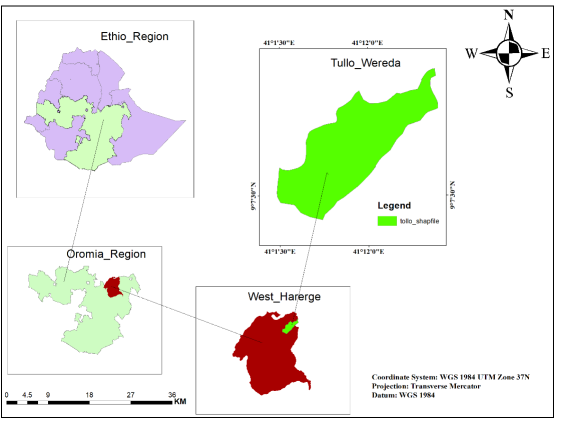
Figure 1. Study area location map.
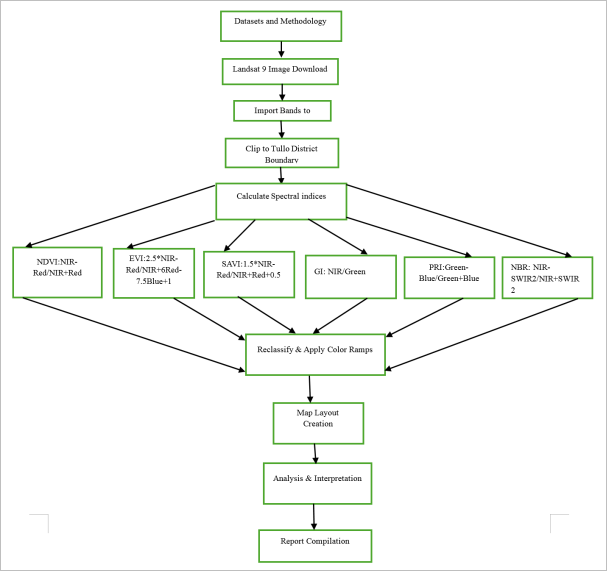
Figure 2. Methodology workflow the above flowchart.
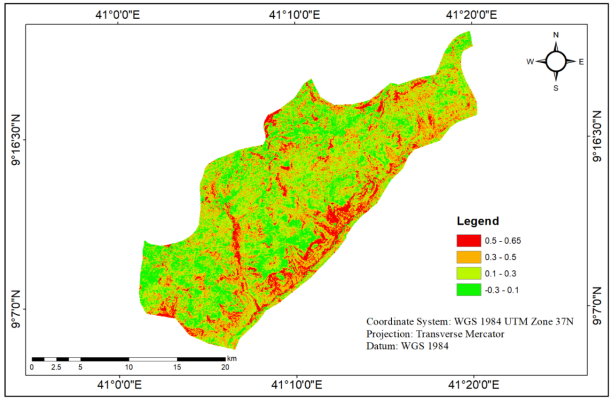
Figure 3. Enhanced Vegetation Index (EVI) Distribution.
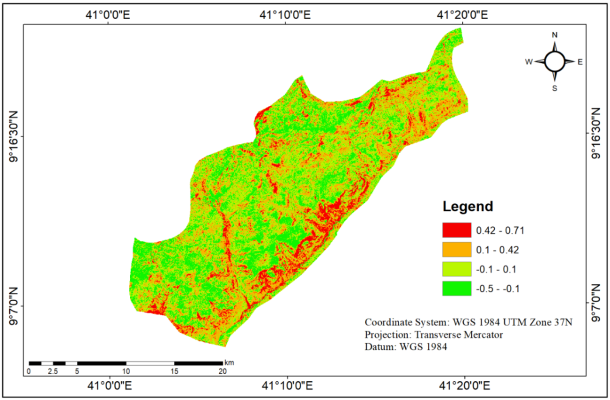
Figure 4. Green Index (GI) Distribution.
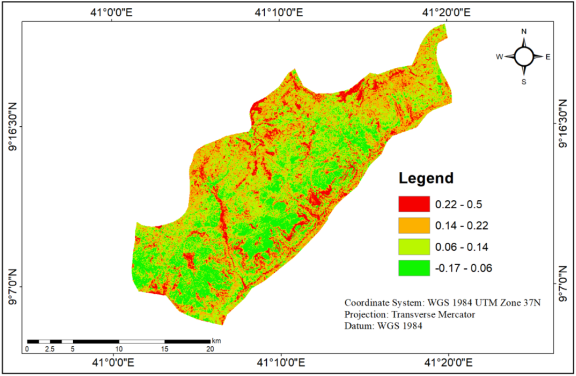
Figure 5. Normalized Burn Ratio (NBR).
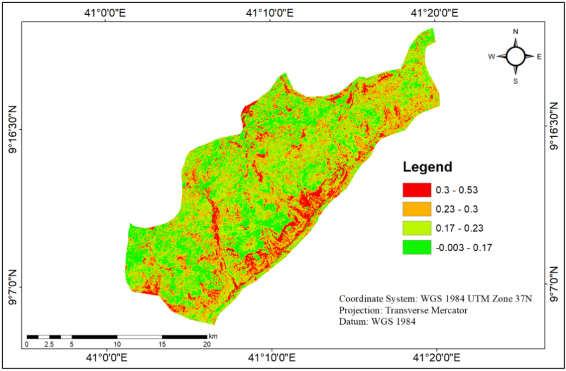
Figure 6. Normalized Difference Vegetation Index (NDVI).
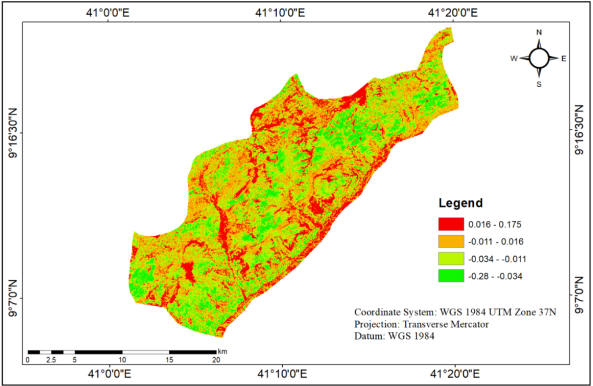
Figure 7. Photochemical Reflectance Index (PRI).
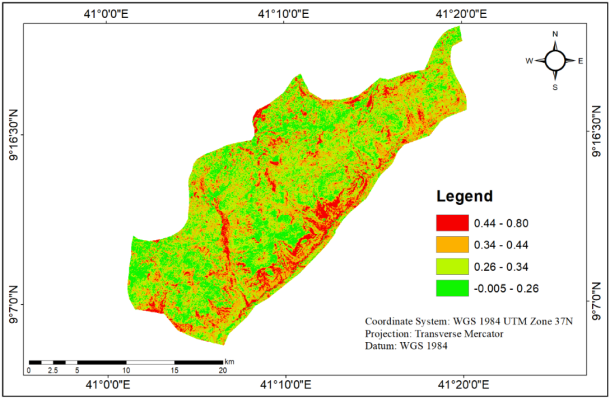
Figure 8. Soil-Adjusted Vegetation Index (SAVI).

Information


 Share This Article
 Twitter
 Linked In
 Facebook
 Copy
Copy Download