Abstract
Although digital government holds significant promise for enhancing administrative efficiency, transparency, and citizen engagement, its implementation across Africa remains fragmented and insufficiently assessed. This study addresses these challenges by integrating the Decision-Making Trial and Evaluation Laboratory-based Analytic Network Process (DANP) with the Technology–Organization–Environment (TOE) framework to identify, prioritize, and analyze the critical success factors (CSFs) influencing digital government applications in Africa. The TOE model structures the determinants into technological, organizational, and environmental dimensions, while DANP captures their complex causal relationships and relative weights. Empirical data were collected from 56 experts across 25 African countries, representing government, academia, the private sector, and civil society. Results indicate that organizational enablers, particularly training and capacity building, institutional commitment, and change management, exert the strongest causal influence, supported by technological drivers such as interoperability and infrastructure readiness, and environmental factors like government policy support and political stability. The integrated DANP–TOE model provides a comprehensive measurement framework that addresses context-specific realities, offering policymakers a decision-support tool to assess readiness, monitor progress, and design targeted interventions. By quantifying interdependencies among success factors, the study advances theoretical understanding of digital governance while delivering actionable insights for strengthening transparency, accountability, and public service delivery in Africa. This systemic approach highlights the dual significance of institutional reforms and contextual adaptation, positioning the DANP–TOE model as a robust foundation for sustainable digital transformation across the continent.
Keywords
Digital Government, Africa, DANP, TOE Framework, Critical Success Factors, Governance Transformation,
Technology Application
1. Introduction
Digital government has emerged as a transformative mechanism to modernize public administration, enhance transparency, and improve public service delivery, addressing long-standing governance challenges such as corruption, bureaucratic inefficiencies, and limited citizen participation
| [1] | Gil-Garcia JR, Dawes SS, Pardo TA. Digital Government and Public Management Research: Finding the Crossroads. Vol. 20, Public Management Review. Taylor and Francis Ltd.; 2018. P. 633-46. https://doi.org/10.1080/14719037.2017.1327181 |
| [2] | Jennifer Schoeberlein. Transparency International Anti-Corruption Helpdesk Answer: National Strategies for Advancing Good Governance in Africa. 2020 May. P. 23 |
[1, 2]
. Leveraging information and communication technologies (ICT), digital government initiatives aim to streamline pro-cesses, reduce delays, and foster accountability, thereby aligning with Sustainable Development Goal (SDG) 16, which emphasizes building effective, accountable, and transparent institutions
| [3] | Wang W, Huang Z, Fu Z, Jia L, Li Q, Song J. Impact of Digital Technology Adoption on Technological Innovation in Grain Production. Journal of Innovation and Knowledge. 2024 Jul 1; 9(3).
https://doi.org/10.1016/j.jik.2024.100520 |
| [4] | Nwetlawung ZE, Lin YH. Development Of an Optimization Algorithm for Designing Low-Carbon Concrete Materials Standardization with Blockchain Technology and Ensemble Machine Learning Methods. Buildings. 2025 Aug 1; 15(16). https://doi.org/10.3390/buildings15162809 |
[3, 4]
. This transformation promises not only to optimize administrative functions but also to promote inclusivity, data-driven governance, and citizen trust in public institutions
| [5] | Lindquist EA, Huse I. Accountability and Monitoring Government in the Digital Era: Promise, Realism and Research for Digital-Era Governance. Canadian Public Administration. 2017 Dec 1; 60(4): 627-56.
https://doi.org/10.1111/capa.12243 |
[5]
.
Despite its recognized importance, the application of digital government across African nations remains uneven, with some countries demonstrating notable progress while others struggle to move beyond pilot initiatives
| [6] | Low MP, Seah C Sen, Cham TH, Teoh SH. Digitalization adoption for digital economy: an examination of Malaysian small medium-sized enterprises through the technology–organization–environment framework. Business Process Management Journal. 2022 Nov 1; 28(7): 1473-94.
https://doi.org/10.1108/bpmj-06-2022-0282 |
| [7] | Zheng L, Zhang H. Bridging Local and Global: Convergence, Divergence and Dialogue in Digital Government Research Communities. Government Information Quarterly. 2025 Sep 1; 42(3). https://doi.org/10.1016/j.giq.2025.102065 |
[6, 7]
. Leading ex-amples such as Rwanda, Mauritius, and South Africa illustrate how digital reforms can accelerate service delivery and governance efficiency, yet many governments continue to face persistent barriers. These include inadequate ICT infrastructure, fragmented policies, weak institutional capacity, financial constraints, low levels of digital literacy, and resistance to organizational change
| [8] | Osman Adam I. ICT Development, E-Government Development, and Economic Development: Does Institutional Quality Matter? 2020. |
| [9] | Plantinga P. Digital Discretion and Public Administration in Africa: Implications for the Use of Artificial Intelligence. Information Development. 2024 Jun 1; 40(2): 332-52.
https://doi.org/10.1177/02666669221117526 |
[8, 9]
. Furthermore, a reliance on models and frameworks developed in more technologically advanced contexts has often led to mismatched strategies that fail to capture Africa’s socio-political and institutional realities
. As a result, digital government initiatives in Africa often experience high failure rates, limited scalability, and suboptimal citizen impact
| [8] | Osman Adam I. ICT Development, E-Government Development, and Economic Development: Does Institutional Quality Matter? 2020. |
[8]
.
To overcome these challenges, identifying and prioritizing Critical Success Factors is crucial. Past research highlights enablers such as leadership commitment, institutional capacity, stakeholder engagement, effective legal frameworks, and sustainable funding
| [11] | Abeer I. Aldayel. An Exploratory Study for Investigating the Critical Success Factors for Cloud Migration in the Saudi Arabian Higher Education Context. 2011 May.
https://doi.org/10.1016/j.tele.2016.10.008 |
| [12] | Sihotang DM, Yudhistira BA, Solikin, Nugroho WS, Wibowo WC, Sensuse DI, Hidayanto AN. A Systematic Literature Review of Barriers and Drivers of E-Government in Developing Countries: TOE Framework Perspective. In: 2022 7th International Conference on Informatics and Computing, ICIC 2022. Institute of Electrical and Electronics Engineers, Inc.; 2022. https://doi.org/ https://doi.org/10.1109/icic56845.2022.10006942 |
[11, 12]
. Yet, these factors rarely operate independently; rather, they are interdependent, influencing each other in complex ways that shape the success or failure of digital reforms. Traditional linear models often fail to account for these interdependencies, leading to incomplete insights and policy misalignments
| [13] | Awa HO, Ojiabo OU, Orokor LE. Integrated Technology-Organization-Environment (T-O-E) Taxonomies for Technology Adoption. Journal of Enterprise Information Management. 2017; 30(6): 893-921.
https://doi.org/10.1108/jeim-03-2016-0079 |
[13]
.
The Technology–Organization–Environment framework evaluates digital innovation applications by examining tech-nological, organizational, and environmental aspects, helping to identify what drives application and highlighting barriers that need to be addressed. In this context, the technological dimension refers to infrastructure, interoperability, and cy-bersecurity; the organizational dimension involves leadership support, institutional capacity, and human resources; and the environmental dimension encompasses political stability, legal frameworks, donor support, and citizen trust. This framework has been widely applied in prior studies to analyze technology application across sectors, demonstrating its rel-evance for understanding complex sociotechnical transitions
| [14] | Darusalam D, Janssen M, Said J, Sanusi ZM, Omar N. An Evaluation Framework for the Impact of Digitalization on the Quality of Governance: Evidence from Indonesia. International Journal of Public Administration in the Digital Age. 2023; 10(1). https://doi.org/10.4018/ijpada.332880 |
[14]
. However, while TOE provides a comprehensive cate-gorization, it does not fully capture the causal dynamics and feedback loops across these domains. For instance, improved technological infrastructure may encourage institutional reform; however, weak legal frameworks could simultaneously hinder its application. To address these interdependencies, advanced analytical approaches are needed to move beyond categorization and reveal the systemic interactions that shape application outcomes.
The DEMATEL-based Analytical Network Process method is used to systematically identify, analyze, and prioritize factors influencing digital government applications by capturing the complex interrelationships among technological, organizational, and environmental dimensions. This approach has been found effective in similar contexts, such as assessing the application of emerging technologies in governance and public service delivery, which shares common themes with digital government in terms of institutional capacity, stakeholder collaboration, and trust
| [15] | Pan L, Hu X. Designing Sustainable Digital Platforms for Ageing Societies: A User-Centred Multi-Level Theoretical Framework. Sustainability [Internet]. 2025 Sep 16; 17(18): 8305. Available From: https://doi.org/10.3390/su17188305 |
| [16] | Kamis NH, Shamudin NAA, Kilicman A, Kadir NA, Yusoff B. A hybrid fuzzy approach of Similarity-influence-network and DEMATEL: visualization and analysis. Malaysian Journal of Fundamental and Applied Sciences. 2024 Mar 1; 20(2): 424-34. https://doi.org/10.11113/mjfas.v20n2.3343 |
[15, 16]
.
Recent studies emphasize the effectiveness of hybrid multi-criteria decision-making approaches like DANP in environments with limited resources, diverse institutions, and complex governance. Unlike traditional models that rely mainly on quantitative data, DANP integrates expert judgment, which is especially useful in Africa, where standardized data systems are often incomplete or unreliable.
The integration of the TOE and DANP model creates a hybrid analytical framework that not only identifies the crit-ical factors influencing digital government applications but also quantifies their causal importance and systemic influence. This makes the model particularly suitable for the African context, where interwoven political, institutional, and socio-economic conditions shape digital governance
| [17] | Taherdoost H, Madanchian M. Understanding Applications and Best Practices of DEMATEL: A Method for Prioritizing Key Factors in Multi-Criteria Decision-Making. Journal of Management Science & Engineering Research. 2023 Jul 6; 6(2) https://doi.org/10.30564/jmser.v6i2.5634 |
| [18] | Manu EK, Asongu SA. The Impact of Environmental Policy, Technological Innovations, and Digitalisation: Does Context Matter in Natural Resource Management in Sub-Saharan Africa? Extractive Industries and Society. 2025 Jun 1; 22. https://doi.org/10.1016/j.exis.2024.101608 |
[17, 18]
. By recognizing feedback loops, asymmetries of influence, and context-specific enablers, the TOE and DANP model provides a more realistic and actionable framework for assessing digital government applications.
Research on digital government applications in Africa re-mains limited, particularly regarding the development of measurement models that can evaluate performance in ways relevant to the continent’s socio-political and economic real-ities, and although digital government has the potential to improve governance, enhance transparency, streamline public services, and promote citizen engagement
| [13] | Awa HO, Ojiabo OU, Orokor LE. Integrated Technology-Organization-Environment (T-O-E) Taxonomies for Technology Adoption. Journal of Enterprise Information Management. 2017; 30(6): 893-921.
https://doi.org/10.1108/jeim-03-2016-0079 |
| [19] | Janowski T. Digital Government Evolution: From Transformation to Contextualization. Vol. 32, Government Information Quarterly. Elsevier Ltd, 2015. P. 221-36.
https://doi.org/10.1016/j.giq.2015.07.001 |
| [20] | Hartanti FT, Abawajy JH, Chowdhury M, Shalannanda W, Hartanti FT. Citizens’ Trust Measurement in Smart Government Services. IEEE Access. 2021; 9: 150663-76.
https://doi.org/10.1109/access.2021.3124206 |
[13, 19, 20]
. Many African countries continue to face barriers, including inadequate technological infrastructure, limited institutional capacity, weak regulatory frameworks, financial constraints, and low digital literacy levels, which collectively result in fragmented systems, inefficient service delivery, and persis-tent gaps in accountability and transparency. At the same time, there is little clarity on the critical success factors required for the effective design, implementation, and sustainability of digital government initiatives, as existing models are often borrowed from developed contexts or presented in generalized forms that overlook Africa’s unique socio-economic, political, and technological conditions, thereby contributing to high failure rates, limited scalability, and reduced impact
| [8] | Osman Adam I. ICT Development, E-Government Development, and Economic Development: Does Institutional Quality Matter? 2020. |
| [21] | Igbokwe-Ibeto CJ. Ethical Governance in Africa: The Case of Nigeria. In: Handbook of Public Management in Africa. Edward Elgar Publishing Ltd.; 2023. P. 209-26.
https://doi.org/10.4337/9781803929392.00025 |
| [22] | Esiefarienrhe BM, Monageng T. Critical Success Factors Frameworks, And Models for Risk Assessment of Egovernment Projects: A Systematic Literature Review. Vol. 8, Journal of Infrastructure, Policy and Development. Enpress Publisher, LLC; 2024. https://doi.org/10.24294/jipd.v8i8.4503 |
[8, 21, 22]
. Moreover, current frameworks frequently overemphasize technical or process-level indicators while neglecting governance quality, political stability, institutional trust, and citizen confidence, and the absence of comprehensive, context-sensitive measurement tools further prevents policymakers from systematically assessing performance, identifying weaknesses, and designing targeted interventions
. To address this gap, the present study applies the DANP–TOE model as a structured decision-support system that integrates technological, organizational, and environ-mental dimensions, captures the complex interrelationships among them, and provides a robust basis for prioritizing context-relevant success factors, thereby enabling targeted policy reforms, effective resource allocation, and resilient, digital government outcomes suited to African realities
.
Several factors are particularly critical to Africa’s digital government trajectory. Technological drivers include ICT infrastructure, interoperability, and cybersecurity
| [22] | Esiefarienrhe BM, Monageng T. Critical Success Factors Frameworks, And Models for Risk Assessment of Egovernment Projects: A Systematic Literature Review. Vol. 8, Journal of Infrastructure, Policy and Development. Enpress Publisher, LLC; 2024. https://doi.org/10.24294/jipd.v8i8.4503 |
| [24] | Azmi R, Tibben W, Win KT. Review of Cybersecurity Frameworks: Context and Shared Concepts. Journal of Cyber Policy. 2018 May 4; 3(2): 258-83.
https://doi.org/10.1080/23738871.2018.1520271 |
[22, 24]
. Organizational enablers involve leadership support, institu-tional readiness, funding availability, and capacity building
| [25] | Edephonce Ngemera Nfuka. Critical Success Factors Framework for Implementing Effective Governance in Public Sector Organizations in A Developing Country. 2011 Jun 8. |
[25]
. Environmental dimensions include political stability, supportive policies, donor engagement, and public trust
| [26] | Evans O. Munich Personal Repec Archive Digital Government: ICT and Public Sector Management in Africa Digital Government: ICT and Public Sector Management in Africa. Lagos, Nigeria; 2019 Jan. |
| [27] | Castro C, Lopes C. Digital Government and Sustainable Development. Journal Of the Knowledge Economy. 2022 Jun 1; 13(2): 880-903. https://doi.org/10.1007/s13132-021-00749-2 |
[26, 27]
. The dynamic interplay of these factors requires a systemic approach that not only identifies their importance but also clarifies how they reinforce or undermine each other.
Based on this analysis, the following research questions are formulated:
1) What are the key technological, organizational, and environmental factors influencing digital government applications in Africa?
2) How do these factors interact and influence each other within Africa’s unique governance ecosystem?
3) How can the DANP–TOE model be applied to systematically prioritize critical success factors and overcome application challenges?
4) In what ways can the resulting measurement model support policymakers and practitioners in enhancing the performance, scalability, and sustainability of digital government initiatives in Africa?
By integrating the TOE framework with the DANP method, this study introduces a novel analytical approach to evaluating digital government applications in Africa. The findings aim to provide policymakers, practitioners, and development partners with evidence-based insights for strengthening governance structures, improving service delivery, and advancing digital transformation strategies tailored to the continent’s realities. Ultimately, the DANP–TOE model contributes not only to academic knowledge but also to practical governance reforms, offering a pathway toward more transparent, accountable, and citizen-centered digital governance in Africa.
2. Literature Review
To clarify the underlying challenges and contextual logic shaping digital government application in Africa, this study reviews two main bodies of literature: (1) the evolution, challenges, and opportunities of digital government in African contexts, and (2) the theoretical foundations and models, including the Technology–Organization–Environment (TOE) framework and multi-criteria decision-making tools such as DANP, used to identify and evaluate (CSFs). These two domains provide the analytical foundation for the integration of the DANP–TOE model and its application to African governance systems.
2.1. Review of Digital Government in the African Context
Digital government is no longer limited to process auto-mation; it is increasingly understood as a mechanism for institutional transformation. In Africa, its relevance is ampli-fied by persistent governance challenges, such as corruption, weak accountability, and bureaucratic inefficiencies, that undermine public trust and service delivery
| [1] | Gil-Garcia JR, Dawes SS, Pardo TA. Digital Government and Public Management Research: Finding the Crossroads. Vol. 20, Public Management Review. Taylor and Francis Ltd.; 2018. P. 633-46. https://doi.org/10.1080/14719037.2017.1327181 |
| [2] | Jennifer Schoeberlein. Transparency International Anti-Corruption Helpdesk Answer: National Strategies for Advancing Good Governance in Africa. 2020 May. P. 23 |
[1, 2]
. While ad-vanced economies have made significant progress in inte-grating ICT into governance, African countries are only be-ginning to realize its full potential. Nonetheless, cases such as Mauritius, South Africa, and Rwanda demonstrate that tar-geted policies, infrastructure investment, and political lead-ership can yield significant improvements in efficiency and transparency
| [28] | Masters L. Africa, The Fourth Industrial Revolution, And Digital Diplomacy: (Re)Negotiating the International Knowledge Structure. South African Journal of International Affairs. 2021; 28(3): 361-77.
https://doi.org/10.1080/10220461.2021.1961605 |
[28]
.
Digital government also intersects with Africa’s geopolitical positioning. The African Union (AU) has prioritized harmonized digital policies, not just for governance efficiency but also to strengthen digital sovereignty and bargaining power in global digital norms
| [29] | Dobrolyubova Ei. Evaluating Digital Government Performance Using Surveys: International Literature Review and Prospects for Future Research. Public Administration Issues. 2022; (5): 152-81
https://doi.Org/10.1007/S11115-021-00584-8 |
[29]
. This repositions digital government as both a domestic governance imperative and a strategic global asset.
The application of digital governance directly advances SDG 16, effective, accountable, and inclusive institutions, while indirectly supporting goals related to education, health, and economic development through improved service deliv-ery
| [3] | Wang W, Huang Z, Fu Z, Jia L, Li Q, Song J. Impact of Digital Technology Adoption on Technological Innovation in Grain Production. Journal of Innovation and Knowledge. 2024 Jul 1; 9(3).
https://doi.org/10.1016/j.jik.2024.100520 |
[3]
. Initiatives such as the AU’s Data Policy Framework emphasize digital justice, balancing individual rights (privacy) with collective economic and social needs
| [30] | Ljuhani F. Systematic Review of Social Entrepreneurship in the Kingdom of Saudi Arabia: Trends, Challenges, And Future Directions. IRJEMS International Research Journal of Economics and Management Studies. 2024 Mar 3; 3: 109-13. https://doi.org/10.56472/25835238/irjems-v3i3p115 |
[30]
. This reflects a shift from compliance-driven approaches to proactive gov-ernance that leverages digital platforms for inclusion, trans-parency, and equity
.
Despite promising initiatives, African countries face unique multi-layered challenges. Infrastructure deficits, especially in rural areas, remain a foundational barrier, compounded by weak institutional capacities and low digital literacy among both civil servants and citizens
| [31] | Söderholm P. The Green Economy Transition: The Challenges of Technological Change for Sustainability. Sustainable Earth. 2020 Dec; 3(1). https://doi.org/10.1186/s42055-020-00029-y |
| [32] | Mlambo VH, Zubane S, Mlambo DN. Examining the Role of Africa in A Changing Global Order: Challenges and Opportunities. African Journal of Public Affairs. 2021. Vol. 12.No. 2 P. 27-42 |
[31, 32]
. Policy fragmentation and overdependence on external actors, for hardware, soft-ware, and digital platforms, create structural vulnerabilities and limit long-term autonomy
| [17] | Taherdoost H, Madanchian M. Understanding Applications and Best Practices of DEMATEL: A Method for Prioritizing Key Factors in Multi-Criteria Decision-Making. Journal of Management Science & Engineering Research. 2023 Jul 6; 6(2) https://doi.org/10.30564/jmser.v6i2.5634 |
| [32] | Mlambo VH, Zubane S, Mlambo DN. Examining the Role of Africa in A Changing Global Order: Challenges and Opportunities. African Journal of Public Affairs. 2021. Vol. 12.No. 2 P. 27-42 |
| [33] | Angelo Paulo S Kitsios. new service development in e-government: identifying critical success factors. 2010 Apr; 4(1): 95–118. Available from:
https://www.emerald.com/insight/content/ https://doi.org/10.1108/17506161011028821 |
[17, 32, 33]
.
Cybersecurity threats and disinformation campaigns fur-ther expose fragile regulatory environments, while political instability in several states undermines continuity in digital reforms
. The heterogeneity of African states also com-plicates regional integration, with uneven digital maturity levels impeding the development of unified digital governance strategies.
Nevertheless, digital government holds vast transformative potential for African public administration. With proper in-vestments in infrastructure and capacity-building, digital tools can streamline service delivery, enhance accountability, and empower citizens to participate in governance
| [5] | Lindquist EA, Huse I. Accountability and Monitoring Government in the Digital Era: Promise, Realism and Research for Digital-Era Governance. Canadian Public Administration. 2017 Dec 1; 60(4): 627-56.
https://doi.org/10.1111/capa.12243 |
[5]
. Moreover, regional peer influence, for instance, Rwanda’s innovations in digital ID systems or Kenya’s e-services, creates a positive pressure on neighboring states to pursue similar reforms
.
At the international level, partnerships with actors such as the EU, US, and China offer financial and technical resources but must be carefully aligned with African priorities to avoid deepening dependency
. Ultimately, the opportunities lie in treating digital infrastructure as a public good and ensuring digital strategies are aligned with inclusive governance and long-term sustainability
| [38] | Musabbeh A, Kaabi A. Multi-Dimensional Sustainability Framework for Service Organisations in The GCC Countries. 2014. |
[38]
.
2.2. Review of Theoretical Models and Analytical Approaches
2.2.1. Critical Success Factors and TOE Framework for Digital Government
In global contexts, leadership commitment, robust IT in-frastructure, legal frameworks, funding, and stakeholder engagement consistently emerge as CSFs
| [24] | Azmi R, Tibben W, Win KT. Review of Cybersecurity Frameworks: Context and Shared Concepts. Journal of Cyber Policy. 2018 May 4; 3(2): 258-83.
https://doi.org/10.1080/23738871.2018.1520271 |
| [35] | The role of public sector digital transformation in the government plans of candidates for Brazil's 2024 municipal elections, Nov; P. 16.
https://dx.doi.org/10.2139/ssrn.5031852 |
| [39] | Nwetlawung ZE, Lin YH. Blockchain-Assisted Gene Expression Programming for Transparent Optimization and Strength Prediction in Fly Ash-Based Geopolymer Concrete. Sustainability [Internet]. 2025 Sep 12; 17(18): 8212. Available From: https://doi.org/10.3390/su17188212 |
[24, 35, 39]
. In Africa, these factors are reframed through local realities. Studies highlight institutional coordination, capacity-building, public trust, and donor support as pivotal enablers
| [25] | Edephonce Ngemera Nfuka. Critical Success Factors Framework for Implementing Effective Governance in Public Sector Organizations in A Developing Country. 2011 Jun 8. |
| [40] | Pedro Isaias. 13th International Conference E-Society-2015. In 2015. H. |
[25, 40]
.
Further argues that the lack of Africa-specific CSF frameworks hinders consistent assessment and reform. Re-gional case studies, such as Tanzania’s IT governance initia-tives or Rwanda’s service digitization, reveal that while technical enablers are essential, sustained political will, cul-tural adaptability, and public participation ultimately deter-mine success. Synthesizing these findings under TOE provides a more nuanced classification of CSFs into technological, organizational, and environmental domains
.
Drawing from the global and regional insights above,
Table 1 synthesizes CSFs for digital government adoption in Africa using the Technology-Organization-Environment (TOE) dimensions.
Table 1. Theoretical Framework of Critical Success Factors (CSFs) for Digital Government Adoption in Africa.
Dimension | Influencing Factor | Factor Code | Description | Sources |
Technological | System Compatibility | T1 | Fit with the existing ICT infrastructure in public administration. | | [23] | Napitupulu D. The Critical Success Factors Study For E-Government Implementation. Int J Comput Appl. 2014 Mar 26; 89(16): 23-32. https://doi.org/10.5120/15716-4588 | | [39] | Nwetlawung ZE, Lin YH. Blockchain-Assisted Gene Expression Programming for Transparent Optimization and Strength Prediction in Fly Ash-Based Geopolymer Concrete. Sustainability [Internet]. 2025 Sep 12; 17(18): 8212. Available From: https://doi.org/10.3390/su17188212 |
[23,39] |
Technological Maturity | T2 | Availability, reliability, and stage of development of digital government systems. | | [23] | Napitupulu D. The Critical Success Factors Study For E-Government Implementation. Int J Comput Appl. 2014 Mar 26; 89(16): 23-32. https://doi.org/10.5120/15716-4588 | | [41] | Echita RM, Stochioiu FPG, Grecu I. Identifying and Prioritizing Factors for Effective Decision-Making in Data-Driven Organizations: A DEMATEL Approach. Systems. 2025 Aug 1; 13(8). https://doi.org/10.3390/systems13080687 |
[23,41] |
Cybersecurity and Privacy | T3 | Security of digital platforms and trust in handling sensitive citizen data. | | [23] | Napitupulu D. The Critical Success Factors Study For E-Government Implementation. Int J Comput Appl. 2014 Mar 26; 89(16): 23-32. https://doi.org/10.5120/15716-4588 | | [25] | Edephonce Ngemera Nfuka. Critical Success Factors Framework for Implementing Effective Governance in Public Sector Organizations in A Developing Country. 2011 Jun 8. |
[23,25] |
Interoperability | T4 | Ability of systems to exchange and use data across departments. | | [23] | Napitupulu D. The Critical Success Factors Study For E-Government Implementation. Int J Comput Appl. 2014 Mar 26; 89(16): 23-32. https://doi.org/10.5120/15716-4588 | | [42] | U M, Farooq U, Tabash MI, Aljughaiman AA, Almulhim AA. Technological Innovation and Trade Orientation as Drivers of Renewable Energy Consumption: Panel Evidence from G7 Economies. Global Challenges. 2025.
https://doi.org/10.1002/gch2.202400345 |
[23,42] |
Internet/Mobile Access | T5 | Public access to digital government platforms via mobile or the internet. | | [43] | Ikram M, Sadki JE. Resilient And Sustainable Green Technology Strategies: A Study of Morocco’s Path Toward Sustainable Development. Sustainable Futures. 2024 Dec 1; 8. https://doi.org/10.1016/j.sftr.2024.100327 | | [44] | Sachs JD, Abdool Karim S, Aknin L, Allen J, Brosbøl K, Cuevas Barron G, Daszak P, Espinosa MF, Gaspar V, Gaviria A, Haines A, Hotez P, Koundouri P, LarraÍN BascuñÁN F, Lee JK, Pate M, Polman P, Reddy S, Serageldin I, Shah R, Thwaites J, Vike-Freiberga V, Wang C, Were MK, Xue L, Zhu M, Bahadur C, Bottazzi ME, Ben Amor Y, Barredo L, Karadag Caman O, Lafortune G, Torres E, Ethridge I, Bartels JGE. Lancet COVID-19 Commission Statement on the Occasion of the 75th Session of the UN General Assembly. Vol. 396, The Lancet. Lancet Publishing Group; 2020. P. 1102-24. Corradini F, Marcantoni F, Polzonetti A, Re B. A Formal Model for Quality-of-Service Measurement In E-Government. In: Proceedings of the International Conference on Information Technology Interfaces, ITI. 2007. P. 747-52.
https://doi.org/10.1016/j.lanepe.2021.100185 |
[43,44] |
Infrastructure Availability | T6 | Accessibility and robustness of national ICT infrastructure. | | [16] | Kamis NH, Shamudin NAA, Kilicman A, Kadir NA, Yusoff B. A hybrid fuzzy approach of Similarity-influence-network and DEMATEL: visualization and analysis. Malaysian Journal of Fundamental and Applied Sciences. 2024 Mar 1; 20(2): 424-34. https://doi.org/10.11113/mjfas.v20n2.3343 | | [35] | The role of public sector digital transformation in the government plans of candidates for Brazil's 2024 municipal elections, Nov; P. 16.
https://dx.doi.org/10.2139/ssrn.5031852 |
[16,35] |
Organizational | Top Management Support | O1 | Commitment and leadership by senior officials in driving digital transformation. | | [25] | Edephonce Ngemera Nfuka. Critical Success Factors Framework for Implementing Effective Governance in Public Sector Organizations in A Developing Country. 2011 Jun 8. | | [45] | Shareef MA, Kumar V, Kumar U, Dwivedi YK. E-Government Adoption Model (GAM): Differing Service Maturity Levels. Government Information Quarterly. 2011 Jan; 28(1): 17-35. https://doi.org/10.1016/j.giq.2010.05.006 |
[25,45] |
Institutional Capacity | O2 | Technical expertise and human resource readiness within public institutions. | | [25] | Edephonce Ngemera Nfuka. Critical Success Factors Framework for Implementing Effective Governance in Public Sector Organizations in A Developing Country. 2011 Jun 8. | | [46] | Garengo P, Biazzo S, Bititci US. Performance Measurement Systems in SMEs: A Review for A Research Agenda. Performance Measurement System in Smes: A Review For A Research Agenda Performance Measurement System in Smes: A Review for A Research Agenda. Vol. 7, International Journal of Management Reviews. 2005.
https://doi.org/10.1111/j.1468-2370.2005.00105.x |
[25,46] |
Organizational Culture | O3 | Openness to change, digital practices, and innovation. | 40] |
Funding Availability | O4 | Budgetary support for developing and maintaining digital platforms. | 40] |
Change Management | O5 | Institutional readiness to manage reforms and user adoption. | | [11] | Abeer I. Aldayel. An Exploratory Study for Investigating the Critical Success Factors for Cloud Migration in the Saudi Arabian Higher Education Context. 2011 May.
https://doi.org/10.1016/j.tele.2016.10.008 | | [47] | Franco-Santos M, Lucianetti L, Bourne M. Contemporary Performance Measurement Systems: A Review of Their Consequences and A Framework for Research. Vol. 23, Management Accounting Research. 2012.
https://doi.org/10.1016/j.mar.2012.04.001 |
[11,47] |
Training and Capacity Building | O6 | Access to digital literacy and ICT training for civil servants. | | [11] | Abeer I. Aldayel. An Exploratory Study for Investigating the Critical Success Factors for Cloud Migration in the Saudi Arabian Higher Education Context. 2011 May.
https://doi.org/10.1016/j.tele.2016.10.008 | | [40] | Pedro Isaias. 13th International Conference E-Society-2015. In 2015. H. |
[11,40] |
Environmental | Government Policy Support | E1 | National strategies, legal frameworks, and data protection laws. | 25] |
Political Stability | E2 | Political conditions affecting the continuity and implementation of digital reforms. | | [11] | Abeer I. Aldayel. An Exploratory Study for Investigating the Critical Success Factors for Cloud Migration in the Saudi Arabian Higher Education Context. 2011 May.
https://doi.org/10.1016/j.tele.2016.10.008 | | [41] | Echita RM, Stochioiu FPG, Grecu I. Identifying and Prioritizing Factors for Effective Decision-Making in Data-Driven Organizations: A DEMATEL Approach. Systems. 2025 Aug 1; 13(8). https://doi.org/10.3390/systems13080687 |
[11,41] |
Donor and Development Partner Support | E3 | Technical or financial aid from international organizations (World Bank, UNDP). | | [41] | Echita RM, Stochioiu FPG, Grecu I. Identifying and Prioritizing Factors for Effective Decision-Making in Data-Driven Organizations: A DEMATEL Approach. Systems. 2025 Aug 1; 13(8). https://doi.org/10.3390/systems13080687 | | [48] | Folan A, Browne P; ORE Open Research Exeter Title A Review of Performance Measurement: Towards Performance Management, a Note on Versions [Internet]. 2015. Available from: https://doi.org/10.1016/j.compind.2005.03.001 |
[41,48] |
Public Trust and Readiness | E4 | Citizens’ willingness to engage with digital platforms and perception of government transparency. | | [16] | Kamis NH, Shamudin NAA, Kilicman A, Kadir NA, Yusoff B. A hybrid fuzzy approach of Similarity-influence-network and DEMATEL: visualization and analysis. Malaysian Journal of Fundamental and Applied Sciences. 2024 Mar 1; 20(2): 424-34. https://doi.org/10.11113/mjfas.v20n2.3343 |
[16, |
ICT Ecosystem Maturity | E5 | The maturity of private sector ICT providers, startups, and service ecosystems. | 27, 43] |
Regional Peer Pressure | E6 | Influence from regional digital innovation success (Rwanda, Kenya). | 36] |
The TOE framework remains the most widely used model for explaining the interplay among technological readiness, organizational capabilities, and environmental pressures in technology application. In the African context, TOE highlights how application is shaped not just by ICT infrastructure and technical maturity, but also by leadership, institutional culture, and funding availability, alongside ena-bling policies, political stability, and public trust. Previous studies confirm its flexibility in capturing both internal and external conditions
| [14] | Darusalam D, Janssen M, Said J, Sanusi ZM, Omar N. An Evaluation Framework for the Impact of Digitalization on the Quality of Governance: Evidence from Indonesia. International Journal of Public Administration in the Digital Age. 2023; 10(1). https://doi.org/10.4018/ijpada.332880 |
| [40] | Pedro Isaias. 13th International Conference E-Society-2015. In 2015. H. |
[14, 40]
.
2.2.2. Decision-Making Tools: DEMATEL–ANP (DANP)
While TOE identifies influencing domains, it does not ac-count for feedback loops or interdependencies among factors. This limitation is addressed by integrating DEMATEL, which maps causal relations, with ANP, which assigns weighted priorities
| [15] | Pan L, Hu X. Designing Sustainable Digital Platforms for Ageing Societies: A User-Centred Multi-Level Theoretical Framework. Sustainability [Internet]. 2025 Sep 16; 17(18): 8305. Available From: https://doi.org/10.3390/su17188305 |
[15]
. The combined DANP method has been suc-cessfully applied in similar contexts, such as the assessment of blockchain integration in supply chains and sustainable housing development, which, like digital government, involve complex stakeholder networks, dynamic institutional envi-ronments, and technologies
| [41] | Echita RM, Stochioiu FPG, Grecu I. Identifying and Prioritizing Factors for Effective Decision-Making in Data-Driven Organizations: A DEMATEL Approach. Systems. 2025 Aug 1; 13(8). https://doi.org/10.3390/systems13080687 |
[41]
. Its application in this study supports a systematic, evidence-based prioritization of CSFs tailored specifically to Africa’s digital governance ecosystem
| [1] | Gil-Garcia JR, Dawes SS, Pardo TA. Digital Government and Public Management Research: Finding the Crossroads. Vol. 20, Public Management Review. Taylor and Francis Ltd.; 2018. P. 633-46. https://doi.org/10.1080/14719037.2017.1327181 |
| [8] | Osman Adam I. ICT Development, E-Government Development, and Economic Development: Does Institutional Quality Matter? 2020. |
[1, 8]
.
Applied in African digital governance, DANP provides a systemic approach that goes beyond linear ranking to identify high-leverage factors that drive broader reforms
| [42] | U M, Farooq U, Tabash MI, Aljughaiman AA, Almulhim AA. Technological Innovation and Trade Orientation as Drivers of Renewable Energy Consumption: Panel Evidence from G7 Economies. Global Challenges. 2025.
https://doi.org/10.1002/gch2.202400345 |
[42]
.
Globally, measurement frameworks have evolved from focusing carefully on system performance to include citizen adoption models and trust-based frameworks
| [19] | Janowski T. Digital Government Evolution: From Transformation to Contextualization. Vol. 32, Government Information Quarterly. Elsevier Ltd, 2015. P. 221-36.
https://doi.org/10.1016/j.giq.2015.07.001 |
| [43] | Ikram M, Sadki JE. Resilient And Sustainable Green Technology Strategies: A Study of Morocco’s Path Toward Sustainable Development. Sustainable Futures. 2024 Dec 1; 8. https://doi.org/10.1016/j.sftr.2024.100327 |
[19, 43]
. How-ever, their reliance on contexts with robust infrastructure and standardized systems limits their transferability in Africa
| [20] | Hartanti FT, Abawajy JH, Chowdhury M, Shalannanda W, Hartanti FT. Citizens’ Trust Measurement in Smart Government Services. IEEE Access. 2021; 9: 150663-76.
https://doi.org/10.1109/access.2021.3124206 |
| [44] | Sachs JD, Abdool Karim S, Aknin L, Allen J, Brosbøl K, Cuevas Barron G, Daszak P, Espinosa MF, Gaspar V, Gaviria A, Haines A, Hotez P, Koundouri P, LarraÍN BascuñÁN F, Lee JK, Pate M, Polman P, Reddy S, Serageldin I, Shah R, Thwaites J, Vike-Freiberga V, Wang C, Were MK, Xue L, Zhu M, Bahadur C, Bottazzi ME, Ben Amor Y, Barredo L, Karadag Caman O, Lafortune G, Torres E, Ethridge I, Bartels JGE. Lancet COVID-19 Commission Statement on the Occasion of the 75th Session of the UN General Assembly. Vol. 396, The Lancet. Lancet Publishing Group; 2020. P. 1102-24. Corradini F, Marcantoni F, Polzonetti A, Re B. A Formal Model for Quality-of-Service Measurement In E-Government. In: Proceedings of the International Conference on Information Technology Interfaces, ITI. 2007. P. 747-52.
https://doi.org/10.1016/j.lanepe.2021.100185 |
[20, 44]
.
When existing digital government measurement models are applied to African contexts, four critical limitations become evident, each reinforcing the inadequacy of relying solely on frameworks designed in more advanced environments. First, there is a persistent overemphasis on technical metrics, where models prioritize system reliability, speed, and availability while largely ignoring the deeper social, cultural, and institu-tional dynamics that often determine whether citizens and governments can meaningfully engage with digital platforms
| [45] | Shareef MA, Kumar V, Kumar U, Dwivedi YK. E-Government Adoption Model (GAM): Differing Service Maturity Levels. Government Information Quarterly. 2011 Jan; 28(1): 17-35. https://doi.org/10.1016/j.giq.2010.05.006 |
[45]
. Second, these models typically lack context-specific indicators, presuming universal conditions of adoption and overlooking the communal norms, informal governance practices, and socio-political complexities that strongly in-fluence decision-making in African societies
| [46] | Garengo P, Biazzo S, Bititci US. Performance Measurement Systems in SMEs: A Review for A Research Agenda. Performance Measurement System in Smes: A Review For A Research Agenda Performance Measurement System in Smes: A Review for A Research Agenda. Vol. 7, International Journal of Management Reviews. 2005.
https://doi.org/10.1111/j.1468-2370.2005.00105.x |
[46]
. Third, performance measurement frameworks tend to suffer from fragmented integration, with separate and often disconnected treatment of financial and non-financial indicators, which prevents them from capturing the holistic and dynamic in-teractions between resource allocation, governance, and outstation
| [47] | Franco-Santos M, Lucianetti L, Bourne M. Contemporary Performance Measurement Systems: A Review of Their Consequences and A Framework for Research. Vol. 23, Management Accounting Research. 2012.
https://doi.org/10.1016/j.mar.2012.04.001 |
[47]
. Finally, these models exhibit weak feedback loops, where data collected from performance assessments is rarely reintegrated into reform processes or policy adjust-ments, resulting in static evaluations that fail to inform con-tinuous improvement or adaptive strategies in the public sector
. Taken together, these interrelated shortcomings underscore the urgent need for Africa-centered measurement models that not only assess technical performance but also integrate governance quality, social trust, and institutional realities, ensuring that digital government systems are evalu-ated in ways that reflect both their technological functionality and their broader societal impact.
2.3. Research Gaps and Theoretical Motivation
The review highlights three critical gaps in the existing lit-erature that constrain the effectiveness of digital government research and practice in Africa. These gaps are deeply interconnected, shaping both the limitations of current models and the opportunities for improvement. The first is the contextualization gap, which arises because many of the frameworks employed in African settings are adopted directly from developed countries and, as a result, fail to reflect the continent’s infrastructural deficits, institutional fragilities, and socio-political complexities, thereby producing models that appear theoretically robust but lack practical applicability in real-world governance systems
| [8] | Osman Adam I. ICT Development, E-Government Development, and Economic Development: Does Institutional Quality Matter? 2020. |
| [21] | Igbokwe-Ibeto CJ. Ethical Governance in Africa: The Case of Nigeria. In: Handbook of Public Management in Africa. Edward Elgar Publishing Ltd.; 2023. P. 209-26.
https://doi.org/10.4337/9781803929392.00025 |
| [48] | Folan A, Browne P; ORE Open Research Exeter Title A Review of Performance Measurement: Towards Performance Management, a Note on Versions [Internet]. 2015. Available from: https://doi.org/10.1016/j.compind.2005.03.001 |
[8, 21, 48]
. The second is the integration gap, where measurement approaches are often fragmented and siloed, treating technological, organizational, and environmental factors in isolation rather than in a unified way, which neglects the reality that these dimensions are deeply interdependent and must be evaluated together to capture the holistic nature of digital government applications
| [13] | Awa HO, Ojiabo OU, Orokor LE. Integrated Technology-Organization-Environment (T-O-E) Taxonomies for Technology Adoption. Journal of Enterprise Information Management. 2017; 30(6): 893-921.
https://doi.org/10.1108/jeim-03-2016-0079 |
| [24] | Azmi R, Tibben W, Win KT. Review of Cybersecurity Frameworks: Context and Shared Concepts. Journal of Cyber Policy. 2018 May 4; 3(2): 258-83.
https://doi.org/10.1080/23738871.2018.1520271 |
| [39] | Nwetlawung ZE, Lin YH. Blockchain-Assisted Gene Expression Programming for Transparent Optimization and Strength Prediction in Fly Ash-Based Geopolymer Concrete. Sustainability [Internet]. 2025 Sep 12; 17(18): 8212. Available From: https://doi.org/10.3390/su17188212 |
[13, 24, 39]
. The third is the systemic gap, whereby existing models tend to provide static analyses that overlook the interdependencies, feedback mechanisms, and evolving relationships among critical success factors, limiting their capacity to explain how application processes unfold over time and how interventions may trigger cascading effects across governance systems
| [19] | Janowski T. Digital Government Evolution: From Transformation to Contextualization. Vol. 32, Government Information Quarterly. Elsevier Ltd, 2015. P. 221-36.
https://doi.org/10.1016/j.giq.2015.07.001 |
| [20] | Hartanti FT, Abawajy JH, Chowdhury M, Shalannanda W, Hartanti FT. Citizens’ Trust Measurement in Smart Government Services. IEEE Access. 2021; 9: 150663-76.
https://doi.org/10.1109/access.2021.3124206 |
| [46] | Garengo P, Biazzo S, Bititci US. Performance Measurement Systems in SMEs: A Review for A Research Agenda. Performance Measurement System in Smes: A Review For A Research Agenda Performance Measurement System in Smes: A Review for A Research Agenda. Vol. 7, International Journal of Management Reviews. 2005.
https://doi.org/10.1111/j.1468-2370.2005.00105.x |
[19, 20, 46]
. To overcome these interconnected shortcomings, this study proposes an integrated approach that combines the structured categorization of the TOE framework, which systematically organizes factors into technological, organizational, and environmental domains
| [14] | Darusalam D, Janssen M, Said J, Sanusi ZM, Omar N. An Evaluation Framework for the Impact of Digitalization on the Quality of Governance: Evidence from Indonesia. International Journal of Public Administration in the Digital Age. 2023; 10(1). https://doi.org/10.4018/ijpada.332880 |
| [40] | Pedro Isaias. 13th International Conference E-Society-2015. In 2015. H. |
[14, 40]
. With the analytical strength of the DANP method, which quantifies causal relations and captures feedback loops, thereby allowing for con-text-sensitive prioritization of interventions
| [15] | Pan L, Hu X. Designing Sustainable Digital Platforms for Ageing Societies: A User-Centred Multi-Level Theoretical Framework. Sustainability [Internet]. 2025 Sep 16; 17(18): 8305. Available From: https://doi.org/10.3390/su17188305 |
| [42] | U M, Farooq U, Tabash MI, Aljughaiman AA, Almulhim AA. Technological Innovation and Trade Orientation as Drivers of Renewable Energy Consumption: Panel Evidence from G7 Economies. Global Challenges. 2025.
https://doi.org/10.1002/gch2.202400345 |
[15, 42]
.
This hybrid DANP–TOE model provides African policy-makers with a decision-support tool that is not only theoreti-cally rigorous in its ability to synthesize complex relationships but also practically adaptable to resource-constrained and institutionally diverse governance environments, making it especially suited to advancing digital transformation strategies in Africa
.
3. Research Methodology
To comprehensively understand and prioritize the critical success factors (CSFs) that influence the application of digital government in Africa, this study employs a hybrid analytical framework that integrates the Technology–Organization–Environment (TOE) model with the Decision-Making Trial and Evaluation Laboratory-based Analytic Network Process (DANP) method. This combined methodology enables a nuanced evaluation of interrelated factors, capturing both their structural importance and causal influence, thereby offering a robust basis for decision-making in complex gov-ernance environments
| [3] | Wang W, Huang Z, Fu Z, Jia L, Li Q, Song J. Impact of Digital Technology Adoption on Technological Innovation in Grain Production. Journal of Innovation and Knowledge. 2024 Jul 1; 9(3).
https://doi.org/10.1016/j.jik.2024.100520 |
| [50] | Lihniash S, Egdair I, Ahmed S. The Proposed Conceptual Framework to Understand the Effect of the Technology Organization Environment (TOE) Model on Internet Financial Reporting (IFR) In Libyan Financial Institutions. Open Journal of Business and Management. 2019; 07(02): 339-47.
https://doi.org/10.4236/ojbm.2019.72023 |
| [51] | Heeks M, Reed S, Tafsiri M, Prince S. The Economic and Social Costs of Crime. Second Edition. 2018. |
[3, 50, 51]
.
In this study, the application of DANP unfolds through a structured sequence that begins with the identification of factors via the TOE framework, where a comprehensive literature review and contextual analysis were conducted to extract critical success factors (CSFs) relevant to Africa’s public sector digital transformation. These factors were sys-tematically classified into technological, organizational, and environmental dimensions to capture the multifaceted nature of application drivers
. Building on this foundation, the second stage involved causal mapping through DEMATEL, in which experts in digital governance, ICT policy, and public administration drawn from 25 African countries (n = 56) provided pairwise comparisons of the identified factors using a 5-point Likert scale, and the DEMATEL technique was subsequently applied to generate an Influence Network Relationship Map (INRM) that made it possible to distinguish between the factors acting as drivers and those that were dependent within the system
| [26] | Evans O. Munich Personal Repec Archive Digital Government: ICT and Public Sector Management in Africa Digital Government: ICT and Public Sector Management in Africa. Lagos, Nigeria; 2019 Jan. |
| [52] | Sandu N, Gide E. Analysis of the Main Factors Affecting the Adoption of Cloud-Based Interactive Mobile Learning in the Australian Higher Education Sector. International Journal of Interactive Mobile Technologies. 2018; 12(4): 43-58.
https://doi.org/10.3991/ijim.v12i4.9200 |
[26, 52]
. Finally, the third stage entailed weighting and prioritization via ANP, in which the interrelationships derived from the DEMATEL process were integrated into a supermatrix, enabling the calculation of global priority weights for each factor and thereby reflecting both their influence and dependencies within the overall network of interconnections
| [53] | Duman, Gazi M. Taskaynatan, Murat, Kongar, Elif, Rosentrater, Kurt A. Integrating Environmental and Social Sustainability into Performance Evaluation: A Balanced Scorecard-Based Grey-DANP Approach for the Food Industry. Frontiers in Nutrition Volume 5 - 2018
https://doi.org/10.3389/fnut.2018.00065 |
| [54] | Huang, Jiajian, Li, Longfei, Jiang, Peng, Zhang, Siqi. DEMATEL-Based ANP Model for Identifying Critical Indicators in Sustainable Emergency Material Reserve Systems. Sustainability 2024, 16(12), 5263;
https://doi.org/10.3390/su16125263 |
[53, 54]
.
Africa’s digital government landscape is characterized by resource constraints, infrastructural fragmentation, and insti-tutional complexity, and traditional linear models often fall short in capturing these contextual realities and dynamic interdependencies, thereby limiting their effectiveness in guiding policymakers. In contrast, the DANP–TOE model offers a more suitable approach as it not only recognizes the asymmetry and feedback loops that exist between critical success factors but also quantifies influence in contexts where statistical data may be sparse, while simultaneously priori-tizing context-sensitive enablers and barriers based on expert knowledge and, ultimately, providing an actionable deci-sion-support system that empowers government leaders and development partners to design more effective digital gov-ernance strategies
.
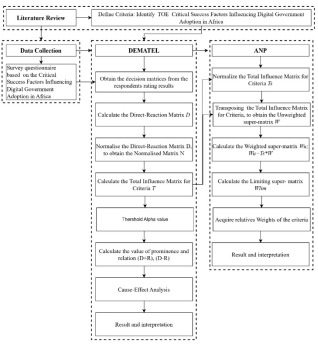
Figure 1 presents the conceptual framework of the DANP–TOE model applied in this study. It illustrates how technological, organizational, and environmental factors are interlinked and assessed through DEMATEL and ANP processes to provide a prioritized and causally informed set of CSFs for digital government applications.
Figure 1. DANP research framework.
3.1. Data Collection
Data were collected in July 2025 through a structured survey administered to 56 experts from 25 African countries, ensuring representation across regions and institutional domains. Participants included professionals from government entities, private sector organizations, universities and research institutes, NGOs, and student bodies. Selection was based on three inclusion criteria: (1) professional or institutional relevance to digital governance, ICT policy, or public sector innovation; (2) a minimum of one year of professional experience, with most participants having between 1–10 years, and several with up to 20 years; and (3) demonstrable expertise in digital systems, governance frameworks, or academic research.
Experts were recruited via professional networks, academic affiliations, and organizational referrals. The panel combined early-career professionals (60%) with seasoned experts (40%), balancing fresh perspectives with institutional memory. This diversity reflects the realities of Africa’s digital transformation landscape, marked by youthful innovation alongside experienced governance leadership.
To quantify perceptions, a five-point Likert scale was employed (ranging from “strongly disagree” to “strongly agree”), allowing structured evaluation of interrelated factors within the DANP–TOE framework. Demographic data, gender, occupation, organization type, experience, and education were also collected to contextualize responses and reveal potential biases (see
Table 2). The sample was majority male (71.4%), with women comprising 28.6%, highlighting persistent gender disparities in Africa’s digital governance sector. Academics and researchers dominated the sample (76.8%), complemented by government officials, ICT practitioners, NGO representatives, and students, ensuring a broad cross-section of viewpoints.
The expert panel provided a pan-African perspective on digital governance application, with respondents drawn from countries such as Nigeria, Ghana, Rwanda, Angola, Mali, and Niger, contexts where digital transformation initiatives are actively underway. The methodological fit of DEMATEL and ANP supports this expert-driven approach, as previous studies confirm that robust causal and prioritization structures can be derived from relatively small, specialized panels. This ensures methodological rigor while capturing Africa’s contextual realities.
Table 2. Basic information of the respondents.
Category | Sub-category | Number | Percentage |
Gender | Male | 40 | 71.4 |
| Female | 16 | 28.6 |
Organization | Government | 4 | 7.14 |
| Universities and Researchers | 40 | 71.43 |
| Private sector entities | 5 | 8.93 |
| Non-Governmental Organizations | 4 | 7.14 |
| Students/Other | 3 | 5.36 |
Experience | 1-5 years | 33 | 58.93 |
| 6-10 years | 10 | 17.85 |
| 11-20 years | 3 | 5.37 |
| Up to 20 years | 10 | 17.85 |
Occupation | Researcher / Academic | 43 | 76.79 |
| General Manager | 2 | 3.57 |
| ICT or Digital Governance Officer | 2 | 3.57 |
| Others | 9 | 16.07 |
Education | Bachelor degree | 14 | 25 |
| Master degree | 30 | 53.6 |
| PhD | 12 | 21.4 |
3.2. DEMATEL Steps for Causal Relationship Analysis
Step 1: Calculating the Direct-Relation Matrix
The Direct-Relation Matrix is a key component in the analysis, serving as a quantitative representation of the relationships among different variables or elements within the dataset.
Based on the respondents rating results, the Direct-Relation Matrix
is obtained by calculating the average of each pairwise comparison. As shown in Eq. (
1), the
is the arithmetic mean of the rating result s
| [18] | Manu EK, Asongu SA. The Impact of Environmental Policy, Technological Innovations, and Digitalisation: Does Context Matter in Natural Resource Management in Sub-Saharan Africa? Extractive Industries and Society. 2025 Jun 1; 22. https://doi.org/10.1016/j.exis.2024.101608 |
| [55] | Lin, Yi-Hsin, Nwetlawung, Zilefac Ebenezer. A DANP model for evaluating the factors influencing blockchain adoption in the construction industry’s carbon trading. Urban Lifeline 2025 (3)10. Pag. 2-16. https://doi.org/10.1007/s44285-025-00045-4 |
[18, 55]
. The diagonals of the matrix
are all zero, as self-influence is not considered, and
represents the number of criteria.
(1)
Step 2: Normalization of Direct-Relation Matrix
using Eq. (
2) and (
3) to calculate the matrix
.
(3)
where is a normalization factor
Step 3: Calculate the Total Influence Matrix for Criteria
by applying Eq. (
4), where
is
| [18] | Manu EK, Asongu SA. The Impact of Environmental Policy, Technological Innovations, and Digitalisation: Does Context Matter in Natural Resource Management in Sub-Saharan Africa? Extractive Industries and Society. 2025 Jun 1; 22. https://doi.org/10.1016/j.exis.2024.101608 |
| [26] | Evans O. Munich Personal Repec Archive Digital Government: ICT and Public Sector Management in Africa Digital Government: ICT and Public Sector Management in Africa. Lagos, Nigeria; 2019 Jan. |
[18, 26]
.
(4)
(5)
where, is the identity matrix
Step 4: Calculate the value of prominence and relation.
Based on the Total-Relation Matrix
the value of prominence and relation can be calculated. As shown in Eq. (
6) and (
7), for the total influence matrix
, the
is the sum of the elements of the
row and
is the sum of the elements in
column. Then
denotes the sum of direct and indirect influence of the
criterion on other criteria, and
represents the sum of direct and indirect influence exerted by other criteria on the
criterion
| [18] | Manu EK, Asongu SA. The Impact of Environmental Policy, Technological Innovations, and Digitalisation: Does Context Matter in Natural Resource Management in Sub-Saharan Africa? Extractive Industries and Society. 2025 Jun 1; 22. https://doi.org/10.1016/j.exis.2024.101608 |
| [26] | Evans O. Munich Personal Repec Archive Digital Government: ICT and Public Sector Management in Africa Digital Government: ICT and Public Sector Management in Africa. Lagos, Nigeria; 2019 Jan. |
[18, 26]
.
(6)
(7)
when , the expression signifies the total strength of influence both imparted and received by the criterion, which we term the “prominence value”. This metric serves as an indicator of the relative value or significance of the criterion within the model. A higher value denotes a greater overall influence of the criterion.
The expression represents the net influence exerted by the criterion relative to its peers, termed the “relation value”. A positive signifies that the criterion has a stronger influence over other criteria, negative value suggests that the criterion is more influenced by others. To delineate significant influence relationships, the mean value of all elements within the Total Influence Matrix for Criteria is adopted as a threshold. Influence relationships are deemed significant and thus represented in the directed graph when exceeds this threshold, thereby facilitating the depiction of the interconnected.
Threshold value:
Where value for the respective rows and columns in the total relation matrix, and is the number of factors in the study.
3.3. DANP Steps for Weighting Factors
Step 1: Normalize Total-Relation Matrix T, the normalized matrix T_s is obtained by dividing the elements of each row by the sum of the components of that row according to the calculation process shown in Eq. (
9) and (
10)
| [51] | Heeks M, Reed S, Tafsiri M, Prince S. The Economic and Social Costs of Crime. Second Edition. 2018. |
| [55] | Lin, Yi-Hsin, Nwetlawung, Zilefac Ebenezer. A DANP model for evaluating the factors influencing blockchain adoption in the construction industry’s carbon trading. Urban Lifeline 2025 (3)10. Pag. 2-16. https://doi.org/10.1007/s44285-025-00045-4 |
| [56] | Izzati, Savina Nur, Ardi, Romadhani, Putri, Shafira Arindra.Evaluating Drivers and Barriers of Integrated Waste Management System Implementation in Indonesian Construction Industry: A DEMATEL-Based Analytical Network Process. Sustainability 2024, 16(6), 2264;
https://doi.org/10.3390/su16062264 |
[51, 55, 56]
.
(9)
Step 2: Develop the unweighted super-matrix by transposing the Total-Relation Matrix .
Step 3: Step 3: The weighted super-matrix W_u, is obtained by multiplying the normalized relation matrix T_s, to the unweighted super-matrix W, as shown in Eq. (
12)
| [51] | Heeks M, Reed S, Tafsiri M, Prince S. The Economic and Social Costs of Crime. Second Edition. 2018. |
| [55] | Lin, Yi-Hsin, Nwetlawung, Zilefac Ebenezer. A DANP model for evaluating the factors influencing blockchain adoption in the construction industry’s carbon trading. Urban Lifeline 2025 (3)10. Pag. 2-16. https://doi.org/10.1007/s44285-025-00045-4 |
| [56] | Izzati, Savina Nur, Ardi, Romadhani, Putri, Shafira Arindra.Evaluating Drivers and Barriers of Integrated Waste Management System Implementation in Indonesian Construction Industry: A DEMATEL-Based Analytical Network Process. Sustainability 2024, 16(6), 2264;
https://doi.org/10.3390/su16062264 |
[51, 55, 56]
.
(12)
Step 4: Calculate the limiting super-matrix. The weighted super-matrix
multiplies itself enough times until the super-matrix converges and becomes stable in the long run. Then the limiting super-matrix
is obtained. And the weights of each factor index can be calculated
| [16] | Kamis NH, Shamudin NAA, Kilicman A, Kadir NA, Yusoff B. A hybrid fuzzy approach of Similarity-influence-network and DEMATEL: visualization and analysis. Malaysian Journal of Fundamental and Applied Sciences. 2024 Mar 1; 20(2): 424-34. https://doi.org/10.11113/mjfas.v20n2.3343 |
| [18] | Manu EK, Asongu SA. The Impact of Environmental Policy, Technological Innovations, and Digitalisation: Does Context Matter in Natural Resource Management in Sub-Saharan Africa? Extractive Industries and Society. 2025 Jun 1; 22. https://doi.org/10.1016/j.exis.2024.101608 |
[16, 18]
.
4. Results
4.1. Causal Relationships Among the Criteria
The DEMATEL methodology was applied to investigate the complex causal relationships among the technological, organizational, and environmental criteria influencing the application of digital government in Africa. Expert judgments from a diverse panel of 56 participants across 25 African countries were aggregated using arithmetic means to form the direct relation matrix. This matrix captured the immediate influence that each criterion exerts on the others.
Following normalization, the Total Influence Matrix (
Table 3) was derived, integrating both direct and indirect effects. This comprehensive overview revealed the systemic interdependencies across the 18 critical success factors (CSFs) identified under the TOE framework. Factors such as System Compatibility
, Training and Capacity Building
, and Government Policy Support
showed high prominence, underscoring their role as root drivers of digital government applications. Conversely, criteria such as Regional Peer Pressure
and Donor Support
were found to be more dependent, reflecting their reactive position within the ecosystem.
To provide a deeper understanding of the dynamics, cause–effect relationships were calculated based on the R (receiver) and D (dispatcher) values from the Total Influence Matrix. Here, indicates the overall involvement of each factor, while determines whether a criterion is primarily a cause (positive value) or an effect (negative value).
Table 4 classifies the Critical Success Factors (CSFs) into distinct groups of causes and effects, thereby illustrating which dimensions actively drive the application of digital government in Africa and which ones are primarily shaped by external influences. On the technological side, System Compatibility
and Interoperability
emerge as dominant causal factors, underscoring the crucial role of ensuring that digital systems can seamlessly integrate and communicate across diverse platforms to enable smooth service delivery and foster widespread application. Within the organizational dimension, Training and Capacity Building
, Top Management Support
, and Funding Availability
are all positioned as central causes, reflecting the reality that skilled human resources, leadership commitment, and sustainable financial support are indispensable prerequisites for any successful reform initiative. From the environmental perspective, Government Policy Support
and Political Stability
are identified as key drivers, emphasizing the necessity of coherent regulatory frameworks and stable governance conditions to create the enabling environment required for large-scale transformation.
In contrast, several factors emerge as effects, meaning that other elements more influence them than they can exert influence themselves. In the technological domain, Technological Maturity , Cybersecurity and Privacy Infrastructure Availability , and Internet/Mobile Access are classified as effect factors, indicating that improvements in these areas are contingent upon prior progress in compatibility, interoperability, and resource mobilization. Organizationally, Institutional Capacity , Organizational Culture , and Change Management appear as dependent outcomes that evolve only when foundational causal drivers such as training, funding, and leadership are adequately in place. Similarly, in the environmental sphere, Donor and Development Partner Support , Public Trust and Readiness , ICT Ecosystem Maturity , and Regional Peer Pressure are positioned as effects, highlighting how trust, ecosystem development, and external stakeholder alignment are all downstream consequences of stronger domestic policies, political stability, and organizational preparedness.
This classification highlights that system compatibilityand training and capacity building are significant drivers of successful digital governance. They exert substantial influence on both technical readiness and institutional performance, cascading into downstream improvements such as interoperability , institutional capacity , and citizen trust . On the other hand, public trust , ICT ecosystem maturity and regional peer pressure emerge as outcomes, heavily dependent on foundational causes like political stability and policy support.
Table 3. Total Influence Matrix for Criteria T.
| | | | | | | | | | | | | | | | | | |
| 1.3519 | 1.3317 | 1.3528 | 1.3877 | 1.3619 | 1.3734 | 1.3782 | 1.3321 | 1.3456 | 1.3238 | 1.3393 | 1.4133 | 1.4043 | 1.3543 | 1.2869 | 1.3696 | 1.4027 | 1.2770 |
| 1.3317 | 1.2244 | 1.2839 | 1.3215 | 1.2924 | 1.3056 | 1.3114 | 1.2639 | 1.2815 | 1.2593 | 1.2777 | 1.3425 | 1.3351 | 1.2897 | 1.2254 | 1.3021 | 1.3311 | 1.2171 |
| 1.3528 | 1.2839 | 1.2627 | 1.3403 | 1.3143 | 1.3276 | 1.3312 | 1.2877 | 1.2985 | 1.2807 | 1.2935 | 1.3639 | 1.3552 | 1.3103 | 1.2427 | 1.3206 | 1.3593 | 1.2354 |
| 1.3877 | 1.3215 | 1.3403 | 1.3355 | 1.3539 | 1.3653 | 1.3713 | 1.3220 | 1.3377 | 1.3195 | 1.3314 | 1.4049 | 1.3972 | 1.3428 | 1.2793 | 1.3581 | 1.3955 | 1.2729 |
| 1.3619 | 1.2924 | 1.3143 | 1.3539 | 1.2848 | 1.3400 | 1.3436 | 1.3009 | 1.3129 | 1.2927 | 1.3055 | 1.3766 | 1.3690 | 1.3190 | 1.2544 | 1.3305 | 1.3696 | 1.2459 |
| 1.3734 | 1.3056 | 1.3276 | 1.3653 | 1.3400 | 1.3097 | 1.3549 | 1.3176 | 1.3182 | 1.3094 | 1.3188 | 1.3894 | 1.3840 | 1.3324 | 1.2696 | 1.3430 | 1.3836 | 1.2563 |
| 1.3782 | 1.3114 | 1.3312 | 1.3713 | 1.3436 | 1.3549 | 1.3169 | 1.3164 | 1.3298 | 1.3105 | 1.3177 | 1.3954 | 1.3877 | 1.3360 | 1.2660 | 1.3477 | 1.3860 | 1.2643 |
| 1.3321 | 1.2639 | 1.2877 | 1.3220 | 1.3009 | 1.3176 | 1.3164 | 1.2342 | 1.2818 | 1.2712 | 1.2757 | 1.3500 | 1.3414 | 1.2912 | 1.2337 | 1.3048 | 1.3444 | 1.2206 |
| 1.3456 | 1.2815 | 1.2985 | 1.3377 | 1.3129 | 1.3182 | 1.3298 | 1.2818 | 1.2555 | 1.2794 | 1.2910 | 1.3624 | 1.3537 | 1.3031 | 1.2416 | 1.3169 | 1.3498 | 1.2332 |
| 1.3238 | 1.2593 | 1.2807 | 1.3195 | 1.2927 | 1.3094 | 1.3105 | 1.2712 | 1.2794 | 1.2249 | 1.2768 | 1.3451 | 1.3365 | 1.2876 | 1.2280 | 1.3023 | 1.3395 | 1.2138 |
| 1.3393 | 1.2777 | 1.2935 | 1.3314 | 1.3055 | 1.3188 | 1.3177 | 1.2757 | 1.2910 | 1.2768 | 1.2455 | 1.3548 | 1.3462 | 1.2970 | 1.2380 | 1.3118 | 1.3492 | 1.2284 |
| 1.4133 | 1.3425 | 1.3639 | 1.4049 | 1.3766 | 1.3894 | 1.3954 | 1.3500 | 1.3624 | 1.3451 | 1.3548 | 1.3846 | 1.4241 | 1.3711 | 1.3054 | 1.3855 | 1.4213 | 1.2918 |
| 1.4043 | 1.3351 | 1.3552 | 1.3972 | 1.3690 | 1.3840 | 1.3877 | 1.3414 | 1.3537 | 1.3365 | 1.3462 | 1.4241 | 1.3688 | 1.3636 | 1.2959 | 1.3790 | 1.4135 | 1.2846 |
| 1.3543 | 1.2897 | 1.3103 | 1.3428 | 1.3190 | 1.3324 | 1.3360 | 1.2912 | 1.3031 | 1.2876 | 1.2970 | 1.3711 | 1.3636 | 1.2721 | 1.2472 | 1.3299 | 1.3619 | 1.2398 |
| 1.2869 | 1.2254 | 1.2427 | 1.2793 | 1.2544 | 1.2696 | 1.2660 | 1.2337 | 1.2416 | 1.2280 | 1.2380 | 1.3054 | 1.2959 | 1.2472 | 1.1535 | 1.2639 | 1.2977 | 1.1790 |
| 1.3696 | 1.3021 | 1.3206 | 1.3581 | 1.3305 | 1.3430 | 1.3477 | 1.3048 | 1.3169 | 1.3023 | 1.3118 | 1.3855 | 1.3790 | 1.3299 | 1.2639 | 1.2976 | 1.3751 | 1.2483 |
| 1.4027 | 1.3311 | 1.3593 | 1.3955 | 1.3696 | 1.3836 | 1.3860 | 1.3444 | 1.3498 | 1.3395 | 1.3492 | 1.4213 | 1.4135 | 1.3619 | 1.2977 | 1.3751 | 1.3679 | 1.2831 |
| 1.2770 | 1.2171 | 1.2354 | 1.2729 | 1.2459 | 1.2563 | 1.2643 | 1.2206 | 1.2332 | 1.2138 | 1.2284 | 1.2918 | 1.2846 | 1.2398 | 1.1790 | 1.2483 | 1.2831 | 1.1351 |
Table 4. Cause-Effect.
| | | | | Identity |
| 24.3864 | 24.3864 | 48.7728481 | 4.81431E-05 | Cause |
| 23.1962 | 23.1962 | 46.3923501 | -4.99243E-05 | Effect |
| 23.5606 | 23.5606 | 47.1211762 | -2.3791E-05 | Effect |
| 24.2369 | 24.2369 | 48.4737774 | -2.25692E-05 | Effect |
| 23.7677 | 23.7677 | 47.5353547 | -4.52697E-05 | Effect |
| 23.9986 | 23.9986 | 47.9971946 | -5.36355E-06 | Effect |
| 24.0649 | 24.0649 | 48.1297515 | -4.85241E-05 | Effect |
| 23.2893 | 23.2893 | 46.5786246 | 2.45762E-05 | Cause |
| 23.4925 | 23.4925 | 46.9850209 | 2.09357E-05 | Cause |
| 23.2007 | 23.2007 | 46.4014179 | 1.78666E-05 | Cause |
| 23.3981 | 23.3981 | 46.7961828 | -1.71738E-05 | Effect |
| 24.6819 | 24.6819 | 49.3638273 | 2.73105E-05 | Cause |
| 24.5396 | 24.5396 | 49.0792123 | 1.23369E-05 | Cause |
| 23.6488 | 23.6488 | 47.297649 | 4.89756E-05 | Cause |
| 22.5082 | 22.5082 | 45.0164317 | 3.16981E-05 | Cause |
| 23.8866 | 23.8866 | 47.7731941 | -5.90195E-06 | Effect |
| 24.5312 | 24.5312 | 49.0623787 | -2.13259E-05 | Effect |
| 22.3265 | 22.3265 | 44.6530409 | 4.08569E-05 | Cause |
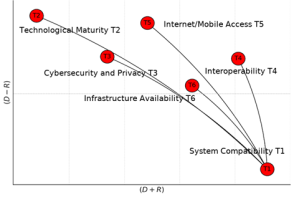
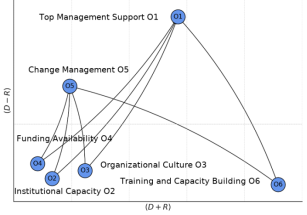
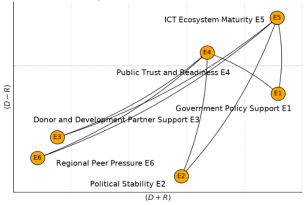
The Influence Network Relation Maps (INRMs) generated from this analysis (
Figures 2 to 4) further illustrate these interdependencies. They show that technological readiness alone cannot guarantee success without corresponding improvements in organizational capacity and environmental stability. For example, advanced ICT systems fail without strong leadership commitment and coherent government policies.
An influence relationship is identified when the value in the integrated influence matrix exceeds the threshold average of 1.3190 (see
Table 5). This threshold (α) signifies strong relationships and influences that are deemed significant and worth considering in further analysis.
Figure 2. INRM of criteria in the Technological dimension.
Figure 3. INRM of criteria in the Organizational dimension.
Table 5 presents the (α)-cut total direct relation matrix, with an (α) threshold of 1.3190. This table highlights the most influential relationships in the system. Relationships with values above this threshold, such as T1 (System Compatibility) influencing T4 (Interoperability) and O6 (Training and Capacity Building) influencing O1 (Top Management Support), are emphasized (e.g., in bold) to indicate their significance for optimizing the application and implementation of digital government in Africa. Similarly, strong environmental links such as E1 (Government Policy Support) influencing E4 (Public Trust and Readiness) also stand out above the threshold, reinforcing the pivotal role of coherent policies in building citizen confidence. In contrast, relationships with values below this threshold are considered weaker and less impactful for further analysis, as they do not exert sufficient systemic influence to alter the dynamics of digital government applications.
Figure 4. INRM of criteria in the Environmental dimension.
4.2. Influential Weights of Dimensions and Criteria
By first calculating the unweighted matrix W and then integrating it with the normalized total-relation matrix Ts, we derive the weighted super-matrix Wu. This matrix is subsequently subjected to iterative multiplication using principles from machine learning (ML) until it reaches convergence, thereby ensuring long-term stability. The resulting limiting super-matrix Wlimit (as shown in
Table 6) exhibits diagonal values that represent the weights of the influencing factors.
The DANP weight analysis (
Table 7) demonstrates that the local weights of the three main dimensions —Technology (0.3333), Organization (0.3333), and Environment (0.3334)—are nearly identical, indicating an almost perfect equilibrium in their significance for digital government applications in Africa. This balanced distribution underscores that no single dimension dominates the others; rather, successful digital governance requires a multidimensional and integrated approach that strengthens technical, organizational, and environmental enablers simultaneously.
At the criteria level, the results also reveal remarkable parity. Within the Technology dimension, criteria such as System Compatibility (T1), Technological Maturity (T2), and Cybersecurity and Privacy (T3) rank highest globally, reflecting their critical role in addressing infrastructural incompatibilities, immature systems, and concerns around information security. Closely behind are Interoperability (T4), Internet/Mobile Access (T5), and Infrastructure Availability (T6), which show comparable influence values, highlighting that technological readiness in Africa must be pursued holistically rather than through piecemeal upgrades.
In the Organizational dimension, factors such as Top Management Support (O1), Institutional Capacity (O2), Organizational Culture (O3), Funding Availability (O4), and Change Management (O5) are closely aligned in their weights. The most prominent organizational driver is Training and Capacity Building (O6), which not only received the highest relative weight within its domain but also emerged as a causal factor strongly influencing leadership support, institutional capacity, and readiness for reform. This finding highlights the importance of human capital in driving digital transformation.
For the Environmental dimension, Government Policy Support (E1), Political Stability (E2), Public Trust and Readiness (E4), and ICT Ecosystem Maturity (E5) show substantial global weights, signaling their importance as external enablers of application. Although Donor Support (E3) and Regional Peer Pressure (E6) rank slightly lower, their weights remain closely aligned, confirming that external financial aid and regional exemplars still play meaningful roles in influencing national strategies.
Finally, the convergence of weights across dimensions and criteria suggests that digital government in Africa cannot advance effectively by focusing on isolated interventions. Instead, a systemic and balanced reform agenda, one that strengthens infrastructure compatibility, invests in training, secures policy coherence, and fosters citizen trust, is essential to ensure long-term sustainability and impact. The DANP results confirm that each factor, while moderately influential in isolation, becomes transformative only when addressed in combination with others, thereby reflecting the interdependent nature of digital governance ecosystems across the continent.
Table 5. The () -cut total direct relation matrix.
| | | | | | | | | | | | | | | | | | |
| 1.3519 | 1.3317 | 1.3528 | 1.3877 | 1.3619 | 1.3734 | 1.3782 | 1.3321 | 1.3456 | 1.3238 | 1.3393 | 1.4133 | 1.4043 | 1.3543 | 1.2869 | 1.3696 | 1.4027 | 1.2770 |
| 1.3317 | 1.2244 | 1.2839 | 1.3215 | 1.2924 | 1.3056 | 1.3114 | 1.2639 | 1.2815 | 1.2593 | 1.2777 | 1.3425 | 1.3351 | 1.2897 | 1.2254 | 1.3021 | 1.3311 | 1.2171 |
| 1.3528 | 1.2839 | 1.2627 | 1.3403 | 1.3143 | 1.3276 | 1.3312 | 1.2877 | 1.2985 | 1.2807 | 1.2935 | 1.3639 | 1.3552 | 1.3103 | 1.2427 | 1.3206 | 1.3593 | 1.2354 |
| 1.3877 | 1.3215 | 1.3403 | 1.3355 | 1.3539 | 1.3653 | 1.3713 | 1.3220 | 1.3377 | 1.3195 | 1.3314 | 1.4049 | 1.3972 | 1.3428 | 1.2793 | 1.3581 | 1.3955 | 1.2729 |
| 1.3619 | 1.2924 | 1.3143 | 1.3539 | 1.2848 | 1.3400 | 1.3436 | 1.3009 | 1.3129 | 1.2927 | 1.3055 | 1.3766 | 1.3690 | 1.3190 | 1.2544 | 1.3305 | 1.3696 | 1.2459 |
| 1.3734 | 1.3056 | 1.3276 | 1.3653 | 1.3400 | 1.3097 | 1.3549 | 1.3176 | 1.3182 | 1.3094 | 1.3188 | 1.3894 | 1.3840 | 1.3324 | 1.2696 | 1.3430 | 1.3836 | 1.2563 |
| 1.3782 | 1.3114 | 1.3312 | 1.3713 | 1.3436 | 1.3549 | 1.3169 | 1.3164 | 1.3298 | 1.3105 | 1.3177 | 1.3954 | 1.3877 | 1.3360 | 1.2660 | 1.3477 | 1.3860 | 1.2643 |
| 1.3321 | 1.2639 | 1.2877 | 1.3220 | 1.3009 | 1.3176 | 1.3164 | 1.2342 | 1.2818 | 1.2712 | 1.2757 | 1.3500 | 1.3414 | 1.2912 | 1.2337 | 1.3048 | 1.3444 | 1.2206 |
| 1.3456 | 1.2815 | 1.2985 | 1.3377 | 1.3129 | 1.3182 | 1.3298 | 1.2818 | 1.2555 | 1.2794 | 1.2910 | 1.3624 | 1.3537 | 1.3031 | 1.2416 | 1.3169 | 1.3498 | 1.2332 |
| 1.3238 | 1.2593 | 1.2807 | 1.3195 | 1.2927 | 1.3094 | 1.3105 | 1.2712 | 1.2794 | 1.2249 | 1.2768 | 1.3451 | 1.3365 | 1.2876 | 1.2280 | 1.3023 | 1.3395 | 1.2138 |
| 1.3393 | 1.2777 | 1.2935 | 1.3314 | 1.3055 | 1.3188 | 1.3177 | 1.2757 | 1.2910 | 1.2768 | 1.2455 | 1.3548 | 1.3462 | 1.2970 | 1.2380 | 1.3118 | 1.3492 | 1.2284 |
| 1.4133 | 1.3425 | 1.3639 | 1.4049 | 1.3766 | 1.3894 | 1.3954 | 1.3500 | 1.3624 | 1.3451 | 1.3548 | 1.3846 | 1.4241 | 1.3711 | 1.3054 | 1.3855 | 1.4213 | 1.2918 |
| 1.4043 | 1.3351 | 1.3552 | 1.3972 | 1.3690 | 1.3840 | 1.3877 | 1.3414 | 1.3537 | 1.3365 | 1.3462 | 1.4241 | 1.3688 | 1.3636 | 1.2959 | 1.3790 | 1.4135 | 1.2846 |
| 1.3543 | 1.2897 | 1.3103 | 1.3428 | 1.3190 | 1.3324 | 1.3360 | 1.2912 | 1.3031 | 1.2876 | 1.2970 | 1.3711 | 1.3636 | 1.2721 | 1.2472 | 1.3299 | 1.3619 | 1.2398 |
| 1.2869 | 1.2254 | 1.2427 | 1.2793 | 1.2544 | 1.2696 | 1.2660 | 1.2337 | 1.2416 | 1.2280 | 1.2380 | 1.3054 | 1.2959 | 1.2472 | 1.1535 | 1.2639 | 1.2977 | 1.1790 |
| 1.3696 | 1.3021 | 1.3206 | 1.3581 | 1.3305 | 1.3430 | 1.3477 | 1.3048 | 1.3169 | 1.3023 | 1.3118 | 1.3855 | 1.3790 | 1.3299 | 1.2639 | 1.2976 | 1.3751 | 1.2483 |
| 1.4027 | 1.3311 | 1.3593 | 1.3955 | 1.3696 | 1.3836 | 1.3860 | 1.3444 | 1.3498 | 1.3395 | 1.3492 | 1.4213 | 1.4135 | 1.3619 | 1.2977 | 1.3751 | 1.3679 | 1.2831 |
| 1.2770 | 1.2171 | 1.2354 | 1.2729 | 1.2459 | 1.2563 | 1.2643 | 1.2206 | 1.2332 | 1.2138 | 1.2284 | 1.2918 | 1.2846 | 1.2398 | 1.1790 | 1.2483 | 1.2831 | 1.1351 |
Table 6. Limiting super-matrix .
| | | | | | | | | | | | | | | | | | |
| 0.05555 | 0.05555 | 0.05555 | 0.05555 | 0.05555 | 0.05555 | 0.05555 | 0.05555 | 0.05555 | 0.05555 | 0.05555 | 0.05555 | 0.05555 | 0.05555 | 0.05555 | 0.05555 | 0.05555 | 0.05555 |
| 0.05556 | 0.05556 | 0.05556 | 0.05556 | 0.05556 | 0.05556 | 0.05556 | 0.05556 | 0.05556 | 0.05556 | 0.05556 | 0.05556 | 0.05556 | 0.05556 | 0.05556 | 0.05556 | 0.05556 | 0.05556 |
| 0.05556 | 0.05556 | 0.05556 | 0.05556 | 0.05556 | 0.05556 | 0.05556 | 0.05556 | 0.05556 | 0.05556 | 0.05556 | 0.05556 | 0.05556 | 0.05556 | 0.05556 | 0.05556 | 0.05556 | 0.05556 |
| 0.05555 | 0.05555 | 0.05555 | 0.05555 | 0.05555 | 0.05555 | 0.05555 | 0.05555 | 0.05555 | 0.05555 | 0.05555 | 0.05555 | 0.05555 | 0.05555 | 0.05555 | 0.05555 | 0.05555 | 0.05555 |
| 0.05556 | 0.05556 | 0.05556 | 0.05556 | 0.05556 | 0.05556 | 0.05556 | 0.05556 | 0.05556 | 0.05556 | 0.05556 | 0.05556 | 0.05556 | 0.05556 | 0.05556 | 0.05556 | 0.05556 | 0.05556 |
| 0.05555 | 0.05555 | 0.05555 | 0.05555 | 0.05555 | 0.05555 | 0.05555 | 0.05555 | 0.05555 | 0.05555 | 0.05555 | 0.05555 | 0.05555 | 0.05555 | 0.05555 | 0.05555 | 0.05555 | 0.05555 |
| 0.05555 | 0.05555 | 0.05555 | 0.05555 | 0.05555 | 0.05555 | 0.05555 | 0.05555 | 0.05555 | 0.05555 | 0.05555 | 0.05555 | 0.05555 | 0.05555 | 0.05555 | 0.05555 | 0.05555 | 0.05555 |
| 0.05556 | 0.05556 | 0.05556 | 0.05556 | 0.05556 | 0.05556 | 0.05556 | 0.05556 | 0.05556 | 0.05556 | 0.05556 | 0.05556 | 0.05556 | 0.05556 | 0.05556 | 0.05556 | 0.05556 | 0.05556 |
| 0.05556 | 0.05556 | 0.05556 | 0.05556 | 0.05556 | 0.05556 | 0.05556 | 0.05556 | 0.05556 | 0.05556 | 0.05556 | 0.05556 | 0.05556 | 0.05556 | 0.05556 | 0.05556 | 0.05556 | 0.05556 |
| 0.05556 | 0.05556 | 0.05556 | 0.05556 | 0.05556 | 0.05556 | 0.05556 | 0.05556 | 0.05556 | 0.05556 | 0.05556 | 0.05556 | 0.05556 | 0.05556 | 0.05556 | 0.05556 | 0.05556 | 0.05556 |
| 0.05556 | 0.05556 | 0.05556 | 0.05556 | 0.05556 | 0.05556 | 0.05556 | 0.05556 | 0.05556 | 0.05556 | 0.05556 | 0.05556 | 0.05556 | 0.05556 | 0.05556 | 0.05556 | 0.05556 | 0.05556 |
| 0.05555 | 0.05555 | 0.05555 | 0.05555 | 0.05555 | 0.05555 | 0.05555 | 0.05555 | 0.05555 | 0.05555 | 0.05555 | 0.05555 | 0.05555 | 0.05555 | 0.05555 | 0.05555 | 0.05555 | 0.05555 |
| 0.05555 | 0.05555 | 0.05555 | 0.05555 | 0.05555 | 0.05555 | 0.05555 | 0.05555 | 0.05555 | 0.05555 | 0.05555 | 0.05555 | 0.05555 | 0.05555 | 0.05555 | 0.05555 | 0.05555 | 0.05555 |
| 0.05556 | 0.05556 | 0.05556 | 0.05556 | 0.05556 | 0.05556 | 0.05556 | 0.05556 | 0.05556 | 0.05556 | 0.05556 | 0.05556 | 0.05556 | 0.05556 | 0.05556 | 0.05556 | 0.05556 | 0.05556 |
| 0.05556 | 0.05556 | 0.05556 | 0.05556 | 0.05556 | 0.05556 | 0.05556 | 0.05556 | 0.05556 | 0.05556 | 0.05556 | 0.05556 | 0.05556 | 0.05556 | 0.05556 | 0.05556 | 0.05556 | 0.05556 |
| 0.05555 | 0.05555 | 0.05555 | 0.05555 | 0.05555 | 0.05555 | 0.05555 | 0.05555 | 0.05555 | 0.05555 | 0.05555 | 0.05555 | 0.05555 | 0.05555 | 0.05555 | 0.05555 | 0.05555 | 0.05555 |
| 0.05555 | 0.05555 | 0.05555 | 0.05555 | 0.05555 | 0.05555 | 0.05555 | 0.05555 | 0.05555 | 0.05555 | 0.05555 | 0.05555 | 0.05555 | 0.05555 | 0.05555 | 0.05555 | 0.05555 | 0.05555 |
| 0.05556 | 0.05556 | 0.05556 | 0.05556 | 0.05556 | 0.05556 | 0.05556 | 0.05556 | 0.05556 | 0.05556 | 0.05556 | 0.05556 | 0.05556 | 0.05556 | 0.05556 | 0.05556 | 0.05556 | 0.05556 |
Table 7. DANP Weight.
Dimensions | Local weight | Criteria’s | Global weight | Rank |
| 0.33333 | | 0.05555 | 13 |
| | | 0.05556 | 1 |
| | | 0.05556 | 2 |
| | | 0.05555 | 14 |
| | | 0.05556 | 3 |
| | | 0.05555 | 15 |
| 0.33333 | | 0.05556 | 4 |
| | | 0.05556 | 5 |
| | | 0.05556 | 6 |
| | | 0.05556 | 7 |
| | | 0.05556 | 8 |
| | | 0.05555 | 16 |
| 0.33334 | | 0.05555 | 17 |
| | | 0.05556 | 9 |
| | | 0.05556 | 10 |
| | | 0.05556 | 11 |
| | | 0.05555 | 18 |
| | | 0.05556 | 12 |
5. Discussion
This study confirms and extends recent findings on the factors shaping digital government applications in the African context. Consistent with, who highlighted the persistent barrier of system incompatibility in digital government projects, our results demonstrate that system compatibility and tech-nological maturity are foundational drivers in Africa’s context. These findings highlight that fragmented ICT infrastructures continue to undermine integration, making interoperability across government departments essential for effective service delivery. Likewise, the prioritization of cybersecurity and privacy aligns with, who found weak security frameworks to be detrimental to citizen trust in Tanzania. Our results em-phasize that, without robust cybersecurity mechanisms, ef-forts at digital transformation may further erode public trust instead of enhancing it
| [24] | Azmi R, Tibben W, Win KT. Review of Cybersecurity Frameworks: Context and Shared Concepts. Journal of Cyber Policy. 2018 May 4; 3(2): 258-83.
https://doi.org/10.1080/23738871.2018.1520271 |
| [25] | Edephonce Ngemera Nfuka. Critical Success Factors Framework for Implementing Effective Governance in Public Sector Organizations in A Developing Country. 2011 Jun 8. |
[24, 25]
.
Equally significant are the findings related to organizational readiness. The analysis identified training and capacity building as the most influential causal factor across the or-ganizational domain. This supports the conclusion that human capital readiness is indispensable for scaling digital government reforms in resource-constrained contexts. Our results extend these insights by showing that training not only strengthens technical expertise but also shapes organizational culture, improves institutional capacity, and fosters stronger management support. Thus, investment in human capital acts as a systemic enabler, cascading benefits across other organ-izational dimensions
| [8] | Osman Adam I. ICT Development, E-Government Development, and Economic Development: Does Institutional Quality Matter? 2020. |
[8]
.
On the environmental side, government policy support and political stability emerged as central enablers. These findings underscore the importance of legal and regulatory frameworks in anchoring legitimacy for digital reforms. Our study extends this by confirming that policy coherence and political continuity are prerequisites for sustaining reforms across electoral cycles, particularly in fragile African governance contexts. Moreover, the role of regional peer pressure validates Institutional Theory’s logic of isomorphism
. Countries such as Rwanda and Mauritius serve as exemplars, influencing their peers to adopt digital reforms not only for efficiency gains but also for legitimacy and alignment with regional and international standards.
The findings confirm that the DANP–TOE model systematically identifies and prioritizes critical success factors (CSFs) by moving beyond static classifications to capture their dynamic interdependencies. TOE organizes the determinants into technological, organizational, and environmental domains, while DEMATEL establishes cause–effect relationships and ANP assigns weighted priorities. This approach highlights high-leverage enablers such as training and capacity building (O6), system compatibility (T1), and government policy support (E1), which emerge as root drivers with cascading effects across the digital governance ecosystem. Conversely, factors such as public trust (E4), ICT ecosystem maturity (E5), and donor support (E3) are positioned as outcomes dependent on prior progress in institutional, technological, and policy foundations. Such causal mapping enables policymakers to sequence reforms strategically, focusing limited resources on the drivers most likely to produce systemic improvements. In this way, the DANP–TOE model provides an evidence-based pathway to overcome entrenched barriers, including fragmented ICT systems, limited institutional readiness, and governance instability.
A critical insight from the DANP–TOE model is the positioning of public trust and readiness as an effect factor. Trust is not a prerequisite but rather an outcome of improvements in system compatibility, institutional capacity, and policy support. This finding resonates with, who observed that citizen skepticism toward digital reforms in developing countries diminishes only when governments consistently deliver secure, transparent, and user-friendly services. In Africa, where governance failures have historically bred mistrust, visible accountability and reliable service delivery must precede meaningful trust-building.
Taken together, the DANP–TOE framework provides policymakers, practitioners, and development partners with a robust tool for enhancing digital government in Africa. Its emphasis on causal relationships underscores that digital governance reforms must be systemic and sequenced, rather than fragmented or technocentric. By prioritizing context-sensitive enablers and clarifying their interdependencies, the model contributes to the design of reform strategies that are not only performance-driven but also scalable and sustainable. This positions digital government as a credible pathway to advancing Sustainable Development Goal 16, fostering more effective, accountable, and inclusive institutions across the continent.
6. Conclusions
This study demonstrates that digital government can significantly strengthen governance in Africa by enhancing transparency, accountability, and service delivery. Using the DANP method within the TOE framework, the research identifies the most influential technological, organizational, and environmental factors shaping successful digital government implementation.
Findings show that technological readiness, particularly system compatibility, technological maturity, and cybersecurity, combined with organizational capacity, especially training and skills development, are central drivers of effective digital transformation. Supportive policies and political stability further underpin these efforts. The interdependence of these factors underscores the need for coordinated, sequenced reforms, as illustrated by successful cases such as Rwanda and Mauritius. Overall, the study proves that leadership commitment, adequate resources, and citizen-centered design are essential for sustaining digital government initiatives.
Despite these contributions, the study acknowledges limitations. The focus on Africa restricts the generalizability of findings to other regions with different institutional or socio-economic contexts. Additionally, reliance on expert judgments through DANP introduces subjectivity, and the limited sample size may exclude broader citizen or frontline perspectives.
Moreover, the research emphasizes enabling factors more than constraints, such as infrastructural deficiencies, regulatory inconsistencies, or financial limitations, which merit deeper exploration.
Further research should expand the model to other developing regions to test its adaptability by integrating emerging technologies and examining long-term impacts to ensure that digital reforms advance both institutional performance and societal trust.
Acknowledgments
This section serves to recognize contributions that do not meet authorship criteria, including technical assistance, donations, or organizational aid. Individuals or organizations should be acknowledged with their full names. The acknowledgments should be placed after the conclusion and before the references section in the manuscript.
Author Contributions
Lídia Kassi Bumba Chitacumbi: Conceptualization, Methodology, Formal analysis, Data curation, Visualization, Writing – original draft, Writing – review & editing
Yuanxiang Dong: Conceptualization, Methodology, Formal analysis, Data curation, Visualization, Supervision, Project administration, Funding acquisition, Writing – review & editing
Bianbian Yang: Conceptualization, Methodology, Formal analysis, Data curation, Visualization, Writing – review & editing
Funding
This work was supported by grants from the Fundamental Research Program of Shanxi Province(Project No.202203021211179).
Data Availability Statement
The data presented in this study are available on request from the corresponding author.
Conflicts of Interest
The authors declare no conflicts of interest.
References
| [1] |
Gil-Garcia JR, Dawes SS, Pardo TA. Digital Government and Public Management Research: Finding the Crossroads. Vol. 20, Public Management Review. Taylor and Francis Ltd.; 2018. P. 633-46.
https://doi.org/10.1080/14719037.2017.1327181
|
| [2] |
Jennifer Schoeberlein. Transparency International Anti-Corruption Helpdesk Answer: National Strategies for Advancing Good Governance in Africa. 2020 May. P. 23
|
| [3] |
Wang W, Huang Z, Fu Z, Jia L, Li Q, Song J. Impact of Digital Technology Adoption on Technological Innovation in Grain Production. Journal of Innovation and Knowledge. 2024 Jul 1; 9(3).
https://doi.org/10.1016/j.jik.2024.100520
|
| [4] |
Nwetlawung ZE, Lin YH. Development Of an Optimization Algorithm for Designing Low-Carbon Concrete Materials Standardization with Blockchain Technology and Ensemble Machine Learning Methods. Buildings. 2025 Aug 1; 15(16).
https://doi.org/10.3390/buildings15162809
|
| [5] |
Lindquist EA, Huse I. Accountability and Monitoring Government in the Digital Era: Promise, Realism and Research for Digital-Era Governance. Canadian Public Administration. 2017 Dec 1; 60(4): 627-56.
https://doi.org/10.1111/capa.12243
|
| [6] |
Low MP, Seah C Sen, Cham TH, Teoh SH. Digitalization adoption for digital economy: an examination of Malaysian small medium-sized enterprises through the technology–organization–environment framework. Business Process Management Journal. 2022 Nov 1; 28(7): 1473-94.
https://doi.org/10.1108/bpmj-06-2022-0282
|
| [7] |
Zheng L, Zhang H. Bridging Local and Global: Convergence, Divergence and Dialogue in Digital Government Research Communities. Government Information Quarterly. 2025 Sep 1; 42(3).
https://doi.org/10.1016/j.giq.2025.102065
|
| [8] |
Osman Adam I. ICT Development, E-Government Development, and Economic Development: Does Institutional Quality Matter? 2020.
|
| [9] |
Plantinga P. Digital Discretion and Public Administration in Africa: Implications for the Use of Artificial Intelligence. Information Development. 2024 Jun 1; 40(2): 332-52.
https://doi.org/10.1177/02666669221117526
|
| [10] |
Mark Tony Ivor Alpern. Critical Success Factors For E-Government Web Services [Internet]. 2020 May P. 13. Available from:
https://scholarworks.waldenu.edu/dissertations
|
| [11] |
Abeer I. Aldayel. An Exploratory Study for Investigating the Critical Success Factors for Cloud Migration in the Saudi Arabian Higher Education Context. 2011 May.
https://doi.org/10.1016/j.tele.2016.10.008
|
| [12] |
Sihotang DM, Yudhistira BA, Solikin, Nugroho WS, Wibowo WC, Sensuse DI, Hidayanto AN. A Systematic Literature Review of Barriers and Drivers of E-Government in Developing Countries: TOE Framework Perspective. In: 2022 7th International Conference on Informatics and Computing, ICIC 2022. Institute of Electrical and Electronics Engineers, Inc.; 2022.
https://doi.org/
https://doi.org/10.1109/icic56845.2022.10006942
|
| [13] |
Awa HO, Ojiabo OU, Orokor LE. Integrated Technology-Organization-Environment (T-O-E) Taxonomies for Technology Adoption. Journal of Enterprise Information Management. 2017; 30(6): 893-921.
https://doi.org/10.1108/jeim-03-2016-0079
|
| [14] |
Darusalam D, Janssen M, Said J, Sanusi ZM, Omar N. An Evaluation Framework for the Impact of Digitalization on the Quality of Governance: Evidence from Indonesia. International Journal of Public Administration in the Digital Age. 2023; 10(1).
https://doi.org/10.4018/ijpada.332880
|
| [15] |
Pan L, Hu X. Designing Sustainable Digital Platforms for Ageing Societies: A User-Centred Multi-Level Theoretical Framework. Sustainability [Internet]. 2025 Sep 16; 17(18): 8305. Available From:
https://doi.org/10.3390/su17188305
|
| [16] |
Kamis NH, Shamudin NAA, Kilicman A, Kadir NA, Yusoff B. A hybrid fuzzy approach of Similarity-influence-network and DEMATEL: visualization and analysis. Malaysian Journal of Fundamental and Applied Sciences. 2024 Mar 1; 20(2): 424-34.
https://doi.org/10.11113/mjfas.v20n2.3343
|
| [17] |
Taherdoost H, Madanchian M. Understanding Applications and Best Practices of DEMATEL: A Method for Prioritizing Key Factors in Multi-Criteria Decision-Making. Journal of Management Science & Engineering Research. 2023 Jul 6; 6(2)
https://doi.org/10.30564/jmser.v6i2.5634
|
| [18] |
Manu EK, Asongu SA. The Impact of Environmental Policy, Technological Innovations, and Digitalisation: Does Context Matter in Natural Resource Management in Sub-Saharan Africa? Extractive Industries and Society. 2025 Jun 1; 22.
https://doi.org/10.1016/j.exis.2024.101608
|
| [19] |
Janowski T. Digital Government Evolution: From Transformation to Contextualization. Vol. 32, Government Information Quarterly. Elsevier Ltd, 2015. P. 221-36.
https://doi.org/10.1016/j.giq.2015.07.001
|
| [20] |
Hartanti FT, Abawajy JH, Chowdhury M, Shalannanda W, Hartanti FT. Citizens’ Trust Measurement in Smart Government Services. IEEE Access. 2021; 9: 150663-76.
https://doi.org/10.1109/access.2021.3124206
|
| [21] |
Igbokwe-Ibeto CJ. Ethical Governance in Africa: The Case of Nigeria. In: Handbook of Public Management in Africa. Edward Elgar Publishing Ltd.; 2023. P. 209-26.
https://doi.org/10.4337/9781803929392.00025
|
| [22] |
Esiefarienrhe BM, Monageng T. Critical Success Factors Frameworks, And Models for Risk Assessment of Egovernment Projects: A Systematic Literature Review. Vol. 8, Journal of Infrastructure, Policy and Development. Enpress Publisher, LLC; 2024.
https://doi.org/10.24294/jipd.v8i8.4503
|
| [23] |
Napitupulu D. The Critical Success Factors Study For E-Government Implementation. Int J Comput Appl. 2014 Mar 26; 89(16): 23-32.
https://doi.org/10.5120/15716-4588
|
| [24] |
Azmi R, Tibben W, Win KT. Review of Cybersecurity Frameworks: Context and Shared Concepts. Journal of Cyber Policy. 2018 May 4; 3(2): 258-83.
https://doi.org/10.1080/23738871.2018.1520271
|
| [25] |
Edephonce Ngemera Nfuka. Critical Success Factors Framework for Implementing Effective Governance in Public Sector Organizations in A Developing Country. 2011 Jun 8.
|
| [26] |
Evans O. Munich Personal Repec Archive Digital Government: ICT and Public Sector Management in Africa Digital Government: ICT and Public Sector Management in Africa. Lagos, Nigeria; 2019 Jan.
|
| [27] |
Castro C, Lopes C. Digital Government and Sustainable Development. Journal Of the Knowledge Economy. 2022 Jun 1; 13(2): 880-903.
https://doi.org/10.1007/s13132-021-00749-2
|
| [28] |
Masters L. Africa, The Fourth Industrial Revolution, And Digital Diplomacy: (Re)Negotiating the International Knowledge Structure. South African Journal of International Affairs. 2021; 28(3): 361-77.
https://doi.org/10.1080/10220461.2021.1961605
|
| [29] |
Dobrolyubova Ei. Evaluating Digital Government Performance Using Surveys: International Literature Review and Prospects for Future Research. Public Administration Issues. 2022; (5): 152-81
https://doi.Org/10.1007/S11115-021-00584-8
|
| [30] |
Ljuhani F. Systematic Review of Social Entrepreneurship in the Kingdom of Saudi Arabia: Trends, Challenges, And Future Directions. IRJEMS International Research Journal of Economics and Management Studies. 2024 Mar 3; 3: 109-13.
https://doi.org/10.56472/25835238/irjems-v3i3p115
|
| [31] |
Söderholm P. The Green Economy Transition: The Challenges of Technological Change for Sustainability. Sustainable Earth. 2020 Dec; 3(1).
https://doi.org/10.1186/s42055-020-00029-y
|
| [32] |
Mlambo VH, Zubane S, Mlambo DN. Examining the Role of Africa in A Changing Global Order: Challenges and Opportunities. African Journal of Public Affairs. 2021. Vol. 12.No. 2 P. 27-42
|
| [33] |
Angelo Paulo S Kitsios. new service development in e-government: identifying critical success factors. 2010 Apr; 4(1): 95–118. Available from:
https://www.emerald.com/insight/content/
https://doi.org/10.1108/17506161011028821
|
| [34] |
Doytch N, Uctum M. Globalization and The Environmental Spillovers of Sectoral FDI. 2012. Volume 40, Issue 4, Pages 582-594
https://doi.org/10.1016/j.ecosys.2016.02.005
|
| [35] |
The role of public sector digital transformation in the government plans of candidates for Brazil's 2024 municipal elections, Nov; P. 16.
https://dx.doi.org/10.2139/ssrn.5031852
|
| [36] |
Luna-Reyes LF, Mellouli S, Bertot JC. Key Factors and Processes for Digital Government Success. In: Information Polity. 2013. P. 101-5.
https://doi.org/10.3233/ip-130307
|
| [37] |
Khairie Ahmad M, Al-Naimat AM, Syazwan Abdullah M. The Critical Success Factors For E-Government Implementation in Jordan [Internet]. 2013. Available From:
https://www.researchgate.net/publication/262673596
|
| [38] |
Musabbeh A, Kaabi A. Multi-Dimensional Sustainability Framework for Service Organisations in The GCC Countries. 2014.
|
| [39] |
Nwetlawung ZE, Lin YH. Blockchain-Assisted Gene Expression Programming for Transparent Optimization and Strength Prediction in Fly Ash-Based Geopolymer Concrete. Sustainability [Internet]. 2025 Sep 12; 17(18): 8212. Available From:
https://doi.org/10.3390/su17188212
|
| [40] |
Pedro Isaias. 13th International Conference E-Society-2015. In 2015. H.
|
| [41] |
Echita RM, Stochioiu FPG, Grecu I. Identifying and Prioritizing Factors for Effective Decision-Making in Data-Driven Organizations: A DEMATEL Approach. Systems. 2025 Aug 1; 13(8).
https://doi.org/10.3390/systems13080687
|
| [42] |
U M, Farooq U, Tabash MI, Aljughaiman AA, Almulhim AA. Technological Innovation and Trade Orientation as Drivers of Renewable Energy Consumption: Panel Evidence from G7 Economies. Global Challenges. 2025.
https://doi.org/10.1002/gch2.202400345
|
| [43] |
Ikram M, Sadki JE. Resilient And Sustainable Green Technology Strategies: A Study of Morocco’s Path Toward Sustainable Development. Sustainable Futures. 2024 Dec 1; 8.
https://doi.org/10.1016/j.sftr.2024.100327
|
| [44] |
Sachs JD, Abdool Karim S, Aknin L, Allen J, Brosbøl K, Cuevas Barron G, Daszak P, Espinosa MF, Gaspar V, Gaviria A, Haines A, Hotez P, Koundouri P, LarraÍN BascuñÁN F, Lee JK, Pate M, Polman P, Reddy S, Serageldin I, Shah R, Thwaites J, Vike-Freiberga V, Wang C, Were MK, Xue L, Zhu M, Bahadur C, Bottazzi ME, Ben Amor Y, Barredo L, Karadag Caman O, Lafortune G, Torres E, Ethridge I, Bartels JGE. Lancet COVID-19 Commission Statement on the Occasion of the 75th Session of the UN General Assembly. Vol. 396, The Lancet. Lancet Publishing Group; 2020. P. 1102-24. Corradini F, Marcantoni F, Polzonetti A, Re B. A Formal Model for Quality-of-Service Measurement In E-Government. In: Proceedings of the International Conference on Information Technology Interfaces, ITI. 2007. P. 747-52.
https://doi.org/10.1016/j.lanepe.2021.100185
|
| [45] |
Shareef MA, Kumar V, Kumar U, Dwivedi YK. E-Government Adoption Model (GAM): Differing Service Maturity Levels. Government Information Quarterly. 2011 Jan; 28(1): 17-35.
https://doi.org/10.1016/j.giq.2010.05.006
|
| [46] |
Garengo P, Biazzo S, Bititci US. Performance Measurement Systems in SMEs: A Review for A Research Agenda. Performance Measurement System in Smes: A Review For A Research Agenda Performance Measurement System in Smes: A Review for A Research Agenda. Vol. 7, International Journal of Management Reviews. 2005.
https://doi.org/10.1111/j.1468-2370.2005.00105.x
|
| [47] |
Franco-Santos M, Lucianetti L, Bourne M. Contemporary Performance Measurement Systems: A Review of Their Consequences and A Framework for Research. Vol. 23, Management Accounting Research. 2012.
https://doi.org/10.1016/j.mar.2012.04.001
|
| [48] |
Folan A, Browne P; ORE Open Research Exeter Title A Review of Performance Measurement: Towards Performance Management, a Note on Versions [Internet]. 2015. Available from:
https://doi.org/10.1016/j.compind.2005.03.001
|
| [49] |
Gil-García JR, Martínez-Moyano IJ. Understanding The Evolution of E-Government: The Influence of Systems of Rules on Public Sector Dynamics. Government Information Quarterly. 2007 Apr; 24(2): 266-90.
https://doi.org/10.1016/j.giq.2006.04.005
|
| [50] |
Lihniash S, Egdair I, Ahmed S. The Proposed Conceptual Framework to Understand the Effect of the Technology Organization Environment (TOE) Model on Internet Financial Reporting (IFR) In Libyan Financial Institutions. Open Journal of Business and Management. 2019; 07(02): 339-47.
https://doi.org/10.4236/ojbm.2019.72023
|
| [51] |
Heeks M, Reed S, Tafsiri M, Prince S. The Economic and Social Costs of Crime. Second Edition. 2018.
|
| [52] |
Sandu N, Gide E. Analysis of the Main Factors Affecting the Adoption of Cloud-Based Interactive Mobile Learning in the Australian Higher Education Sector. International Journal of Interactive Mobile Technologies. 2018; 12(4): 43-58.
https://doi.org/10.3991/ijim.v12i4.9200
|
| [53] |
Duman, Gazi M. Taskaynatan, Murat, Kongar, Elif, Rosentrater, Kurt A. Integrating Environmental and Social Sustainability into Performance Evaluation: A Balanced Scorecard-Based Grey-DANP Approach for the Food Industry. Frontiers in Nutrition Volume 5 - 2018
https://doi.org/10.3389/fnut.2018.00065
|
| [54] |
Huang, Jiajian, Li, Longfei, Jiang, Peng, Zhang, Siqi. DEMATEL-Based ANP Model for Identifying Critical Indicators in Sustainable Emergency Material Reserve Systems. Sustainability 2024, 16(12), 5263;
https://doi.org/10.3390/su16125263
|
| [55] |
Lin, Yi-Hsin, Nwetlawung, Zilefac Ebenezer. A DANP model for evaluating the factors influencing blockchain adoption in the construction industry’s carbon trading. Urban Lifeline 2025 (3)10. Pag. 2-16.
https://doi.org/10.1007/s44285-025-00045-4
|
| [56] |
Izzati, Savina Nur, Ardi, Romadhani, Putri, Shafira Arindra.Evaluating Drivers and Barriers of Integrated Waste Management System Implementation in Indonesian Construction Industry: A DEMATEL-Based Analytical Network Process. Sustainability 2024, 16(6), 2264;
https://doi.org/10.3390/su16062264
|
Cite This Article
-
ACS Style
Chitacumbi, L. K. B.; Dong, Y.; Yang, B. DANP- TOE Model to Identify Factors Influencing Digital Government Application in Africa. Sci. J. Appl. Math. Stat. 2025, 13(5), 92-110. doi: 10.11648/j.sjams.20251305.11
 Copy
|
Copy
|
 Download
-
@article{10.11648/j.sjams.20251305.11,
  author = {Lídia Kassi Bumba Chitacumbi and Yuanxiang Dong and Bianbian Yang},
  title = {DANP- TOE Model to Identify Factors Influencing Digital Government Application in Africa},
  journal = {Science Journal of Applied Mathematics and Statistics},
  volume = {13},
  number = {5},
  pages = {92-110},
  doi = {10.11648/j.sjams.20251305.11},
  url = {https://doi.org/10.11648/j.sjams.20251305.11},
  eprint = {https://article.sciencepublishinggroup.com/pdf/10.11648.j.sjams.20251305.11},
  abstract = {Although digital government holds significant promise for enhancing administrative efficiency, transparency, and citizen engagement, its implementation across Africa remains fragmented and insufficiently assessed. This study addresses these challenges by integrating the Decision-Making Trial and Evaluation Laboratory-based Analytic Network Process (DANP) with the Technology–Organization–Environment (TOE) framework to identify, prioritize, and analyze the critical success factors (CSFs) influencing digital government applications in Africa. The TOE model structures the determinants into technological, organizational, and environmental dimensions, while DANP captures their complex causal relationships and relative weights. Empirical data were collected from 56 experts across 25 African countries, representing government, academia, the private sector, and civil society. Results indicate that organizational enablers, particularly training and capacity building, institutional commitment, and change management, exert the strongest causal influence, supported by technological drivers such as interoperability and infrastructure readiness, and environmental factors like government policy support and political stability. The integrated DANP–TOE model provides a comprehensive measurement framework that addresses context-specific realities, offering policymakers a decision-support tool to assess readiness, monitor progress, and design targeted interventions. By quantifying interdependencies among success factors, the study advances theoretical understanding of digital governance while delivering actionable insights for strengthening transparency, accountability, and public service delivery in Africa. This systemic approach highlights the dual significance of institutional reforms and contextual adaptation, positioning the DANP–TOE model as a robust foundation for sustainable digital transformation across the continent.},
 year = {2025}
}
Copy
|
Download
-
TY  - JOUR
T1  - DANP- TOE Model to Identify Factors Influencing Digital Government Application in Africa
AU  - Lídia Kassi Bumba Chitacumbi
AU  - Yuanxiang Dong
AU  - Bianbian Yang
Y1  - 2025/12/27
PY  - 2025
N1  - https://doi.org/10.11648/j.sjams.20251305.11
DO  - 10.11648/j.sjams.20251305.11
T2  - Science Journal of Applied Mathematics and Statistics
JF  - Science Journal of Applied Mathematics and Statistics
JO  - Science Journal of Applied Mathematics and Statistics
SP  - 92
EP  - 110
PB  - Science Publishing Group
SN  - 2376-9513
UR  - https://doi.org/10.11648/j.sjams.20251305.11
AB  - Although digital government holds significant promise for enhancing administrative efficiency, transparency, and citizen engagement, its implementation across Africa remains fragmented and insufficiently assessed. This study addresses these challenges by integrating the Decision-Making Trial and Evaluation Laboratory-based Analytic Network Process (DANP) with the Technology–Organization–Environment (TOE) framework to identify, prioritize, and analyze the critical success factors (CSFs) influencing digital government applications in Africa. The TOE model structures the determinants into technological, organizational, and environmental dimensions, while DANP captures their complex causal relationships and relative weights. Empirical data were collected from 56 experts across 25 African countries, representing government, academia, the private sector, and civil society. Results indicate that organizational enablers, particularly training and capacity building, institutional commitment, and change management, exert the strongest causal influence, supported by technological drivers such as interoperability and infrastructure readiness, and environmental factors like government policy support and political stability. The integrated DANP–TOE model provides a comprehensive measurement framework that addresses context-specific realities, offering policymakers a decision-support tool to assess readiness, monitor progress, and design targeted interventions. By quantifying interdependencies among success factors, the study advances theoretical understanding of digital governance while delivering actionable insights for strengthening transparency, accountability, and public service delivery in Africa. This systemic approach highlights the dual significance of institutional reforms and contextual adaptation, positioning the DANP–TOE model as a robust foundation for sustainable digital transformation across the continent.
VL  - 13
IS  - 5
ER  -
Copy
|
Download




 Share This Article
 Twitter
 Linked In
 Facebook